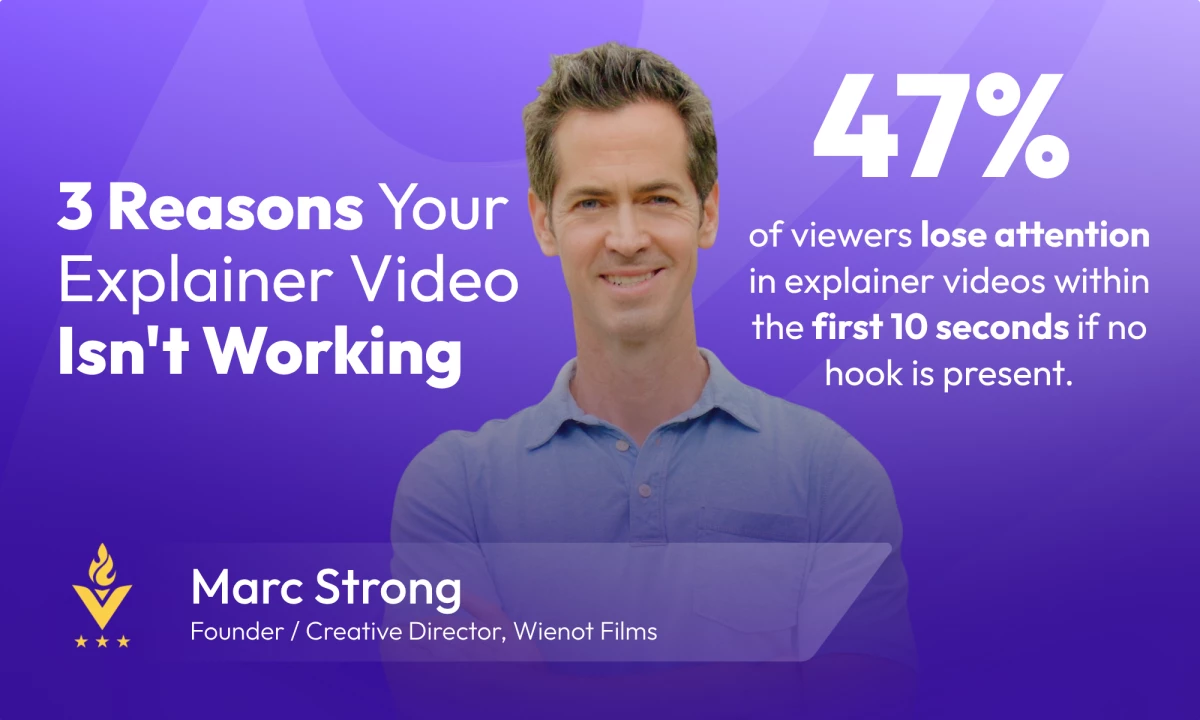

Explainer videos have become one of the most effective ways to communicate complex ideas quickly.
Whether you're introducing a new product, educating your audience, or driving conversions, a strong explainer video can simplify your message and make it stick.
Key Findings: Why Explainer Videos Fail
- Feature-first explainer videos confuse viewers instead of clarifying value.
- Emotion influences decisions, even in B2B explainer video strategy.
- Overloaded scripts reduce attention, retention, and conversion impact.
But what exactly qualifies as an explainer video?
At a high level, explainer videos are short, focused pieces of content designed to make complex topics accessible and easy to understand.
Some are sales-driven, helping explain products and services. Others are educational, breaking down ideas, processes, or ways of thinking.
They can take many forms, often centered around animation, and range from simple visuals to more complex, highly produced pieces.
What makes them so effective is their ability to combine visuals and narration to reinforce understanding.
This taps into what’s often referred to as dual coding, where the brain processes information more efficiently when it’s delivered both visually and verbally.
When done well, an explainer video becomes a clear, compelling entry point into your brand.
But when done poorly, it can confuse viewers or turn them off entirely.
The 3 Mistakes Killing Your Explainer Video

Here are three of the most common mistakes companies make when creating explainer videos, and how to avoid them.
1. Focusing Too Much on Features Instead of the Viewer
One of the most common mistakes is building the video around your product instead of your audience.
When you’ve invested time and energy into building something, it’s natural to want to showcase every feature and capability. But most viewers aren’t looking for a full breakdown. They’re trying to answer a simpler question: Is this relevant to me?
With 96% of people having watched an explainer video to learn more about a product or service, audiences have plenty of reference points. They know quickly when a video is talking at them instead of to them.
Explainer videos often become overloaded with details that feel important internally but don’t resonate with your audience.
The result is a message that feels dense, technical, and hard to follow.
Instead, shift your perspective.
Start with your audience:
- What problem are they trying to solve?
- What frustration are they experiencing?
- What outcome would help them?
Your video should meet them there first. Features can be woven into the story, but they shouldn’t lead it.
How to avoid this mistake:
- Adopt the customer’s perspective
- Lead with the problem, not the product
- Prioritize benefits over features
2. Overlooking the Emotional Impact

Another common, related issue is focusing only on what a product does, without addressing how it makes people feel.
Even in B2B environments, decisions are rarely purely logical. Buyers are influenced by emotions like confidence, relief, security, and a sense of control. A product that reduces stress or helps a company outperform competitors carries more weight than one that simply adds functionality.
Explainer videos that ignore this emotional layer tend to feel flat. They inform, but they don’t persuade.
To create a stronger connection, show the transformation your audience experiences. What does life look like before your solution, and how is it better after?
That contrast is what makes the message memorable.
How to avoid this mistake:
- Highlight the before-and-after experience
- Connect features to real-world outcomes
- Use language that reflects emotional benefits, not just functional ones
3. Trying to Include Too Much
It’s easy to fall into the trap of adding more and more content to an explainer video.
Teams often feel pressure to include every detail, which leads to longer runtimes and a diluted message. Beware of the urge to “do it all” with one video.
Most effective marketing explainer videos fall in the 1-2 minute range. That window forces clarity. It gives you enough time to communicate a surprising amount of value without overwhelming your audience.
Some videos can go longer, especially if they are more educational. But that decision should be intentional, not the result of trying to fit everything in just for the sake of being “complete.”
A helpful question to ask: Does the audience need this information right now?
If not, it likely belongs somewhere else, such as a follow-up video, a demo, or a sales conversation.
Viewers will continue watching if the content is relevant and engaging. But as length increases, average attention drops. That makes prioritization critical. Cut out the nonessential.
How to avoid this mistake:
- Aim for 1-2 minutes for most explainer videos
- Include only what is essential for initial understanding
- Cut anything that doesn’t directly support the core message
Final Thoughts
Explainer videos are powerful because they simplify complexity. But that only works when the message is focused, relevant, and easy to absorb.
To get the most out of your investment:
- Speak from your audience’s perspective, not your internal priorities
- Connect with viewers on both a logical and emotional level
- Keep your message concise and intentional
A strong explainer video doesn’t try to say everything. It says the right things, clearly and effectively, and moves the viewer forward—whether that means taking action or simply understanding something in a new way.

Our team ranks agencies worldwide to help you find a qualified partner. Visit our Agency Directory to find top-rated video editing companies, as well as:
- Best Digital Marketing Agency in Los Angeles
- Top Explainer Video Companies
- Top Video Marketing Agencies
- Best Video Production Companies
And don’t miss our Awards section, where we celebrate the most innovative projects in design — from logo and app design to print and packaging.