

React design patterns are proven, reusable solutions that address common challenges in React application development. They guide developers in structuring and organizing code effectively, ensuring scalability, maintainability, and efficiency throughout the project lifecycle.
However, these patterns aren’t one-size-fits-all but instead provide flexible approaches to solving specific issues while adhering to React’s component-driven architecture. Let’s explore some of the most effective React design patterns, their practical use cases, and actionable tips to integrate them into your development process.
Benefits of React Design Patterns
The complexity of modern web applications makes it essential to adopt strategies that simplify development and maintenance. React design patterns offer numerous advantages to developers:
- They simplify maintenance by providing a clear separation of concerns, making it easier to debug and update applications.
- They enhance scalability. Patterns like Context API and custom hooks help manage state and logic in growing codebases.
- They promote reusability. Standardized patterns ensure consistency across projects and improve development efficiency.
React Design Patterns vs. UI Patterns
While React patterns focus on logic and component behavior, UI patterns emphasize layout and user interaction design. For instance, React’s Context API addresses state management, whereas a UI pattern like breadcrumb navigation helps users track their location within an app.

Top 6 React Design Patterns
React’s flexibility enables developers to create highly functional and scalable applications. However, without structured approaches, projects can become messy and difficult to maintain. This is where React design patterns come in.
These reusable solutions address common challenges and ensure that your code is clean, efficient, and scalable. Below is a deeper dive into six key React design patterns, their purpose, and when to use them.
1. Presentational and Container Components
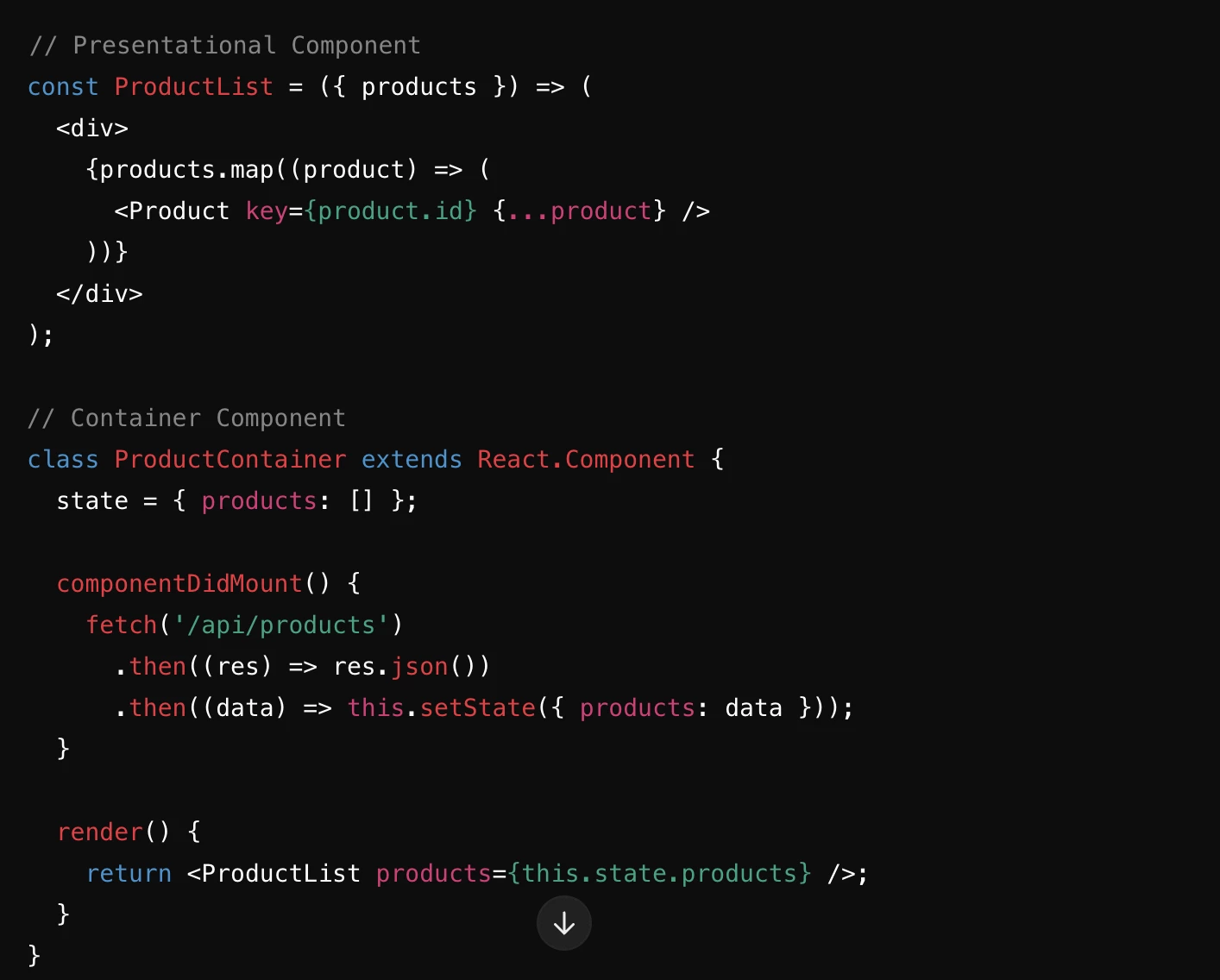
The Presentational and Container Components pattern divides components into two distinct roles:
- Presentational Components: Focus solely on the UI, rendering elements based on props without managing state or logic
- Container Components: Handle state, business logic, and data fetching, passing the necessary information to presentational components via props
Example in Action:
In an eCommerce application, a Presentational Component could display a list of products, while the Container Component would handle fetching product data from an API and managing filtering or sorting logic.
When to Use It:
This pattern is ideal for separating concerns in large applications, ensuring the UI is reusable and independent of the underlying logic.
2. Higher-Order Components (HOCs)
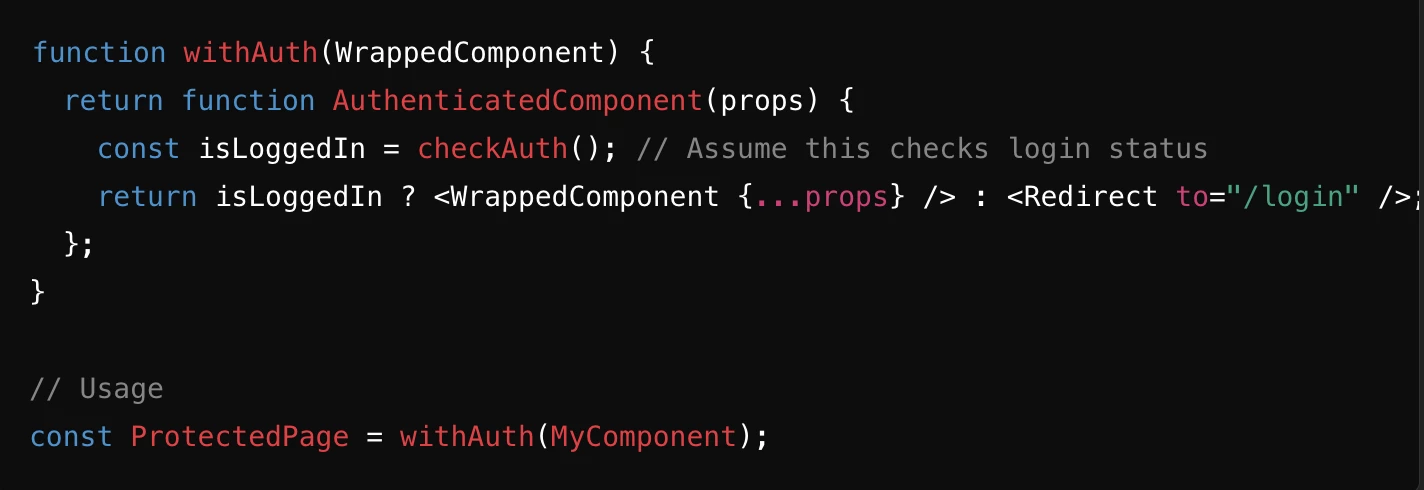
HOCs are functions that take a component and return an enhanced version of it. They are used to add cross-cutting concerns, like authentication or logging, without duplicating logic across components.
Example in Action:
Implementing authentication checks to protect specific routes is a common use case for HOCs. It can protect routes by verifying user authentication before rendering components, redirecting unauthorized users to a login page while allowing access to authenticated ones.
When to Use It:
Use HOCs to wrap multiple components with the same functionality, such as logging, error boundaries, or feature toggles, without duplicating code.
3. Render Props
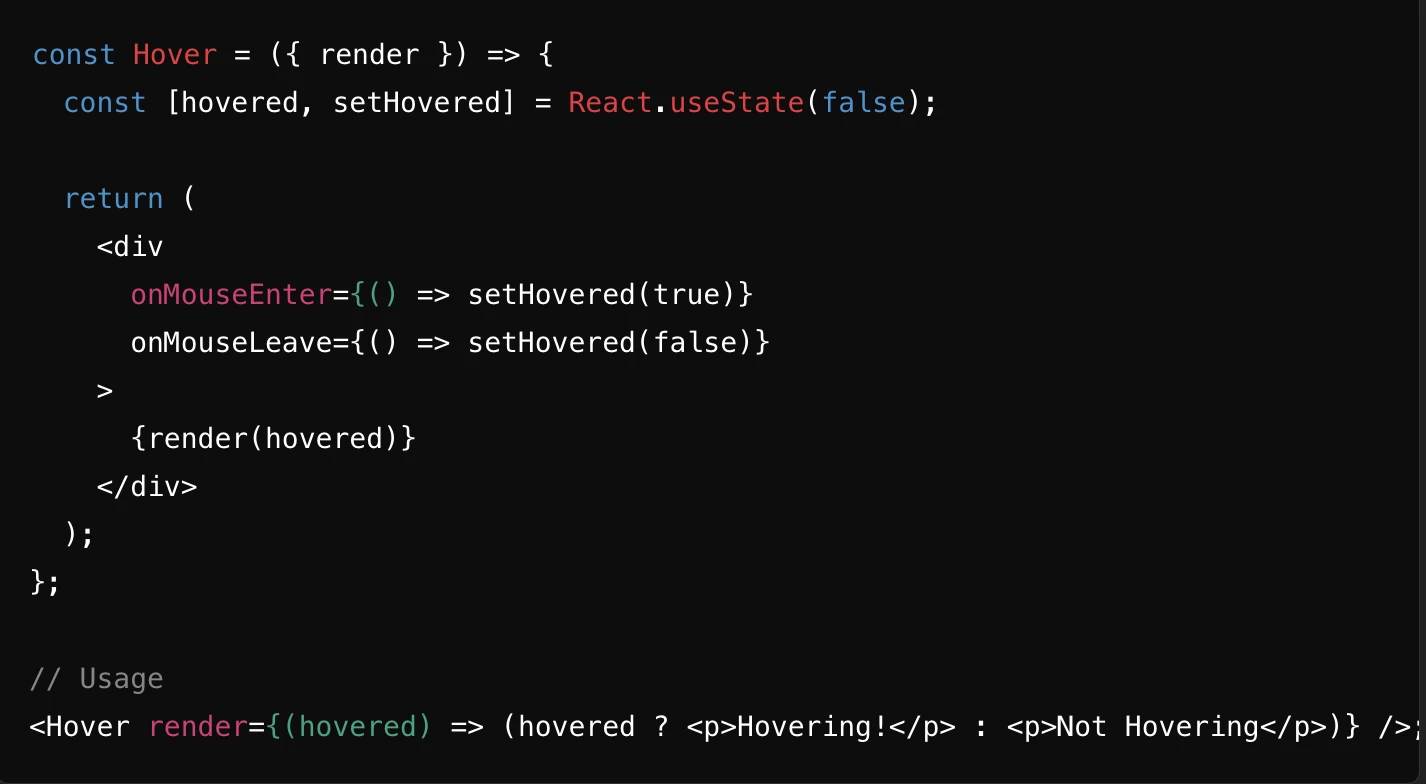
The Render Props pattern involves sharing functionality between components by using a prop that is a function. This allows greater flexibility and dynamic behavior.
Example in Action:
Render Props can manage a hover state tracker by passing a function as a prop to handle hover interactions dynamically. For example, a Hover component can track whether an element is being hovered and pass that state to child components, enabling reusable and customizable UI behavior.
When to Use It:
This pattern is ideal for creating reusable logic, such as managing states (hover, focus, etc.) or animations, while keeping your components modular.
4. Custom Hooks
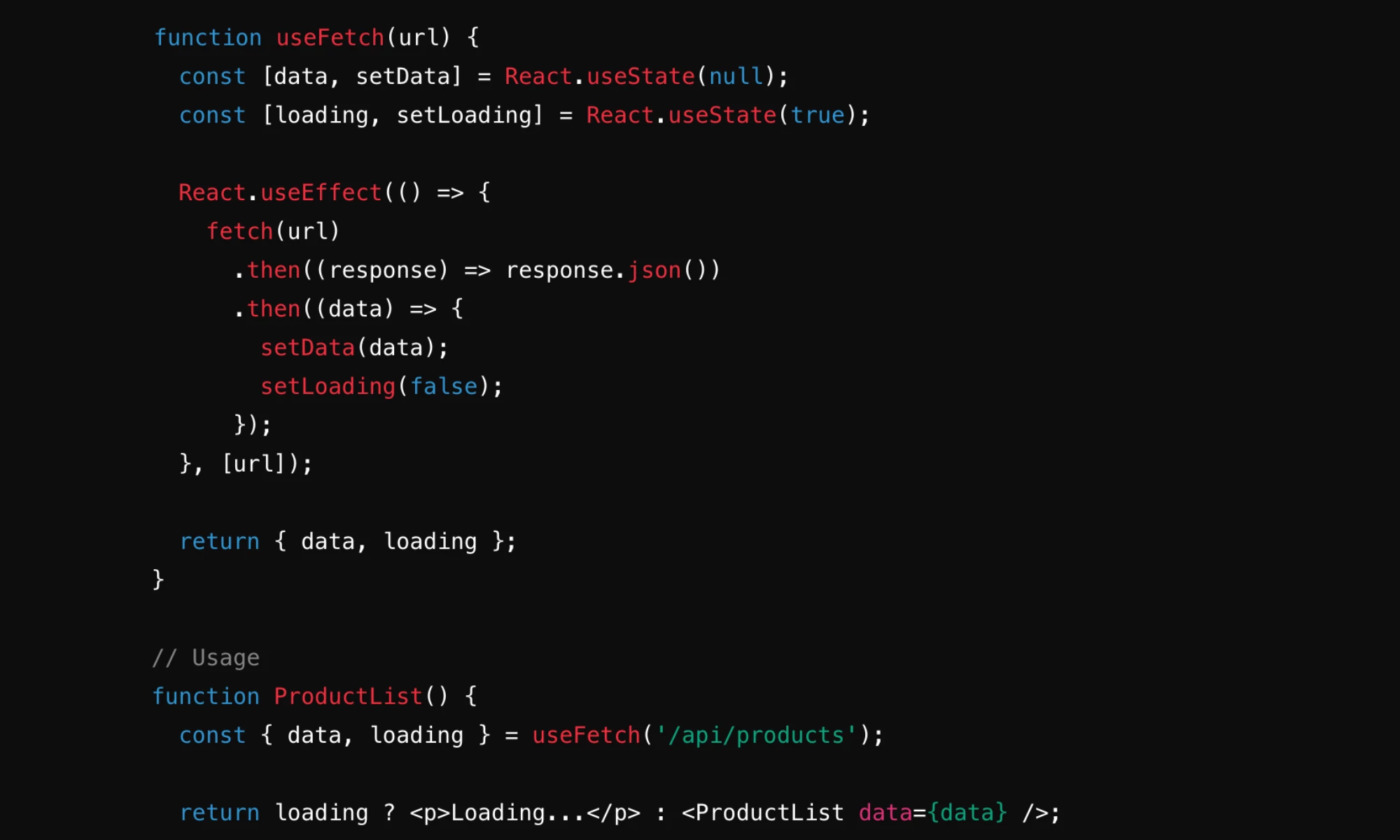
Custom hooks are one of React’s most powerful patterns, introduced with React Hooks. They encapsulate reusable logic, making it easy to share functionality between components.
Example in Action:
Custom hooks simplify API calls by encapsulating reusable logic into a function. For example, a useFetch hook can manage data fetching, loading states, and errors, allowing components to easily integrate API requests with minimal repetitive code.
When to Use It:
Use custom hooks whenever you have reusable stateful logic, such as fetching data, managing forms, or interacting with local storage.
5. Context API for State Management
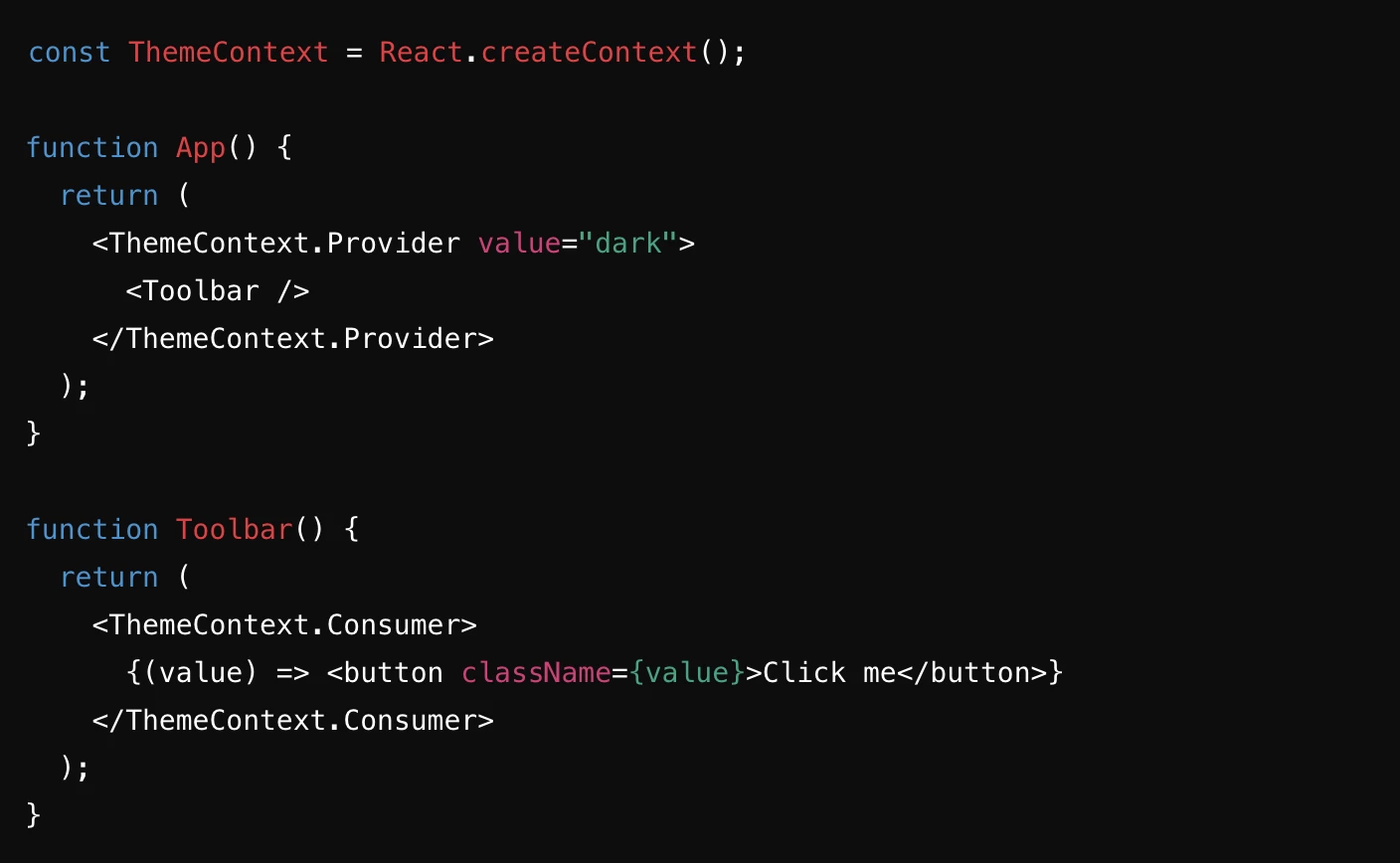
The Context API provides a way to share state globally across components without passing props manually through the component tree. This is particularly useful for smaller projects or simple use cases where installing Redux or other libraries would be overkill.
Example in Action:
The Context API simplifies state management by providing a centralized way to share data, like theme settings, across an application. For instance, a ThemeContext can store and distribute theme preferences (e.g., light or dark mode) to multiple components without the need for prop drilling.
When to Use It:
Use the Context API for managing simple global states like themes, language preferences, or authentication status.
6. Component Composition
Component composition is a core React feature that promotes modularity by allowing components to be nested and reused in flexible ways. Unlike patterns that rely on inheritance, composition is declarative and aligns perfectly with React’s design principles.
Example in Action:
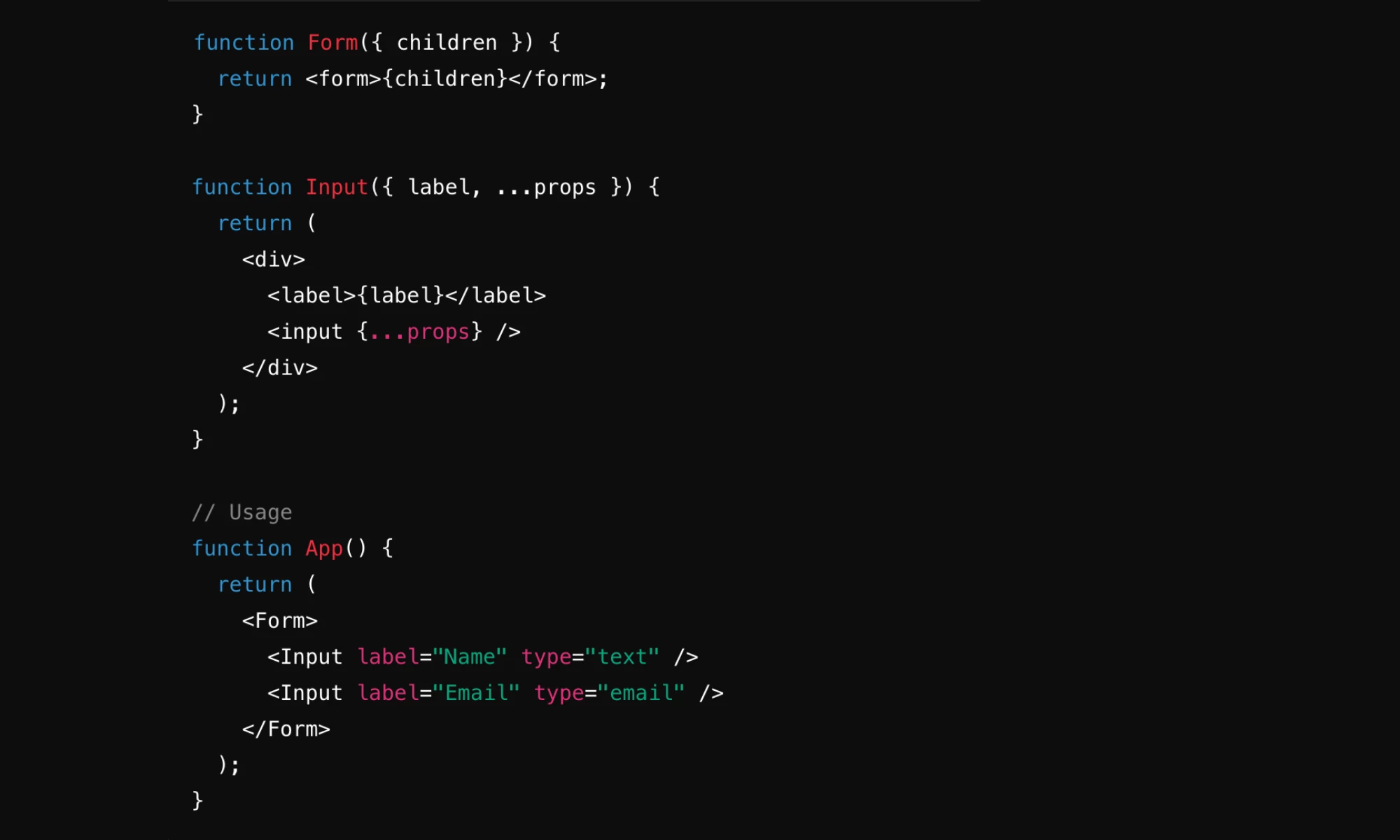
Component composition enables the creation of a reusable form builder by combining modular components like a form, input, and a button. This approach allows developers to dynamically assemble forms with customizable elements while maintaining flexibility and code reusability.
When to Use It:
Use composition to build modular, reusable UI components like forms, cards, or grids that need flexibility in their implementation.
React Design Patterns Best Practices
Applying React design patterns effectively requires a thoughtful approach to ensure your application remains scalable, maintainable, and efficient.
These best practices will help you get the most out of React design patterns, ensuring your project stays organized and easy to extend as it grows.
1. Prioritize Simplicity
One of the most important principles in React development is keeping your implementations simple. Over-engineering patterns can lead to complex, hard-to-maintain code that defeats the purpose of using design patterns in the first place.
In practice, prioritizing simplicity means opting for the most straightforward solution to address a given problem, avoiding unnecessary abstractions that complicate your code.
The goal is to tackle the immediate need effectively while ensuring the solution remains flexible enough to accommodate future adjustments or enhancements. This approach keeps your code clean, manageable, and adaptable as requirements evolve.
2. Follow Modular Principles
React’s component-based architecture naturally supports modular development. By breaking down your application into small, reusable components, you enhance scalability and make your code easier to manage.
Achieving modularity in React applications involves identifying parts of your application that can be reused across different features, such as shared UI elements or utility functions. To promote reusability and maintainability, it’s essential to keep components focused on a single responsibility, ensuring they handle only one aspect of the application.
Additionally, patterns like presentational and container components can help separate logic from UI, making the codebase more organized and easier to manage as the application scales.
Pro tip: Explore how web development tools can assist in testing and organizing modular components efficiently.
3. Leverage Development Tools
Development tools can drastically improve the implementation and testing of React design patterns. Tools like Storybook enable you to build and test components in isolation, making it easier to ensure that each pattern behaves as expected.
Development tools significantly enhance the efficiency and accuracy of implementing React design patterns.
Storybook enables developers to visualize and test individual components in isolation, eliminating the need to run the entire application during development. React Developer Tools provide insights into component hierarchies and help track prop and state changes, making debugging more intuitive.
Additionally, tools like Jest and React Testing Library streamline unit and integration testing, ensuring components function correctly within different contexts and interactions. Together, these tools simplify the development process and improve the reliability of React applications.
Pro tip: Learn about other web development tools that can enhance your workflow and ensure the smooth implementation of React design patterns.
React Design Patterns: The Bottom Line
What makes React design patterns especially significant is their ability to adapt to evolving requirements. In an ecosystem where user needs, technologies, and project scopes change rapidly, these patterns empower developers to write code that is both flexible and future-proof.
From managing state with Context API to leveraging modular principles for better scalability, React design patterns streamline the development process and enhance collaboration within teams.
React Design Patterns FAQs
1. What is a React design pattern?
A reusable solution for common development challenges, promoting efficient and scalable React applications.
2. Why are design patterns important in React development?
They simplify code, enhance readability, and ensure consistent approaches across projects.
3. What are the most commonly used React design patterns?
Popular patterns include Presentational and Container Components, Higher-Order Components, Custom Hooks, and Context API.
4. How do React design patterns differ from UI patterns?
React patterns focus on logic and behavior, while UI patterns deal with visual and interactive elements.




-preview-webp.webp)