
Rather than one algorithm, Facebook is a set of ranking and recommendation systems each trying to predict what a person will find valuable right now.
You get better results by matching formats to goals, and avoiding the behaviors Meta is actively downranking in 2026.
Facebook Algorithm: Key Findings
- 23% of Facebook users aged 18–34 say they use Marketplace at least once a day, showing how much high-intent activity happens off the main feed.
- Each format (Feed, Reels, Stories, Groups, Marketplace) follows different priorities, so it’s worth treating them separately instead of using one universal playbook.
- Organic ranking and paid delivery work differently, since organic is ordered by predicted value while paid reach is won through an auction optimized for outcomes.
How Does the Facebook Algorithm Work?
Instead of Facebook showing posts in chronological order, it ranks them based on what it predicts each person will find most relevant in that moment.
To do so, it uses a four-step process:
- Inventory: The pool of posts a person could see (from accounts they’re connected to and content they aren’t).
- Signals: The data points about the post and the viewer.
- Predictions: Estimates what the viewer is likely to do.
- Score: Assigns a value score to prioritize what appears first.
A few practical realities shape how Facebook distribution works today, and they’re worth keeping in mind before you worry about hooks, hashtags, or posting times:
- Eligibility is the gatekeeper: If a post trips policy or quality signals, it can be limited or demoted before it even enters the ranking race (think clickbait, engagement bait, or low-quality link posts).
- Discovery often beats followers: Much of modern reach comes from recommendations to non-followers, especially in video-first placements, so content has to earn distribution beyond your existing audience.
- Organic ranking and paid delivery work differently: Organic content is ranked by predicted value, while paid distribution is won through an auction and optimized for outcomes. A good organic post might not make a good ad.
Each format or “surface” below has its own goals and signals, so it’s worth looking at them separately to understand what drives reach and results in each.
1. Feed
Feed still a blend of friends, Pages, and recommendations. It uses thousands of datapoints to optimize for what you’re likely to find most valuable.
Meta said improvements to its AI-driven feed and video recommendations led to an 7% increase in time spent on Facebook in Q4 of 2025.
How to optimize for Feed:
- Posts that earn meaningful interactions (not just low-effort clicks).
- Content that fits the viewer’s demonstrated interests (topics, creators, formats).
- Posts that earn real dwell time and follow-through (people pause, expand “See more,” watch longer, or click through).
2. Reels
In the Q4 2025 earnings call, Meta said Facebook video time grew at double-digit rates YoY in the U.S. and Reels are effectively the discovery engine. Distribution is driven less by who follows you and more by whether the video is likely to hold attention and get shared
Meta has explicitly pushed Facebook toward video and recommendations, and its own reporting and product moves underline that priority.
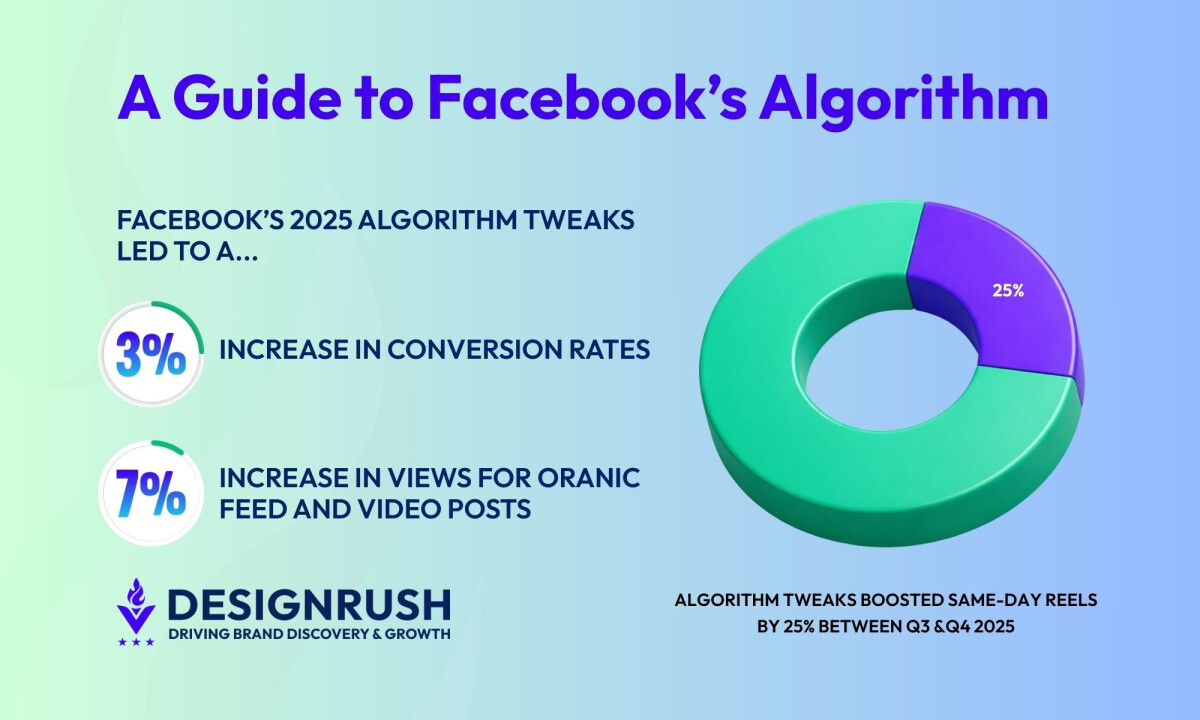
Its Q4 report also noted that Facebook is now recommending more same-day Reels, with the system surfacing 25%+ more Reels posted that day compared with the previous quarter.
In 2025, Meta made all new Facebook videos publish as Reels with no length limits, so your video strategy is your Reels strategy.
What tends to win in Reels:
- Strong early retention (your first seconds matter)
- Watch time and replays
- Shares and saves that show content is worth passing along
- Assume sound-off viewing and add captions plus on-screen context
A survey found that 69% of users prefer watching videos with the sound muted when in public, and 25% when in private, so keep that in mind.
3. Stories
Stories are primarily a connected channel as they’re shown most to people who already know you, and they’re ordered by how likely someone is to tap, reply, or keep watching, based on recent interactions with your account.
One billion Stories are shared every day, and they attract over four million advertisers every month.
Think of them as a simple way to stay present and keep the relationship warm with:
- Quick, low-effort check-ins between bigger posts
- Behind-the-scenes, quick updates, creator-style “in the moment” content
- Clear calls to reply or tap through when relevant
4. Groups
Groups are intent-driven where people join because they care about a topic, so Facebook prioritizes posts that are most likely to spark discussion and participation inside that group, based on what members have engaged with before.
In 2022, 1.8 billion people were using Facebook Groups every month, with 25 million monthly active public groups, a number which is sure to have grown.
Groups behave differently because intent is different: people join for a topic, identity, or utility.
You’ll usually see stronger reach when:
- Posts create discussion people want to join (not manufactured engagement)
- Content is useful, specific, and clearly fitting for that specific group
- You participate like a member, not a broadcaster
5. Marketplace
Marketplace behaves more like search and shopping than social. Listings surface based on what a buyer is likely to want now, usually driven by query/category relevance, location, price/value cues, and trust signals (including responsiveness).
Morning Consult found 23% of 18–34-year-olds who use Facebook say they use Marketplace at least once a day.
Success here tends to be about:
- Complete, accurate listings (title, category, price, location)
- Fast response times and trustworthy seller signals
- Clear photos and descriptions that reduce buyer uncertainty
Recent Facebook Algorithm Changes up to 2026
These Facebook algorithm changes matter because they change what it prioritizes for reach and distribution, so tactics that worked a year ago may underperform today.
Here are the updates that should change how you plan content.
- Local and explore tabs expand discovery (October 2024)
- Friends-only tab for more user control (March 2025)
- Spam crackdown with clear penalties (April 2025)
- All videos become reels (June 2025)
- Faster recommendations (2024-2026)
1. Local and Explore Tabs Expand Discovery (October 2024)
Meta began testing new Local and Explore tabs designed to surface more interest- and location-based recommendations beyond the classic Feed.
In plain terms, Facebook created more recommendation surfaces where content can reach people who don’t follow you yet.
How to leverage it:
- Publish content with clear topical relevance (so Facebook can confidently recommend it)
- Lean into local and community signals where relevant (events, local angles, practical utility)
2. Friends-Only Tab for More User Control (March 2025)
In 2025, Meta updated the Friends tab to show content only from friends, with no recommended content. That’s a reminder that recommendation-heavy reach isn’t guaranteed in every user view.
How to leverage it:
- Don’t rely on one surface for distribution
- Treat recommendations as earned reach, not baseline reach
3. Spam Crackdown With Clear Penalties (April 2025)
Meta’s 2025 enforcement targets cheating in the form of unrelated captions, excessive hashtags, spam networks, coordinated fake engagement, and impersonation. Meta says offending accounts may see content limited to followers and lose monetization.
4. All Videos Become Reels (June 2025)
Meta announced that all new Facebook videos will be shared as reels, keeping video formats under one umbrella. Basically, that means video strategy and Reels strategy are now the same thing.
What to do:
- Build one video workflow that can produce both a hero cut and several cutdowns
- Assume Reels-style consumption patterns even for longer videos
5. Faster Recommendations (2024-2026)
Meta has said it upgraded Facebook’s recommendations engine to learn interests faster and surface more relevant Reels.
This is what Matt Cayless, founder of Bubblegum Search, refers to as the interest graph algorithms, which is a good thing because it “creates a level playing field to get views and attention if the creative is good enough.”
Best Practices for Working With Facebook’s Algorithm
View this post on Instagram
There’s no gaming the algorithm with hacks, so posts need to actually fit how people use each format. These best practices focus on the handful of actions that can help improve reach and results.
- Start with the format, not the post
- Optimize for retention, shares, and saves
- Avoid spam signals that limit reach
1. Start With the Format, Not the Post
Go with a format that matches the business outcomes you want to achieve (reach, engagement, leads, or sales).
- Reels for discovery and new audience reach
- Feed for broad distribution and discussion
- Stories for frequency and relationship-building
- Groups for community and depth
- Marketplace for high-intent commerce
2. Optimize for Retention, Shares, and Saves
Meta has been explicit about promoting authentic creators, It means, to earn wider distribution, your content has to make people keep watching, share it, or save it.
What you can do:
- Publish native-first content and add real value when you repurpose
- Avoid posting the same asset repeatedly with minor changes
- Build recognizable creative patterns (series formats tend to work)
“High-quality creative content that truly engages people will always stand out,” says Kevin Chenault, founder of Blackstrap Media. He believes that branded Facebook content, especially that which transcends advertising, “...must be crafted by human creativity to resonate deeply and authentically with audiences.”
3. Avoid Spam Signals That Limit Reach
Meta is getting much more direct about what it considers spam, and taking action again accounts that game the system. If you’re padding posts with unrelated captions or going heavy on hashtags, your reach can be throttled to followers-only, and you may lose access to monetization.
Also worth avoiding:
- Engagement bait (like “comment YES,” “tag 3 friends”)
- Clickbait framing that doesn’t match the content
- Low-quality outbound links and ad-heavy landing pages
Facebook Algorithm: Final Words
Instead of trying to beat the Facebook algorithm, focus on aligning with what it. Be sure to build a repeatable system for learning, ship consistent content by format, watch what earns retention and shares, and let that decide what you scale.
Our team ranks agencies worldwide to help you find a qualified partner. Visit our Agency Directory to find top-rated social media marketing companies, as well as:
- Top Facebook Marketing Companies
- Best Instagram Marketing Companies
- Best TikTok Marketing Agencies
- Top Facebook Marketing Companies
- Top Brand Strategy Agencies
Facebook Algorithm FAQs
1. Does Facebook still prioritize posts from friends and family?
Yes, but recommendations are also a major part of the experience, and Meta has even separated a Friends-only tab with no recommended content. The best approach is to diversify surfaces and earn recommendation reach.
2. Are Reels the best way to grow on Facebook right now?
For discovery, usually yes, especially after Meta’s move to make all new Facebook videos into Reels.
3. What gets content downranked on Facebook?
Low-quality or manipulative behaviors like engagement bait, clickbait, spammy caption tactics, excessive hashtags, and coordinated fake engagement. These can all reduce distribution or limit reach to followers.
4. How often should a brand post to satisfy the algorithm?
Consistency matters more than volume. Pick a sustainable cadence you can maintain while keeping quality high, then use performance data to decide which formats deserve more reps.
5. Is there a way to reset the Facebook algorithm?
There’s no single reset button, but you can “retrain” it quickly using Facebook’s controls. Mark posts Interested or Not interested, and use Hide, Snooze, and Unfollow to reduce unwanted topics and accounts. Facebook says this feedback directly affects what you’re shown next.
6. How Do You Reset the Facebook Reels Algorithm?
Reels has its own recommendation stream, and it responds fast to feedback. Use the menu on Reels to choose Interested or Not interested (or hide them), then consistently watch, save, and share the Reels you want more of for a few days to shift recommendations.