
So, a social media marketing agency promises to improve performance, refresh creative, and report weekly. That’s great, but how can you probe deeper to test whether they really can deliver those results?
Questions To Ask a Social Media Agency: Key Findings
- The biggest risk is not performance, it is losing control of accounts, data, and assets when ownership and process are unclear.
- Google notes well designed experiments aim for a 90%–95% confidence interval, so a real partner should define clear test gates and stop loss rules up front.
- Repeatable creative systems beat guesswork as TikTok found with AI supported Spark Ads that drove 53% higher CTR and 48% higher CVR.
What Should You Ask a Social Media Marketing Agency?
Some questions about how an agency measures impact, how they make decisions, and how they deal with problems might not be obvious, but they’re always revealing.
The right agency (and knowing what questions to ask social media marketing professionals) can materially change outcomes. Making expectations and transparency clear from day one is more important than ever as an increasing number of businesses outsource social execution and measurement.
Outsourcing social and digital work is now the norm, with 63.1% of marketers surveyed having outsourced work to an agency or third party between 2024 and 2025 (up from 46.2% the year before).
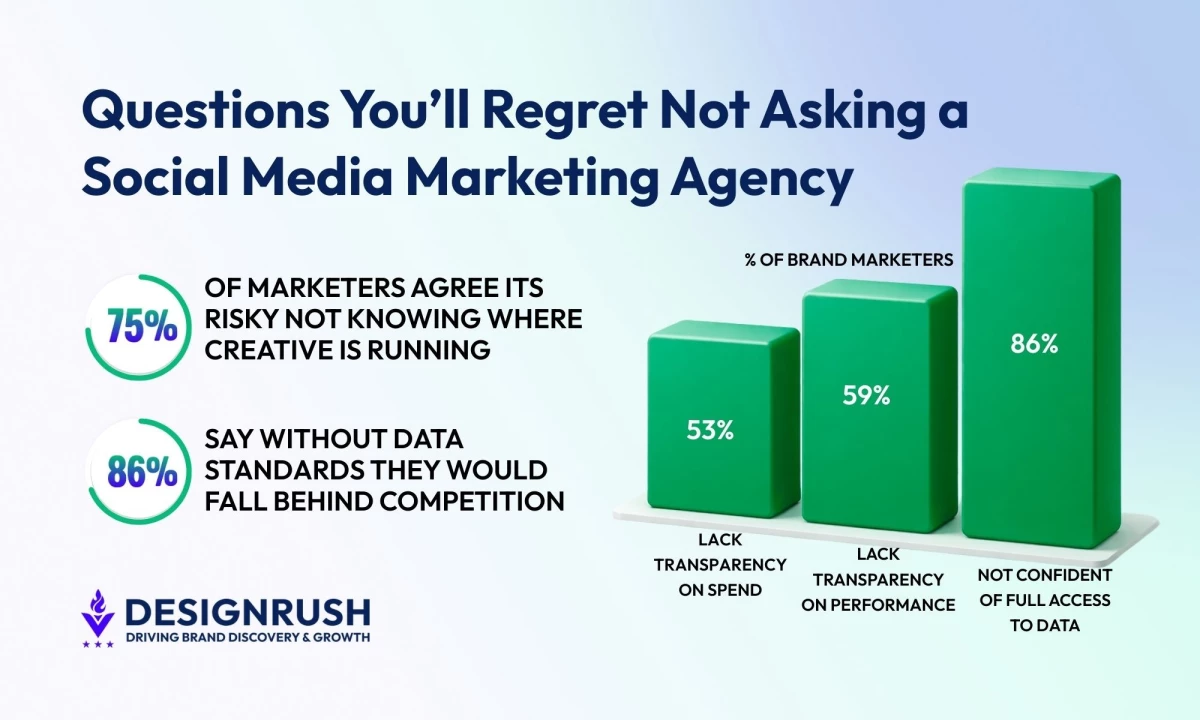
But many are finding that visibility isn’t guaranteed. Claravine found roughly three in four advertisers see medium-to-high risk in not knowing where creative is running across channels and campaigns, yet 70% struggle to keep track, while 86% agreed that without data standards they would fall behind competitors.
These blind spots show up when access, ownership, and reporting standards aren’t nailed down up front.
I want to help you avoid a decision you regret because of something you didn’t think to ask. Below are 10 questions to help you spot teams that can prove they’re driving real growth.
1. Will We Own the Ad Accounts, Pixels, and Audiences With Admin Access?
Before you discuss performance, I suggest locking down ownership. A common (and costly) complaint is agencies running campaigns in their accounts or holding the keys to critical assets, which limits transparency and make it hard to switch partners later.
If you don’t own the ad account, tracking pixel, and audiences, you may lose history, learnings, and retargeting ability. Plus, you’ll have a harder time verifying spend, setup, and changes.
A survey of brand marketers found 86% weren’t fully confident they could access historical social campaign performance. The risk is higher when an agency controls the accounts or data.
The same research found 53% reported partial to no transparency into campaign spend and 59% reported partial to no transparency into performance, which is exactly why I push for full admin access and clear ownership from day one.
Ideal answers:
“Everything lives in your company’s accounts. You’re the owner and primary admin, and we request partner access with no shared passwords.”
“You’ll own the ad account, pixel, audiences, catalogs, pages, and analytics connections, and we’ll confirm exactly who on your team has admin rights.”
“We’ll start with an onboarding checklist that includes an asset inventory, access levels, and a clean offboarding plan so you’re never locked in.”
Red flags:
“It’s faster if we run this through our accounts; you’ll still get reporting.”
“We’ll add you once everything’s set up.”
“For security reasons, we don’t give full admin access.”
“Don’t worry about pixels and audiences, we’ll manage that for you.”
Proof to request:
A quick screen share or screenshot from platform settings showing your team as owner/admin on the ad account and pixel, plus a written asset list (who owns what) and an access/ownership clause in the contract.


2. How Many New Creative Concepts Will You Launch Each Week?
People often realize too late they bought vague “management” rather than specific outputs. A team should consistently produce new angles, and then capture the learning.
The best agencies have a steady flow of new concepts, quick tests, and a simple “what we learned” log that shows which hooks, proof points, and offers actually moved people.
TikTok’s research points to why a repeatable creative system matters. Spark Ads assets supported by TikTok’s artificial intelligence (AI) tools (which help teams generate and test more creative variations) saw a 53% higher click-through rate (CTR) and a 48% higher conversion rate (CVR).
Ideal answers:
“We run a weekly pipeline from hypothesis to brief, production, testing, learning, and iteration.”
“You’ll get a clear target for net-new concepts each week, not just minor variations of one idea.”
“We maintain a simple learning log that tracks which hooks, proof points, offers, and storylines consistently drive results.”
Red flags:
“We’ll A/B test hooks and headlines every week.”
“We’ll keep fresh content flowing, the algorithm will surface winners.”
“We move fast; documentation can slow momentum.”
Proof to request:
An anonymized creative testing log, plus a simple performance view that groups results by the big idea behind each ad (the core theme or angle) rather than just by individual ad variations.
4. What Reporting Will We Get, and Will It Include Raw Platform Data?
In my experience, a lot of bad agency stories start with a transparency gap. You get a polished deck, but you can’t see what changed, what was tested, or how results tie back to your site and sales data.
This question forces them to be clear about it from the start, so you’re not paying for a story you can’t verify.
I push for raw exports plus Google Analytics (GA) and customer relationship management (CRM) tie-ins because it gives you an audit trail, reduces spreadsheet detective work and makes it easier to see what actually changed week to week.
Ideal answers:
“You’ll get a live dashboard, a written weekly recap, and raw platform exports whenever you want them.”
“We report across platform performance and your GA/CRM view so traffic quality, lead quality, and revenue stages line up.”
“We keep a change log that shows what we changed, why we changed it, and what happened next.”
“We define metrics upfront so ‘lead,’ ‘qualified,’ and ‘revenue’ mean the same thing to everyone.”
Red flags:
“We’ll send a monthly deck with highlights. That’s usually all clients need.”
“Our reporting is proprietary, so we don’t share raw data.”
“Platform metrics tell the story; GA/CRM can be a later phase.”
Proof to request:
A redacted weekly report + dashboard example, a sample raw export (even a small one), and a screenshot showing how GA/CRM outcomes are reflected alongside platform results.
4. What Naming and Tracking Rules Do You Use To Compare Results?
This is the unglamorous part that makes everything else easier: clean naming, clean links, clean tracking. Without it, learning gets fuzzy fast, because you can’t reliably compare tests, roll up results by theme, or understand what changed when performance takes a turn.
Gartner estimates that poor data quality costs organizations at least $12.9 million per year, and they also report that 59% of organizations don’t even measure data quality.
That’s why your social media marketing agency should have a consistent system for:
- Naming campaigns/ad sets/ads so you can quickly see the offer, audience, and funnel stage at a glance and so reporting doesn’t turn into detective work later.
- Tracking links (UTMs) that follow a standard pattern, so results in GA4/Shopify/HubSpot match what you see in-platform.
- Reporting rollups that let you filter performance by a few key dimensions (like offer, theme, stage) instead of scrolling through dozens of mismatched campaign names.
Ideal answers:
“We use a defined naming convention and a UTM template, and we apply them consistently across every campaign.”
“Every campaign includes the same core fields so you can see offer, audience, and funnel stage at a glance.”
“Ninety days from now, you’ll still be able to compare Offer A vs Offer B and TOF vs MOF vs BOF without rebuilding reports.”
Red flags:
“We’re flexible. We’ll use whatever naming you like.”
“UTMs help, but platform reporting is usually enough.”
“CRM and analytics integration can come later.”
5. Who Is Actually Doing the Day-to-Day Work, and What’s Their Experience?
I always ask this because it’s common to be sold by senior people and then handed off to a junior team you never met. Not to be dismissive of juniors, but you should know exactly who’s steering the work and whether they’ve succeeded with a business like yours.
The day-to-day team should be able to explain the levers that matter for your model, like whether success depends on repeat purchases or one-time orders, how long the buying cycle typically runs, or what counts as a qualified lead.
Ask who owns each piece (media, creative, tracking, reporting), how often senior review happens, and what happens if your main operator is out or reassigned.
Ideal answers:
“You’ll meet the day-to-day team before you sign, including who owns media, creative, analytics, and reporting.”
“We’ll show you relevant experience tied to your business model, not just a general industry claim.”
“We’ll set a clear cadence with weekly working sessions, quick async updates, and a named escalation path.”
“Senior oversight is defined, including what gets reviewed and how often.”
Red flags:
“You’ll have a dedicated account manager, backed by our full team.”
“We staff flexibly based on needs, so the exact team can change.”
“Our juniors are great. They’re trained on our process.”
Proof to request:
Names/roles in writing, brief bios or LinkedIn profiles, one relevant case study tied to your model, and a simple responsibility map (who owns creative, media, tracking, and reporting).
6. How Will You Tie Ads to Revenue, Removing Duplicates and Existing Customers?
If an agency optimizes only to leads or form fills, you can end up buying volume instead of value. The real question is whether they can reliably connect paid social activity to what sales actually cares about (qualified opportunities and revenue), while keeping the data clean enough to trust.
That means matching ad-driven contacts to CRM records, sending back higher-quality conversion signals for optimization, and preventing common measurement traps like double-counting the same person across multiple forms, devices, or touchpoints.
Ideal answer:
“We’ll connect paid social to CRM stages so optimization and reporting reflect MQL → SQL → opportunity → revenue.”
“We’ll send higher-quality conversion signals back to the platforms using server-side or CRM-based signals where appropriate.”
“We have a documented deduplication method so the same person isn’t counted multiple times across forms, sources, or repeat submissions.”
“We’ll implement suppression rules to exclude existing customers, disqualified leads, and active sales conversations.”
Red flags:
“We optimize to leads and report MQLs; revenue attribution is on your side.”
“We mostly rely on the pixel, we don’t typically tie back to the CRM.”
“We don’t have a formal deduping approach; your CRM should handle that.”
“We don’t usually exclude existing customers unless you ask.”
Proof to request:
A simple architecture diagram plus a redacted mapping example showing the path from ad click/view → UTM/click ID → lead/contact → opportunity → revenue, including deduplication rules and stage conversion rates.
7. How Do You Define a Winning Test, and When Do You Pull the Plug?
Testing that drags on without financial guardrails can burn months of budget. You want an agency that can say: “Here’s what we expect, here’s the cash-flow impact, here’s how long we’ll test, and here’s the exact point where we stop, iterate, or scale.”
Google’s Proving Marketing Impact guide notes that well-designed experiments usually aim for a 90%–95% confidence interval.
It specifically recommends estimating the expected confidence interval before you run the test so you know whether it’s likely to produce a decisive answer (instead of dragging on).
Ideal answers:
“Before we test, we forecast expected outcomes using CPC, CTR, CVR, CAC, and payback so we’re aligned on what ‘good’ looks like.”
“Every test has clear gates for kill, iterate, or scale based on time, spend, and signal quality.”
“We use explicit stop-loss rules so experiments don’t drag on and burn budget.”
“Our thresholds and timelines change appropriately based on your model, whether eCommerce, subscription, or B2B.”
Red flags:
“We’ll know it when we see it.”
“We don’t use set timelines or spend limits for tests.”
“We don’t do stop-loss rules; we just keep iterating until it works.”
Proof to request:
A redacted forecast sheet with scenarios and the stop-loss/scale rules highlighted.
8. What Happens to Our Data and Assets if We Leave?
This question is about control and continuity. If the partnership ends, you should be able to keep operating without losing access, history, or usable creative, and you should know exactly what the agency keeps or deletes.
I say it’s worth asking even when everything feels promising because exit terms are easiest to agree on before there’s pressure. To avoid a lock-in situation, it's best to see it coming from a long way off.
Pay caerful attention to all the contract details, especially length, renewal language, notice periods, and any cancellation or termination fees.
A confident agency should be comfortable with fair terms and a clean handoff that protects your business.
Ideal answers:
“Our terms are straightforward, with reasonable notice, clear renewal language, and no surprise penalties.”
“Everything stays in your business-owned accounts, and we support a defined transition window with complete documentation.”
“You keep your accounts, pixels, audiences, and the creative you paid for, with usage rights clearly spelled out.”
“We’ll specify exactly what data we retain, what we delete, and when.”
Red flags:
“Your ad accounts stay under our agency umbrella, but we’ll keep you posted.”
“We can transfer access later once the contract is complete.”
“Early termination fees protect our planning.”
“Our dashboards and playbooks are proprietary, so those don’t transfer.”
“We don’t provide a formal offboarding process.”
Proof to request:
The contract clause covering termination and asset ownership, an offboarding checklist, and a written inventory of what you own (accounts, pixels, audiences, creative files, landing pages, tracking docs, dashboards).
9. How Do You Use Creators Safely, With Clear Rights and Fast Approvals?
Creators and user-generated content can be a growth lever., but it’s also one of the easiest ways to stumble into messy rights issues, inconsistent brand standards, or slow approvals that kill momentum.
You want an agency that can scale creator output without putting your brand at risk or turning every video into a weeks-long negotiation.
They should stop creator content becoming chaotic by outlining a repeatable workflow for sourcing creators, briefing them, reviewing content, and securing ad usage rights. That should include who owns the relationship, what “approved” means, how long approvals take, and how usage is tracked across channels and time.
Jordan Freed, Sony’s deputy head and senior director, personal entertainment business, says creator trust is paramount in such a relationship for it to last. When it does, “other creators and the industry take note", which, he adds, opens doors for more collaboration and innovation.
Ideal answers:
“We use a standard creator brief with guardrails, do’s and don’ts, claims rules, and examples of what we’re aiming for.”
“Usage rights are in writing, including paid usage, duration, platforms, exclusivity, and whether you can edit or repurpose.”
“We run a defined approval workflow with SLAs, including who reviews, how many rounds, and turnaround times.”
“We have a clear allowlisting process with access steps and brand safety checks.”
“We maintain a content library that tracks performance and permissions so winners can be reused confidently.”
Red flags:
“We’ll handle rights as we go.”
“Creators are usually fine with paid usage.”
“We don’t need strict language on usage duration or platform restrictions.”
“We’ll send it when it’s ready.”
“We don’t have a system for tracking what’s cleared for paid use.”
Proof to request:
A redacted creator agreement template, a sample brief, an approvals checklist/timeline, and an example of how they track usage rights and performance (even a simple spreadsheet is fine if it’s consistent).
Find More Agency Hiring Resources:
- In-House Marketing vs. Agency: Key Pros and Cons
- Digital Marketing Objectives That Drive Real Business Outcomes
- Qualities of a Good Digital Marketing Agency
Use these questions to find the team that gets more specific under scrutiny, stays honest when results are messy, and treats your budget like an investment.
Our team ranks agencies worldwide to help you find a qualified partner. Visit our Agency Directory to find top-rated social media marketing companies, as well as:
- Top Influencer Marketing Agencies
- Best Instagram Marketing Companies
- Best TikTok Marketing Agencies
- Top Facebook Marketing Companies
- Top Brand Strategy Agencies
Questions To Ask a Social Media Marketing Agency FAQs
1. How much does a social media marketing agency usually cost?
Most agencies charge a monthly retainer, a percentage of ad spend, a project fee, or a hybrid. To compare fairly, ask for a line-item scope showing exactly what’s included vs. Extra.
2. How long until we should expect results?
Expect an initial setup and testing period before performance stabilizes. Ask for a clear 30/60/90-day plan and what they expect to improve first.
3. Should we hire a full-service agency or specialists?
Choose full-service if you need one team to own strategy, creative, media, and reporting; choose specialists if you already have strong in-house capabilities. The best fit depends on what you can execute well internally.
4. What access should an agency have, and what should never be shared?
They should get partner/role-based access, not shared passwords, and your company should own the accounts and keep admin control. Avoid agencies that insist on running ads through their own accounts.
5. What should we send an agency before the first call?
Share goals, key offers, customer context, basic unit economics (even ranges), past performance, and brand/compliance rules. The more specific you are, the more accurate their plan and forecast will be.
6. How do we compare agencies fairly if everyone uses different metrics?
Standardize the evaluation by asking every agency the same questions and request the same proof (sample report, creative test log, onboarding checklist, contract terms).
7. What are the most common reasons agency relationships fail, and how can we prevent them?
Most fail due to unclear goals, weak transparency, slow approvals, and fuzzy ownership of accounts or assets. Prevent it with written success metrics, reporting cadence, approval timelines, and exit terms before you sign.