
With rising costs and limited in-house bandwidth, agency leaders are turning to outsourcing software development projects to scale, increase margins, and move faster.
Outsourcing Software Development Projects: Key Points
- Use a hybrid outsourcing model to scale fast and cut development costs by up to 70% without sacrificing quality.
- Over one-third of vetted software agencies charge $35/hour or less, according to DesignRush data, enabling high-quality work at accessible rates.
- With 96% of organizations now using third-party talent, outsourcing is a strategy to expand services, launch faster, and improve margins.
When and Why Agencies Should Outsource
According to Deloitte’s Global Outsourcing Survey 2024, the top reason companies outsource is to gain better access to talent, not just to cut costs.
Here’s how to outsource your software development project the right way.
Step 1: Select the Right Outsourcing Model for Your Goals
How you structure your outsourcing engagement will directly impact speed, cost, and control. Choosing the right model, in terms of geography and collaboration style, is the first step to success.
Offshore, Nearshore, Onshore, or Hybrid?
Each geographic model has pros and cons that align differently with your priorities:
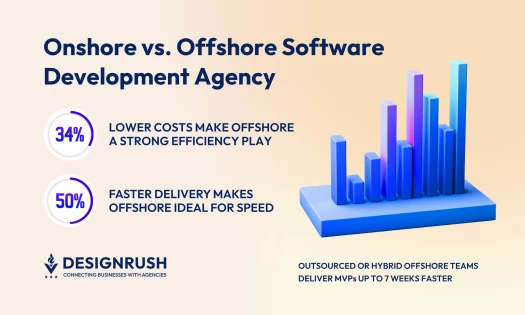
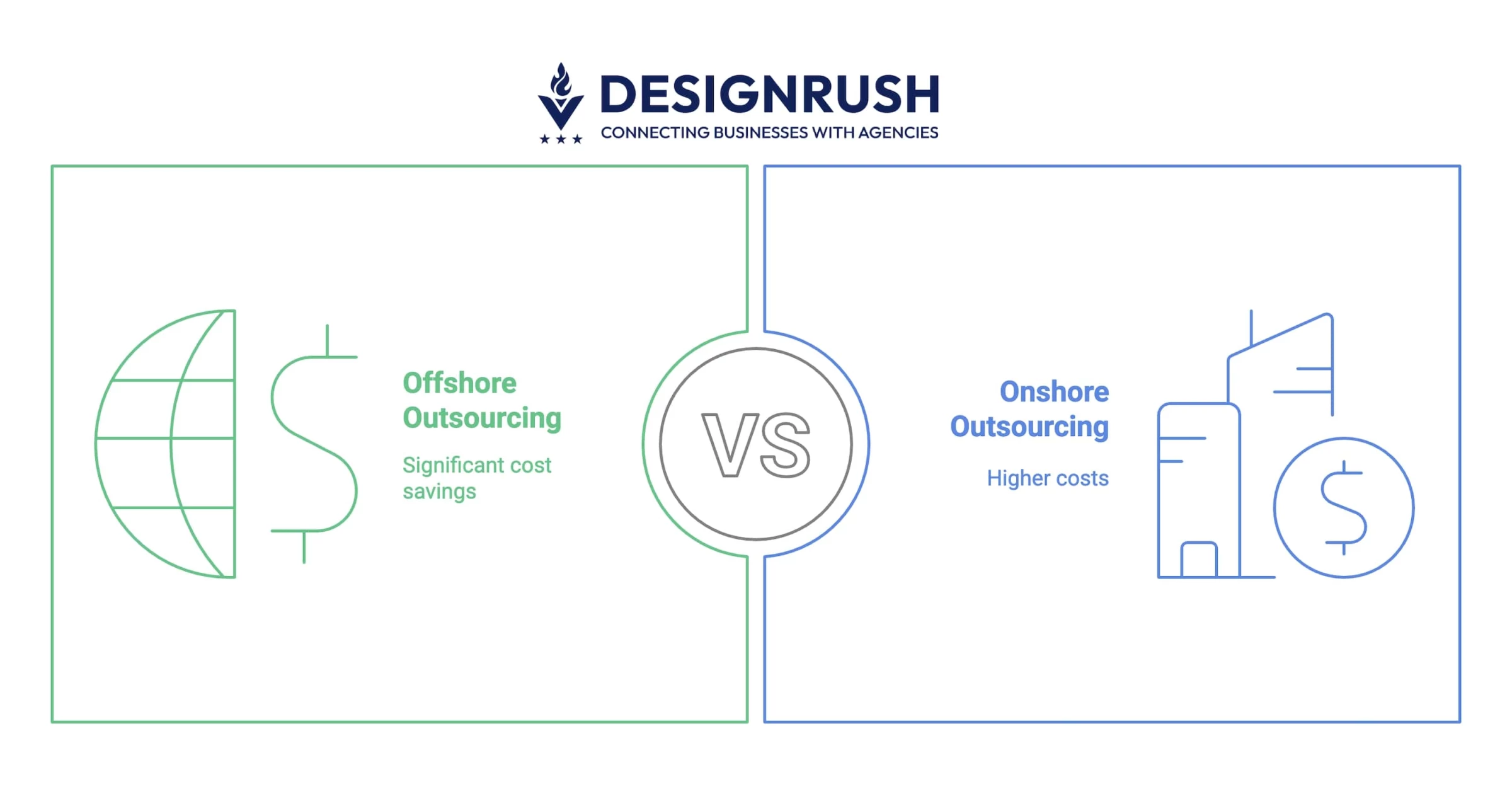
- Offshore outsourcing offers the biggest cost savings: typically 30–70% less than US or EU rates, and allows for around-the-clock progress with follow-the-sun development. The tradeoff? Time zone gaps and cultural or language barriers can make collaboration tricky.
- Nearshore outsourcing balances cost and convenience. It’s still affordable, with teams in similar time zones and closer cultural alignment, making communication easier. It’s not as cheap as offshore, and talent pools may be smaller, but it’s often easier to manage.
- Onshore outsourcing delivers the smoothest communication and fastest feedback thanks to shared language, culture, and time zones. But that convenience comes at a premium—local rates often eat into the cost benefits of outsourcing.
- Hybrid outsourcing mixes the best of both worlds: a local lead for oversight and offshore teams for execution. It helps companies stay efficient without compromising on quality or collaboration.
If you’re unsure, going hybrid is usually a safe bet.
For example, you might keep a senior architect or product manager in-house (or onshore) to interface with the client, while outsourcing the build to a vetted nearshore or offshore team.
Ivan Dabic, Co-Founder and CEO of BlueGrid.io, noted that one of outsourcing’s biggest advantages is avoiding the headache of recruitment and retention. Instead, companies can “tap into a global pool of experts who are already equipped with the skills you need.”
He added that this not only saves time but also cuts costs, since there's no need to invest heavily in training and development.
Dedicated Teams vs. Project-Based Engagement
Another structural choice is whether you need a long-term dedicated software development extension of your team, or a one-off project vendor:
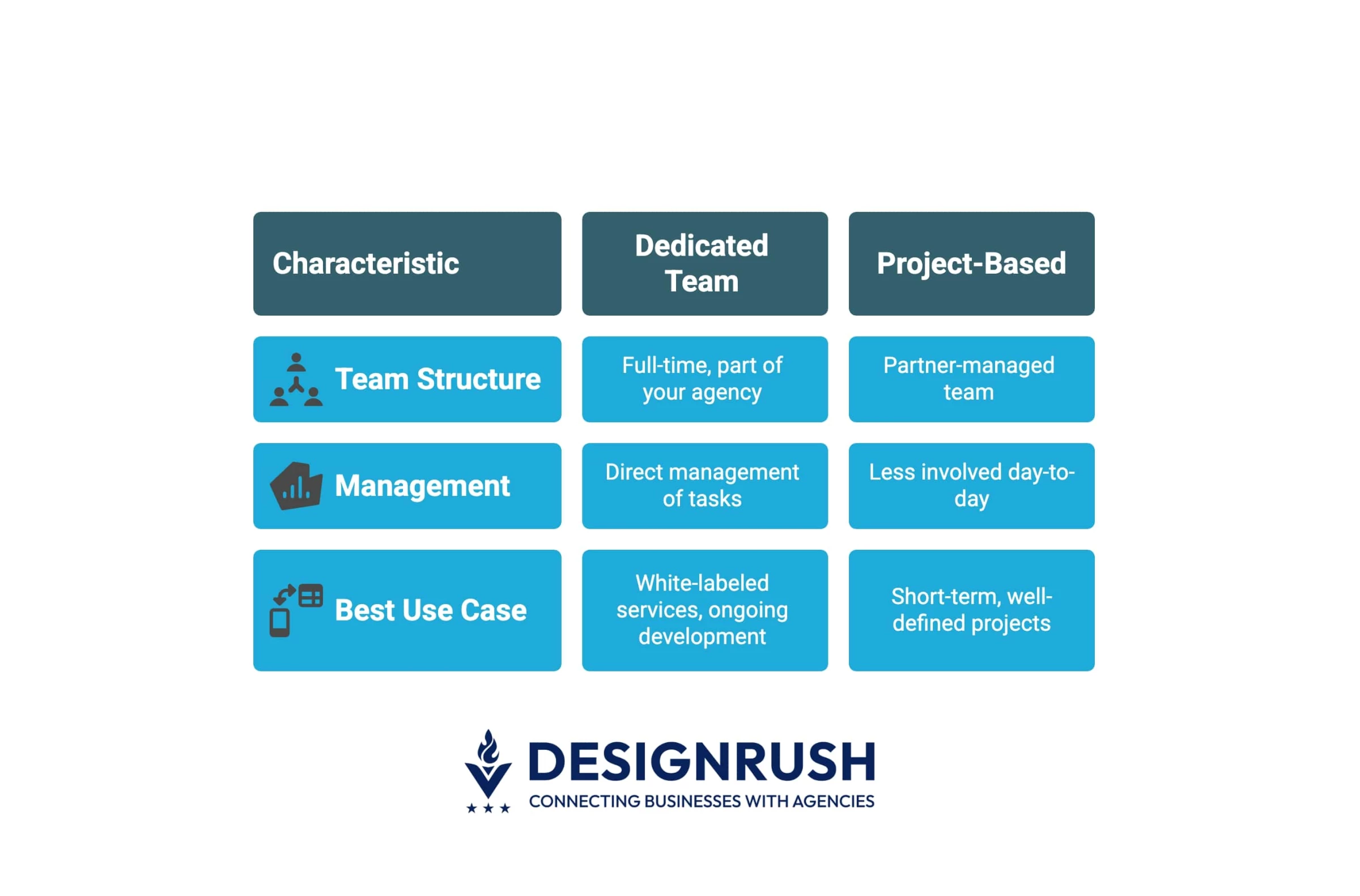
- Dedicated team gives you a full-time team that works as part of your agency. You manage their tasks directly, making it a good fit for white-labeled services or ongoing product development where consistency matters.
- Project-based means you hand over a clear scope and timeline, and the partner delivers. You’re less involved day to day, and they manage their own team. Best for short-term, well-defined projects.
Many agencies use a mix: e.g. maintain a small dedicated team for ongoing development needs, and spin up separate project-based contracts for sporadic client projects outside the team’s capacity or expertise.


Step 2: Vet and Select the Right Software Development Partner
Your outsourcing partner is an extension of your team and a steward of your client’s success. Picking the right partner (and team) is key for your software development outsourcing initiative.
According to research from DesignRush, more than 1 in 3 companies across all markets charge $35 an hour or less.
-content-content-large-webp.webp "global outsourcing market")
Many of these are well-established, highly rated agencies, not just budget freelancers.
That means you can find quality partners at reasonable rates if you know where and how to look.
Create a brief or checklist covering:
- Tech stack and deliverables: What technologies, platforms, or languages must the team be proficient in? What exactly do you expect them to deliver — a prototype, a full product, API integrations, etc.?
- Milestones and success metrics: Outline the timeline and key milestones and define how you’ll measure success. This could include KPIs like performance benchmarks, user acquisition targets after launch, etc.
- QA and deployment expectations: Be explicit about quality standards. Will the partner be responsible for end-to-end testing and fixing bugs? What about deploying to production or app stores — do you expect their help in that process? Define “done” for each stage.
- IP ownership and code management: It’s crucial to specify that you or your client retain intellectual property rights to all code produced. Decide where code will live and how it will be handed off. Also clarify repository structure or branch policies if important.
By nailing down these requirements, you have a clear yardstick to evaluate candidates – and later a basis for your contracts.
It also helps potential partners give you accurate proposals.
Evaluation Framework for Executives
When vetting outsourcing partners, consider multiple dimensions. Here’s a framework used by successful agencies:
- Technical depth: Look at their engineering chops. Check GitHub activity, open-source contributions, and sample code. Make sure their skills align with your tech stack and quality standards.
- Domain experience: Pick a partner with experience in your industry or something close. If you're building a fintech app, a team that's done similar work will ramp up faster and spot domain-specific issues early.
- Communication and process fluency: Software projects live or die by communication. Pay attention to how well they understand your needs during early calls. Do they ask the right questions? Are they fluent in Agile? You want a team that gets both your language and your business.
- Team structure and talent quality: Ask who will actually be on your team. What’s their experience? Can you speak with a lead developer or review resumes? Make sure the senior people you meet will actually be involved, not just sales reps.
- References and reputation: Check client references and independent reviews. Talking to past clients can reveal a lot about reliability. Also confirm the partner is stable, with enough people and financial health to see the project through.
It’s often wise to run a short pilot or sprint simulation with the top candidate before fully committing.
This “test drive” lets you observe their coding quality, communication, and sprint process firsthand.
Step 3: Mitigate Risk: IP, Legal, and Quality Assurance
Outsourcing opens your business to legal, IP, and operational vulnerabilities that must be managed proactively.
Treat contracts, security, and quality processes as non-negotiable elements of your outsourcing strategy. Here’s how to stay safe.
Contractual Must-Haves
Iron-clad contracts set the foundation for a secure partnership. Ensure you have the following documents/clauses in place:
- Non-Disclosure Agreement (NDA): Signed before sharing any project details. It protects your confidential info during and after the engagement, outlines what’s considered confidential, and defines the legal jurisdiction in case of a breach. It sets a baseline of trust and protection.
- Master Service Agreement (MSA): Covers the overall relationship. It lays out payment terms, IP rights, confidentiality, warranties, and dispute handling. This is your umbrella agreement, with individual projects handled through separate SOWs.
- Statement of Work (SOW): Spells out what the vendor will deliver, by when, and how success is defined. It includes scope, milestones, timelines, and acceptance criteria. A clear SOW keeps everyone aligned and helps avoid vague or missed deliverables.
- IP ownership and licensing clauses: Make sure the contract clearly states that your company (or client) owns all work produced. The vendor should waive any claims and agree to hand over all code, designs, and documentation when the job is done.
- Jurisdiction and dispute resolution: Define which country’s laws apply and how conflicts will be handled. If you're in the US and working with a global partner, you might choose US law and arbitration to keep things simple if issues arise.
Investing time with a lawyer to get these documents right is well worth it.
A well-structured contract is your safety net if the relationship goes south.
Data and IP Security
When you outsource development, you must safeguard your code and data as diligently as you would in-house.
Some best practices:
- Use your own repositories: Have the team work in a GitHub or GitLab repo you control. This gives you full code access at all times. Set up access properly by giving each developer their own credentials and revoke them when the project ends.
- Role-based access control: Only give developers the access they actually need. They might need the code repo and a staging environment, but not production data or full system credentials. Check access logs regularly.
- Data protection compliance: Make sure the vendor follows any required regulations, like SOC 2, HIPAA, or GDPR. You might require anonymized data or limit access to dev-only datasets to stay compliant.
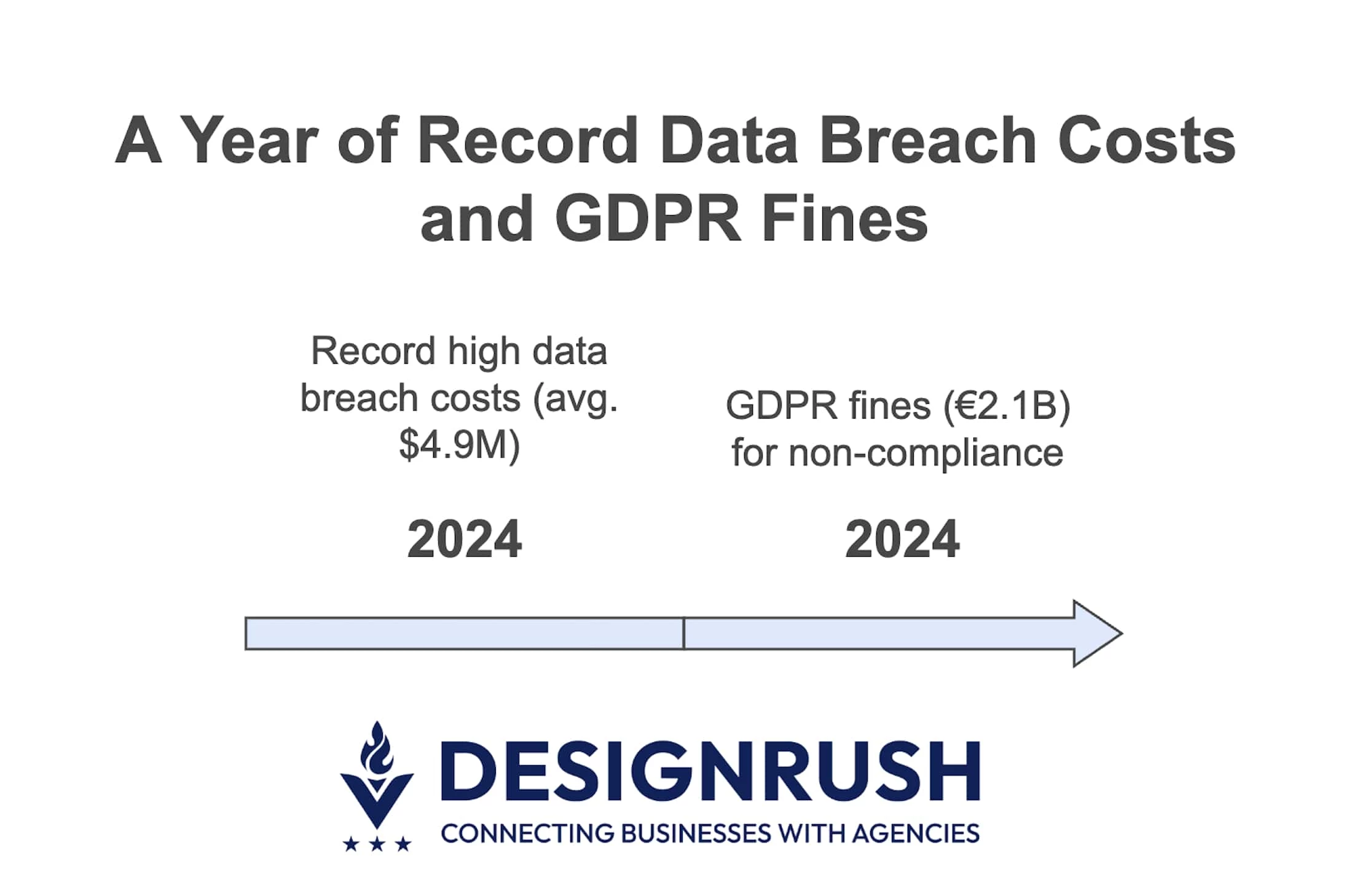
Remember: 2024 saw record high data breach costs (avg. $4.9M) and GDPR fines (€2.1B) for companies that failed compliance.
Many new laws demand strict data localization and protection, so choose partners based on where they store/process data.
If a vendor can’t meet your security standards, they should be a non-starter.
Step 4: Manage the Relationship Like a Strategic Asset
Signing the contract is just the beginning. To reap the full benefits of outsourcing, you need to manage the collaboration proactively.
Think of your outsourced team as a strategic partner and put in place the tools and practices that drive accountability, productivity, and continuous improvement.
Tech Stack To Manage Remote Devs
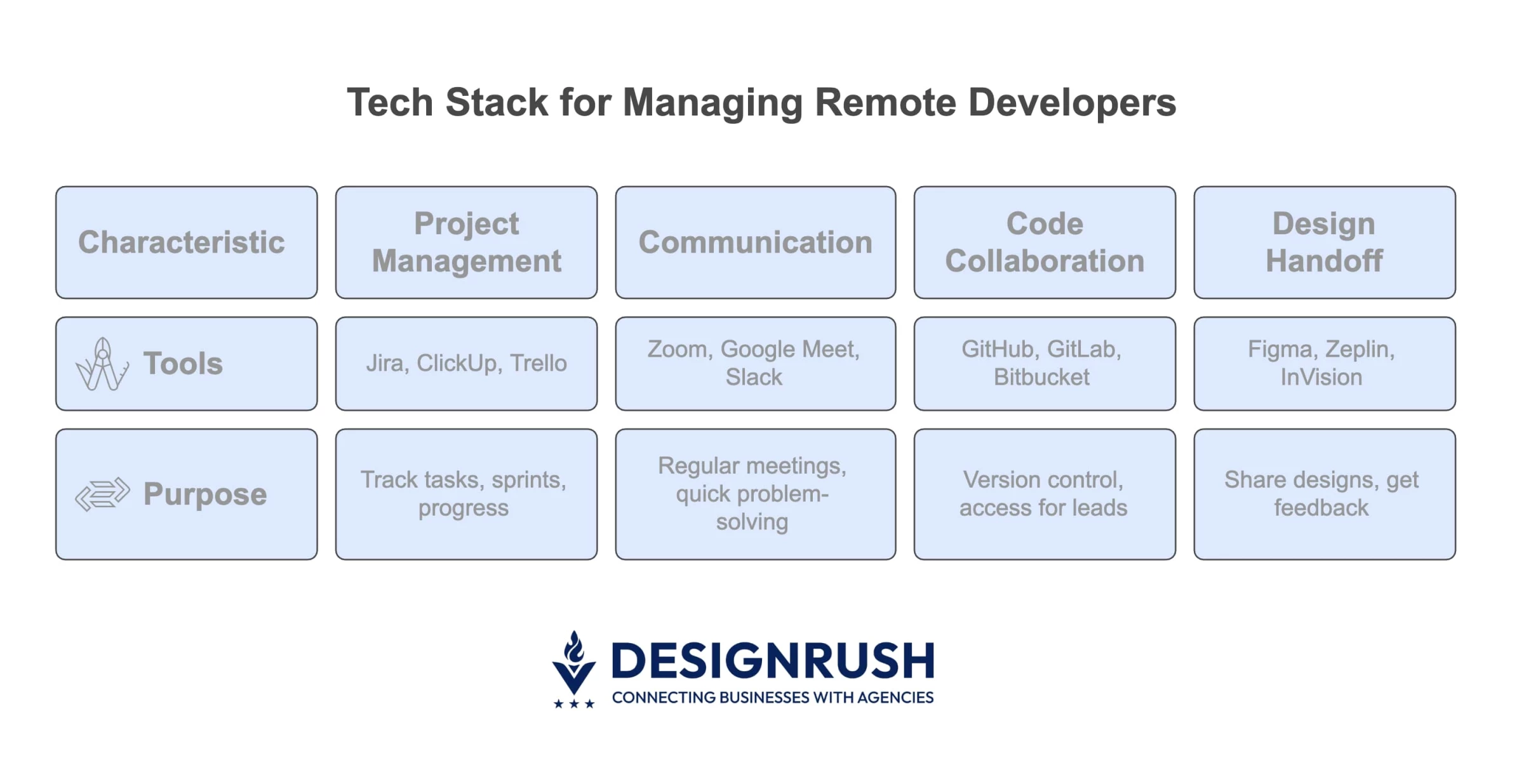
Equip yourself (and the team) with the right collaboration tools. A typical stack for managing outsourced software projects includes:
- Project management: Use a shared tool like Jira, ClickUp, or Trello to track tasks, sprints, and progress. It helps with planning and keeps everyone in the loop on what’s happening.
- Communication: Set up a regular meeting rhythm with Zoom or Google Meet, and use Slack or similar for quick problem-solving and ongoing updates.
- Code collaboration: Use GitHub, GitLab, or Bitbucket for version control, and make sure your leads have access. Tools like GitHub Projects or Azure DevOps can help if they match your workflow.
- Design handoff: If you’re handling design and the partner’s doing dev, use Figma to share designs and get feedback. Zeplin or InVision can help with assets, specs, and keeping things pixel-perfect.
Transform Vendors Into Strategic Allies
Don’t treat the engagement as a fire-and-forget contract. Instead, nurture a partnership mentality:
- Integrate them into your rituals: Include the vendor’s team in your quarterly planning and retros. Treat them like part of your own team, review what worked, what didn’t, and how to improve together.
- Align on shared KPIs: Make sure they know which metrics matter, whether it’s sprint velocity, on-time delivery, QA pass rates, or business results like user satisfaction. Shared goals help build a true team mindset.
- Foster open communication and feedback: Give feedback just like you would to your in-house team, early, honest, and constructive. And don’t forget to celebrate wins. It keeps motivation high and builds trust.
- Offer white-label opportunities: If it fits, involve the vendor transparently in client-facing work. Let them join calls under your brand or co-brand deliverables. It builds pride and ownership while keeping your agency front and center.
A collaborative, partnership approach transforms the dynamic: instead of a client-vendor tension, you have a unified team focused on shared success.
Software Development Project Outsourcing Decision Matrix
To summarize the strategy, here’s a quick decision matrix aligning business goals to outsourcing models:
| Business Goal | Ideal Outsourcing Model | Team Type |
| Scale without hiring | Hybrid (onshore lead + offshore devs) | Dedicated team (long-term) |
Speed up MVP delivery | Nearshore or offshore | Project-based (fast sprints) |
Serve new verticals | Offshore + local PM (for domain guidance) | Retained team (specialists) |
Reduce overhead | Offshore | Project-based (as needed) |
Use this as a guideline:
- If your goal is to enter a new industry or tech vertical, you might keep a local product manager who understands the domain, but outsource the development offshore with a team retained over multiple projects, so they accumulate domain knowledge.
- If your goal is simply to get a minimum viable product (MVP) out quickly on a tight budget, a purely offshore, project-scoped engagement might suffice.
Final Take: Outsourcing as a Growth Engine
When done right and backed by good processes, outsourcing becomes a scalable advantage.
It helps agencies expand services, launch products faster, and turn fixed costs into flexible ones, all while maintaining quality and protecting your brand.
In fact, according to Deloitte’s survey, 96% of organizations are now using third-party sources for talent, a clear sign that outsourcing has become a core strategy for growth.
Instead of turning down work due to limited capacity or missing skills, you can confidently take it on, knowing a trusted external team is there to support you.

Our team ranks agencies worldwide to help you find a qualified partner. Visit our Agency Directory for the top software development companies, as well as:
- Top Software Outsourcing Companies
- Top Nearshore Software Development Companies
- Top Offshore Software Development Companies
- Top IT Outsourcing Companies
- Top App Development Companies
Our design experts also recognize the most innovative design projects across the globe. Given the recent uptick in app development, you'll want to visit our Awards section for the best & latest in app designs.
How To Outsource Software Development Projects FAQs
1. What’s the most effective outsourcing model for agencies?
For most agencies, a hybrid model offers the best balance. This means keeping strategic roles in-house or onshore, while outsourcing development to a skilled remote team. You get strategic oversight and alignment with client/business goals, combined with affordable execution power.
2. What if my in-house team fears they’ll be replaced?
Make sure to explain that outsourcing is about enhancing capacity, not cutting jobs. Emphasize that it will free your internal folks to focus on higher-value activities (strategy, creative work, innovation) instead of crunching on overflow coding tasks. Include in-house team leads in vetting and managing the outsourcers, so they feel ownership.
3. Can outsourcing help me expand services without diluting our brand?
Definitely, and this is one of the biggest strategic advantages. You can add offerings like web/mobile development, AI integration, or product strategy consulting by partnering with specialists, instead of acquiring or hiring a whole new department.