
Choosing the right digital marketing agency can be the difference between steady growth and wasted spend.
With more channels, tools, and data than ever before, businesses need partners that think strategically, execute consistently, and can clearly tie marketing activity to real business outcomes.
Digital Marketing Agency Qualities: Key Findings
- Top agencies align work to measurable financial performance (ROAS, CAC, LTV) plus client health signals (CSAT, NPS)
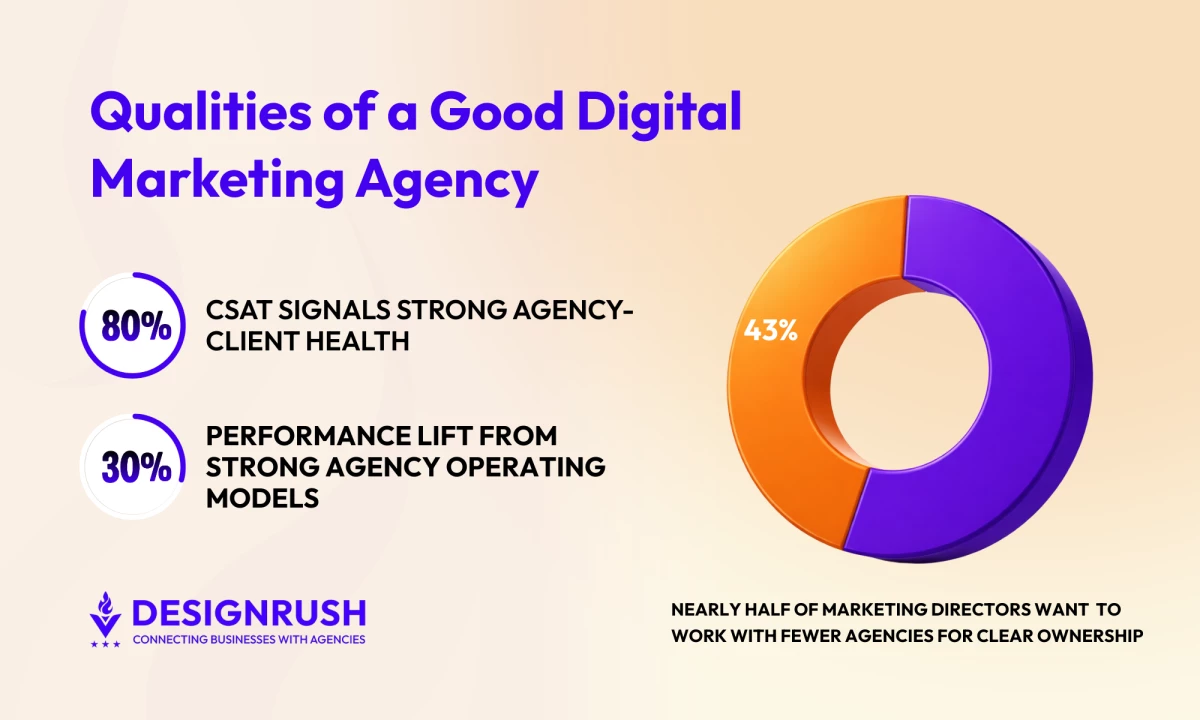
- Well-designed operating models can drive up to 30% improvements in customer satisfaction, operational efficiency, and execution quality.
- High-performing agencies win through integration, agility, and ethics.
What Makes a Good Digital Marketing Agency?
High-performing digital marketing agencies distinguish themselves through how they approach problems, structure their work, and measure success.
The characteristics below are the common defining qualities of agencies that deliver real wins.
1. Anchors Strategy to Measurable Results
Marketing budgets continue to face pressure as executives push for clearer accountability. In 2024, they fell to the lowest level in three years, 7.7% of company revenues.
Despite reaching 9.4% in 2025, budget discipline carried through 2025, demanding that marketing spend demonstrate business impact beyond channel metrics.
Good agencies treat marketing as a system for achieving business outcomes, never as a collection of tactics in isolation.
Before recommending channels, creative approaches, or technology, they focus on understanding how the business creates value and where marketing can most directly influence growth, efficiency, or retention.
This normally includes:
- Revenue or growth targets, including time-to-impact expectations
- Competitive positioning, category dynamics, and differentiation gaps
- Customer acquisition, retention, and lifetime value challenges
Strategy is then built to support those objectives, ensuring marketing efforts are directly connected to meaningful outcomes rather than disconnected tactics.
2. Uses Data and Marketing Tools Effectively
Any agency can collect data, but do they understand it, question it, and know how to apply it across platforms? The ability to interpret data accurately and use the right tools has become a defining capability.
Only 54% of marketers are confident measuring ROI across digital channels, which shows how often data exists without being fully understood or applied.
Valuable marketing data often goes unused due to skill gaps, disconnected systems, or unclear ownership.
Strong agencies close that gap by building teams that are fluent in analytics and comfortable working across multiple tools and data sources.
You’ll often see this reflected in:
- Clear data models that define which metrics matter and why
- Proficiency with current attribution, CRM, marketing automation, and analytics tools
- The ability to connect platform-level metrics to business outcomes
A data-literate agency will validate inputs, understand limitations, and ensure decisions are based on accurate, comparable information.
As Gavin Johnston, director of UX research at Hyatt Hotels, tells us: “If an agency partner can’t align the data with the needs of the audience, then it calls all their work into question.
3. Implements Documented, Repeatable Processes
Clients most often cite scope misalignment and lack of transparency around time and resourcing as reasons value-for-money perceptions decline, as reported in What Clients Think 2024.
Missed deadlines and unexpected requests for additional budget are also named as the most internally damaging outcomes, putting client teams in difficult positions with stakeholders.
Strong, documented processes provide the governance needed to manage scope, align effort to expectations, and deliver work predictably, protecting both outcomes and trust.
A 2025 McKinsey report found that organizations with well-designed operating models (where roles are clearly aligned to strategy, workflows are streamlined, teams have the right skills and expectations are clear) see real performance gains.
These include up to a 30% improvement in:
- Customer satisfaction
- Operational efficiency
- Execution quality
...along with significantly faster decision-making and change adoption.
In practice, strong agency processes often include:
- Structured onboarding and discovery phases that align stakeholders, define success metrics, and surface risks early.
- Defined workflows for execution and approvals that reduce bottlenecks and prevent rework.
- Quality assurance and post-project reviews that identify improvements and reinforce best practices.
Well-established processes reduce uncertainty, improve efficiency, and help ensure that work meets the same standards across every engagement.
4. Uses Audience Insight to Drive Performance
The best digital marketing agencies invest time in understanding the audience’s motivations, pain points, and decision-making behaviors, as well as the competitive context influencing those decisions.
80% of consumers say they prefer brands that deliver personalized experiences and report spending up to 50% more with those brands.
Yet there’s a clear disconnect: while 92% of retailers believe they personalize effectively, only 48% of consumers agree.
@brannonzimbelman What you're Selling vs What People are actually Buying. #branding#marketing#perceptiongap♬ original sound - Brannon
Closing this gap requires deeper audience insight and ongoing testing, areas where strong agencies consistently outperform.
This deeper understanding shows up through:
- Research-driven positioning and messaging rooted in real customer insights
- Use of customer language and behavior data rather than internal assumptions
- Strategic segmentation based on intent, needs, and lifecycle stage
Purpose-driven agencies develop creative to address specific challenges, such as clarifying a value proposition, reducing friction in the user journey, or improving conversion efficiency.
You can recognize effective digital marketing creative by:
- Clear alignment between creative decisions and strategic goals
- Choices informed by observed audience behavior and performance data
- Ongoing evaluation of creative based on impact, not aesthetics alone
When agencies truly understand the market, strategy and creative decisions become more relevant and impactful.
5. Delivers Transparent, ROI-Driven Reporting
Clarity matters just as much as performance: about 70% of marketers say they face moderate to significant challenges measuring ROI, and 66% struggle to demonstrate impact to stakeholders.
When agencies fail to clearly communicate the value of their work, clients are inclined to view the agency as too expensive, as the What Clients Think report shows. Transparent, ROI-driven reporting bridges this gap by translating performance into business impact decision-makers can trust.
View this post on Instagram
Transparent reporting only creates value when it helps teams understand ROI and make better decisions about where to invest. In addition to visibility, clients need context, benchmarks, and clear guidance on what performance actually means.
Different digital marketing channels deliver very different returns depending on use case and maturity, which is why benchmarks matter.
For example, email marketing often delivers $36–$40 for every dollar spent, while organic search generates an average ROI of over $7 per dollar invested over time.
Benchmarks like these provide context without which performance data can be misleading or incomplete. They help businesses (clients) understand:
- Whether channel performance falls within acceptable ROI ranges
- Which investments are compounding value versus driving short-term results
- Where diminishing returns may signal the need for budget reallocation
ROI-focused agencies connect metrics like ROAS, CAC, and conversion rates back to revenue impact and opportunity cost, instead of reporting channels in isolation.
6. Combines Specialist Expertise
Digital marketing efforts are most effective when they work together, rather than in isolation. An agency should combine expertise across multiple disciplines to create cohesive strategies.
This integration is especially important as customer journeys span multiple touchpoints and platforms such as paid social, organic search, websites, and email, each influencing conversion in different ways.
Nielsen has pointed out that marketers risk missing revenue opportunities when channels are planned and measured in isolation. It shows the value of cross-media strategies where each channel amplifies the others rather than competing for credit.
Common areas of integration include:
- Brand positioning and messaging frameworks, ensuring consistency across paid, organic, and owned channels
- UX, website optimization, and conversion-focused development, aligning user journeys with acquisition and revenue goals
- Content strategy, SEO, paid media, and analytics, so creation, distribution, and performance measurement operate as a single system
A cross-functional approach reduces friction and aligns strategy, creative, and execution.
7. Adapts Quickly to Change
Digital marketing moves fast thanks to platform algorithm changes, shifting privacy regulations, new ad formats, and rapid advances in AI and automation.
A good agency will treat adaptability as a core capability rather than a reactive response.
For example, Google has confirmed thousands of search algorithm updates each year, while paid media platforms regularly adjust targeting options, attribution models, and bidding mechanics.
Adaptability in digital marketing agencies shows up as:
- Continuous upskilling in platforms and tools, including analytics, automation, and AI-assisted optimization.
- Structured experimentation, such as testing new ad formats, bidding strategies, or attribution approaches before scaling.
- Rapid iteration based on performance data, allowing spend, messaging, and targeting to shift as conditions change.
Rather than relying on tactics that worked in previous quarters or years, adaptable agencies reassess assumptions frequently. That allows them to maintain performance even as others struggle to keep up.
Alyssa Villa, founder of Canilla Creative, tells us that as new trends emerge “marketers will need to be more agile and innovative than ever, ready to adapt to an increasingly tech-driven, socially conscious, and interconnected marketing world.”
8. Operates Ethically with Long-Term Focus
The best digital marketing agencies operate with clear ethical standards, set realistic expectations around performance, and make recommendations based on long-term business impact rather than tactics that inflate short-term metrics.
In practice, this shows up most clearly in how agencies handle data, media spend, and optimization decisions.
Ethical agencies are transparent about tradeoffs, for example, when a tactic may improve short-term acquisition numbers but increase costs, reduce lead quality, or undermine long-term efficiency.
This discipline is increasingly important as privacy and compliance risks rise.
View this post on Instagram
Recent analysis shows most leading websites (~75%) still fail to meet core privacy requirements across the US and Europe, frequently sharing personal data with multiple advertising third parties without proper consent.
These are risks clients don’t want agencies creating (or ignoring) through weak governance or opaque tooling choices.
This mindset is reflected in:
- Transparent pricing and scope definitions, including clarity around fees, media spend, and third-party tools
- Responsible use of data and AI, with adherence to privacy regulations, consent requirements, and platform policies
- Measurement frameworks that prioritize durable metrics, such as customer lifetime value and cost efficiency, rather than vanity metrics
By acting as strategic partners instead of transactional vendors, ethical agencies help clients avoid wasted spend, reduce risk, and build marketing systems that remain effective as platforms, regulations, and customer expectations evolve.
9. Proves Results and Earns Trust
To make performance tracking valuable, digital marketing agencies should use structured KPI frameworks that inform business decisions.
Leading agencies break KPIs down by department and purpose, with metrics that reveal client health, operational efficiency, and profitability and not just clicks and impressions.
The What Clients Think report shows why proof matters: only 45% of clients say their agency is good value for money in 2024, a massive decrease from 66% in 2014. Hence, the need to back claims with measurable outcomes.
Top-performing agencies track client health through CSAT (aiming for a CSAT score north of 80%) and Net Promoter Score, where scores above ~50 signal strong loyalty and renewal potential.
They also integrate performance and financial metrics into regular reviews, such as:
- Return on Ad Spend (ROAS) paired with Customer Acquisition Cost (CAC) and Lifetime Value (LTV) to assess true marketing efficiency
- Funnel conversion rates at each stage to pinpoint optimization opportunities
- Utilization and project margin benchmarks (e.g., 75–85% utilization and ~20%+ margins) to balance delivery capacity with profitability
- On-time deliveryand revision ratios to keep execution predictable and high quality
Aligning KPIs with business objectives and reviewing them at the right cadence allows agencies to identify performance issues early, make informed adjustments, and build long-term trust through consistent, measurable impact.
10. Knows Who’s Responsible
If team composition is unstable or decision authority is unclear, you can expect performance to suffer. Account structures should balance functional specialization with continuity while explicitly defining ownership, decision rights, and escalation paths.
That clarity matters because clients are actively trying to simplify their agency rosters.
In the What Clients Think report, 43% of marketing directors say they’d ideally like to work with fewer agencies, showing clients want fewer moving parts and clearer ownership.
The result will be faster execution, reduced rework, and decisions made at the appropriate level with full context.
You'll see evidence of this with:
- Clearly defined account ownership, RACI-style decision rights, and escalation frameworks.
- Stable, well-resourced delivery teams with redundancy planning to mitigate dependency risk during staffing changes.
- Sustainable team-to-client ratios that protect delivery quality, responsiveness, and institutional knowledge.
- Decision-making frameworks grounded in performance data, tradeoff analysis, and agreed priorities rather than hierarchy or opinion.
Together, these practices reduce operational risk, make decision-making faster, and allow engagements to grow in scope and complexity without losing accountability or momentum.
Find More Agency Hiring Resources:
- Questions To Ask a Digital Marketing Agency
- Planning Your Digital Marketing Budget
- Digital Marketing Objectives That Drive Real Business Outcomes
Qualities of a Good Digital Marketing Agency: Wrapping Up
The most effective marketing agencies combine strengths with strategy informed by data, creativity grounded in purpose, and execution supported by clear processes and transparent communication.
To evaluate digital marketing agency partners, try to find alignment rather than perfection.
Our team ranks agencies worldwide to help you find a qualified partner. Visit our Agency Directory to find top-rated digital marketing companies, as well as:
- Content Marketing Agencies
- Conversion Rate Optimization Services
- Media Buying Agencies
- Affiliate Marketing Companies
- Direct Marketing Companies
Qualities of a Good Digital Marketing Agency FAQs
1. How long does it typically take to see results after hiring a digital marketing agency?
Timelines vary based on goals, channels, and starting conditions, but most agencies need an initial ramp-up period for discovery, strategy, and testing before meaningful results appear. Early indicators often show within the first few months, while sustained impact takes longer.
2. Is a full-service agency or a specialized agency the better choice?
The right choice depends on business needs and internal resources. Those looking for integrated strategy and execution may benefit from a full-service agency, while those with specific gaps may prefer specialized expertise.
3. What should a business prepare before working with a digital marketing agency?
Businesses should have clear goals, budget parameters, and internal ownership defined before engagement. Providing access to historical performance data and decision-makers also helps agencies move faster and deliver better results.