Find reputable IT services companies in the USA, which were vetted by our team of 12 experts based on 5 criteria and supported by over 2,000 client reviews for your next project.
Organic rankings are determined by five factors: top services, reviews, portfolio, awards/press, and team expertise. Sponsored listings pay for a placement that appears above organic positions. Sponsorship does not affect star ratings or review content - read more on our methodology page.
More Than Code We Build Trust Through Craft & Commitment
Engineered with integrity. Backed by mentorship. Delivered with care. BTS transforms ideas into scalable, secure, and impactful digital products that deliver long-term value...
Top Services:
- Software Development
- AI Development
- Big Data Analytics
- Mobile App Development
- UI/UX Design
- Show more
- Location
- San Francisco, California
- Number of Employees
- 100 - 249
- Average Hourly Rate
- $55/hr
- Minimal Budget
- $50,000 & Up
- Portfolios Count
- 11 Projects Listed
Data sourced from the agency's DesignRush profile, its website, and other relevant accountsBlue Trail Software Services
Data sourced from the agency's DesignRush profileSamsung Cartier Axeptio AxisCare Compredict Odia Precision Bearing AI Collaborative Classroom Certain
IT Hardware Solutions That Power Innovation
ORM Systems is a Texas-based company menufacturing company that produces and sells computers, computer peripheral equipment, and software for business and public organizations. ORM Systems was founded in 2013...
Top Services:
- IT Services
- Cybersecurity
- Managed Services
- Location
- Sugar Land, Texas
- Number of Employees
- 250 - 499
- Average Hourly Rate
- $125/hr
- Minimal Budget
- $50,000 & Up
Data sourced from the agency's DesignRush profile, its website, and other relevant accountsORM Systems Services
Data sourced from the agency's DesignRush profileNovartis Siemens Healthineers ExxonMobil


IT Services Companies by City
IT Services Companies by State
IT Services Specializations in the US
Popular Services
Hiring Guide: How to Choose a Top IT Company in the US
What can an IT services company in USA do for businesses?
An IT services company in the USA can help businesses configure, deploy, upgrade, and secure their infrastructure, cloud platforms, data systems and end-user support channels.
By managing and modernizing their core systems, IT providers reduce clients’ operational frictions and strengthen their technical capabilities.
Organizations that outsource IT operations commonly report 25% lower IT operating costs, attributing them to the reduced downtime and predictable monthly spend.
Over the past decade, the demand for IT services hasn't stopped seizing momentum.
Namely, over 90% of small and mid-sized businesses in the US use external IT providers for some of their technology operations.
In earlier phases, most IT engagements focus on basic infrastructure setup and break-fix support, which accounts for roughly 30-40% of service demand.
What kind of budgets do companies typically allocate for these services?
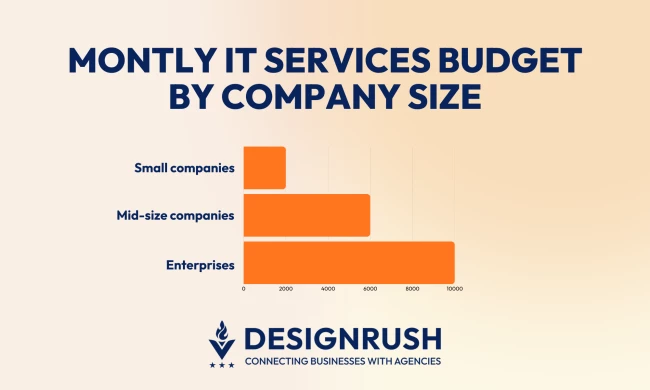
For most businesses in the US, the IT services budget they allocate is determined based on the company size, i.e., the number of users, complexity of their systems, and the level of support they require.
For managed services, companies allocate between $2,000 and 10,000 per month, depending on their size:
- Small businesses with up to 20 employees: $2,000-$3,000 per month
- Med-size businesses with ~50 employees: $5,000-$7,000 per month
- Enterprises with over 200 endpoints: $10,000+ per month
Based on the service level, the cost estimations are usually based on number of users:
- Basic monitoring services: $100 per user/month
- Standard packages: $150-$200 per user/month
- Premium packages: $250-$300 per user/monthly
How to choose the best IT specialist in the US for your business?
To help you choose the best IT specialist in the USA for your businesses, we compiled a list of practical steps to guide you in the process:
- Outline service objectives
Define the number of users, current pain points, and desired outcomes to streamline the search for a provider with the right expertise. - Make a list of prospects
Seach US IT firms across directories like DesignRush and read their customer reviews to determine the reliability of their work. - Research their background
Review their certifications, partnerships, technical skills, industry standing, and case studies to assess the company’s compatibility for your needs. - Send a request for proposal (RFP)
Submit a detailed RFPs to your top prospects to compare service offerings, pricing, and support levels. - Schedule interviews
Set a meeting with the shortlisted candidates to discuss your expectations before making a final decision.
Still looking for an IT consultant? Visit our Marketplace and send us a project brief. Based on your request, we'll send you five agency suggestions that meet the criteria.
How to find the best US-based IT provider on DesignRush that fits your budget?
We’ve curated a list of top IT providers on DesignRush across multiple price points, so you can identify a vendor that's within your budget.
| High budget: $50,000+ |
|
| Low budget: $25,000-$50,000 |
|
Beyond budget, our agency directory allows you to filter agency profiles by location, area of expertise, agency reviews, client types, team size, and hourly rates.
What questions should be asked before hiring a professional IT services company?
Before hiring a professional IT services company in USA, you should ask some of the following questions to make sure the candidate is a good fit for the project:
Relevant Background
- What industries do you specialize in?
- Can you share case studies or references from US companies similar to ours?
- Do you have experience supporting businesses that require compliance with data protection laws, such as HIPAA, CCPA, or FINRA?
Services and Processes
- What technologies, systems, and applications are your specialty?
- What IT support models do you offer?
- Do you offer monitoring and maintenance services?
- Are your IT support services available 24/7, and how do you manage emergencies?
Related to Your Project
- What type of onboarding can we expect?
- How will you ensure minimal downtime when implementing new systems or integrating with our existing processes and systems?
- What software, hardware, and cloud solutions do you recommend for us?
Sources
DesignRush sustains a directory of over 40,000 agencies categorized by service category, location, expertise, and reviews. We build our database in two ways:
- Our dedicated team of agency experts actively searches the web for top-performing companies. We then pull information from their websites, online presence, and client testimonials to verify their status and qualifications prior to listing.
- The agencies listed get notified of their profiles on the website and they can choose to claim it or not, which suggests their availability for more collaborations.
Agencies can also reach out to DesignRush and must go through the verification process prior to being listed.

Why companies trust DesignRush
Every agency is independently vetted before it can be listed or ranked
 4.8
 4.8
Some agencies pay for sponsored placement, clearly labeled and held to the same vetting standards.
IT Services FAQs
What services do IT services companies in USA provide?
IT services providers in USA provide a variety of services for modernizing businesses’ IT ecosystems and fortifying their security posture. On account of their nuanced expertise in automation, cloud deployment, cybersecurity, and data systems, these providers are commonly sought to facilitate transition from legacy dependencies to more agile operating setups.
Common services offered by IT services companies encompass:
- IT consulting
- Custom software development
- Cloud hosting and management
- Cybersecurity services
- Technical support
- System integration
- Managed IT services
- Network support
How much do IT services cost in the US?
US-based IT services providers typically charge between $150 to $250 per hour for break-fix or pay-per-use services. On the other hand, when a managed IT service is in question, the pricing model is determined based on the number of devices or users, ranging from $100 per workstation and$200 per server.
Based on these estimations, businesses can anticipate these price ranges:
| Pricing model | Pricing range | Recommended for |
| Flat rate | $2,000-$3,000 per month | Small and mid-size businesses |
| Pay-per use | $150-$250 per hour | Businesses with set IT infrastructure |
| Per user | $100-$200 per user | Businesses enduring expansion |
The price can also vary based on the requested service:
- Network setup: $1,000-$3,000
- Software licensing: $15-200 per user/month
- Cybersecurity: $500-$2,500 per month
- Data backup and recovery: $150-500 per month
When can clients expect ROI from an IT service?
Return on investment (ROI) from IT services depends on the provided service:
- Managed IT support usually shows ROI within 1 to 3 months because it quickly reduces downtime and ticket backlog.
- Infrastructure upgrades typically return value in 2 to 6 months because performance improvements are shown almost immediately once the new setup is up.
- Cloud migration or modernization is slower, usually 4 to 9 months, as the payback comes after the systems are reconfigured and decommissioned.
- DevOps/automation tends to show ROI in 3 to 7 months because it cuts release effort and lowers change-related outages over several cycles.
- Cybersecurity programs usually take 6 to 18 months as the biggest returns are reflected in avoided losses.
What are the typical timelines for IT projects across different complexity levels?
There’s no set timeframe for IT projects as some work is largely configuration, while other work requires rethinking how core systems operate together. Approximate timelines are:
- Low complexity projects (2-6 weeks): Helpdesk onboarding, endpoint setup, basic monitoring, small infrastructure changes
- Med-complexity projects (up to 3 months): Cloud migrations for small environments, network refreshes, security tool rollouts, backup and DR implementations
- Complex projects (3-6 months): Multi-system cloud migrations, ERP or core app integrations, DevOps pipeline implementation, compliance-driven security programs
- Transformational projects (6-12 months): Full infrastructure modernization, large enterprise migrations, data center exits, platform re-architecture
How often do IT firms conduct performance turning after delivery?
Most IT firms do performance tuning in bursts, i.e., right after going live, after major changes, or when metrics show underperformance. If the contract is for managed services, the tuning is done in scheduled frequences.
This is what “typical” looks like in practice:
- Hypercare (right after delivery): weekly or even daily tuning for 2-6 weeks while usage stabilizes and early issues surface.
- Managed services: light tuning monthly for review metrics and quick fixes, and a deeper optimization quarterly for capacity planning and bottleneck analysis.
- Project-only handoff (no ongoing contract): tuning is usually ad hoc, only when there’s a complaint, incident, or a planned upgrade.
Latest Trends Related to IT Services