Finding a software development company in Texas means filtering through 450+ agencies with wildly different specializations, pricing models, and track records. Our directory does that work for you, profiling verified reviews and real case studies, to help you find a match faster.
Organic rankings are determined by five factors: top services, reviews, portfolio, awards/press, and team expertise. Sponsored listings pay for a placement that appears above organic positions. Sponsorship does not affect star ratings or review content - read more on our methodology page.
Lets Bring Your Vision To Life
Forjwell is a premier technology and product development firm built for founders who demand clean, scalable digital solutions. We specialize in transforming raw ideas into refined, high-traction platforms, offering deep expertise across mobile and web app development, custom software, and immersive game...
Top Services:
- AI Development
- Mobile App Development
- Software Development
- Web Design
- Web Development
- Show more
- Location
- Austin, Texas
- Number of Employees
- 50 - 99
- Average Hourly Rate
- $100/hr
- Minimal Budget
- $10,000 - $25,000
Enterprise eCommerce solutions for B2B Industries
Klizer helps manufacturers, distributors, and enterprise businesses accelerate digital growth through connected commerce solutions. We specialize in B2B ecommerce, ERP integrations, AI-powered applications, cloud transformation, and custom software development. As experts in Adobe Commerce, Shopware, Shopify...
Top Services:
- eCommerce Development
- Web Design
- Web Development
- SEO
- Mobile App Development
- Show more
- Location
- Austin, Texas
- Number of Employees
- 100 - 249
- Average Hourly Rate
- $100/hr
Your Partner in Digital Transformation
We provide Powerful ERP Reporting and Dashboards for Microsoft Dynamics ERP users...
Top Services:
- Business Consulting
- ERP Consulting
- Big Data Analytics
- IT Services
- Software Development
- Show more
- Location
- Austin, Texas
- Number of Employees
- Under 49
- Average Hourly Rate
- $100/hr
- Minimal Budget
- Under $1,000
Engineering Connected Systems For Businesses
Genius Logix pairs cloud engineering with commercial thinking. We help companies in healthcare, financial services, logistics, and B2B eCommerce modernize legacy systems, integrate ERP and CRM platforms, and build custom software across AWS, Azure, and Google Cloud then back it with the marketing and AI...
Top Services:
- Software Development
- Mobile App Development
- DevOps Consulting
- SEO
- Web Development
- Show more
- Location
- Austin, Texas
- Number of Employees
- 50 - 99
- Average Hourly Rate
- $100/hr
- Minimal Budget
- $10,000 - $25,000
- Portfolios Count
- 2 Projects Listed
Shopify stores, websites and automation for small businesses
Austin studio founded in 2020 that builds Shopify stores, small business websites and workflow automation. Fixed-price quotes in writing, websites from $3,000, and a $100/month Care Plan for hosting, security and updates. Led by Alex Abushanab, MBA, CISA. Clients keep ownership of their domain, code and...
Top Services:
- Web Development
- eCommerce Development
- Web Design
- Software Development
- Show more
- Location
- Austin, Texas
- Number of Employees
- Under 49
- Average Hourly Rate
- $100/hr
- Minimal Budget
- $1,000 - $10,000
You Grow We Go
Adscular Agency helps businesses improve their online visibility, attract potential customers, and build more effective digital growth strategies. Our services include performance marketing, Google Ads, Meta Ads, SEO, paid advertising, lead generation, website development, and conversion rate optimization...
Top Services:
- Digital Services
- Digital Strategy
- Branding
- Digital Marketing
- SEO
- Show more
- Location
- Austin, Texas
- Number of Employees
- Under 49
- Average Hourly Rate
- $100/hr
- Minimal Budget
- Under $1,000
- Portfolios Count
- 1 Project Listed
Shaping the Future of Technology
When enterprise clients need scalable custom platforms, Plego builds web, mobile, and AI solutions using React, Node.js, Python, and .Net. Founded in 2002 and headquartered in Chicago, the firm has delivered software for Apple TV+, NBCUniversal, Google, Fitbit, and Berkshire Hathaway across eCommerce, ERP...
Top Services:
- Web Development
- eCommerce Development
- Software Development
- Web Design
- AI Development
- Show more
- Location
- Houston, Texas
- Number of Employees
- Under 49
- Average Hourly Rate
- $105/hr
- Minimal Budget
- $10,000 - $25,000
- Portfolios Count
- 13 Projects Listed
Cutting-Edge Digital Solutions Made To Improve Your Online Visibility
OSM 3 Technologies offers IT solutions and services designed to optimize business processes and improve digital workflows...
Top Services:
- Web Development
- Web Design
- Mobile App Development
- Software Development
- AI Development
- Show more
- Location
- Austin, Texas
- Number of Employees
- Under 49
- Average Hourly Rate
- $110/hr
- Minimal Budget
- $1,000 - $10,000
Wisdom In Motion
Pendoah helps North American SMBs turn AI strategy into production systems that pass audits. We deliver secure data foundations, reliable models, and MLOps with compliance and ROI proven in real deployments...
Top Services:
- AI Development
- Software Testing
- Staff Augmentation
- Software Development
- Show more
- Location
- Houston, Texas
- Number of Employees
- 100 - 249
- Average Hourly Rate
- $110/hr
- Minimal Budget
- $25,000 - $50,000
- Portfolios Count
- 4 Projects Listed
Simplifying Technology
At Mayan Technologies, we are experts in creating game-changing solutions tailored to your business needs and providing highly specialized technology services...
Top Services:
- Software Development
- IT Services
- Business Consulting
- Location
- Allen, Texas
- Number of Employees
- Under 49
- Average Hourly Rate
- $120/hr
- Minimal Budget
- $1,000 - $10,000
- Portfolios Count
- 6 Projects Listed
Bespoke software solutions built for your business
For over a decade, Lucky Media has been a leading Software Development Agency, based in Dallas, TX. Our extensive experience spans across startups to enterprise-level organizations, demonstrating our flexibility and commitment to delivering high-quality code...
Top Services:
- Web Development
- Software Development
- Mobile App Development
- UI/UX Design
- eCommerce Development
- Show more
- Location
- Dallas, Texas
- Number of Employees
- Under 49
- Average Hourly Rate
- $120/hr
- Minimal Budget
- $10,000 - $25,000
- Portfolios Count
- 5 Projects Listed
Transforming Ideas Into Robust Online Experiences
In 2016, we founded Web Design Glory, a company specializing in website design projects. Over time, our expertise expanded to include app design and development projects, which we successfully delivered alongside our website projects. Building on this success, in 2018, we established a subsidiary venture "App...
Top Services:
- Software Development
- Mobile App Development
- VR/AR
- IoT
- Software Testing
- Show more
- Location
- Austin, Texas
- Number of Employees
- Under 49
- Average Hourly Rate
- $120/hr
- Minimal Budget
- $10,000 - $25,000
AI-Powered Engineering Gen AI & Agentic AI
Inventiple builds production AI products, MCP servers, and startup MVPs for funded founders and enterprise teams. Delivered in 6-8 weeks by senior engineers averaging 10+ years experience. Fixed price, no juniors. Live products: Incu, Smart Stack Advisor, Hierk...
Top Services:
- Web Development
- AI Development
- Mobile App Development
- Software Development
- DevOps Consulting
- Show more
- Location
- Houston, Texas
- Number of Employees
- Under 49
- Average Hourly Rate
- $120/hr
- Minimal Budget
- $25,000 - $50,000
- Portfolios Count
- 3 Projects Listed
The B2B Digital Brand Experience Agency.
Technology-led digital brand experiences...
Top Services:
- Web Design
- Web Development
- Branding
- Graphic Design
- UI/UX Design
- Show more
- Location
- Houston, Texas
- Number of Employees
- 50 - 99
- Average Hourly Rate
- $125/hr
- Portfolios Count
- 24 Projects Listed
Lofty builds data driven software for the AEC, Agriculture and Energy industries.
Lofty Labs is a web software development consultancy...
Top Services:
- Mobile App Development
- Software Development
- IT Services
- Web Development
- Show more
- Location
- Lubbock, Texas
- Number of Employees
- Under 49
- Average Hourly Rate
- $125/hr
- Minimal Budget
- $10,000 - $25,000
Award-winning custom software dev & web design
SPARK provides custom software, web design, and digital marketing services that move your business forward...
Top Services:
- Mobile App Development
- Software Development
- Web Development
- UI/UX Design
- Branding
- Show more
- Location
- Houston, Texas
- Number of Employees
- 50 - 99
- Average Hourly Rate
- $125/hr
- Minimal Budget
- $10,000 - $25,000
- Portfolios Count
- 5 Projects Listed
Our Focus Is The Success Of Your VR Project
We are your VR experts. Trusted by the world's leading brands. As the industry's most trusted and experienced VR resource, we will guide and implement the best VR solution for your needs...
Top Services:
- VR/AR
- Software Development
- Video Production
- Creative Services
- Video Marketing
- Show more
- Location
- Addison, Texas
- Number of Employees
- Under 49
- Average Hourly Rate
- $125/hr
Empowering Digital Excellence, One Mind at a Time
Elevate your digital presence with Mindshare Consulting Inc, Austin's premier agency for digital marketing, web design, and advertising. Unlock growth, engage audiences, and achieve remarkable results with our expertise...
Top Services:
- SEO
- Digital Marketing
- Email Marketing
- PPC
- Content Marketing
- Show more
- Location
- Austin, Texas
- Number of Employees
- 250 - 499
- Average Hourly Rate
- $125/hr
- Minimal Budget
- $1,000 - $10,000
We Scale Your Business By Enhancing productivity
EB DevTech LLC is a Houston-based technology and AI-automation consultancy that helps small and mid-sized businesses turn paper and chaos into clean, reliable systems. By combining cloud infrastructure, custom software, and intelligent automation, EB DevTech streamlines operations, enhances efficiency, and...
Top Services:
- AI Development
- CRM Consulting
- ERP Consulting
- Mobile App Development
- Software Development
- Show more
- Location
- Houston, Texas
- Number of Employees
- Under 49
- Average Hourly Rate
- $125/hr
- Minimal Budget
- $1,000 - $10,000
Build Faster Ship Cleaner
Adapter AI is an AI-powered software development agency that helps businesses build, launch, and scale digital products faster than traditional methods. Focused on speed, efficiency, and innovation, the company delivers enterprise-ready solutions in months and MVPs in weeks through automated, AI-driven...
Top Services:
- AI Development
- Software Testing
- Software Development
- Web Development
- Mobile App Development
- Show more
- Location
- Austin, Texas
- Number of Employees
- Under 49
- Average Hourly Rate
- $125/hr
- Minimal Budget
- $10,000 - $25,000
- Portfolios Count
- 1 Project Listed
Custom Software Solutions For Industries
The Conklin Group is a senior-level Microsoft and AI development team based in Prosper, TX, serving Dallas-Fort Worth and B2B clients nationwide since 2002. We build custom .NET/Azure systems and integrate Anthropic Claude into production applications no junior bench, no account managers relaying messages...
Top Services:
- Web Development
- ERP Consulting
- eCommerce Development
- IoT
- AI Development
- Show more
- Location
- Prosper, Texas
- Number of Employees
- Under 49
- Average Hourly Rate
- $125/hr
CodeCross is an Austin-registered mobile app and web studio. Results-first engagements: discovery locks success metrics, then senior builders ship production software with dated proof — not slide-deck theater. Austin HQ + overlapping US Central hours...
Top Services:
- Digital Services
- Web Development
- Mobile App Development
- Software Development
- Show more
- Location
- Austin, Texas
- Number of Employees
- Under 49
- Average Hourly Rate
- $125/hr
- Minimal Budget
- $10,000 - $25,000
Data, Cloud, And Automation Delivery You Can Run
Ascendant Systems LLC is a Dallas-based technical delivery firm serving growing organizations, specialist consultancies, and internal teams across the United States. We take on defined data engineering, cloud and DevOps, and business automation problems and deliver them as scoped engagements: an assessment, a...
Top Services:
- IT Services
- Software Development
- Big Data Analytics
- Cloud Consulting
- DevOps Consulting
- Show more
- Location
- Dallas, Texas
- Number of Employees
- Under 49
- Average Hourly Rate
- $125/hr
- Minimal Budget
- $1,000 - $10,000
Websites, hosting and custom software from Longview, Texas since 1998
Inhouse Associates is a small Longview, Texas team that has built and hosted websites since 1998. We design and develop custom Umbraco CMS sites that our clients' own staff can edit, write the web applications behind them, and host everything on servers we manage ourselves. Recent work includes Longview...
Top Services:
- Web Design
- Web Development
- Software Development
- SEO
- IT Services
- Show more
- Location
- Longview, Texas
- Number of Employees
- Under 49
- Average Hourly Rate
- $125/hr
- Minimal Budget
- $1,000 - $10,000
Our Focus: Empowering Your Growth
Whatever your industry, you use technology to help you do it better, faster, and more efficiently.But technology comes with its own challenges that require expertly-crafted solutions. That’s. What. We. Do.We listen to our clients to understand your vision. Because we stay on the cutting edge of our...
Top Services:
- Mobile App Development
- Software Development
- Cybersecurity
- IT Services
- Web Development
- Show more
- Location
- San Antonio, Texas
- Number of Employees
- 100 - 249
- Average Hourly Rate
- $135/hr
- Minimal Budget
- $25,000 - $50,000
We Automate Your Business Grunt Work.
Quacito LLC is a leading provider of business consulting, Web development, process automation and mobile application development services for corporate bodies, Industries, small business and government agencies...
Top Services:
- Mobile App Development
- Software Development
- Digital Marketing
- Location
- San Antonio, Texas
- Number of Employees
- Under 49
- Average Hourly Rate
- $135/hr
- Minimal Budget
- $1,000 - $10,000
Scaling Made Effortless.
Whether it's websites, marketing, advertising, contracts, business filing, or software solutions. We have you covered. Everything custom and made to order, according to your needs and specifications...
Top Services:
- Business Consulting
- Software Development
- Accounting
- Web Design
- Digital Marketing
- Show more
- Location
- El Paso, Texas
- Number of Employees
- Under 49
- Average Hourly Rate
- $135/hr
- Minimal Budget
- $1,000 - $10,000
Everything is possible with tech!
VND is a software and IT company in San Antonio, Texas, specializing in creating efficient tech solutions like web dashboards, mobile apps, and private clouds, and offering advanced services in managed IT, cybersecurity, data-center operations, cloud virtualization and AI implementations...
Top Services:
- Web Development
- WordPress Website Design
- AI Development
- Mobile App Development
- Software Development
- Show more
- Location
- San Antonio, Texas
- Number of Employees
- Under 49
- Average Hourly Rate
- $135/hr
- Minimal Budget
- $10,000 - $25,000
- Portfolios Count
- 25 Projects Listed
We Are Creators
Aidan James is a creative agency that brings brands and people together with a multidisciplinary approach, combining strategy and creativity to build brand experiences...
Top Services:
- UI/UX Design
- Web Design
- Advertising
- Branding
- Public Relations
- Show more
- Location
- El Paso, Texas
- Number of Employees
- Under 49
- Average Hourly Rate
- $145/hr
- Minimal Budget
- $10,000 - $25,000
Digital Transformation Consulting Company You Can Trust
Texas Software Inc. is a cutting-edge professional services firm that specializes in providing innovative software solutions and business process automation, as well as support for their own custom designs. With many years of multi-faceted experience under its belt, this young but highly knowledgeable company...
Top Services:
- Mobile App Development
- Software Development
- Web Development
- eCommerce Development
- SEO
- Show more
- Location
- Spring, Texas
- Number of Employees
- Under 49
- Average Hourly Rate
- $149/hr
- Minimal Budget
- $10,000 - $25,000
Empowering Businesses To Flourish Through Effective Technology
At Phidev, we partner with businesses and entrepreneurs who recognize the transformative power of technology, and understand how the web and mobile devices are changing the way we live and conduct business. Our approach is to collaborate with clients, gaining a deep understanding of their unique business...
Top Services:
- Digital Marketing
- Web Development
- Social Media Marketing
- Web Design
- UI/UX Design
- Show more
- Location
- El Paso, Texas
- Number of Employees
- Under 49
- Average Hourly Rate
- $149/hr
- Minimal Budget
- $1,000 - $10,000
Custom Software Solutions That Enhance Your Business
At Solwey Consulting, we are a boutique agency that focuses on our customers' success by delivering excellent work. We understand that the solutions businesses need to function are often complex, which is why we work tirelessly to create simple, effective solutions that meet our clients' needs...
Top Services:
- UI/UX Design
- eCommerce Development
- Web Design
- Web Development
- Software Development
- Show more
- Location
- Austin, Texas
- Number of Employees
- Under 49
- Average Hourly Rate
- $149/hr
- Minimal Budget
- $10,000 - $25,000
Josh Software - Your Reliable Development Partner Since 2007
At Josh Software, we have consistently been ranked as the #1 most reliable software development partner by most of our clients for 15 years now...
Top Services:
- Mobile App Development
- Software Development
- UI/UX Design
- Location
- Dallas, Texas
- Number of Employees
- 500 - 999
- Average Hourly Rate
- $149/hr
- Minimal Budget
- $25,000 - $50,000
Digital transformation company based in Houston, TX
With specialized support in areas like product strategy, UX research, UX/UI design, web development, mobile app creation, and IoT development, our services cover the entire product lifecycle...
Top Services:
- Web Development
- Software Development
- Mobile App Development
- UI/UX Design
- IT Services
- Show more
- Location
- Houston, Texas
- Number of Employees
- Under 49
- Average Hourly Rate
- $149/hr
- Minimal Budget
- $10,000 - $25,000
Delivering Innovation for the Digital Age
R/CS is a digital transformation catalyst that blends strategy, design, and engineering to bring businesses closer to their customers, employees, and partners. They prioritize their clients and their enterprise business goals in all of their services, going beyond application design, development, and...
Top Services:
- Software Development
- UI/UX Design
- Location
- Austin, Texas
- Number of Employees
- Under 49
- Average Hourly Rate
- $149/hr
- Minimal Budget
- $10,000 - $25,000
Preparing Brands for the Digital World
Company A is a custom application development company that transforms brands and organizations for the digital world. We provide world-class enterprise solutions, system integration services and application maintenance and support for legacy applications...
Top Services:
- Software Development
- Location
- Plano, Texas
- Number of Employees
- Under 49
- Average Hourly Rate
- $149/hr
- Minimal Budget
- $50,000 & Up
Bringing Ambitious Concepts To Life
At SeeSaw Labs, our team transforms tedious tasks into streamlined experiences. We believe that thoughtful design and collaboration can have an immense impact on improving lives while working towards strategic business goals. Our simple yet effective solutions offer a dynamic approach to problem solving with...
Top Services:
- Software Development
- UI/UX Design
- Mobile App Development
- Web Development
- Product Design
- Show more
- Location
- Austin, Texas
- Number of Employees
- Under 49
- Average Hourly Rate
- $149/hr
- Minimal Budget
- $10,000 - $25,000
Leading Development Studio
Since 2011, Pixel and Texel has produced custom apps, VR experiences, websites, and backend solutions...
Top Services:
- VR/AR
- AI Development
- Mobile App Development
- Software Development
- Web Development
- Show more
- Location
- Dallas, Texas
- Number of Employees
- Under 49
- Average Hourly Rate
- $149/hr
- Minimal Budget
- $50,000 & Up
We Are Your Outsourced Innovation Team
Touch To is an Austin-based development and design consultancy, providing innovative solutions to technically challenging initiatives for enterprises, SMBs, startups, and nonprofits. With expertise in UX/UI design, full-stack web and mobile development, interactive installations, hardware/software...
Top Services:
- Software Development
- BPO
- Location
- Austin, Texas
- Number of Employees
- Under 49
- Average Hourly Rate
- $149/hr
- Minimal Budget
- $10,000 - $25,000
Innovation Delivered Just in Time.
Prosigliere is a technology service company specializing in a Just-in-Time approach to empower businesses with tailored solutions, innovation, and strategic planning for sustainable growth...
Top Services:
- Software Development
- Mobile App Development
- Business Consulting
- Product Design
- Show more
- Location
- Austin, Texas
- Number of Employees
- Under 49
- Average Hourly Rate
- $149/hr
- Minimal Budget
- $1,000 - $10,000
AI that runs the busywork for small businesses audits, automation, and content.
Most small businesses know AI could save them hours they just don't know where to start. BizSuite by J&B Enterprise fixes that. We run a $997 AI Audit that maps every repeatable task in your business and ranks what to automate first, then build and operate the systems: lead-gen, AI video clipping, and...
Top Services:
- AI Development
- Mobile App Development
- Software Development
- Software Testing
- IT Services
- Show more
- Location
- Austin, Texas
- Number of Employees
- Under 49
- Average Hourly Rate
- $149/hr
- Minimal Budget
- Under $1,000

Goji Labs
VerifiedVerified by the DesignRush team for authenticity and credibility.AI LeaderRecognized for strong visibility across AI-powered search and answer engines.+1Award WinnerRecipient of a Best Design Award for outstanding work.We Define the Right Build Before We Start It.
Goji Labs builds custom web and mobile apps, AI-powered products, and digital platforms for startups and nonprofits, with clients like WWF and WHO. It serves healthcare, fintech, and media verticals. A practical fit for early-stage startups and mission-driven organizations needing a product partner...
Top Services:
- Mobile App Development
- Software Development
- UI/UX Design
- AI Development
- Web Design
- Show more
- Location
- Dallas, Texas
- Number of Employees
- 50 - 99
- Average Hourly Rate
- $150/hr
- Minimal Budget
- $25,000 - $50,000
- Portfolios Count
- 23 Projects Listed

Digital Silk
VerifiedVerified by the DesignRush team for authenticity and credibility.AI LeaderRecognized for strong visibility across AI-powered search and answer engines.+1Award WinnerRecipient of a Best Design Award for outstanding work.Growing Brands Online
Digital Silk builds custom websites, eCommerce platforms on Shopify and Magento, and software with AI and ERP integration. Its work has been featured on CNN, Bloomberg, and Reuters. Best fit for mid-market and enterprise brands needing a full-service web development and digital marketing partner...
Top Services:
- Web Design
- eCommerce Development
- Branding
- Digital Strategy
- Digital Marketing
- Show more
- Location
- Austin, Texas
- Number of Employees
- 100 - 249
- Average Hourly Rate
- $150/hr
- Portfolios Count
- 42 Projects Listed

Groove Jones
Award WinnerRecipient of a Best Design Award for outstanding work.Award-Winning AR / VR / XR / AI / WebGl Experiences
Groove Jones is an innovative technology company that specializes in creating AI/VR/AR software solutions for a wide range of industries, including advertising, entertainment, marketing, health, and training...
Top Services:
- VR/AR
- Software Development
- Mobile App Development
- Web Development
- Web Design
- Show more
- Location
- Dallas, Texas
- Number of Employees
- Under 49
- Average Hourly Rate
- $150/hr
- Minimal Budget
- $50,000 & Up
- Portfolios Count
- 26 Projects Listed
Shaping the Digital Future
Idea Theorem is an award-winning design and development agency. Through our empathy-driven approach, we have crafted digital products that have positively impacted over 10 million users. Our mission is to shape the digital future by delivering exceptional experiences...
Top Services:
- Web Design
- Product Design
- Mobile App Development
- Web Development
- eCommerce Development
- Show more
- Location
- Austin, Texas
- Number of Employees
- Under 49
- Average Hourly Rate
- $150/hr
- Minimal Budget
- $50,000 & Up
- Portfolios Count
- 10 Projects Listed
Many THINK, Some SAY, at Watermark We DO.
Watermark Digital was founded on a single yet critical principle, how can we help our clients be significantly more visible, relevant and quickly more profitable. Our passion at Watermark is to be “the supporting partner behind your brand”, like the watermark that is visible when held up to light; b...
Top Services:
- Mobile App Development
- Software Development
- UI/UX Design
- Digital Marketing
- Digital Services
- Show more
- Location
- Dallas, Texas
- Number of Employees
- Under 49
- Average Hourly Rate
- $150/hr
- Minimal Budget
- $10,000 - $25,000
Leading Edge Mobile Virtual Reality Development.
ForwardXP creates interactive content for Virtual Reality, Augmented Reality and Mixed Reality. We are focused on experiences, which is what the “XP” part of our name stands for. Our internal research and development is focused on the intersection of Voice User Interfaces with AI in both VR and AR worlds...
Top Services:
- VR/AR
- Software Development
- Location
- Dallas, Texas
- Number of Employees
- Under 49
- Average Hourly Rate
- $150/hr
- Minimal Budget
- $25,000 - $50,000
Business software with AI inside, built in Houston since 2004.
Espresso Moon is a Houston custom software company that builds AI-enabled business applications, mobile apps, and cloud platforms for B2B clients, and hosts and supports everything it delivers. We also own and operate GageList, a calibration management SaaS with AI built into the product...
Top Services:
- AI Development
- Software Development
- Mobile App Development
- Software Testing
- UI/UX Design
- Show more
- Location
- Spring, Texas
- Number of Employees
- Under 49
- Average Hourly Rate
- $150/hr
- Minimal Budget
- $25,000 - $50,000
Experts In Innovation
TVW is an innovation & creative development studio based in Dallas, Tx. We pride ourselves on our ability to discover unique solutions to client’s marketing challenges with technology, design, and strategy. Anything but traditional, we’re a collective of tech nerds, digital storytellers & empathetic...
Top Services:
- Mobile App Development
- Software Development
- Social Media Marketing
- Digital Marketing
- VR/AR
- Show more
- Location
- Dallas, Texas
- Number of Employees
- Under 49
- Average Hourly Rate
- $150/hr
- Minimal Budget
- $50,000 & Up

Timbergrove
VerifiedVerified by the DesignRush team for authenticity and credibility.Transforming Complexity Into Clarity
Timbergrove, based in Houston, leverages decades of experience in tech and IoT to simplify decision-making and enhance performance. From real-time monitoring to custom-tailored solutions, our passionate team addresses complex operational issues with precision...
Top Services:
- Software Development
- IoT
- Location
- Houston, Texas
- Number of Employees
- Under 49
- Average Hourly Rate
- $150/hr
- Minimal Budget
- $10,000 - $25,000












































Software Development Companies in Texas by City
Related Services in Texas
Software Development Specializations in Texas
Popular Services
Everything you need to know before hiring a software development company in Texas
How do I know if I'm ready to hire a software development company in Texas?
You are ready to hire a Texas software development company when you can define the problem your software needs to solve, connect it to a business outcome, and name a single internal person with the authority to approve decisions throughout the engagement.
Before briefing any Texas software company, confirm if you can present the following:
- A problem statement, not a feature list
"We need a client portal" is a feature request. "Our account managers spend 11 hours per week answering status emails that a self-serve portal would eliminate" is a problem statement. The latter allows for faster build, more accurate scope, and fewer questions mid-project. - A realistic, disclosed budget
Withholding your budget will not lead to better proposals. Knowing your bracket upfront eliminates agencies that would underscope your project to win it. - A named internal owner
Projects with multiple decision-makers and no single owner experience longer approval cycles, more change orders, and higher final costs. Assign one person, give them authority, and ensure the agency knows who that person is before the sprint starts. - Defined requirements
If your core requirements have changed more than once in the last four weeks, you are not ready to brief an agency. - Access to your existing technical environment
If you have a current codebase, database, or third-party integrations the new build must connect to, document them before any agency conversation. Agencies that discover mid-project that integrations exist will issue change orders for the discovery work they should have done in week one.
How do I shortlist software development companies in Texas without spending weeks on the wrong ones?
A shortlist should contain up to three agencies, selected by filtering on four non-negotiable criteria before a single conversation takes place: relevant domain experience, project size match, recent client reviews, and a disclosed pricing model.
The sheerness of available options always poses intimidation. Most buyers start reading agency descriptions before applying filters, which means they spend time evaluating agencies for whom they are too small, too large, or in the wrong vertical.
Apply these filters to cut the list before opening any agency profile:
- Project size alignment
An agency whose minimum engagement is $250,000 will assign a junior team to your $80,000 project. Filter for agencies whose stated minimum falls within 50% of your budget in either direction. - Verified reviews with industry relevance
Star ratings without context are meaningless. Look for agencies with three or more verified reviews from clients in your industry, completed recently. - Disclosed pricing model
Any agency that won't share its pricing structure in the first email exchange is creating an information asymmetry that will not resolve itself after signing. Move on. - Founding team tenure
Check the founding team's LinkedIn profiles. Agencies younger than three years carry significantly higher delivery risk regardless of how polished the website is. The portfolio will be thin, the processes immature, and the team more likely to be figuring things out on your project.
Should I start with a pilot project or commit to a full engagement upfront?
For any software engagement over $100,000 or longer than four months, a paid pilot scoped to a real but non-critical deliverable is the most reliable way to validate quality before full commitment.
The pilot will not be a free sample. When agreed to, it is a structured four-to-six-week engagement with a written brief, a defined deliverable, sprint demos, and a handover package at the end.
Pilots should be treated as real projects as they reveal a lot about communication, code quality, and deadline management.
A solid start in that direction is to choose a deliverable that exercises the stack, architecture decisions, and team communication patterns you wish to see.
Then, define what "done" looks like before the pilot begins. A vague success criterion will inevitably produce a vague result.
The first two weeks will reveal how the agency runs the kickoff, provisions environments, and manages the first sprint.
If the pilot delivers late, produces poorly documented code, or requires you to chase status updates, do not rationalize it; these outcomes are your answer if you should trust the agency with the remainder of the project.

How do I evaluate a software development company in Texas if I don't have deep technical knowledge?
Non-technical individuals can evaluate software development companies effectively by measuring the clarity of technical communication.
Namely, if an agency can explain architecture decisions in plain language, it means it understands your problem and can build a product that addresses it.
If you still feel unsure in your capacity to evaluate a developer, consider some of these options:
- Hire a fractional CTO for two to three days
- Ask agencies to argue against their own recommendation
- Ask about post-launch maintenance costs, in addition to build costs
How do I set expectations with a Texas software agency so I'm not disappointed three months in?
The most effective solution in this direction is a written kickoff document, produced and signed by both parties before sprint one.
The document should state who approves what, how quickly decisions must be made, what "done" means for each deliverable type, and what the escalation path is when timelines slip.
Define these four things in writing before development begins:
- Decision SLA: Agree in writing that client responses will arrive within one business day and make it reciprocal, so the agency commits to the same.
- Communication channel: Agencies and clients that communicate across five channels produce five different versions of project status. Agree on one channel and maintain all communication there.
- Definition of "deliverable complete:” Define this for every category before the building sprint begins.
- Escalation path: Name a contact on both sides for issues that cannot be resolved at the project manager level. Define the timeline for escalation: if a blocker is not resolved within 48 hours at the PM level, it moves up.
Sources
DesignRush sustains a directory of over 40,000 agencies categorized by service category, location, expertise, and reviews. We build our database in two ways:
- Our dedicated team of agency experts actively searches the web for top-performing companies. We then pull information from their websites, online presence, and client testimonials to verify their status and qualifications prior to listing.
- The agencies listed get notified of their profiles on the website and they can choose to claim it or not, which suggests their availability for more collaborations.
Agencies can also reach out to DesignRush and must go through the verification process prior to being listed.

Why companies trust DesignRush
Every agency is independently vetted before it can be listed or ranked
 4.8
4.8 4.8
4.8Some agencies pay for sponsored placement, clearly labeled and held to the same vetting standards.
5 FAQs About Software Development Companies in Texas
What are the red flags when evaluating software developers in Texas?
The clearest red flag is an agency that skips a paid discovery phase and moves directly to writing code, which almost always leads to scope creep, plenty of rework, and a final bill that bears no resemblance to the original quote.
If the development requirements are not well defined prior to billing, the ambiguity works in the software agency’s favor as it allows it to add more billable hours. Here are some other warning signs to look for during evaluation:
- No structured discovery phase offered. Any agency that can quote a fixed price within 48 hours of a brief discovery call hasn't fully scoped your project.
- Case studies that show screenshots but not outcomes. A credible case study should name the client, the problem, the timeline, and the outcome.
- The team you meet in sales is not the team building your product. Ask to meet your assigned project manager and lead developer before signing.
- Vague answers on IP ownership. You should own 100% of the code on day one after final payment. Any hedging on this needs a lawyer before you proceed.
- No defined communication frequency in the contract. If sprint reviews, status reports, and escalation paths aren't written into the agreement, you'll be chasing updates six months in.
- References are unavailable or from more than three years ago. Tech projects fail regularly; ask for two references from engagements completed in 2024 or 2025.
What do software development companies in Texas charge that most clients don't expect?
Project management overhead and infrastructure provisioning routinely add 30% to 50% to the base development rate. Here's what other costs are commonly add-ons:
- Change order premiums. Every feature added after scope sign-off is typically billed at a higher rate. Agencies add 20% to 40% contingency to fixed-price quotes simply because requirements almost always change.
- Post-launch support and maintenance. Annual post-launch support for any application is rarely included in a proposal for the build phase.
- Cloud infrastructure and DevOps setup. AWS, Azure, or GCP configurations do not fall under development, and agencies often bill them separately.
- QA and testing. Many proposals quote for development hours only.
- Handover and documentation. At the end of the engagement, you need working documentation to maintain and extend the codebase.
What's the difference between a good Texas software agency and an average one?
The difference between a good and average software developer in Texas will reflect in the way they handle your first two conversations: a good agency asks harder questions than you do, while an average agency rushes to propose solutions before understanding the problem.
Here's what separates them across the five critical evaluation criteria:
| Criteria | Average agency | Good agency |
| Discovery | Quotes after one call | Charges for discovery; won't quote without it |
| Case studies | Screenshots and logos | Named client, defined problem, measurable outcome |
| Team access | Sales team only pre-contract | Introduces your actual PM and lead dev before signing |
| Scope handling | Agrees with everything you say | Pushes back on unrealistic timelines or budgets |
| Risk discussion | No mention of what could go wrong | Mentions technical and timeline risks proactively |
What should a software development case study feature?
A case study worth taking seriously names the client or offers a reference call, describes the specific technical problem, identifies the stack used, and quantifies a measurable outcome. Here's what to look for:
- A defined starting point: Where was the client's system before the engagement? Without a baseline, be it legacy architecture, error rate, deployment frequency, or user drop-off, there is no way to evaluate how much the agency actually moved.
- A specific problem: "The client needed a modernized platform" is not a problem. "The client's monolithic architecture was preventing deployments more than once per quarter" is. The specificity of the problem statement tells you how precisely the agency scopes work.
- Stack and architecture decisions explained: Why did they choose that framework, cloud provider, or database? Agencies that can articulate sequencing decisions understand software architecture as a system.
- Timeline honesty: How long did the engagement actually run versus what was originally scoped? An agency that only presents on-time, on-budget case studies is either working in low-complexity environments or omitting the engagements that didn't go as smooth.
- A business outcome: Deployment frequency doubled. Support ticket volume dropped 60%. Time-to-close for sales-assisted workflows cut from 14 days to 3. If the case study stops at "we re-architected the backend," ask directly why no business result is cited.
How do I choose between two software developers in Texas that look equally qualified on paper?
When two software development companies look equally qualified on paper, the differentiator is always process. Ask each one the same operational questions and compare the specificity of their answers:
- What happens if a requirement needs to change mid-sprint?
A named change order process with a written approval step is the right answer. "We're flexible" is not. - How do you handle a project that falls behind schedule?
You're looking for a specific escalation contact and a defined timeline for resolution. - Who do I contact at 4pm on a Friday with an urgent issue?
The answer should be a name, not a reference to a support portal. - Can I see a sample sprint report from a current engagement?
Redacted client information is expected. What you're evaluating is the format, the depth, and whether it's the kind of document that would actually keep you informed. - What would you do differently if you could restart your most recent project?
An agency with no candid answer to that question hasn't examined its own work closely enough to improve it.
Latest Trends Related to Software Development

Software Development
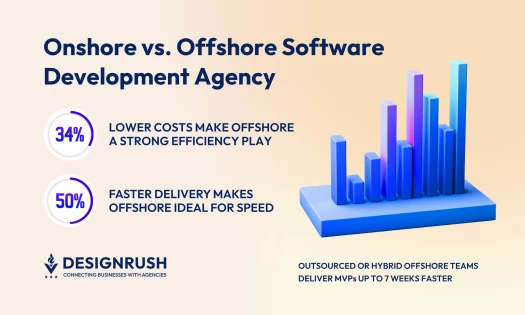
Onshore vs. Offshore Software Development Company: Which One Is a Better Choice?
2,659