I’ve been called in by CEOs who burned a year and seven figures discovering that what they bought isn’t what they needed. Nine times out of ten it traces back to their software development RFP.
Software Development RFP: Key Points
The RFP Is Where Your Project Fails or Succeeds
Boards never blame the RFP when a build goes sideways. They point fingers at the strategy, the vendor, or the CTO.
Yet every post-mortem traces back to something missing or assumed right here. The RFP defines what winning looks like, what resources are required, and what risks you accept.
Here are my tips on how to do it right and be mindful of things most leaders aren’t.
1. Publish Timeline, Budget Band, and Decision Dates
A BCG survey found nearly half of global C-suite leaders say more than 30% of their tech projects run over budget and late. The cause is usually unclear expectations in the RFP.
When leaders hide budget or process, every agency guesses.
Some of them lowball to win then claw back with change orders.
Others price high because they assume complexity.
To avoid this, I start every RFP with three facts:
- When I expect the proposal
- How much we can invest
- When we decide
In a fintech scaleup I advised, we moved from 14 wildly different proposals to only 6 qualified ones simply by stating a budget band upfront.
The conversations shifted from “How much do you have?” to “How much value can we drive with this?”
Clarity early saves everyone time later.
2. Clarify Assumptions and What's Out of Scope
Scope creep is the top project management challenge for 2026, cited by 59% of MSPs, up from 46% the year before. The fastest way it happens is leaving assumptions open in the RFP.
To avoid, I maintain a short list of assumptions agencies must agree to:
- What success looks like
- Which systems remain untouched
- What data sources are available
- Who approves what, and when
If any of those are left open, vendors will fill the gaps with wishful thinking.
I also include a short Out-of-Scope section. One line that says “We are not rebuilding the CRM” has saved clients months of budget conversations.
Every assumption you fail to write down becomes a dispute later. Defining what is not included prevents “just one more feature” from silently multiplying into a missed deadline.
3. Expose Hidden Systems and Shadow IT Up Front
The systems that create the most risk are the ones nobody admits exist. Nearly 1 in 2 cyberattacks stem from shadow IT, and the average cost to clean up is more than $4.2 million.
I once found a logistics operation running mission-critical pricing updates from a manager’s personal Excel file. No version control. No backups. No one at the executive table even knew it existed.
To avoid such risks, your RFP must reveal:
- Manual workflows that secretly run revenue
- Legacy systems glued together by humans
- Unsupported integrations that scare everyone
IBM reports that shadow AI services drive up to 20% of security incidents and add about $670,000 to breach costs. Yet 60% of companies still fail to include shadow IT in threat assessments, and 85% have a team using it today.
When vendors understand the true environment, they estimate accurately and design for reality instead of fantasy.
4. Require Cost to Serve Forecasts
Cheap software that is expensive to run is not cheap software.
I make vendors model:
- Cost per active user
- Cost per 1,000 requests
- Cost per inference if AI is involved
A marketplace founder I advised saved $1.4M in the first year simply by disqualifying a vendor whose infrastructure design scaled cost linearly with traffic. Success shouldn’t break your business model.
Unit economics belong inside the proposal, not discovered in year two when CFOs start yelling.
5. Request a High-Level Architecture Snapshot
I don’t need 40 pages. I need one clear diagram showing:
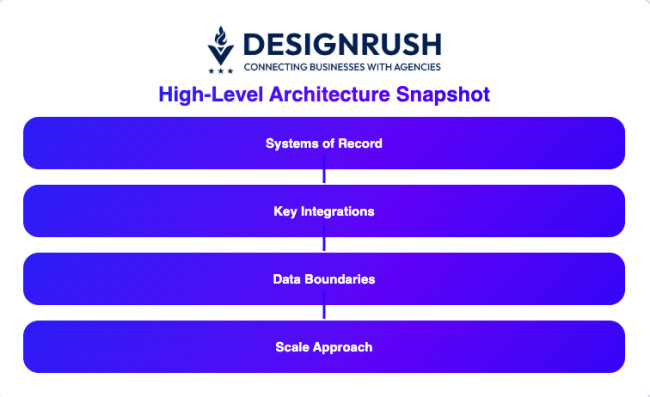
I ask for one page because that’s where truth and weak spots show up fast.
On a payments project I rescued, this single page exposed that checkout depended on a single-region cache with no fallback; catching it pre-award saved a quarter of rework and a future outage.
If a team can’t show “where truth lives” and “what breaks first under load” on one page, they don’t understand your business well enough to build it.
6. Ask for an SBOM and Signed Releases
In every software development RFP I draft, a software bill of materials (SBOM) is non-negotiable. It stems from a reality I’ve encountered too many times that modern attacks come directly from the libraries and packages buried inside your codebase.
That’s why I always require a SBOM which is simply a list of every dependency, version, and license included in your product.
Without that inventory, you have no way to trace a vulnerability when the next zero-day exploit hits a library you rely on.
What to ask agencies in the RFP:
- Provide your SBOM generation and update process: how often it runs, how it handles transitive dependencies, and how you maintain accuracy.
- Submit evidence of signed artifacts: how you sign build outputs, control access to private keys, and trace deployments.
- Explain your vulnerability-remediation process: how you monitor open-source libraries, how quickly you patch, what your SLAs are for upstream vulnerabilities.
- Demonstrate license-compliance tracking: which open-source licenses you use, how you manage incompatible ones, and how you mitigate resulting risk.
7. Align Payments to SLOs and Business Outcomes
I refuse to pay for tickets closed or features launched because none of that matters if the product crashes when customers try to use it.
I structure payments around performance on a few revenue-critical journeys. These differ by industry, but they usually look like:
- Login and authentication
- Checkout, booking, or payment confirmation
- Creating, submitting, or approving something that blocks revenue
- Any workflow where compliance or trust is at stake
I set service level objectives (SLOs) that customers can feel and business leaders can measure:
- Uptime for those key journeys
- Response times that keep people moving
- Error rates low enough that users do not abandon the process
Research from the DORA 2024 report shows that teams measured on reliability recover faster and break less, which means better business results.
When the vendor is rewarded for a stable experience instead of speed alone, you get a system that scales with your growth instead of collapsing under it.
8. Demand a Rollback and Kill-Switch Plan
When releases fail, the difference between a minor incident and a headline outage is how quickly you can shut the problem down.
We saw this in June 2025 when a faulty Google Cloud update took major services offline.
Google identified the issue in 10 minutes, but because the update was not behind a proper feature flag, the “stop” action took hours to reach all regions. One click would have prevented the outage.
If the largest platform teams in the world can get caught without safeguards, anyone can.
That is why the RFP must require hard proof that the vendor can contain failure without taking revenue offline.
When I write the RFP, I ask for:
- A rollback procedure that has already been tested
- A kill-switch that turns off a feature without stopping the core flows
- Clear triggers for using both in real incidents
- A dry-run demonstration before any contract is awarded
I have used kill-switches to stop a fraud spike in under a minute. Without that safeguard, the same issue would have turned into hours of outage, damage control, and refund math.
9. Require Named Roles and Bench Depth
You are not buying a brand. You are buying the people who will actually build the product.
That is why I require vendors to name the specific team members they are assigning, show relevant experience, and commit their availability for the duration of the project.
In the RFP, I ask for:
- Named leads for engineering, security, data, and delivery
- Each role’s percentage allocation to your project
- A qualified backup for every critical role
- Conditions for if and when substitutions are allowed
This requirement protects your timeline from staffing surprises and stops vendors from swapping in junior talent once the contract is signed.
10. Require Live References and a Clickable Demo
View this post on Instagram
I need to see real software working in the real world. If a vendor cannot give me access to a clickable demo or a sandbox environment, I assume they are selling a promise instead of a product.
In the RFP, I request:
- A working demo environment with synthetic data
- At least two live references for similar projects
- End-to-end access to one core user flow
I won’t accept:
- PowerPoints
- “Under NDA” excuses
- Vaporware screenshots
Five minutes clicking through an actual checkout or booking flow tells me more about quality, decisions, and stability than any polished proposal deck.
Find More Agency Hiring Resources:
- In-House vs. Outsourcing Software Development
- How To Plan a Software Development Budget
- Building a Practical Budget for Mobile App Development
Final Advice From Someone Who Has Fixed Too Many Failed Builds
You should stop treating a software development RFP as paperwork and start treating it as a risk elimination tool.
Every requirement above exists because I’ve lived the cost of skipping it:
Lost revenue, blown deadlines, contractors vanishing with the knowledge, security liabilities discovered after launch, and software that scales costs faster than users.
You write the RFP well, so the project doesn’t need rescuing later.
If you want a guided version of everything above, grab our editable RFP template and keep every one of these risks covered.
 Our team ranks agencies worldwide to help you find a qualified partner. Visit our Agency Directory for the top software development companies, as well as:
- Top Enterprise Software Development Companies
- Top Custom Software Development Companies for Small Business
- Top Mobile App Development Companies
- Top AI Development Companies
- Top Software Testing Companies
Our design experts also recognize the most innovative design projects across the globe. Given the recent uptick in app usage, you'll want to visit our Awards section for the best & latest in app designs.
Software Development RFP FAQs
1. How detailed should a software development RFP be?
Detailed enough so vendors can estimate accurately and propose systems that fit your reality. That means describing your goals, constraints, user environment, and success metrics, but not dictating every feature. You give the what and why. Let the experts propose the how.
2. How many vendors should we send the RFP to?
Three to five qualified vendors is the sweet spot. Less than three and you lose competitive tension. More than five and you drown in proposals and waste everybody’s time. Focus on ones that have delivered similar complexity before.
3. What does a strong RFP response look like?
It shows they understand your business, not just the technology. That means clear architecture thinking, evidence of security and delivery maturity, realistic costs, and a team that has done this before. The best proposals will also point out what not to build and the risks you haven’t addressed yet.