Searching for a reliable ReactJS web development company? DesignRush helps you find top experts trusted by Fortune 500 brands. With 40,000+ vetted agencies and over 100,000 client-agency matches monthly, our platform ensures you get the best fit for your needs. Compare providers by industry expertise, client type, budget, reviews, team size, and portfolio.
Discover the top React.js Development Companies for Your Project
52 Companies-Rankings updated: August 26, 2026
DesignRush evaluates all React.js developers listed based on their technical expertise, past work, and client reviews. Some listings may be paid.
Outsource your marketing efforts at a cost of an employee!
Merlin Marketing is a top-ranked B2B marketing agency and has accelerated growth for the worlds most iconic brands including Elementor, Omnisend, Snov, NordVPN, and a lot more. We are a dedicated team of magicians that create smart, data-driven marketing strategies to connect your brand with your audience...
Best Top-Rated Website & Mobile App Development Company.
We are an innovative, top-rated Website, Mobile &software development company specialising in the creation and design of web-based applications, websites, and mobile solutions (iOS, Android, React Native, and hybrid). Our primary expertise lies in collaborating closely with clients to transform their ideas...
Frequently Asked Questions About React.js Developers
What are the typical React.js development services?
React.js development companies provide end-to-end services that span the entire software development lifecycle, from strategy and design to development and launch. Core services include:
React.js consulting: Guiding businesses on building and optimizing their React applications through component selection, architecture design, and roadmap development.
Custom React.js development: Engineering applications tailored to a business's specific needs, goals, and existing IT infrastructure, and typically include web design and web development.
UI/UX design: Delivering intuitive interfaces, clear user flows, and standardized design systems that align with a brand and its target users.
API integration: Connecting the React frontend to back-end systems, third-party tools, and external data sources to support seamless functionality and user experiences.
Platform migration: Rebuilding or migrating legacy frontends to React to improve maintainability, usability, and performance, often with minimal disruption.
Maintenance and support: Providing post-launch monitoring, debugging, performance optimization, and technical support.
Many React.js developers also offer specialized expertise, including SaaS products, web application development, customer portals, eCommerce solutions, and minimum viable products (MVPs).
Some React.js development companies may also offer digital marketing services, such as content marketing, search engine optimization (SEO), and branding.
What is the difference between React and React Native?
The main difference is that React is used to build web user interfaces, while React Native is for developing mobile applications. Here are more details on their differences:
React
React Native
Primary platforms
Websites, web applications, and single-page applications
iOS and Android mobile apps
Tech base
JavaScript/TypeScript with React for web UI
JavaScript/TypeScript with React, rendered through native UI components
Best for
Businesses building browser-based products, customer portals, dashboards, eCommerce sites, and SEO-focused web experiences
Businesses building cross-platform mobile apps for both iOS and Android with shared logic and accelerated development time
Examples
Facebook, Instagram, Netflix web
Microsoft Teams and Shopify
What are the typical React developer tools?
React.js developers typically choose their stack based on a client's product goals, technical requirements, and existing systems. For example, they may use Formik for complex forms and validation, Storybook for developing and testing components in isolation, and MUI for production-ready UI components and design systems.
Back-end options: Express, Laravel, Rails, ASP.NET
Databases and infrastructure: PostgreSQL, SQL Server, Redis
Can React.js developers build AI-powered features into web applications?
Yes. A React.js developer can build AI-powered features into a web application by integrating model APIs, SDKs, and AI workflows into the product experience.
Depending on your goals, this may include providers such as Google Gemini or Anthropic Claude, along with React developer tools, like Vercel's AI SDK for building chat, search, recommendation, and automation experiences in React-based apps.
These companies can help you build features such as:
Personalized content and recommendations based on user behavior
Chatbots and virtual assistants for real-time customer support
Smart search with autocomplete, semantic search, and related-result suggestions
AI-assisted dashboards that generate summaries, reports, forecasts, and insights from business data
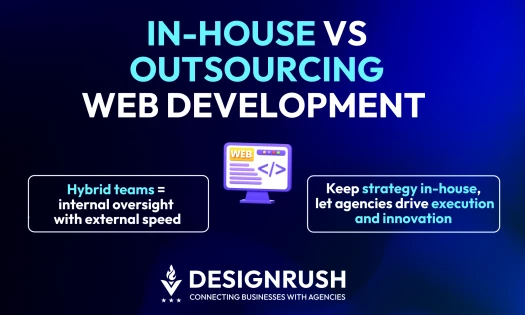
When should you hire a React.js development company instead of using an in-house team?
The right choice depends on your project goals, internal capacity, timeline, and need for control. You may want to hire a React.js development company if:
You have a short-term or time-sensitive project, but your internal team is already at capacity.
You do not have the specialized expertise required for the project, such as React architecture, performance optimization, migration, or AI feature integration.
You need to accelerate delivery without hiring and onboarding a full internal team.
You want access to a broader range of skills, such as design, front-end engineering, QA, and post-launch support, through a single external partner.
You need temporary support to fill skill gaps or expand delivery capacity.
Use an in-house team when:
The application is a core business product that requires long-term ownership and deep institutional knowledge.
The project involves highly sensitive systems, proprietary logic, or strict security and compliance requirements.
You need close day-to-day collaboration, faster internal feedback loops, and direct control over priorities.
The product requires continuous iteration and alignment with multiple internal teams over time.



 Proposals