
AI marketing tools are now part of everyday workflows, with 91% of marketers actively using them.
As platforms multiply, the challenge is choosing tools that actually deliver.
I tested today’s leading AI digital marketing tools to see which ones truly streamline content, ads, and strategy. Here’s what impressed me, what fell short, and which tools are worth including in your marketing stack in 2026.
Best AI Digital Marketing Tools: Key Findings
- AI marketing stacks are becoming specialized, with tools like Omnisend, ActiveCampaign, and Pixis handling execution, while platforms such as Brandi AI focus on visibility through AI-driven discovery.
- Content and video workflows are increasingly automated through tools like Narrato, Descript, and Syllaby, reducing production time without removing strategic input.
- Measurement is shifting beyond clicks and attribution, with Prescient AI refining performance insights and Brandi AI introducing tracking of how brands appear in AI-generated answers.
Top AI Digital Marketing Tools Reviewed
Not all AI marketing tools solve the same problem. Some are built for content production, others for paid media, automation, or attribution, and a few focus on how brands appear inside AI-driven discovery.
In practice, most teams combine multiple tools rather than relying on a single platform. The payoff can be significant, with marketers reporting 10+ hours saved per week by using AI.
To choose the right fit, focus on how the tool supports your work:
- Primary function
Look for depth in one area, such as content, ads, or analytics
- Integration with your stack
Tools that connect with your CRM, ad platforms, and data sources are easier to adopt and more effective
- Decision support
Prioritize platforms that give you insights that you can act on
- Level of control
Automation should simplify execution without removing the ability to adjust targeting, creatives, or strategy
- Visibility and measurement
Some tools now track how brands appear in AI-generated answers
Use the table to compare where each tool fits and what it does best:
| AI Digital Marketing Tool | Best For | Content Generation | Paid Ads Management | Tracking, Analytics, & Reporting | Pricing Starts At |
| Omnisend | eCommerce multi-channel campaigns | ✅ | ❌ | ✅ | $11.20 monthly |
| ActiveCampaign | Email and sales automation | ✅ | ❌ | ✅ | $15 monthly |
| Descript | All-in-one video and podcast editor | ✅ | ❌ | ❌ | $16 per person monthly |
| Brandi AI | AI visibility (GEO) | ❌ | ❌ | ✅ | Custom |
| Pixis | AI media buying and campaign optimization | ❌ | ✅ | ✅ | Inquire |
| Prescient AI | Predictive marketing attribution | ❌ | ✅ | ✅ | Inquire |
| Narrato | AI-powered content workflows | ✅ | ✅ | ✅ | $36 monthly |
| Socialfaim | AI influencer marketing | ❌ | ❌ | ✅ | Inquire |
| Syllaby | AI multichannel video marketing | ✅ | ❌ | ✅ | $24.67 monthly |
| Rekla AI | Ad automation | ✅ | ✅ | ✅ | $87+ monthly |
If you’re looking for a smarter way to run campaigns, Ryan Hernandez, Founder & CEO at WGA, believes AI tools are the key:
"AI tools in digital marketing source and study a tremendous amount of data and information in seconds that would otherwise take us months.
This fast research ability gives marketers a leg up on their campaigns with all the more insights to gather from all of this data and then act on it accordingly to develop a solid campaign."
Jackie Palmer, VP Product Marketing at ActiveCampaign, puts it simply: AI is turning email marketing from clunky workflows into smart, self-driving campaigns.
"Traditional email automation was about drawing boxes and arrows; autonomous marketing is about setting goals and letting AI figure out the next best move.
We’re watching marketers move away from hand-built workflows toward systems that continuously optimize timing, content, and segmentation in real time — turning email from a static schedule into a living, adaptive journey for every contact."
1. Omnisend: Best for eCommerce Email and Multi-Channel Campaigns
For eCommerce teams running multi-channel campaigns
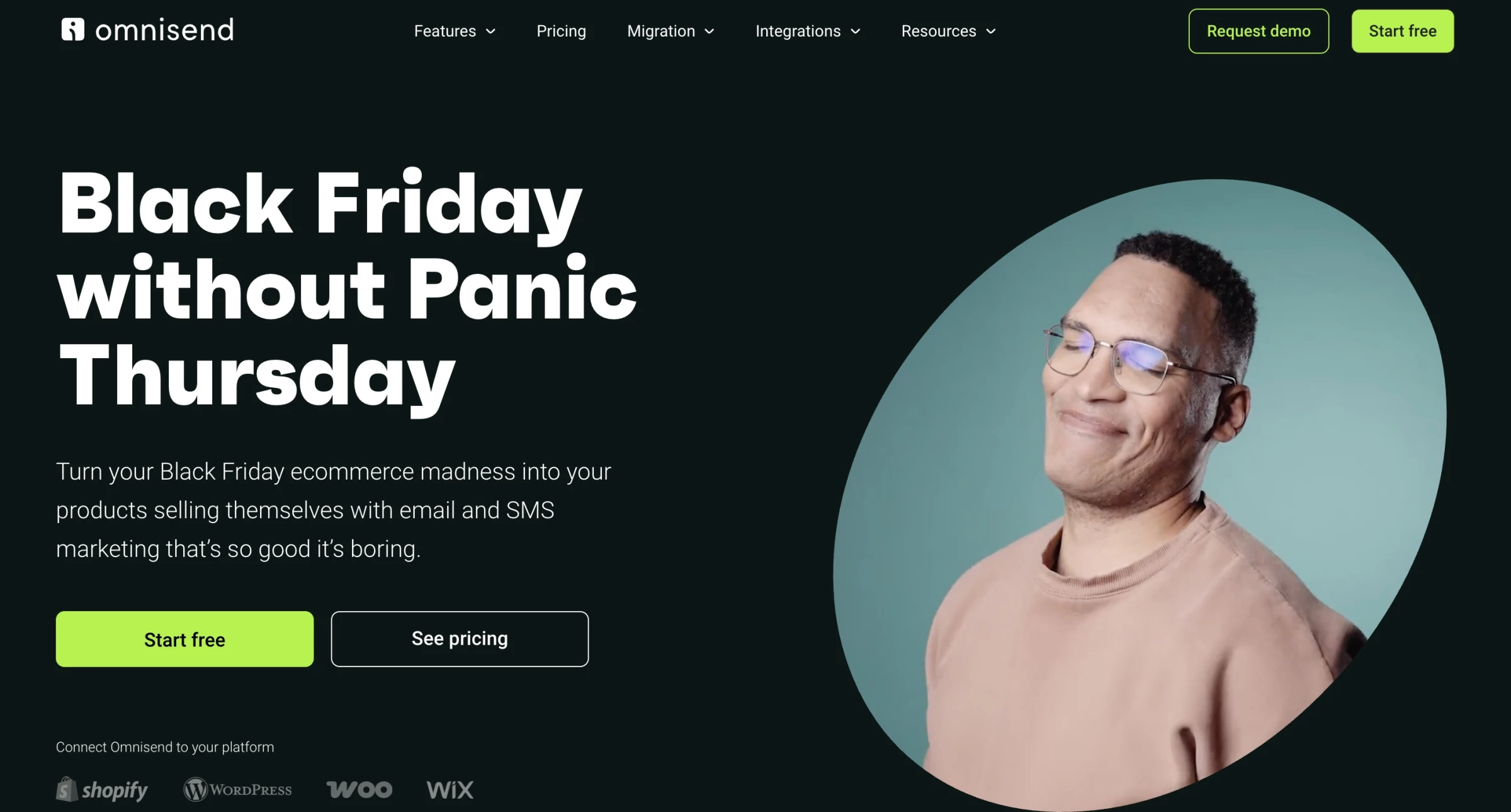
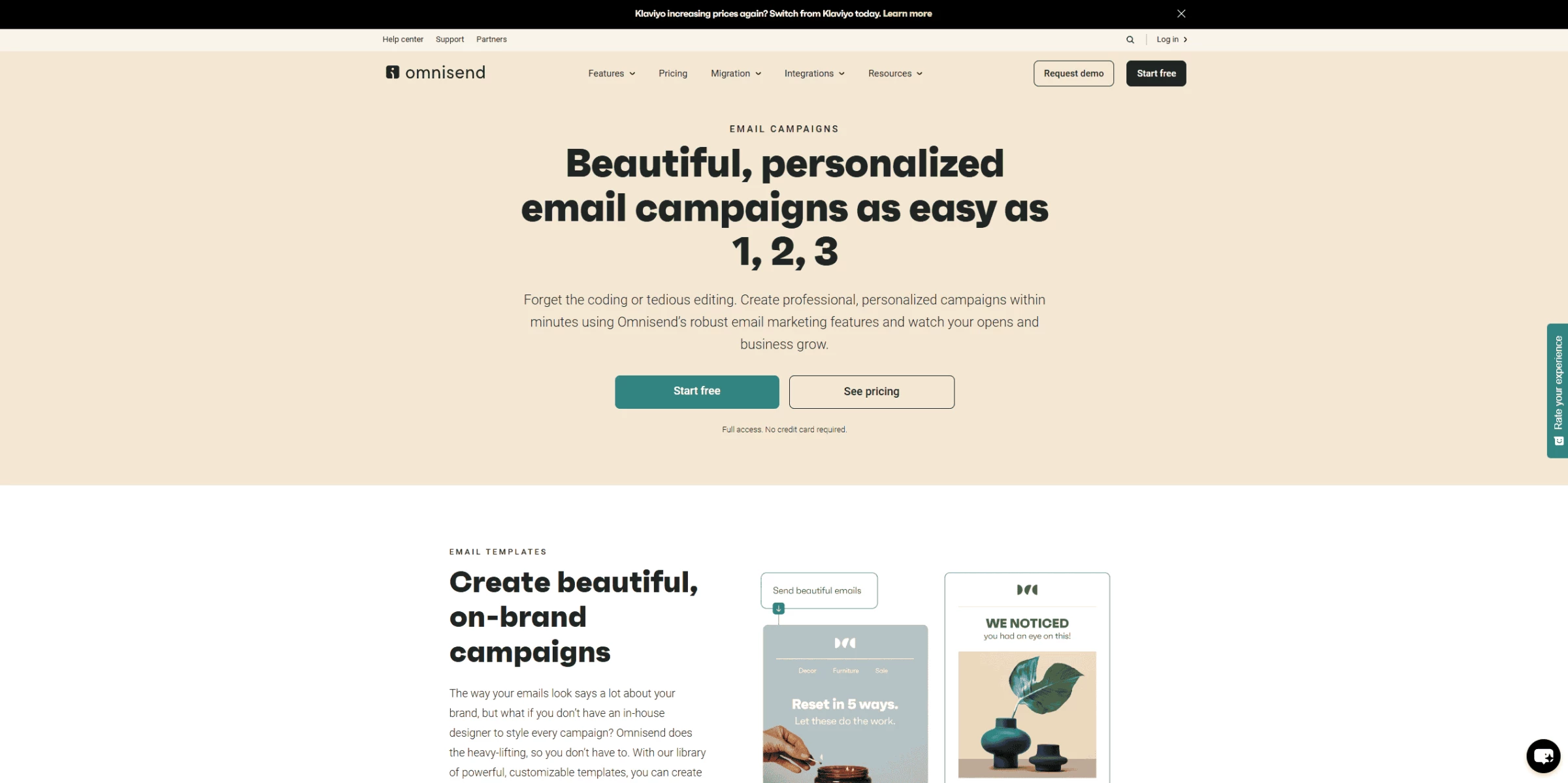
I’ve tried a lot of email marketing platforms, but Omnisend felt like it was built with online stores in mind from day one.
The platform combines email, SMS, and web push notifications in one place, eliminating the need to juggle different dashboards or log into multiple tools.
| Pros | Cons |
|
|
Using the drag-and-drop builder, I was able to create a shoppable email in minutes, complete with product blocks, discount codes, and a professional-looking layout, all without hiring a designer.
The AI templates guided me gently, suggesting optimizations and helping me structure campaigns.
What impressed me most was how quickly Omnisend let me iterate. I could A/B test subject lines, tweak messages, and see results almost immediately.
Integrations with Shopify, WooCommerce, and BigCommerce made the workflow seamless, and their support team was responsive when I had questions.
Of course, it’s not flawless. Some of the AI suggestions need refining. Also, more advanced marketers might notice limits in reporting and automation complexity.
For smaller or mid-sized online stores, Omnisend feels like an efficient marketing partner. It doesn’t replace creative input, but it speeds up campaign creation and helps you stay consistent across channels.
Pricing
- Standard: $11.20/month
- Pro: $41.30/month
Get started with Omnisend for free.
What Users Say
Omnisend is widely praised for its automation tools, multi-channel reach, and solid ROI.
Users especially like how easy it is to launch email and SMS campaigns, segment audiences, and manage sales workflows without getting bogged down in technical details.
Of course, it’s not perfect. Creating forms can be a bit tricky, and larger businesses might find the customization options a little limited compared to more advanced platforms.
Who’s It For?
Omnisend is perfect if you run an online store and want to make your marketing smarter without extra hassle.
It’s especially handy for small to mid-sized shops that want to reach customers and boost sales, all through simple, automated workflows.
Other Notable Features
- Up to 8 personalized product suggestions per email for upsells and cross-sells
- Easy-to-use drag-and-drop email builder
- Segmentation and scheduling tools for targeted campaigns
- Pre-built automation templates for quick deployment
2. ActiveCampaign: Best for Autonomous Customer Lifecycle Marketing
For teams managing full-funnel automation in marketing and sales
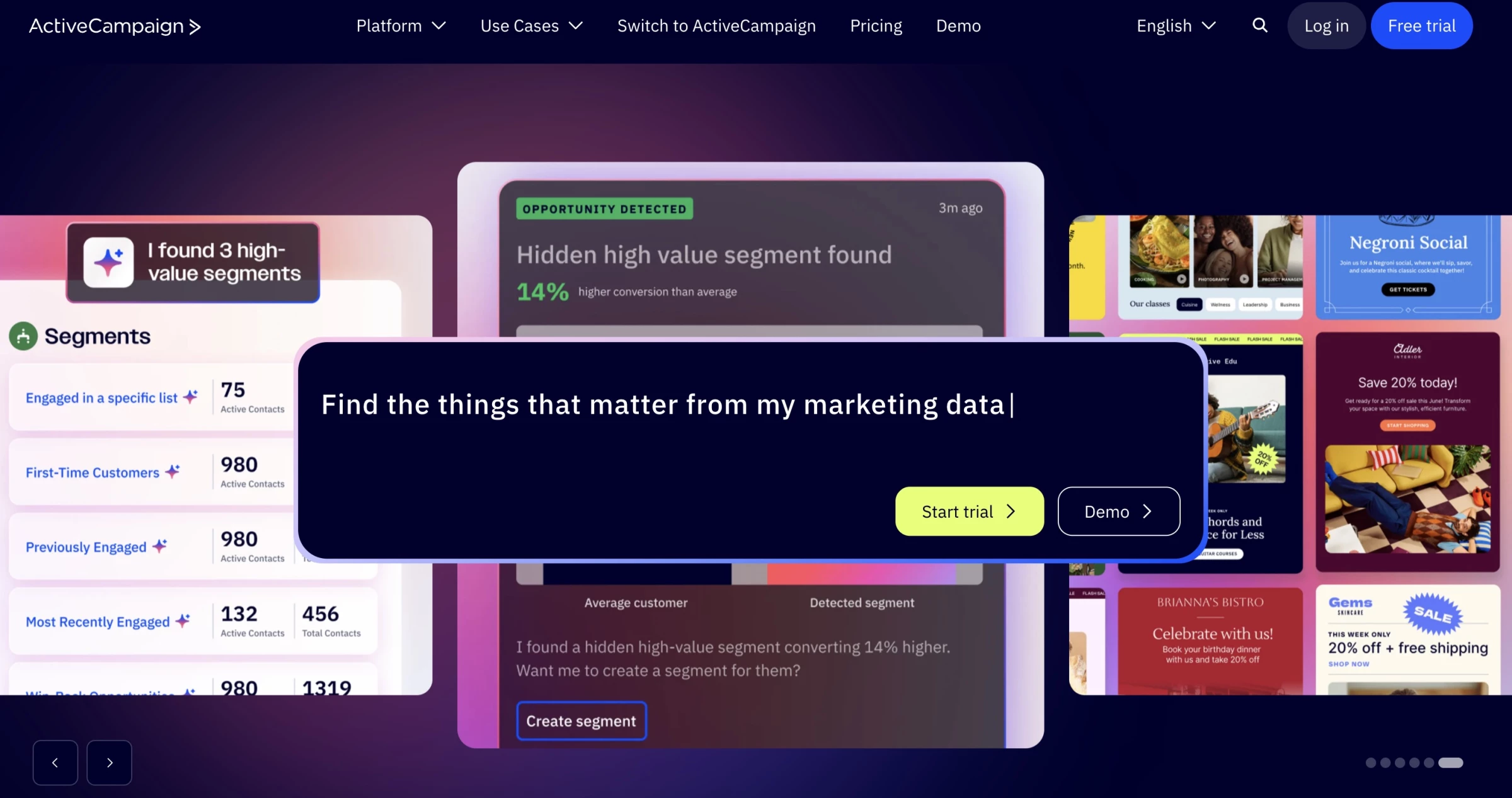
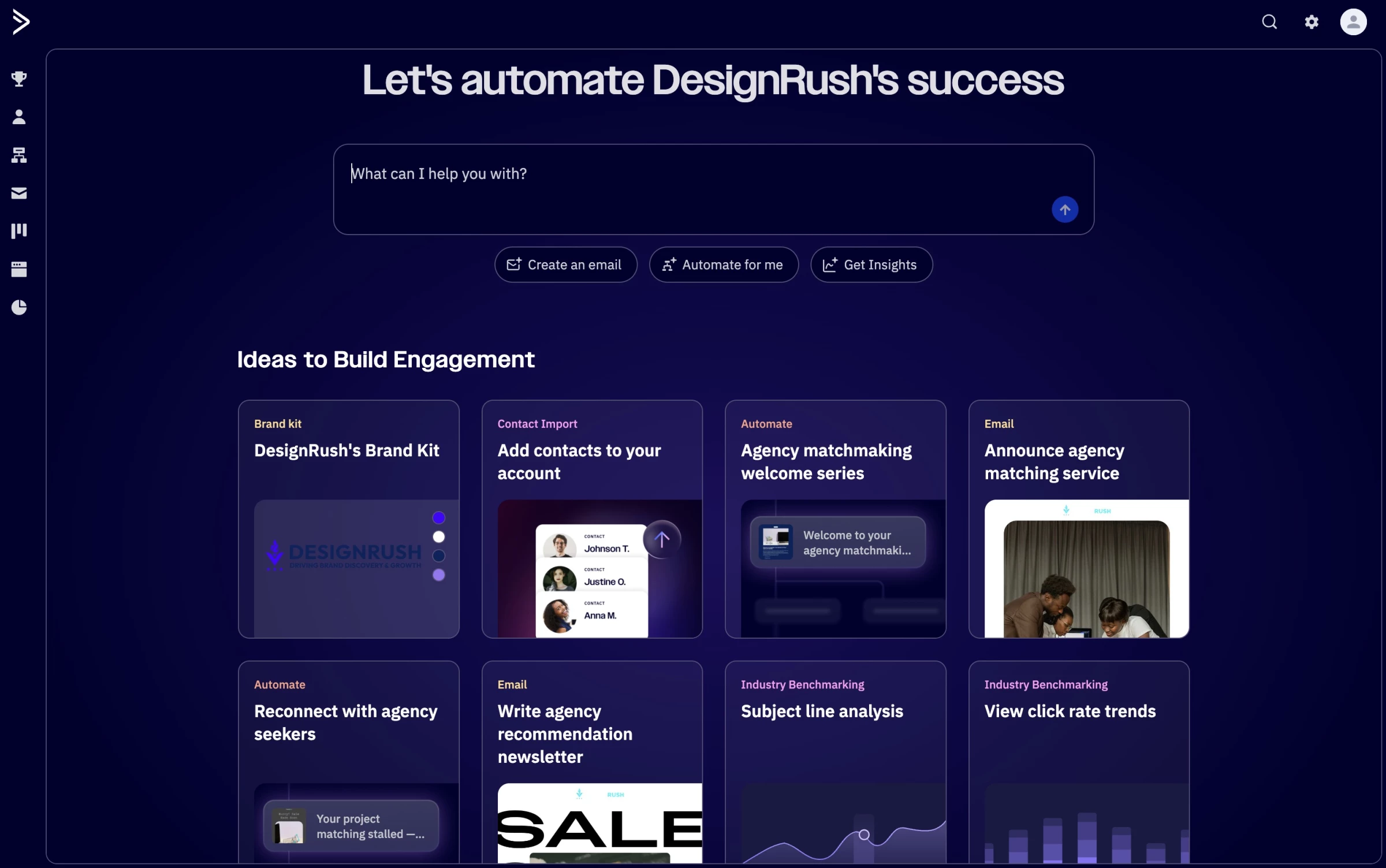
I've tested a lot of automation platforms, and most of them still rely on you to think through every branch, delay, and condition manually. ActiveCampaign felt different.
I didn't have to stitch together workflows step-by-step. Instead, I simply had to describe a goal like booking more demos or re-engaging cold leads, and ActiveCampaign's AI agents built the automation system for that outcome.
| Pros | Cons |
|
|
Everything was consolidated into one predictive system.
The Predictive Sending recalculates the best send time weekly for each contact, while AI-Suggested Segments surface high-value audiences I wouldn't have manually identified.
And because the CRM sits inside the same ecosystem, its win probability scoring highlights which deals deserve attention.
ActiveCampaign's AI impressively coordinated the full lifecycle for me, from first touch to closed deal.
I was also able to connect email, SMS, WhatsApp, CRM pipelines, and behavioral tracking under one layer. Meaning that if engagement patterns shift, the timing automatically adjusts.
If leads go cold, nurture flows adapt. If the deal probability drops, the system flags the next steps. It feels less like I'm running campaigns and more like simply managing a system that's continuously optimizing behind the scenes.
Jackie Palmer, ActiveCampaign's VP Product Marketing, puts it this way:
"In 2026, AI isn’t a ‘nice-to-have’ add-on for email marketers—it’s the baseline. Across our platform, we see teams reclaiming 13+ hours a week as AI agents handle the busywork of building, testing, and optimizing campaigns, while humans stay focused on strategy and storytelling.
The competitive edge now comes from how well you orchestrate AI across the full lifecycle, not whether you use it at all."
Pricing
- Starter: Starts at $15/month
- Plus: Starts at $49/month
- Pro: Starts at $79/month
- Enterprise: Starts at $145/month
Start your 14-day trial with ActiveCampaign.
What Users Say
Users consistently praise ActiveCampaign for its advanced automation.
They love how it allows them to automate almost every aspect of marketing and sales, from campaigns and ecommerce flows to contact management.
View this post on Instagram
They caution, however, that the platform's depth can make it challenging for beginners, and some have noted that rising costs make it hard to justify for smaller lists.
Still, many see ActiveCampaign as superior for email automation. It is widely respected for its power and flexibility, while pricing and the learning curve are the main drawbacks.
Who's It For?
ActiveCampaign is best suited for teams that manage full customer lifecycles and not just one-off campaigns.
It fits SaaS companies with multi-touch funnels, ecommerce brands moving beyond basic flows, and sales-driven teams that need marketing and CRM tightly aligned.
If you only need AI to write emails, this may be more than you need. But if you want AI to coordinate segmentation, timing, and follow-up across the entire journey, ActiveCampaign is built for that level of sophistication.
Other Notable Features
- AI Campaign Builder (turn prompts into full campaigns)
- AI Brand Kit (auto-import brand assets from your website)
- AI Actions Library for automation enhancements
- Integration with ChatGPT and Claude via the MCP server
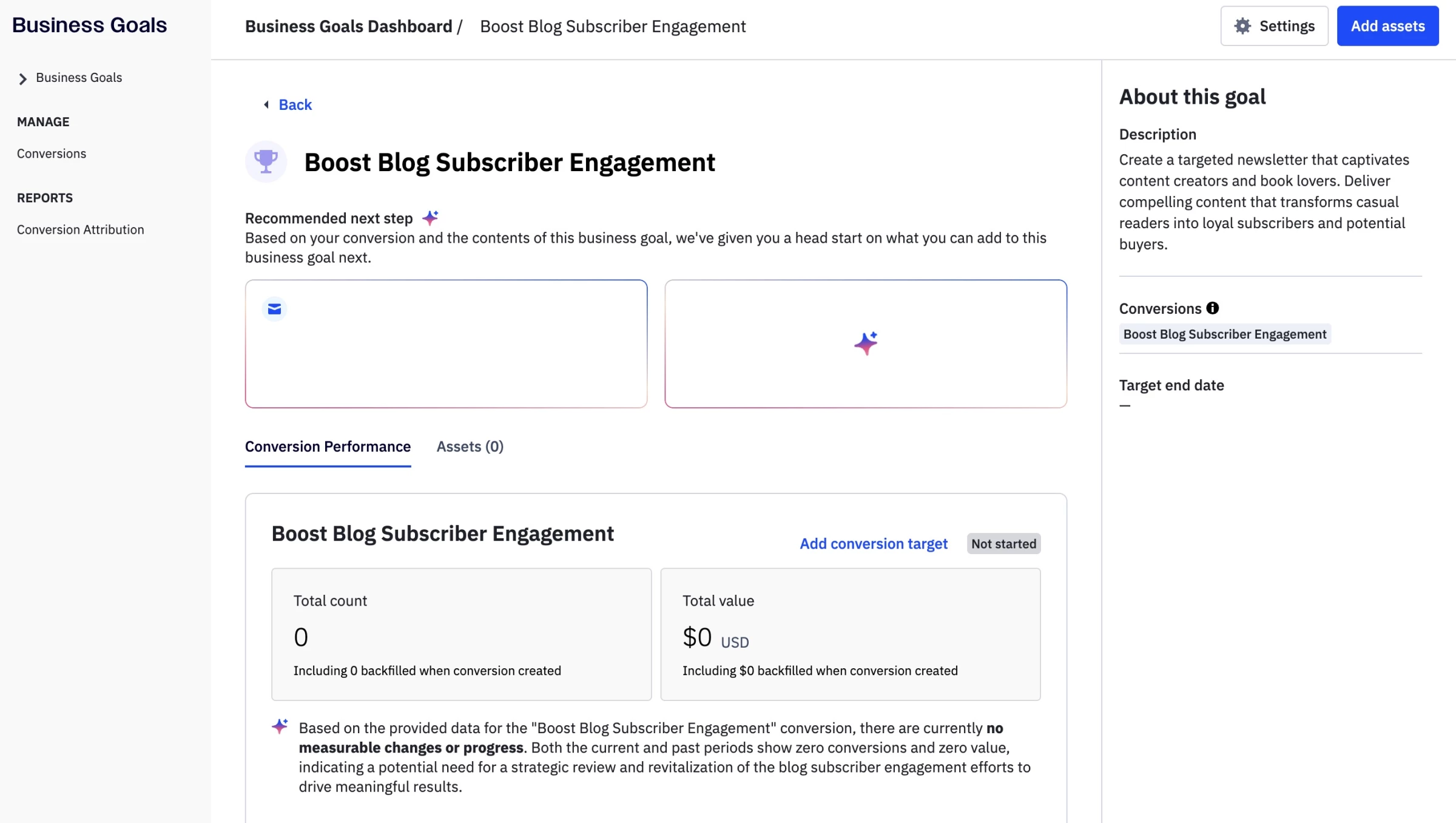
- Business Goals tracking with next-step recommendations
3. Descript: Best for All-in-One Video and Podcast Editor
For content teams producing video and audio without editing overhead
I’ve tried Descript for our marketing videos, and it has made editing much simpler for our team.
| Pros | Cons |
|
|
The best part is how it lets you edit video like a Google Doc. You don’t need to figure out and manually edit timelines. Instead, you just delete, insert, or rearrange words in the transcript, and the video updates automatically.
For someone without professional video editing background, this makes trimming webinars, product demos, or training videos faster, more precise, and far less intimidating.
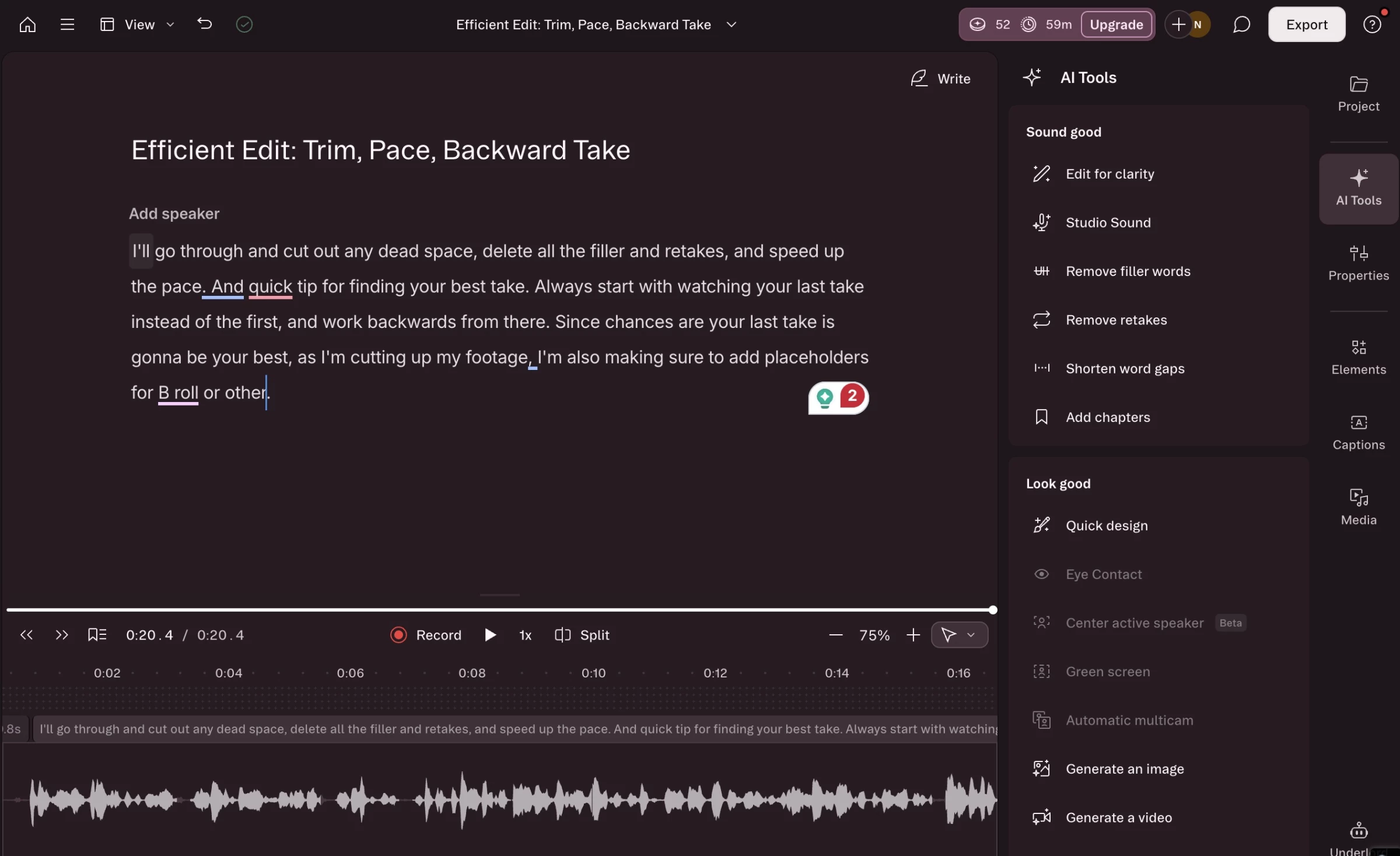
Recording is straightforward, too. Descript combines screen and webcam capture into a single tool, which is useful for product walkthroughs, feature demos, or educational content.
For example, I can record a 10-minute demo, clean up my speech using Descript’s AI tools, and have a polished video ready in under an hour.
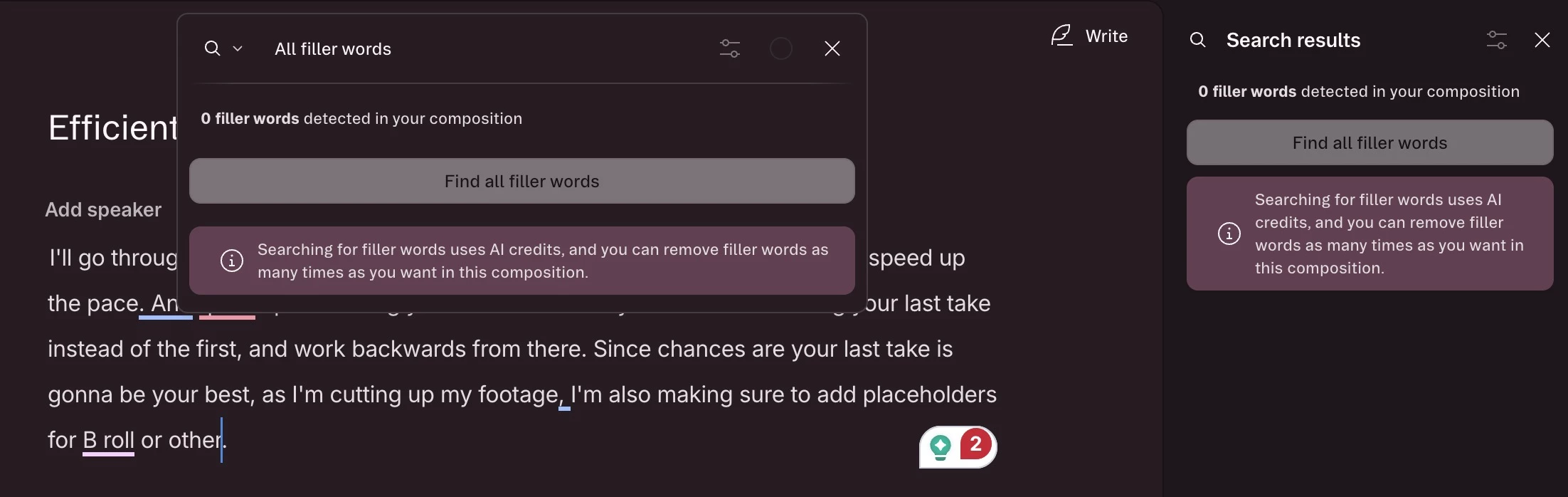
Descript’s AI features are genuinely useful. They save time on tedious tasks like cleaning up filler words, improving audio, or adding captions.
Filler Word Removal automatically trims “ums,” “uhs,” and other non-essential words, while Overdub lets you fix mistakes or add narration without having to re-record.
I’ve found these tools amazing for cutting down the back-and-forth and manual cleanup that usually slows video production.
I love how Descript makes collaboration and feedback easy with shareable links, collaborator commenting, and versioning that keeps track of changes so nothing gets lost.
With Descript, you don’t need multiple tools to go from idea to published video. You still get polished, professional videos faster, with less tool-switching and minimal reliance on external editors.
Pricing
- Free plan with limited recording and exports
- Hobbyist: $16/person/month (billed annually)
- Creator: $24/person/month (billed annually)
- Business: $50/person/month (billed annually)
- Enterprise: Custom pricing
Get started with Descript for free.
What Users Say
People love how Descript makes podcast and video editing so much simpler. The text-based workflow makes it easy to cut filler words, rearrange segments, and polish recordings without fuss.
Many find it a huge time-saver for cutting, arranging, and creating social clips.
At the same time, some users do run into glitches, slow performance, and a learning curve, particularly with video or large projects.
Still, for many creators, especially small teams or solo podcasters, Descript is a handy all-in-one tool that keeps editing fast and manageable.
Who’s It For?
Descript is designed for marketers and creators. Product marketing managers, content marketing managers, developer advocates, and technical marketers will find it especially useful.
Built for modern content teams, it empowers resource-constrained teams to produce high-quality videos quickly and efficiently, without needing professional editing experience.
Other Notable Features:
- Short-form clip creation to repurpose content for social
- Multi-track audio and video editing
- Templates for demos and webinars for fast styling
- AI tools like filler word removal, Studio Sound, Overdub, auto captions
4. Brandi AI: Best for AI Search Visibility & GEO Strategy
For SEO and content leaders tracking visibility in AI search
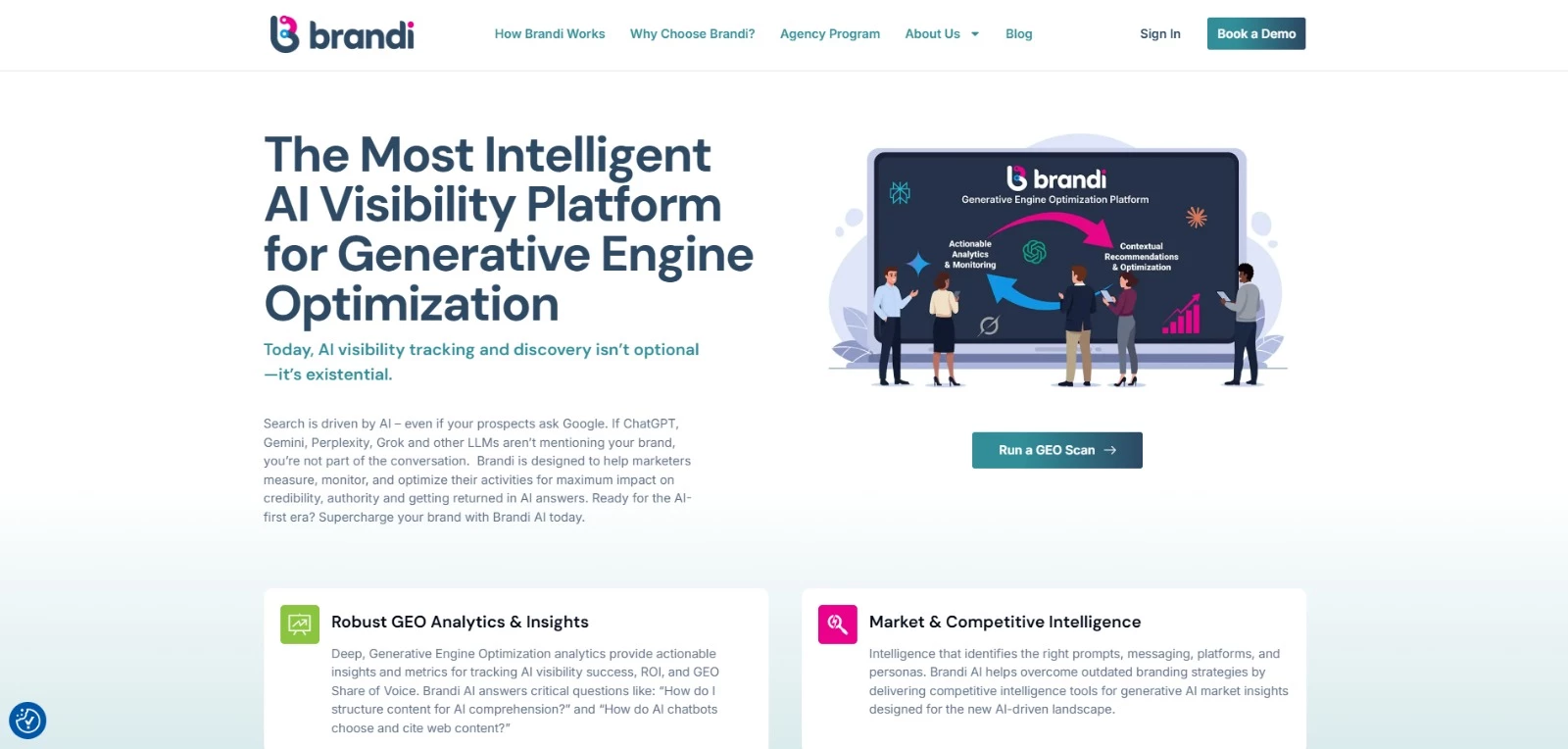
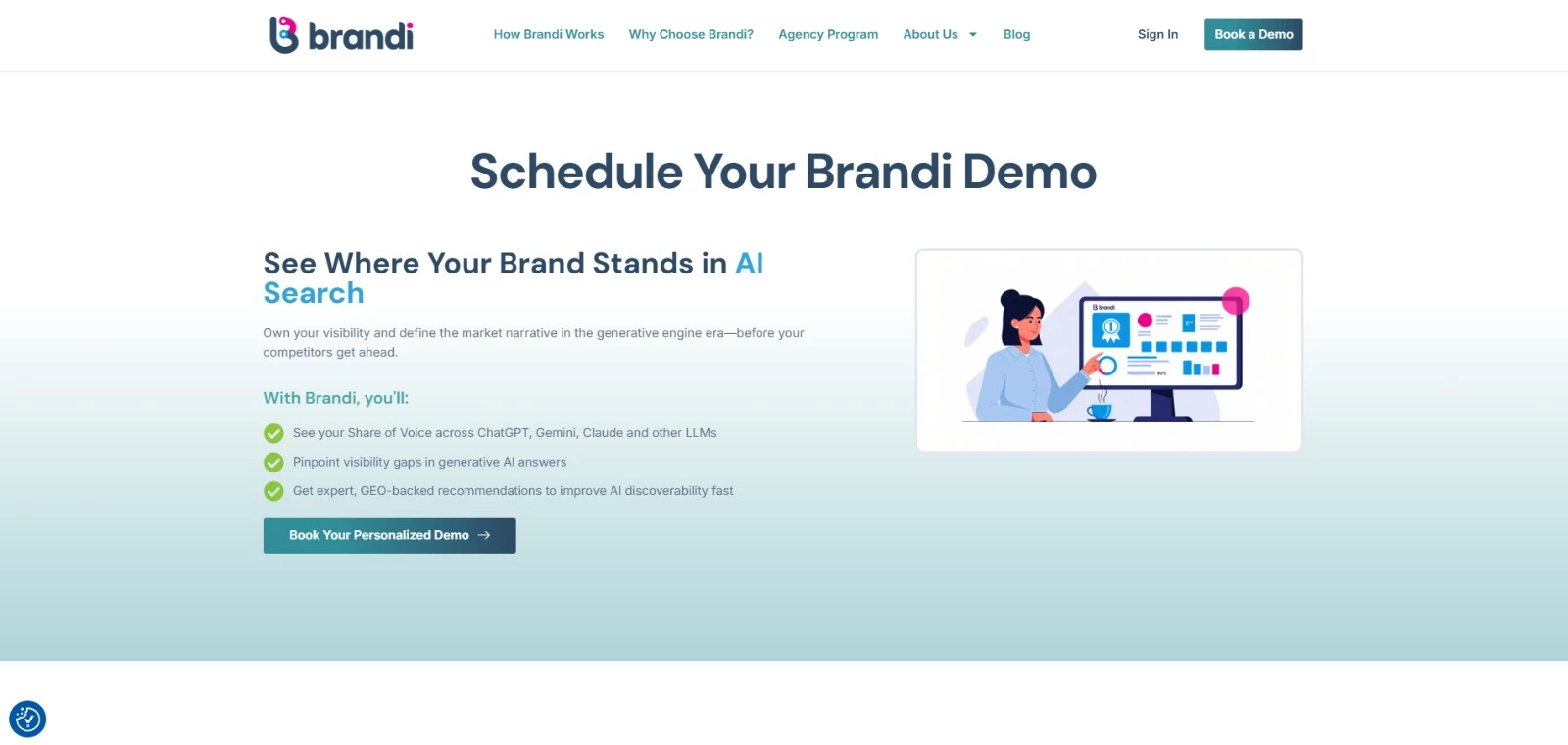
Brandi AI focuses on a problem most marketers are only starting to notice, which is your brand’s visibility inside AI-generated answers.
Brandi shows how your brand appears in tools like ChatGPT, Google AI Overviews, Gemini, and Perplexity. It finds the actual questions buyers ask AI and reveals whether your brand is cited, how often, and in what context.
What stood out to me is how it connects visibility to action. It identifies the prompts driving competitor visibility and guides you on restructuring content so it becomes AI-readable and more likely to be cited.
This moves content strategy away from keyword targeting toward answering real buyer questions in a format AI systems can extract and reference.
For global teams, the platform provides an extra layer of visibility into AI across languages and regions, helping you understand how they appear in different markets.
| Pros | Cons |
|
|
Pricing
- Custom (inquire for demo)
Get started with Brandi AI by booking a demo tailored to your team.
What Users Say
Brandi AI is often described as intuitive to navigate, with clear visibility into how brands appear in AI-generated answers. Features like the prompt hub and optimization tools make it easier to track performance, spot gaps, and adjust content to improve citation rates.
Users also mention the pace of product updates and a responsive team that actively incorporates feedback.
On the flip side, the amount of data can take time to get used to, and maintaining prompt coverage requires ongoing input.
Who’s It For?
Brandi AI is built for CMOs, SEO leaders, and content teams focused on maintaining visibility as discovery expands to AI platforms.
Other Notable Features
- AI discovery intelligence layer
- Competitive AI visibility benchmarking
- Prompt-level content optimization insights
5. Pixis: Best for AI Media Buying and Campaign Optimization
For performance marketers scaling paid campaigns with AI optimization
Running paid campaigns always felt like trial and error taken to the extreme until I tested Pixis.
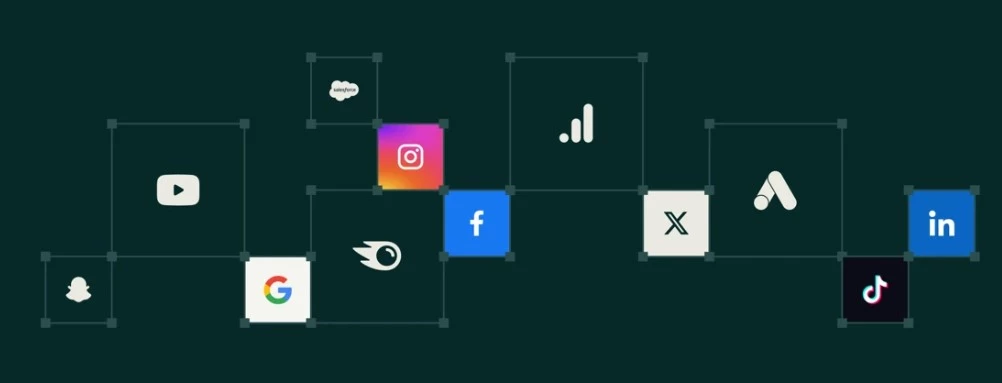
I connected it to both my Meta and Google Ads accounts, and almost immediately, it began working behind the scenes like a smart media buyer.
| Pros | Cons |
|
|
Within days, it started reallocating budget across ad sets, automatically testing creatives, and refining audience targeting based on live performance data.
What surprised me most was that the overall results improved while my budget remained unchanged. It was like plugging in an invisible campaign manager who doesn’t sleep and never misses a beat.
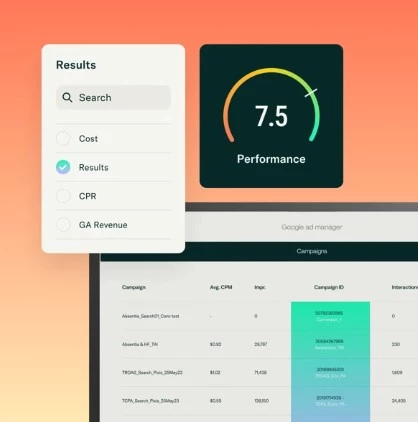
Pixis uses predictive AI models that continuously analyze what’s working and what's not. It efficiently scales marketing campaigns.
I could see performance lift even in underperforming segments because the system quickly caught and corrected issues in real time.
This AI digital marketing tool may not be built for beginners. You need active campaigns and a decent ad volume for the AI to learn from.
When I started from scratch, the insights were limited, but once it had historical data to work with, it really hit its stride.
Pricing
- Pricing is available upon inquiry or demo request
What Users Say
While the results were strong, Pixis can sometimes feel like a black box, i.e., you don’t always know why it made certain decisions unless you dig deep.
However, when set up correctly, Pixis genuinely felt like a predictive, algorithmic partner that fine-tuned campaigns with impressive speed.
Who’s It For?
Pixis is a strategic tool for high-leverage accounts.
Hence, mid to large-scale growth marketing agencies can benefit greatly from it, particularly those spending $10,000 or more in monthly paid media and needing to scale without constantly babysitting every detail.
Other Notable Features
- Predictive AI optimization engine
- Autonomous budget reallocation and budget pacing controls
- Real-time targeting refinement
- Cross-platform ad management
- Automatic A/B testing
Mo Sabri, Co-Founder & COO at Trust Outsourcing Solutions, highlights how integrating AI with your existing systems is critical:
"By using APIs and integration platforms to make sure there is a solid connection established with your primary data storage, instead of using AI tools as stand alone apps, you can also set up a monitoring system to govern access control so things don't get out of hand.
A well trained admin with basic understanding of data filtering and data analysis can cover this for you if you have the right system set up."
6. Prescient AI: Best for Predictive Marketing Attribution
For growth teams needing accurate multi-channel attribution insights
Prescient AI wasn’t on my radar until I hit a wall trying to understand where my conversions were coming from.
Standard attribution models like last-click or platform-specific reports from Meta and Google weren’t telling the full story. This especially applies to longer customer journeys that cover multiple touchpoints.
| Pros | Cons |
|
|
When I tested Prescient AI, it felt like someone finally turned the lights on.
The AI digital marketing tool uses machine learning (ML) to predict and map multi-touch attribution to show how different channels contribute to conversion outcomes over time, not just at the point of sale.
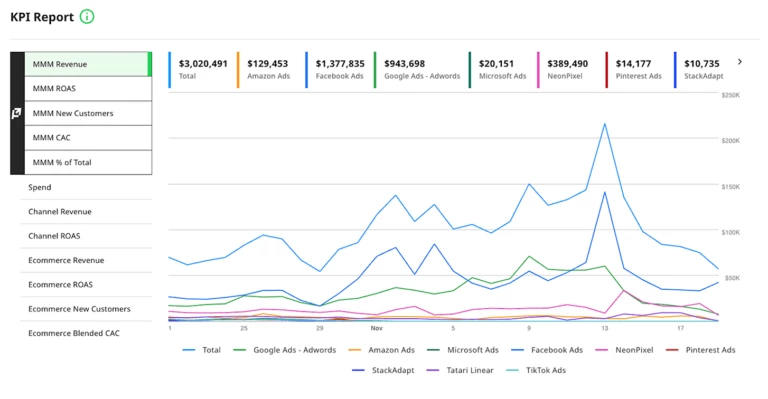
One of the most valuable things I got out of it was the ability to reassign the budget more strategically.
Through Prescient, I discovered that TikTok, a platform I had almost written off, was quietly driving high-intent traffic for my eCommerce campaign.
That insight alone helped justify a shift in spend that eventually improved ROAS across the board.
Pricing
- Pricing is available upon inquiry or demo request
What Users Say
Prescient AI's system continuously learns, so the more historical data it has, the more accurate and actionable its predictions become.
It’s not flashy, and it doesn’t overwhelm with dashboards. It simply gives strategic clarity, whereas other tools give vague attribution percentages.
Who's It For?
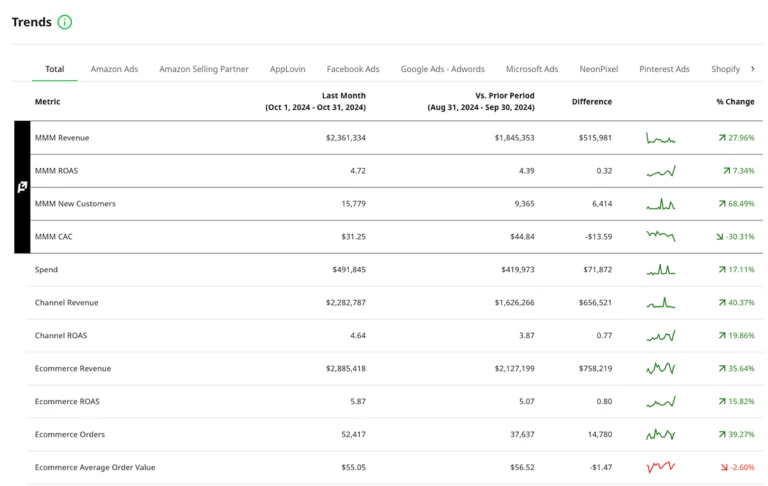
Prescient AI can deliver the most value to growth strategists, performance marketers, or media planners working across fragmented channels and high-ticket or long-cycle funnels.
If you're tired of your budget being dictated by last-click logic or inconsistent platform metrics, this AI digital marketing tool gives you the full picture.
Other Notable Features
- Predictive attribution modeling
- Halo effects attribution
- Multi-touch journey mapping
- Channel contribution analysis
- Budget allocation insights via forecast from historical performance
7. Narrato :Best for AI-Powered Content Workflows
For teams managing high-volume content production and workflows
Narrato quickly proved to be a powerful content engine for managing multiple channels, from blogs and newsletters to LinkedIn posts and email sequences.
This AI digital marketing tool stands out because it blends content ideation, AI writing, collaboration, and publishing into one seamless interface.
| Pros | Cons |
|
|
Instead of manually tracking content progress in Google Sheets, Narrato consolidates everything, acting almost like a project manager for my content.
I’ve found it incredibly useful for creating briefs, assigning tasks, auto-generating drafts, and tracking SEO and deadlines in one place.
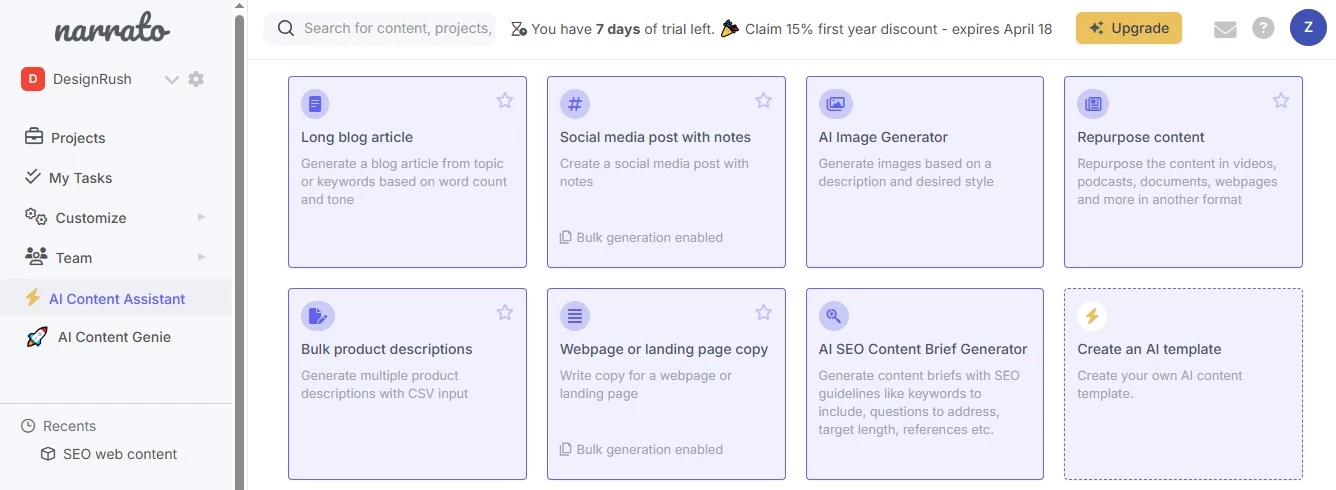
Narrato outlines blog content by logically grouping subtopics under broader themes. Rather than listing random ideas, it builds a clear narrative flow.
It defines AI’s role in marketing, then proceeds to showcase tools and ground everything in real-world use.
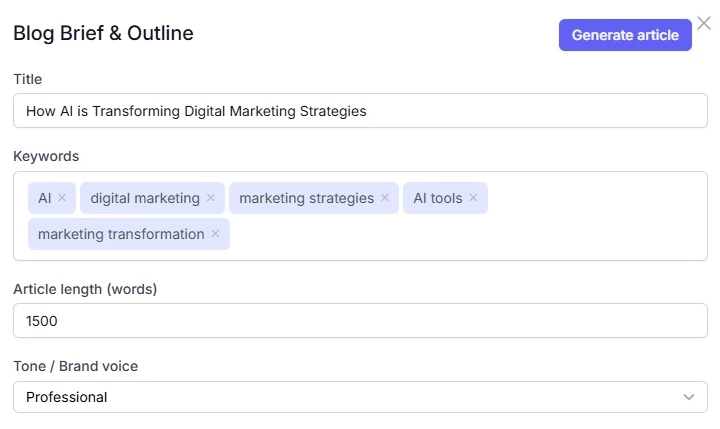
I’ve scaled content production without sacrificing quality or sanity. It understands my writing style, tone, and structure, which makes drafting much faster.
The time-saving templates have been a huge bonus, as they allow me to effortlessly onboard writers or clients.
Plus, the workflow automation with drag-and-drop boards makes task management feel seamless.
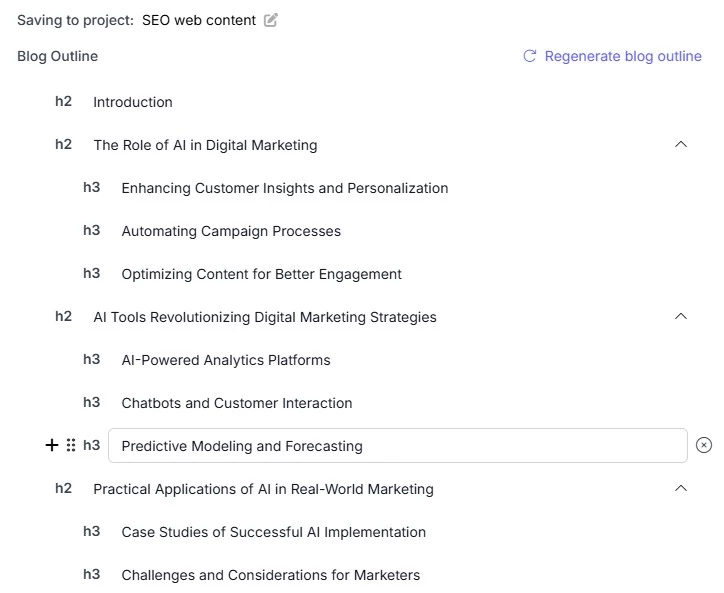
Each H2 introduces a stage in the reader’s learning journey, while H3s break it down into digestible, actionable points.
More than a structure, it’s a strategy. Narrato anticipates user intent and search behavior, guiding content optimized for clarity and engagement.
Pricing
- Pro: $36/month (annually)
- Business: $96/month (annually)
- Customizable enterprise plan: Inquire
What Users Say
View this post on Instagram
For all its capabilities, the interface can feel a bit cluttered when handling larger projects, and the limited formatting options seem quite restrictive for more design-heavy content.
Still, it’s an absolute game-changer in streamlining content operations.
Who’s It For?
I'd suggest Narrato to editorial leads, marketing agencies, and startups that need to maintain a consistent tone and SEO structure from various contributors.
It certainly has saved me hours of manual coordination and oversight when managing blogs, newsletters, or multilingual campaigns on different platforms.
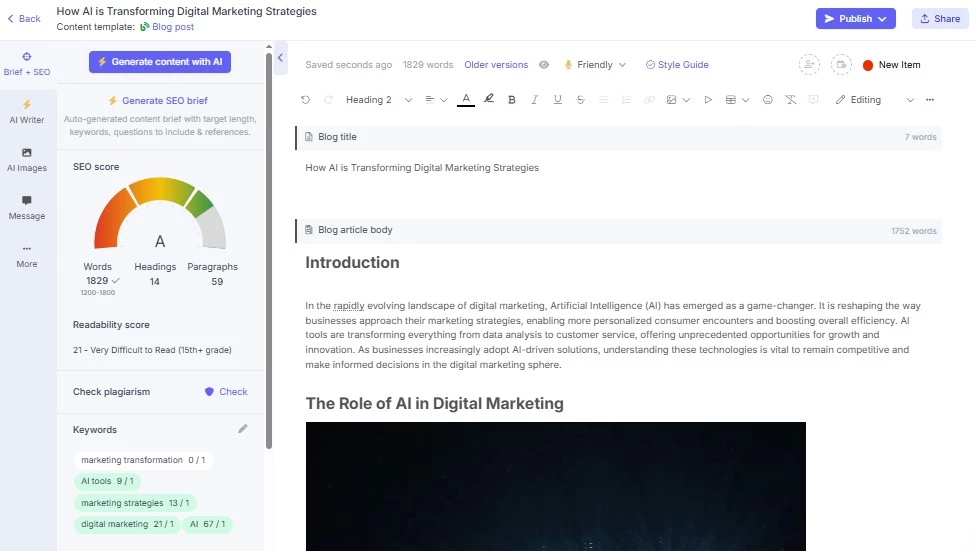
Narrato optimizes digital marketing content using AI-assisted SEO scoring.
The scorecard evaluates content based on keyword usage, heading structure, and paragraph count.
With a strong "A" grade and keyword performance indicators (e.g., “AI tools” used 9 times), users can instantly see how well their article aligns with SEO best practices.
These contextual scoring guides revisions and lets marketers identify optimization gaps and fine-tune their content for better discoverability.
Other Notable Features
- Real-time content tracking
- Content calendar integration
- Performance analytics dashboard
- Customizable templates
- Content approval system
8. Socialfaim: Best for AI-Driven Influencer Marketing
For brands running data-driven influencer campaigns
I went onto Socialfaim expecting another influencer search tool but found something more sophisticated.
Everything I needed, from search filters to campaign forecasting, was right where I expected it to be in a very intuitive interface.
| Pros | Cons |
|
|
I could filter influencers and content creators across platforms by follower count, gender, category, and other parameters.
Socialfaim was finding niche influencers with real, active audiences that matched my campaign goals. The profiles themselves were also incredibly detailed.
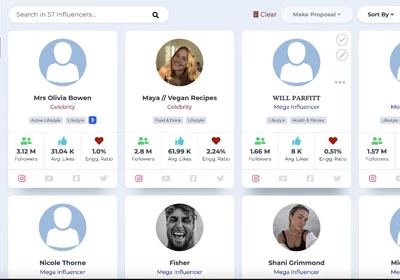
Instead of vague metrics, I saw predictive engagement rates, audience authenticity scores, follower growth patterns, and even a breakdown of age demographics.
That level of detail made it much easier to make smart, data-informed decisions.
Pricing
- Pricing is available upon inquiry
What Users Say
Socialfaim's predictive analytics estimated impressions, reach, views, and engagement per post based on past data and current trends.
These weren’t just vanity forecasts; they aligned shockingly well with the actual campaign outcomes.
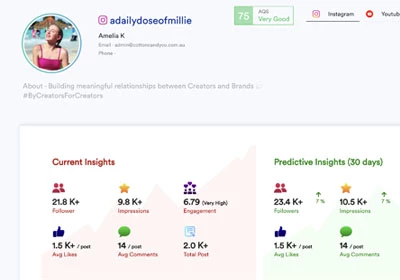
The dynamic pricing engine, which uses ML to suggest influencer rates based on performance history, made negotiating more efficient. Socialfaim backed its recommendations with hard data.
Who's It For?
Socialfaim is ideal for performance-driven marketers and agencies that want to take influencer marketing beyond gut feel and vanity metrics.
It makes every part of the process, i.e., search, selection, and prediction, smarter and faster.
Other Notable Features
- Predictive campaign analytics
- Audience authenticity analysis
- Platform-wide search filters (followers, gender, niche)
- Cross-platform influencer database (TikTok, Instagram, etc.)
- ML cost estimation per campaign
9. Syllaby: Best for AI-Based Multichannel Video Marketing
For lean marketing teams creating video content without an in-house studio
When I first opened Syllaby, I wasn’t expecting the interface to be this clean and approachable.
I have used AI digital marketing tools that feel either too stripped down or overwhelmingly complex, but this one struck the right balance.
| Pros | Cons |
|
|
I could jump into scriptwriting almost immediately, and the AI did a solid job of generating content tailored to the specific audiences I defined.
It used insights to shape the copy and its messaging for different customer journey stages.
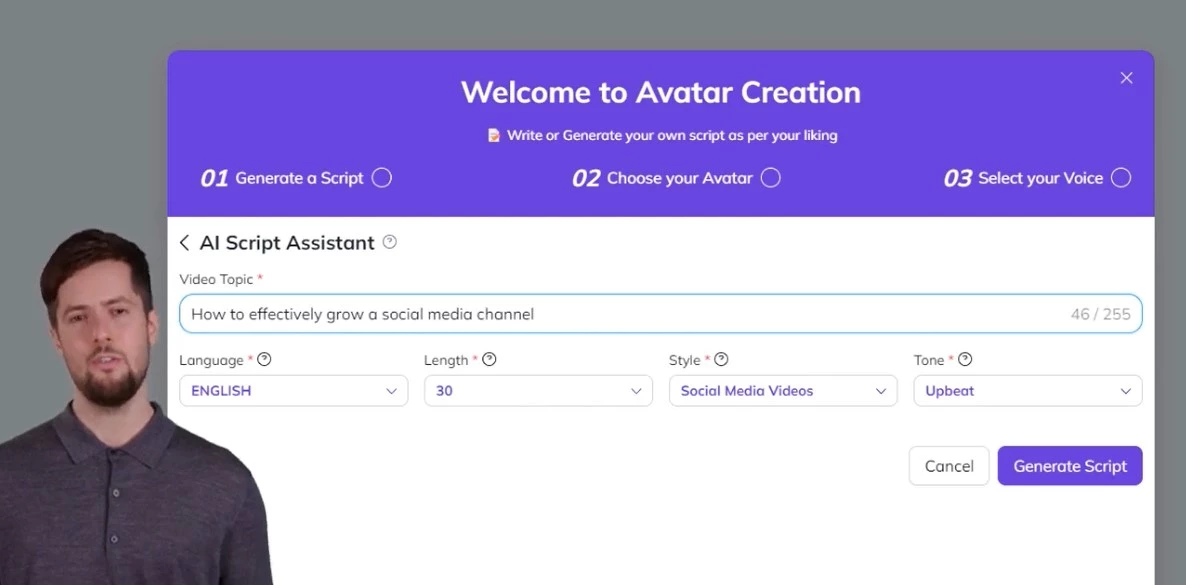
The video creation flow is where Syllaby started to feel like more than just a writing assistant. With features like voice cloning and AI avatars, I could produce full videos without stepping in front of the camera.
That alone made it easy to push content across email, socials, and landing pages, minus bottlenecking the creative process.
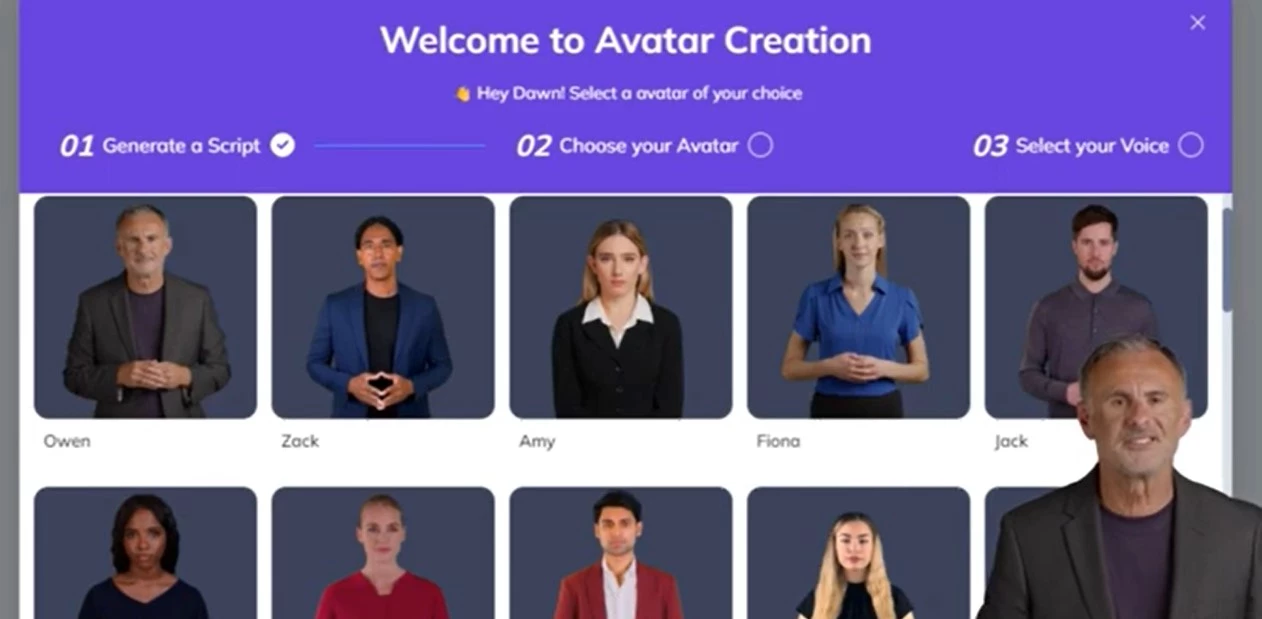
It’s also one of the few tools I’ve used that integrates interactive elements into videos, like calls-to-action (CTAs) and quizzes, to boost engagement and viewer retention.
Pricing
- Basic: $24.67/month (annually)
- Standard: $66.33/month (annually)
- Premium: $130.08/month (annually)
- Enterprise: Custom; inquire
What Users Say
Syllaby is valuable when faced with limited resources to produce professional-quality videos. It does not require extensive video editing experience, which is a big plus.
However, Sabri also emphasizes the limits of AI:
"While AI can do an amazing job at qualifying leads and lead screening, it cannot yet replace the human element of closing a sale or performing a live demo on a feature or service [...]"
Who's It For?
Syllaby is an excellent choice for small to mid-sized marketing teams looking to streamline content production without needing a full in-house studio.
It could also benefit online educators, especially those using avatars to teach without appearing on camera.
Other Notable Features
- SEO optimization for video titles, tags, and descriptions
- Cloud-based video storage
- Campaign performance analytics
- AI-powered video editing
- Persona-based content recommendations
10. Rekla AI: Best for Automated Multi-Platform Ads
For small teams launching multi-platform ads without manual setup
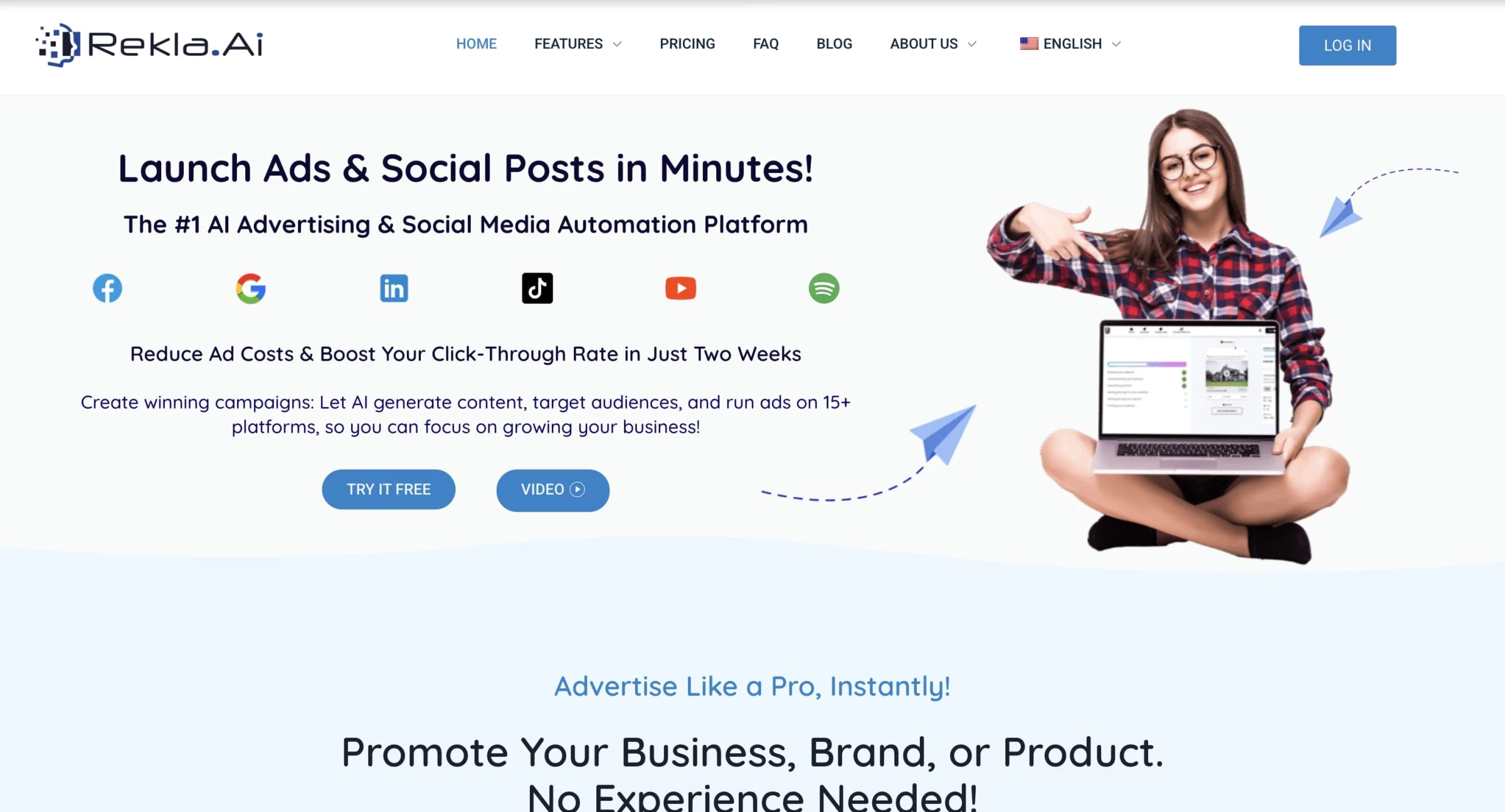
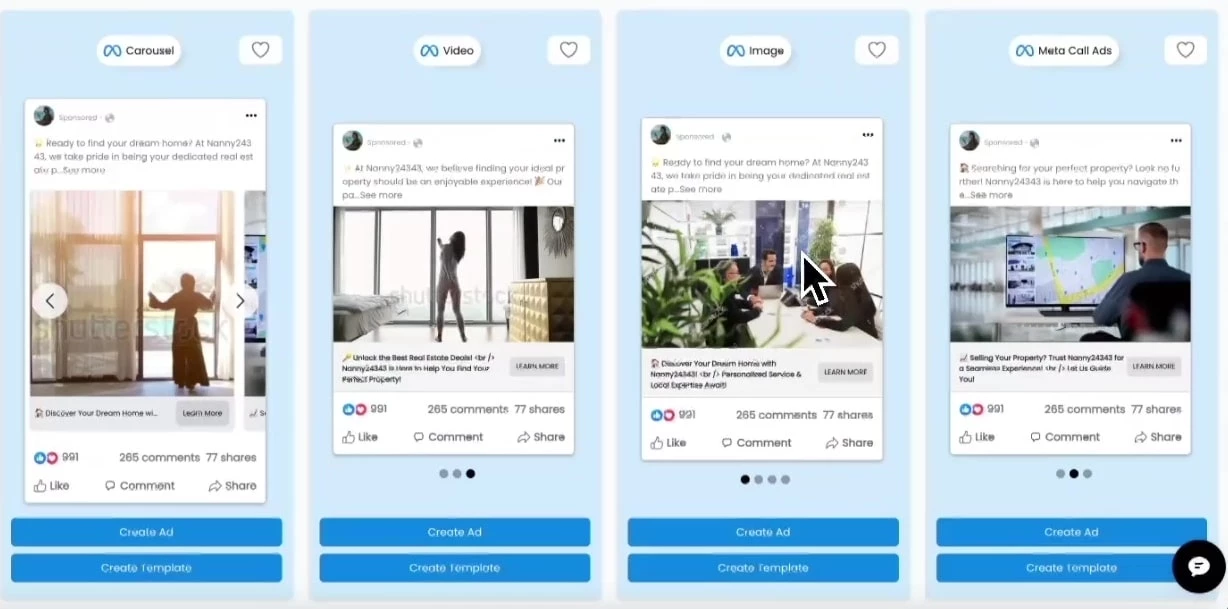
Rekla.Ai aims to automate digital advertising across platforms like Meta, Google, TikTok, LinkedIn, and more. I used it for a small ad campaign targeting a niche audience in tech consulting.
| Pros | Cons |
|
|
Setup was genuinely easy. The platform walked me through ad generation, targeting, and publishing in one flow.
It generated image and video creatives using AI and gave suggestions for headlines and CTAs. I appreciated that I could edit these suggestions before publishing.
The multi-platform launch was quick, and Rekla’s “SpendGuard” feature did help control budget drift by throttling spend on underperformers.
That said, Rekla.Ai isn’t perfect and not for everyone. One of the most common criticisms, which I personally encountered, is that the creative quality from the AI can be hit or miss.
Another issue is the lack of deep customization. If you want to tweak individual platform settings, audience exclusions, or placement controls, Rekla doesn’t provide that kind of granularity.
Rekla.Ai works best for startups, eCommerce stores, and service providers who don’t have in-house marketers or the time to learn every ad platform’s quirks.
Pricing
- Starter: $87 monthly
- Booster: $187 monthly
- Pro: $497 monthly
What Users Say
Early users mention how Rekla.Ai simplifies campaign setup. Teams without deep marketing experience also say they were able to launch ads quickly, generate multiple creative variations, and start seeing results within days.
That said, feedback is still limited compared to more established platforms, so long-term performance is less documented.
Who’s It For?
Rekla.Ai is best suited for startups, small businesses, and lean teams that want to run multi-platform ad campaigns without managing each channel manually.
It’s a good fit if you don’t have a dedicated performance marketer and need a tool that handles setup, creative generation, and optimization in a single workflow.
Other Notable Features
- SpendGuard budget optimization to control underperforming ads
- Multi-platform campaign deployment across 15+ channels
- AI-generated ad designs with editable variations
- “Optimize for me” mode for automated performance improvements
- Built-in targeting recommendations based on campaign goals
Final Thoughts on AI Tools for Digital Marketing
AI marketing tools are rapidly becoming part of everyday marketing workflows, helping teams generate content faster, analyze performance data, and automate repetitive tasks.
If you’re looking to combine AI capabilities with expert campaign planning and execution, working with experienced digital marketing agencies can help you get more value from these technologies.

Our team ranks agencies worldwide to help you find a qualified partner. Visit our Agency Directory for the top digital marketing agencies, as well as:
- Top Digital Marketing Agencies in Pittsburgh
- Top AI Companies
- Top SEO Agencies
- Top Social Media Marketing Agencies
- Top Content Marketing Agencies
- Top Video Marketing Agencies
AI Digital Marketing Tool FAQs
1. How is AI used in digital marketing?
AI is used in digital marketing to personalize ads, analyze customer data, automate tasks like email marketing, create content, and improve targeting to reach the right audience more effectively.
2. How can AI personalize digital marketing campaigns?
AI personalizes digital marketing campaigns by analyzing customer behavior, preferences, and purchase history to deliver tailored content, product recommendations, and targeted ads that match customers’ interests.
3. Can AI digital marketing tools help create better content?
Yes, AI digital marketing tools can help create better content by taking the guesswork out of the task.
These platforms help you find the right topics based on search trends, generate outlines, suggest keywords, and even draft content that matches your brand voice.
They speed up the process and keep things consistent, especially across large campaigns.
4. How do you measure performance beyond clicks and conversions with AI tools?
AI marketing platforms now go beyond typical metrics like clicks and conversions by analyzing full customer journeys, attribution channels, and predicting outcomes.
Tools like Prescient AI model how each touchpoint contributes to revenue, while newer tools track how brands appear in AI-generated answers, adding a visibility layer that isn’t captured in standard analytics.
This helps teams understand what influences discovery and decision-making earlier in the funnel.
5. What’s the difference between SEO and AI visibility (GEO)?
SEO focuses on ranking in search engine results, while AI visibility, often called Generative Engine Optimization (GEO), focuses on being cited in AI-generated answers.
Instead of optimizing for keywords alone, GEO prioritizes structuring content around real user questions, clear entities, and authoritative information that AI systems can extract and reference.
As more users rely on tools like ChatGPT or Google AI Overviews for research, visibility in these answers is becoming a separate and increasingly important channel.