
In 2026, modern auto advertising has to meet buyers where they already are: online, informed, and often close to a decision.
If you’re not influencing that journey early, you’re probably not influencing it at all. Here’s what actually works, from hyper-local SEO to Connected TV and first-party data.
Automotive Advertising Ideas: Key Findings
- Focus on local SEO first. 90% of buyers purchase within 50 miles, so optimize your Google Business Profile and local pages before scaling ads.
- Build search campaigns around intent. Top automotive ads hit 6-8% CTR vs. ~3.17% average, proving specificity wins.
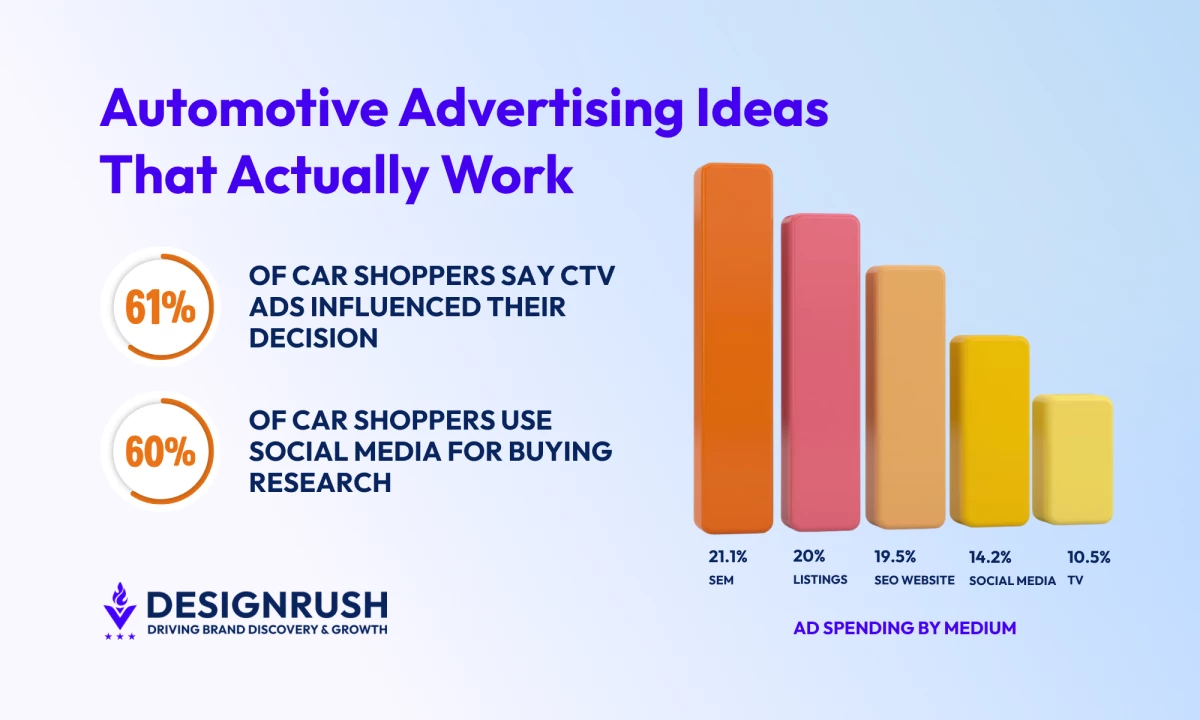
- Invest in Connected TV for awareness. 61% of car shoppers say CTV ads influenced their purchase, especially for new models and EVs.
Automotive Advertising in 2026: Where a $9.96 Billion Industry Is Heading
1. Automotive Marketing Strategies
2. Digital Marketing for Dealerships
3. Advertising Statistics 2026
4. Targeted Advertising ROI
Auto advertising covers every paid and organic tactic dealers and manufacturers use to attract car buyers across digital and traditional channels.
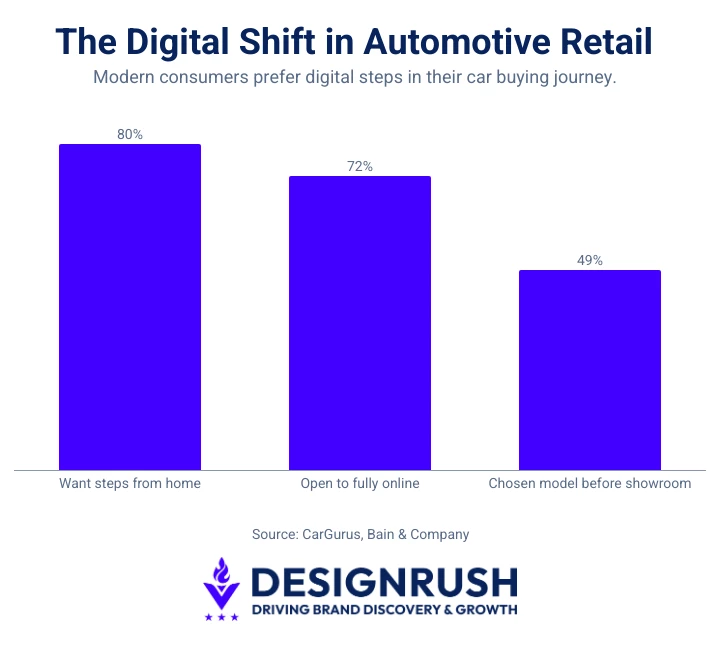
In 2026, the car-buying journey has become largely digital. Buyers now rely heavily on online tools for discovery and decision-making:
80% want to complete more steps from home, 72% are open to fully online purchases, and about half have already chosen their vehicle before setting foot in a showroom.
 Michael Krieger, President at Prime Marketing Experts, adds that the average buyer only visits an auto dealership three to four times in their lifetime.
As a result, dealerships have fewer opportunities to influence buyers in person, making early digital touchpoints significantly more important.
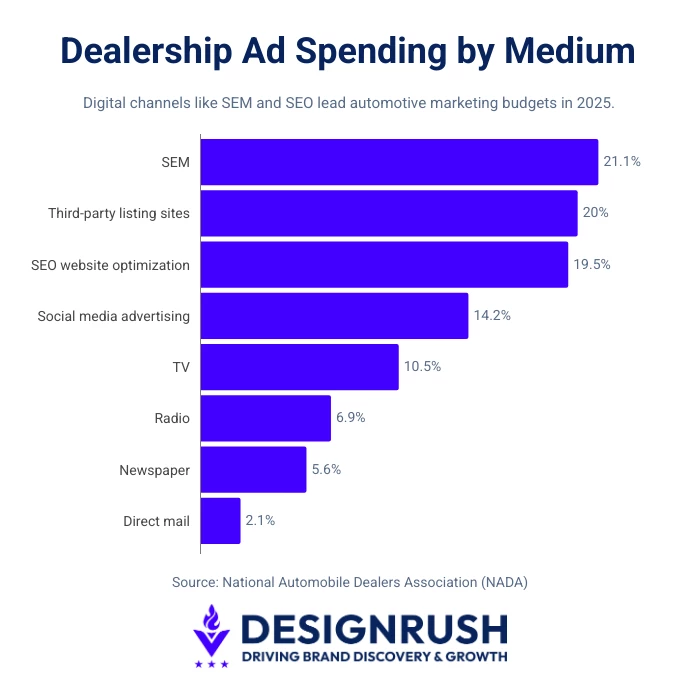
Total dealership advertising spend reflects this shift, rising from $7.48 billion in 2020 to $9.96 billion in 2025 (NADA).
More importantly, how that budget is distributed shows a clear response to digital-first behavior: SEM (21.1% of total ad spend) and SEO website optimization (19.5%) now dominate, while direct mail (5.6%) and newspapers (2.1%) receive a much smaller share.
This raises a more practical question: what does effective automotive advertising actually look like today?
Here’s a breakdown of strategies and best practices that show how it’s actually done.
1. Local SEO: The Highest-ROI Channel Dealers Still Underinvest In
Here's something many dealerships don't factor in: 90% of buyers stay local, purchasing within 50 miles of home (CarGurus).
That means local search visibility is the primary arena where automotive advertising is actually won or lost.
1.1. Your Google Business Profile (GBP) Is the Starting Point
At minimum, your GBP should have real photos of your current inventory and lot, updated hours, active Q&A responses, and a recent stream of replied-to reviews.
Dealers who post weekly updates to their GBP, such as new arrivals, service specials, and event announcements, consistently rank higher in the local map than those who don't.
1.2. Target "Near Me" and Geo-Specific Searches
"Near me" intent queries like "Honda dealership near me" or "used trucks under $30,000 near me" are among the highest-converting searches in automotive.
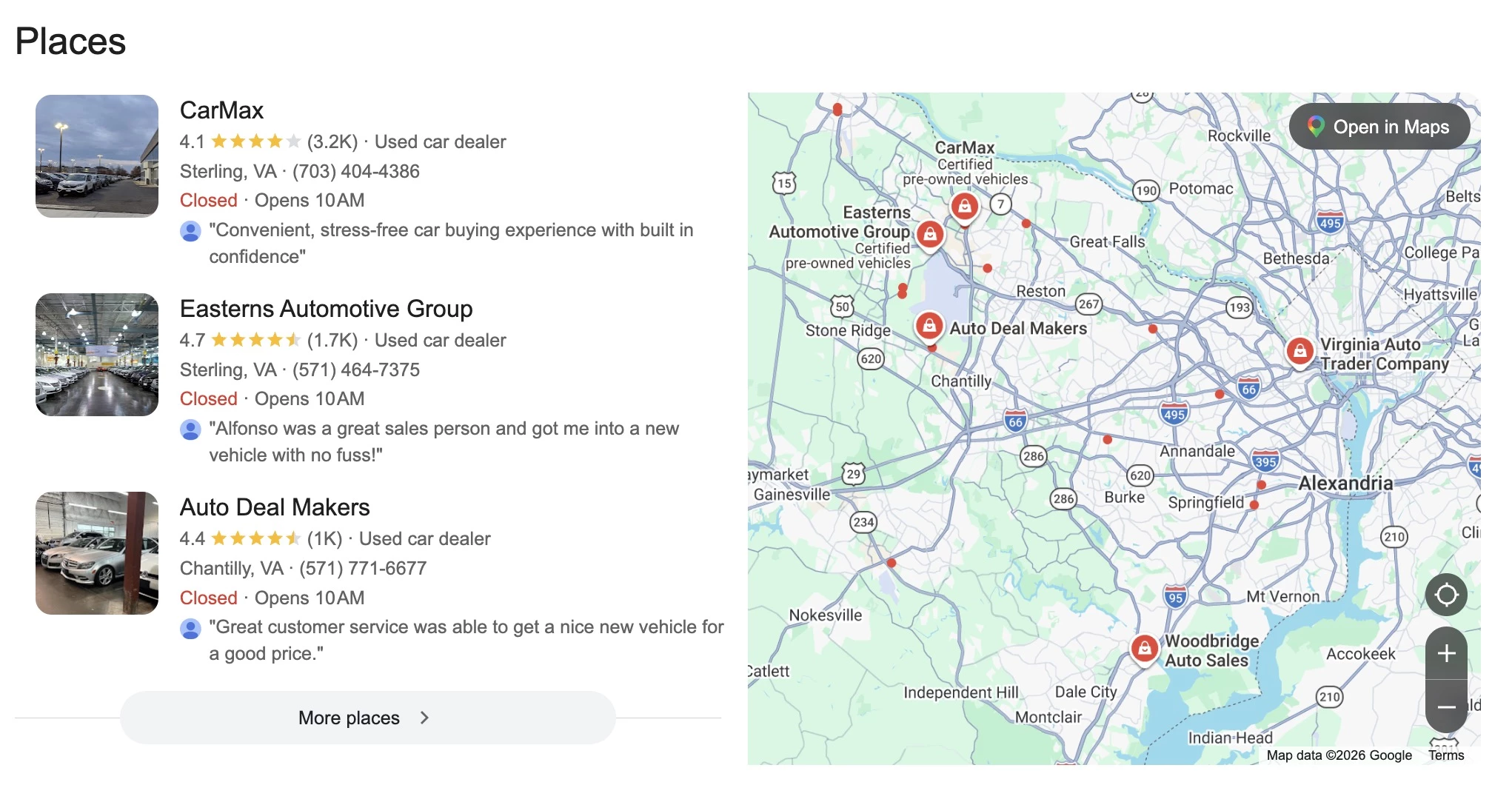
Your website needs to be structured to capture this traffic: city and neighborhood landing pages, inventory pages with schema markup showing real-time trim-level availability, and localized title tags that include your market (e.g., "Used Ford F-150 Trucks in Austin, TX").
1.3. Google Vehicle Listing Ads (VLAs) to Showcase Real Inventory
These are one of the most underutilized tools in the dealer's arsenal.
Unlike standard search ads, VLAs pull directly from your inventory feed and show shoppers specific vehicles, including make, model, year, mileage, and price, in the search results.
This means buyers can see your actual available unit before they even visit your site.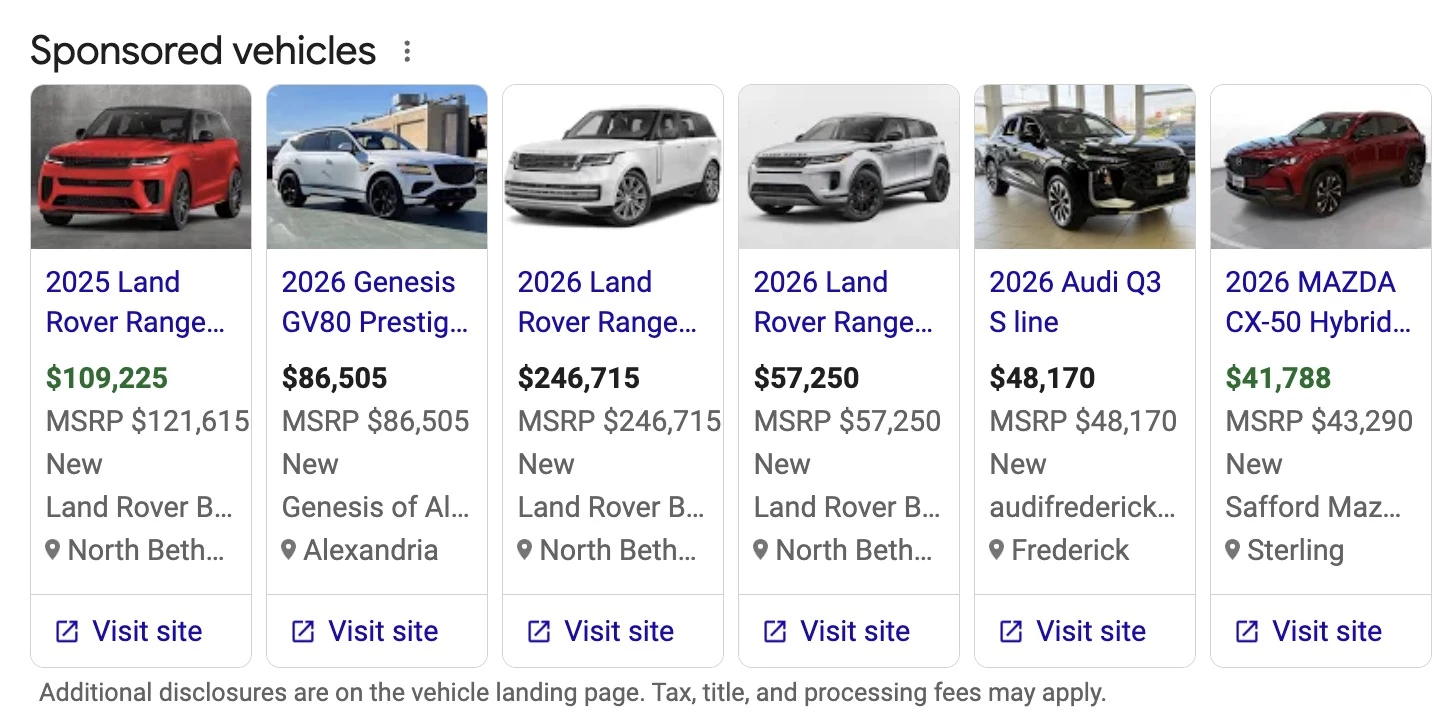
To run VLAs, you'll need:
- A Google Merchant Center account with an automotive inventory feed
- Accurate, real-time inventory data (make, model, year, price, VIN, image)
- A Google Ads campaign configured for vehicle ads
VLAs are best combined with local bid adjustments to ensure your spend is concentrated on searchers within a realistic driving radius of your dealership.


2. Paid Search: Nearly Double the CTR of Cross-Industry Baselines
Automotive search ads consistently outperform other industries, with ~4% average CTR and top campaigns reaching 6-8%+, compared to a ~3.17% cross-industry baseline (WordStream).
But running a generic search campaign in 2026 is roughly as effective as a newspaper insert. It reaches people, but it doesn't reach the right people at the right moment.
View this post on Instagram
The dealers consistently outperforming the market are building campaigns around specific intent signals.
2.1. Google Ads: Build Campaigns Around Specific Buyer Intent
On the Google side, that means separate campaigns for:
- Branded campaigns: Protect your dealership name from competitor bidding
- Competitor conquest campaigns: Bid on competitor dealership names to capture comparison shoppers
- Model-specific campaigns: Target buyers searching for specific makes and models you carry. e.g., "2025 Tacoma TRD Off-Road price."
- Service and parts: Often ignored, but highly profitable with strong return rates
- Trade-in intent: "what's my car worth," "KBB trade-in value"
2.2. Meta Automotive Inventory Ads (AIA) for Dynamic Retargeting
On Meta, Automotive Inventory Ads (AIA) are the equivalent of VLAs but within the Facebook and Instagram ecosystem.
They dynamically pull from your catalog and retarget past website visitors with the specific vehicles they viewed.
For instance, a shopper who spent 4 minutes on your Camry VDP and then scrolled Facebook at 9 PM will see that exact Camry with your current price.
3. Retargeting: The Average Buyer Visits 4.2 Websites Before Purchasing
The average automotive buyer visits around 4.2 websites before purchasing (Cox Automotive). They browse, compare, leave, and return multiple times.
Retargeting is the mechanism that keeps your dealership present throughout that entire journey instead of losing them after one visit.
A simple retargeting sequence most dealerships use:
- Vehicle detail page (VDP) retargeting shows the exact car viewed within 24 hours.
- Trade-in retargeting targets users who didn't complete the estimator.
- Service retargeting reaches past customers when maintenance is due using data from your dealer management system (DMS).
Each of these audiences has a different intent, so they need different creatives.
When a prospect shares their email (via lead form, trade-in, or service booking), you can match it to paid social audiences and reach them across channels.
This kind of reinforcement increases return visits and improves lead-to-appointment conversion.
4. Connected TV: 61% of Buyers Say It Influences Their Decision
CTV ads are served on streaming platforms like Hulu, Peacock, Paramount+, and through programmatic streaming networks. What makes CTV different from traditional broadcast TV is the targeting.
For example, you can serve a 30-second pre-roll to households within a 20-mile radius of your dealership that show in-market auto intent based on browsing, search, and streaming behavior. That level of precision isn't possible with local TV buys.
In fact, 61% of car shoppers say connected TV (CTV) ads have influenced their purchase decision.
CTV is particularly well-suited to three use cases:
- New model launches, where you need to build awareness before inventory arrives;
- Conquest campaigns against a competitor whose franchise location just closed or downsized
- EV education, where the buying decision often requires more emotional and informational groundwork
Getting Started With CTV
Dealerships and regional advertisers can access CTV inventory through platforms like:
- Hulu for Business: Self-serve and managed options with strong automotive audience segments
- The Trade Desk: A leading programmatic platform with broad CTV inventory access and automotive-specific data integrations
- Google Display & Video 360: For advertisers already in the Google ecosystem
The main challenge for most dealers is creative, since CTV requires a proper video asset.
If a full production shoot isn't feasible, use lifestyle footage with a local offer overlay and a clear call-to-action as a cost-effective alternative.
5. Email Marketing and CRM: Sustaining a 6-Month Buying Cycle Without Ad
The automotive buying cycle is long, often 3 to 6 months from first research to purchase.
Email is the only channel that lets you maintain a consistent, personalized presence throughout that entire window without paying for every impression.
David Ispiryan, CEO of Effeect, agrees with this, noting how competitive the market has become:
"Dealerships and manufacturers should focus on brand differentiation and multi-faceted marketing to stand out from the stiff competition.
Also, buying a car is a significant investment and dealerships must plan, nurturing leads over a longer period with targeted ads and content until they are ready to buy."
Most dealerships dramatically underutilize their CRM data. They collect contact information at every touchpoint, such as web leads, service appointments, and test drive inquiries, and then send the same generic monthly newsletter to everyone.
A well-segmented email program for a dealership would look something like this:
- New leads (30+ days): Focus on model benefits, comparisons, and current incentives, not generic follow-ups
- New owners: Congratulating buyers on their vehicle anniversary while planting repurchase intent
- Owners at ~3 years: Highlight trade-in value and upgrade opportunities
- Inactive service customers (12+ months): Service reminders like oil change, tire rotation, and recall notifications triggered by mileage or time since last visit
Email delivers one of the highest ROIs in automotive marketing because it's low-cost to send and targets an already warm audience.
6. AI-Driven Targeting: Predicting Purchase Intent Before Buyers Inquire
No two buyers are alike, but today, AI drives how those differences are identified and acted on.
AI analyzes behavior, intent signals, and CRM data to automatically group buyers and tailor messaging in real time:
- First-time buyers: Affordability, financing clarity, reliability, ease of ownership
- Family buyers: Safety ratings (NCAP, IIHS), space, seating, family features
- Performance enthusiasts: Horsepower, 0-60 times, motorsport pedigree
- Sustainability buyers: Range, charging, total cost of ownership, environmental impact
- Luxury buyers: Exclusivity, craftsmanship, advanced tech, premium experience
View this post on Instagram
Beyond segmentation, AI is shifting from simply generating ads to predicting purchase intent before inquiry.
It can now rank buyers by purchase likelihood, match ads to their vehicle preferences, adjust pricing based on market signals, and identify service customers likely to leave before their next visit.
7. First-Party Data Strategy: What Actually Replaces Third-Party Cookies
Third-party cookies, which are the tracking technology that powered much of programmatic digital advertising for two decades, are effectively dead or dying.
For automotive advertisers, this creates an opportunity:
Dealerships that invest in collecting, organizing, and activating their own first-party data will be able to target and personalize in ways that competitors relying on third-party data sources simply can't match.
View this post on Instagram
7.1 What Counts as First-Party Data
First-party dealership data includes:
- CRM records from past buyers and service customers
- Website behavioral data (pages visited, vehicles viewed, and time on site)
- Email engagement data (opens, clicks, and conversions)
- In-store and service history records
- Loyalty and referral program activity
- Survey and preference data collected at the point of sale
Unified in a CDP or CRM, you can create precise segments like past buyers with recent site visits and strong trade-in equity.
7.2 Building Your First-Party Data Asset
The practical starting point is simple: own your own website and your own first-party pixel. Many dealerships operate on websites they don't control, and if a vendor relationship ends, you lose the audience.
The most effective first-party data strategies combine browsing behavior, service history, and lifecycle signals like high mileage, lease end dates, and seasonality.
This includes:
- Lead capture optimization: Add simple email capture across all touchpoints, such as vehicle pages, search tools, chat, and trade-in forms
- Loyalty and service programs: Use service visits to track ownership stage, upcoming needs, and repurchase signals
- Trade-in and upgrade timing: Buyers from 36-48 months ago are likely to upgrade. Use this data to trigger targeted outreach.
This allows dealerships to time outreach so it feels relevant rather than intrusive.
For example, a customer just passing 60,000 miles becomes a strong trade-in candidate, turning to timely, contextual messaging instead of broad advertising.
8. Social Media Advertising: Where 60% of Car Buyers Start Researching
Over 60% of car shoppers now use social media in their research, and the dealerships winning on social media are those that produce creative car ads that feel native to the platform instead of polished automotive commercials.
@tiktokforbusiness At NADA 2026, TikTok’s Brian Torpey shared how Smart+ Auto Ads help dealers simplify inventory marketing, connecting live catalogs into TikTok and using behavioral signals to reach shoppers most likely to convert 🚗 #carsoftiktok#automotive#advertising#marketingtips♬ original sound - TikTok for Business
For instance, smart+ Auto Ads on TikTok make it easier for dealers by automatically connecting their live inventory to shoppers already showing buying intent. It uses AI to serve the right vehicles to the right people.
On the creative side, the bar is surprisingly low. A 60-second walk-around video shot on an iPhone can outperform a $10,000 produced spot if it feels authentic and actually answers a buyer’s question.
@tiktokforbusiness At NADA 2026, TikTok’s Brian Torpey shared how Smart+ Auto Ads help dealers simplify inventory marketing, connecting live catalogs into TikTok and using behavioral signals to reach shoppers most likely to convert 🚗 #carsoftiktok#automotive#advertising#marketingtips♬ original sound - TikTok for Business
The key is specificity and authenticity. A video titled "Here's every hidden storage spot in the 2025 Sequoia Platinum" serves the viewer something genuinely useful. A video that says "Come see our great selection" does not.
Short-form video formats that consistently drive engagement in automotive:
- Model-specific walk-arounds focusing on a single unusual or appealing feature
- Buyer testimonials shot immediately after delivery (the emotional high makes for authentic content)
- Side-by-side comparisons of trims within the same model (an underserved research need)
9. Video Content: What Buyers Watch Before Visiting Any Dealer
Many car buyers start their search with a video, turning to platforms like YouTube to explore options, compare models, and narrow decisions early.
9.1. 360-Degree Walkaround Videos
360-degree vehicle walkarounds give online buyers the spatial sense of actually walking around a vehicle.
View this post on Instagram
Posted on VDP pages and YouTube, these videos answer the question "what does this car actually look like in person?" more effectively than static photos.
9.2. Interactive Video Experiences
Interactive video, where viewers can click on specific areas of a vehicle to trigger feature callouts and specifications, takes engagement further.
While production costs are higher, interactive video formats have demonstrated strong performance for premium and luxury vehicle segments, where buyers research extensively before visiting.
10. Influencer Marketing: Why 15K Local Creators Outperform Big Reach
Influencer marketing in automotive often works better with a local lifestyle creator who has 15,000 highly engaged followers in your metro market.
A collaboration on a test drive video or a feature on a specific model can introduce your dealership to an audience that's demographically aligned and geographically relevant, and it typically costs far less than the CPM you'd pay on broadcast.
@georgejsaliba Classic Jaguar Turned EV… Mistake or Genius??? #cardealership#classic#ev#jaguar♬ original sound - George Saliba
Partnership tiers worth considering:
- Macro influencers (500K+ followers): Broad reach, brand awareness. Best for OEM-level campaigns and model launches
- Mid-tier influencers (50K-500K): Strong engagement, category-specific audiences (off-road, EV, luxury, JDM, etc.) Ideal for model-specific campaigns
- Micro-influencers (5K-50K): Hyper-local and niche. Dealerships can partner with regional car enthusiasts for authentic, community-trusted content
11. Online Reputation Management: The Half-Star Difference Costing You Sales
In automotive, reviews are advertising. A 4.2-star rating next to a competitor with 4.7 stars sends buyers elsewhere. That's because buyers read reviews, trust them, and use them as a primary decision signal.
A best practice is to trigger an automated email and/or text to every sold and serviced customer within 24 hours of their transaction, with a direct link to your Google review page.
Especially since buyers who had a great experience simply never think about leaving a review without that prompt.
How you respond also matters. Public, professional replies to negative reviews signal accountability, and even old complaints lose impact when they're visibly addressed.
12. EV-Specific Advertising: Why Deal-Focused Messaging Misses Today's Most Informed Car Buyers
Electric vehicle buyers in 2026 are a genuinely different audience from the traditional vehicle buyer.
EV shoppers tend to be more deeply research-driven. They arrive at your dealership or your website having already read extensively about range, charging infrastructure, incentive eligibility, and total cost of ownership.
Advertising that leads with "great deals" lands flat. Instead, the content and paid strategy for EVs should include:
- Dedicated landing pages that address the charging infrastructure by local area
- Honest range calculators that account for weather and driving style
- Clear breakdowns of available federal and state incentives.
CTV is particularly effective for EV awareness because the format allows you to tell a story. For example, a 60-second ad can convey lifestyle fit in a way that a search ad never can.
13. Traditional Advertising: Offline Still Wins Lease-End & Conquest
Traditional channels are shrinking, but they still work in specific, high-intent scenarios, especially when paired with digital:
- Direct mail: Still one of the strongest performers for trade-in conquest and lease-end campaigns. Using data from your DMS, you can target buyers from 3-4 years ago who likely have equity in their vehicle.
- Radio: Reaches commuters at high-intent moments. The key is sustained presence; sporadic ads rarely perform, while steady frequency creates recall that supports other channels.
Offline works best as reinforcement. When combined with CTV and digital retargeting, each touchpoint compounds impact instead of working in isolation.
Auto Advertising Strategies: Final Thoughts
In 2026, the most effective automotive marketing ideas feel less like advertising and more like genuinely helpful guidance, delivering the right information to the right buyer at the right moment, across every channel they use throughout their purchase journey.

Our team ranks agencies worldwide to help you find a qualified partner. Visit our Agency Directory for the Top Automotive Advertising agencies as well as:
- Top Automotive Digital Marketing Agencies
- Top Automotive SEO Companies
- Top Automotive Web Design Companies
- Top Automotive Branding Agencies
- Top Advertising Agencies in Philadelphia
Our design experts also recognize the most innovative design projects across the globe. Visit our Awards section for the best & latest in automotive designs.
Car Dealership Advertising Ideas FAQs
1. How much should a dealership spend on advertising?
Industry benchmarks suggest dealerships allocate between 0.5% and 1.0% of gross revenue to advertising. In per-vehicle terms, the 2026 industry average sits around $700-$750 per unit sold.
The optimal allocation depends on market size, competition intensity, and growth objectives. Dealerships in high-competition metro markets typically spend toward the upper end of the range.
2. What is the most cost-effective way to advertise a car dealership?
Local SEO and Google Business Profile optimization offer the strongest return relative to investment. They are "always on" and capture high-intent buyers actively searching for your inventory.
Combined with targeted retargeting campaigns (which recapture already-interested visitors), these two channels are the highest-ROI foundation for most dealership budgets.
3. What are the best automotive advertising digital channels?
For most dealerships, the priority order is:
- Google paid search and Vehicle Listing Ads for in-market intent
- Meta Automotive Inventory Ads for retargeting and social discovery
- Connected TV for brand-building reach
- Email/CRM for nurture and retention
- Local SEO for long-term organic visibility.
The optimal mix will vary by budget, market, and target customer profile.
4. Can SEO help with automotive marketing?
Absolutely, both at the local dealership level and at the manufacturer/brand level. SEO compounds over time, making it one of the highest long-term return investments in the automotive marketing mix.
Nearly 90% of buyers conduct online research before visiting a dealership; appearing organically in those searches is a fundamental advantage.
5. How should dealerships approach EV auto marketing differently from ICE vehicles?
EV marketing needs to address concerns that don't apply to gas vehicles, like range, charging access, total cost of ownership, and incentives.
Instead of focusing on brand or features, lead with education: real-world range, charging options, and cost comparisons.
First-time EV buyers need more reassurance, so ads that directly answer common questions and concerns consistently perform better than standard vehicle promotions.
6. What is Generative Engine Optimization (GEO) for car dealers?
GEO refers to structuring your web content to be picked up by AI-powered search assistants. As more buyers ask questions in natural language (e.g., "best compact SUV for families" in [city]), your content needs to directly answer those queries.
For example, a page titled "Top 5 Reliable SUVs under $30k in Springfield" could be cited by an AI engine. By creating clear Q&A content, dealers can get their site featured in voice search or AI chat results, making their dealership visible in the "zero-click" phase.