
Consumers have more choices than ever, which makes attention difficult to earn and even harder to convert into sales.
Promotional marketing closes that gap by giving people a clear reason to act. Whether through discounts, referral rewards, loyalty perks, contests, or free gifts, the strongest promotions align an incentive with a specific business goal.
The impact goes beyond short-term sales. Strong promotions build loyalty, generate customer insights, and provide measurable results that help shape future campaigns.
Promotional Marketing Examples: Key Findings
- Match the promotion to the goal, not the trend. Discounts drive immediate sales, referral rewards acquire customers, free gifts increase order value, and loyalty programs encourage repeat purchases.
- Use limited-time discounts when speed matters. Amazon's Prime Day helped drive $26.4 billion in online spending because urgency and deadlines push shoppers to act instead of waiting.
- Reduce risk to win first-time customers. HelloFresh built a multi-billion-euro business by lowering the barrier to trial with heavily discounted first orders that converted into recurring subscriptions.
Why Promotional Marketing Matters in 2026
Promotional marketing has shifted from a seasonal tactic to a year-round expectation.
In a Salsify and Digital Shelf Institute study, 70% of shoppers said they had made an unplanned online purchase after receiving a discount offer, which shows how fast an incentive turns interest into a sale.
Discount depth sharpens the effect, since research by 2 Visions found that shoppers are roughly twice as likely to buy a product at a 20% discount than at the regular price.
Promotions also recover sales that would otherwise disappear, since 87% of consumers said a discount would most strongly motivate them to complete a purchase rather than abandon their cart, at a time when roughly 70% of online carts are left behind.
Promotional Marketing vs. Brand Advertising
Promotional marketing is often confused with brand advertising, though the two solve different problems. The table below shows where they diverge.
| Aspect | Promotional marketing | Brand advertising |
| Primary goal | Drive immediate action, such as a purchase or a sign-up | Build long-term awareness and shape how people feel about the brand |
| Time horizon | Short and time-sensitive, tied to a deadline | Ongoing, working over months or years |
| Measurement | Direct and trackable, through redemptions and sales lift | Indirect and harder to tie to a single sale |
That difference is easiest to see in practice. The ten promotions below light that fire in their own way, spanning discounts, loyalty rewards, referrals, and cause-driven offers, with each showing how a well-built incentive turns interest into measurable action.
1. How Amazon Prime Day Turned Limited-Time Discounts Into a $26B Sales Event
Amazon launched Prime Day in 2015 as a members-only sale, and it has become the clearest example of a limited-time discount working at scale. The event offers steep markdowns available only to Prime subscribers, which ties a strong incentive to a hard deadline and a paid membership.
Amazon builds urgency with countdown timers and lightning deals that expire within hours, alongside Prime-only pricing that rewards members for acting fast. The 2026 event ran four days, and rival retailers now launch competing sales during the same window.
That gravity has turned a single retailer's promotion into a summer shopping season that rivals Black Friday across the entire US market.
The results:
- US shoppers spent $26.4 billion online across retailers during the four-day 2026 event, a 9.3% increase over the previous year, according to Adobe Analytics.
- The first 24 hours drove $8.3 billion in US online spend, more than consumers spent on Thanksgiving Day in 2025.
- Mobile devices generated 54.2% of the spending, or $14.2 billion, an all-time high.
- Deep discounts pushed shoppers toward pricier items, with electronics up 105% compared to average daily June sales.
2. How HelloFresh Uses First-Box Discounts to Convert Trials Into Subscribers
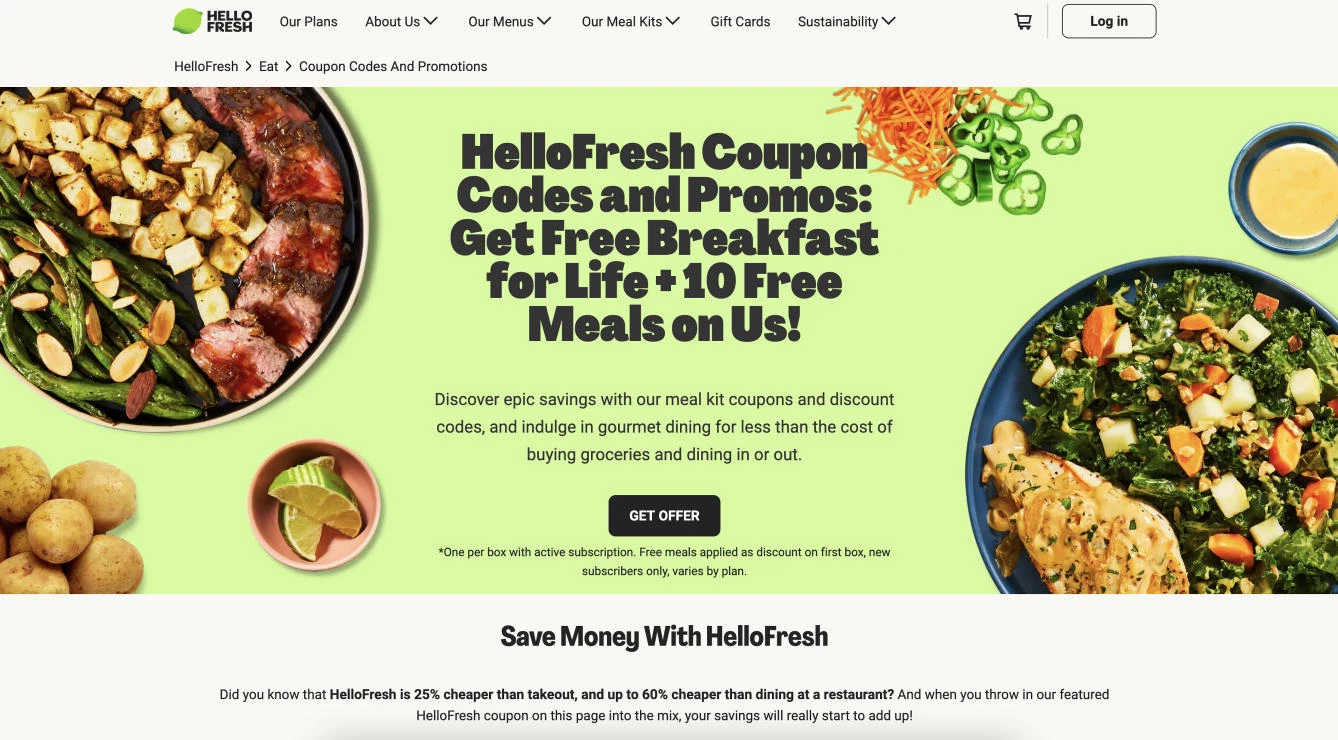
HelloFresh built the meal-kit category on one acquisition tactic: a heavy discount on a customer's first box. New subscribers see a large percentage off their opening order, often spread across several early deliveries, which lowers the barrier to trying a service that would otherwise feel pricey.
The discount opens an ongoing subscription that renews automatically each week unless the customer skips or cancels. That structure turns a one-time deal into recurring revenue, since many buyers stay on past the discounted boxes once the routine sets in.
The model made HelloFresh the world's largest meal-kit company, operating in 18 countries under brands such as Factor and EveryPlate.
The results:
- HelloFresh reported about €6.76 billion in group net revenue for 2025, holding its place as the world's largest meal-kit company.
- The company served roughly 7.15 million active customers as of its last disclosed annual figure for 2024.
- Marketing stayed a heavy cost of the discount model, running at about 22% of revenue in the first quarter of 2026.
3. How Dropbox's Referral Reward Grew Signups 3,900% in 15 Months
In 2008, Dropbox had a problem. Paid search ads were costing far more to win a customer than the product brought in. Its fix was a two-sided referral reward, where any user who invited a friend earned 500MB of extra storage, and the friend who signed up received 500MB as well.
The reward mapped directly onto the product's core value, since storage was exactly what users wanted. Dropbox built the invite into onboarding and surfaced it when people neared their storage limit, which put the offer in front of them at the moment it mattered most.
The loop turned users into a sales force and did it with almost no marketing budget.
The results:
- Dropbox grew from 100,000 to 4 million registered users in 15 months, a 3,900% increase, based on figures from founder Drew Houston's presentations.
- At its peak, the referral program drove 35% of all daily signups.
- Users were sending roughly 2.8 million referral invites per month by early 2010.
- The program ran on storage rewards rather than ad spend, and a version of it still operates today.
4. How Starbucks Rewards Drives Nearly 60% of U.S. Store Revenue
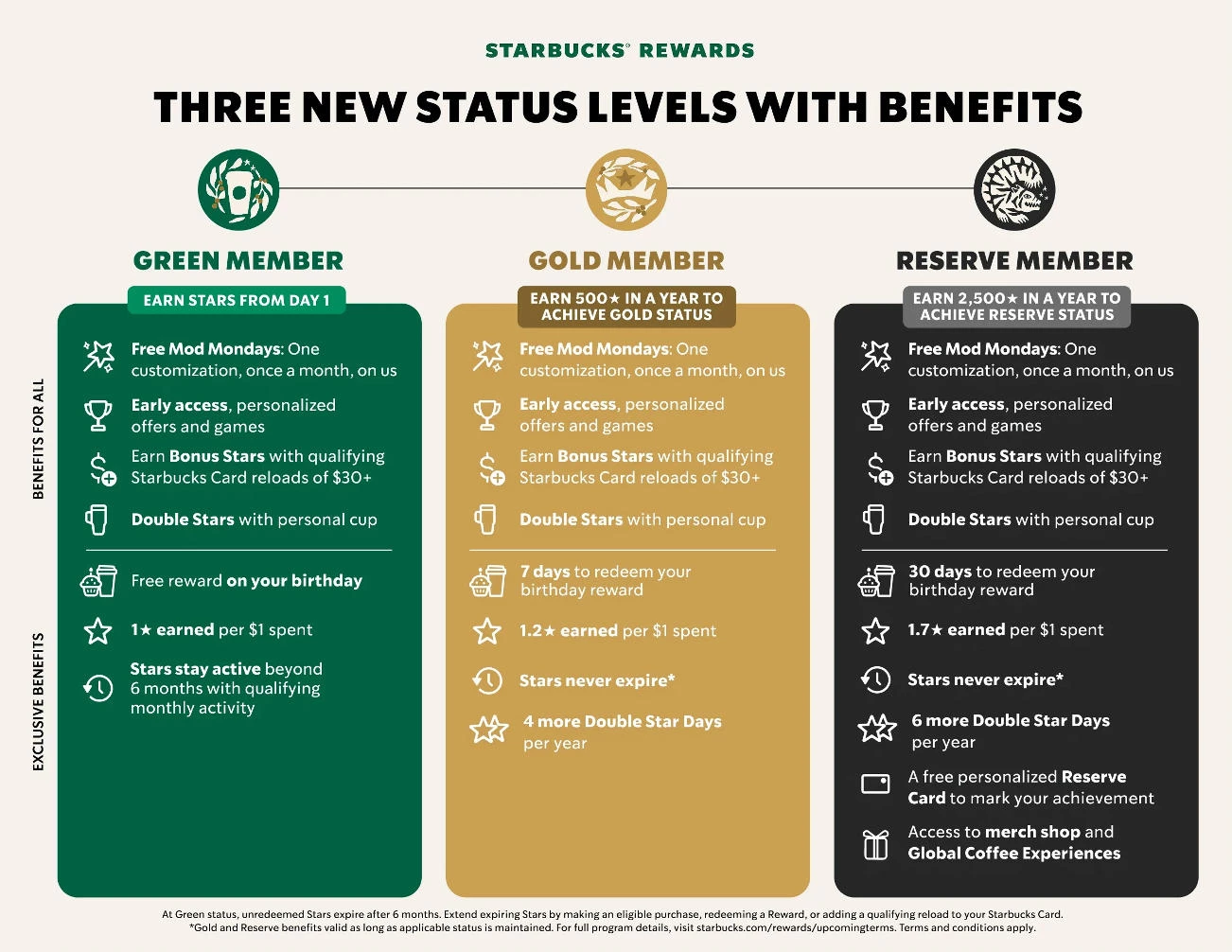
Starbucks Rewards is a points-based loyalty program built into the company's mobile app. Members earn Stars on purchases and redeem them for free drinks and food, while the app handles ordering and payment in one place. That design turns occasional buyers into frequent, tracked customers.
The program has become central to the US business. Rewards members drove nearly 60% of US company-operated revenue in fiscal 2025, and 90-day active membership reached an all-time high above 35 million.
In March 2026, as part of its "Back to Starbucks" turnaround, the company relaunched the program with a three-tier structure and new perks, from a lower 60-Star reward to faster earning at higher tiers.
The results:
- Rewards members drove nearly 60% of US company-operated revenue in fiscal 2025, which Starbucks valued at more than $13 billion in spend.
- The program reached an all-time high of more than 35 million 90-day active members in the US.
- In March 2026, Starbucks relaunched Rewards as a three-tier program, adding Gold and Reserve levels above the standard Green membership.
- The reimagined program introduced a 60-Star redemption for $2 off and made Stars non-expiring for Gold and Reserve members.
5. How Lay's Do Us a Flavor Contest Lifted Sales 12% on Millions of Submissions
Lay's Do Us a Flavor invited customers to invent a new potato chip flavor for the chance to win $1 million. Entrants submitted a flavor name and its ingredients on a dedicated site, the public voted on the finalists, and the winning flavor went to store shelves. The contest launched in the US in 2012.
The format turned product development into a public game with a large cash prize, which gave people a reason to engage and to buy the finalist flavors they had helped choose. It also handed Frito-Lay consumer research at scale for very little cost.
The idea proved durable. After several editions and a long pause, Lay's revived the contest in the US for 2024 and 2025, with finalist flavors reaching shelves in 2025.
The results:
- The 2012 US launch drew 3.8 million flavor submissions, far above Frito-Lay's target of 1.2 million.
- Year-over-year sales rose about 12% during that first US campaign, well beyond the 3% lift the company had projected.
- Later editions grew the crowd further, with the 2014 contest drawing 14.4 million submissions.
- Across its run the contest produced 14 new flavors, and Lay's revived it in the US for 2024 and 2025 after a seven-year pause.
6. How Sephora's Beauty Insider Program Built a Multi-Million-Member Repeat-Buyer Base
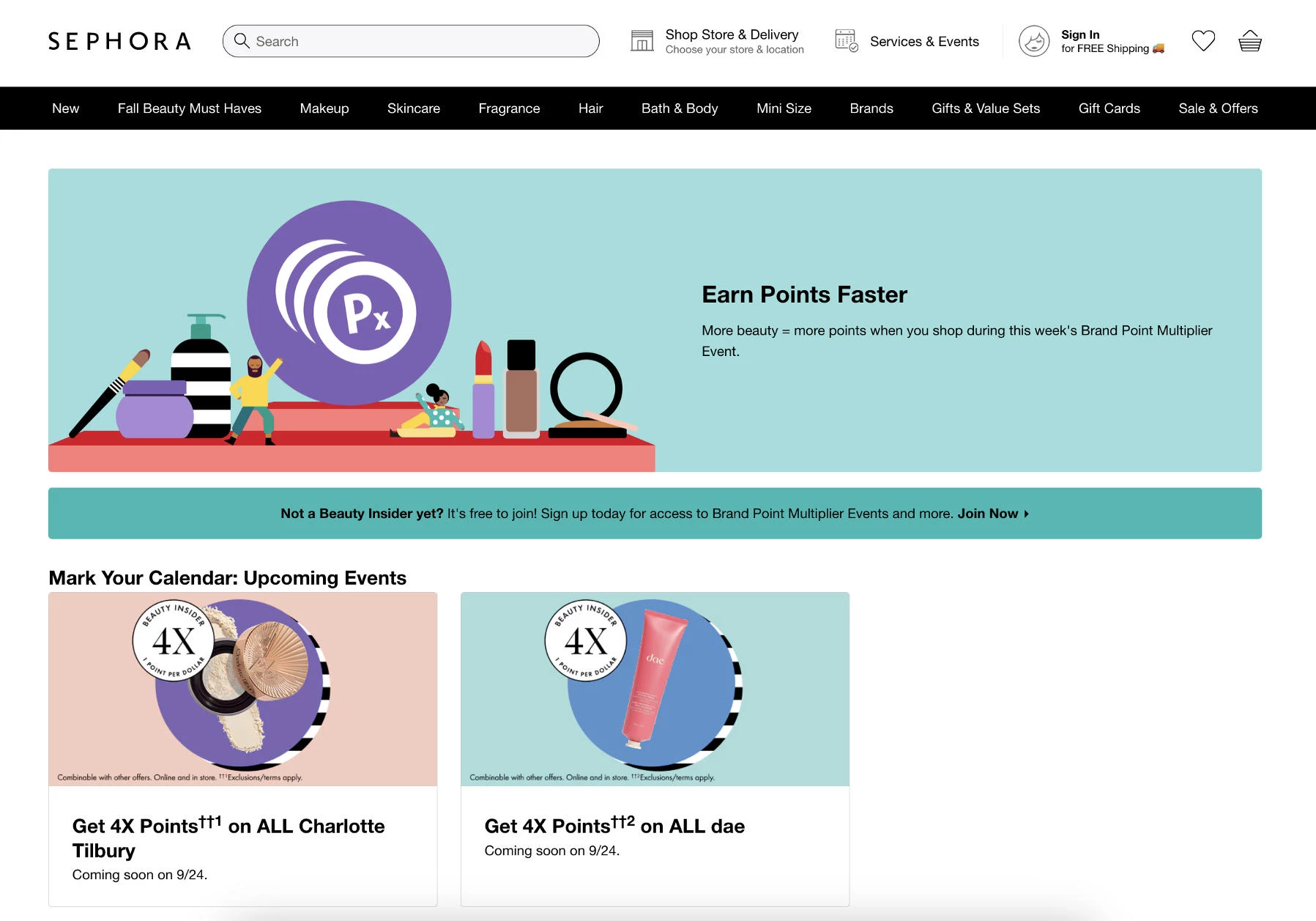
Sephora's Beauty Insider program is free to join and rewards members with points on every purchase. Its sharpest promotional tool is the Brand Point Multiplier Event, a recurring window in which members earn two to four times the usual points per dollar on selected brands or categories.
Because the multiplier runs for only a few days and covers specific brands, it gives members a reason to buy now rather than wait, and to concentrate spending on the featured products. The points they bank then pull them back for a later purchase, which keeps the cycle turning.
Sephora reinforces the habit with app-only alerts and Beauty Insider Challenges that award points for shopping during these promotional windows.
The results:
- Beauty Insider reached over 45 million members in North America by the end of 2025, up more than 75% over five years, according to Sephora's loyalty leadership.
- Members earn 2X to 4X points per dollar during Brand Point Multiplier Events, and Sephora Credit Card holders earn 5X.
- Beauty Insider Challenges, which award points for shopping during promotional windows, have drawn about 30% of members.
- Sephora does not publish sales figures for point multiplier events on their own, so their impact shows up mainly through the program's overall scale and growth.
7. How Bombas's Buy-One-Give-One Model Powered 200 Million Donations
Bombas launched in 2013 after its founders learned that socks are the most requested item in homeless shelters. The company built a promise into every sale: for each item a customer buys, Bombas donates one to someone in need. The model, called One Purchased = One Donated, makes the purchase itself the good deed.
The giveback gives socially minded shoppers a reason to pick Bombas over a cheaper pack of socks and to feel good about paying a premium. It also hands the brand a clear story to tell in its marketing, which turns buyers into repeat customers and advocates.
What began as a scrappy Indiegogo campaign and a Shark Tank pitch has become one of that show's biggest success stories.
The results:
- Bombas customers have powered more than 200 million donated clothing items for people in need.
- Those donations reach communities through 4,000+ giving partners across all 50 states.
- Bombas grew from a 2013 startup into a brand with more than $1.3 billion in lifetime sales.
- It is widely described as the most successful product in Shark Tank history.
8. How Who Gives A Crap Built a Loyal Base by Donating 50% of Profits
Who Gives A Crap is a bathroom and household brand that donates 50% of its profits to build toilets and expand clean water access. The Australian company launched in 2012 through a crowdfunding campaign and made the giving pledge the center of its pitch rather than a side note.
The pledge lets buyers turn a routine purchase into a donation, which gives a commodity product a reason to be chosen and shared. Who Gives A Crap layers limited-edition designs and a subscribe-and-save option on top, adding scarcity and convenience to the cause.
The mix has earned the brand a devoted following and repeat coverage from reviewers like The New York Times Wirecutter.
The results:
- Who Gives A Crap donates 50% of its profits to clean water and sanitation projects.
- The company reports raising more than $14.4 million for those causes to date in the US.
- In 2023, its nonprofit partners gave 575,082 people access to improved water and sanitation services.
- The brand is a Certified B Corp and makes its products from recycled fiber or FSC-certified bamboo rather than virgin trees.
9. How Quince Grows Through a Give-$20-Get-$20 Referral Program
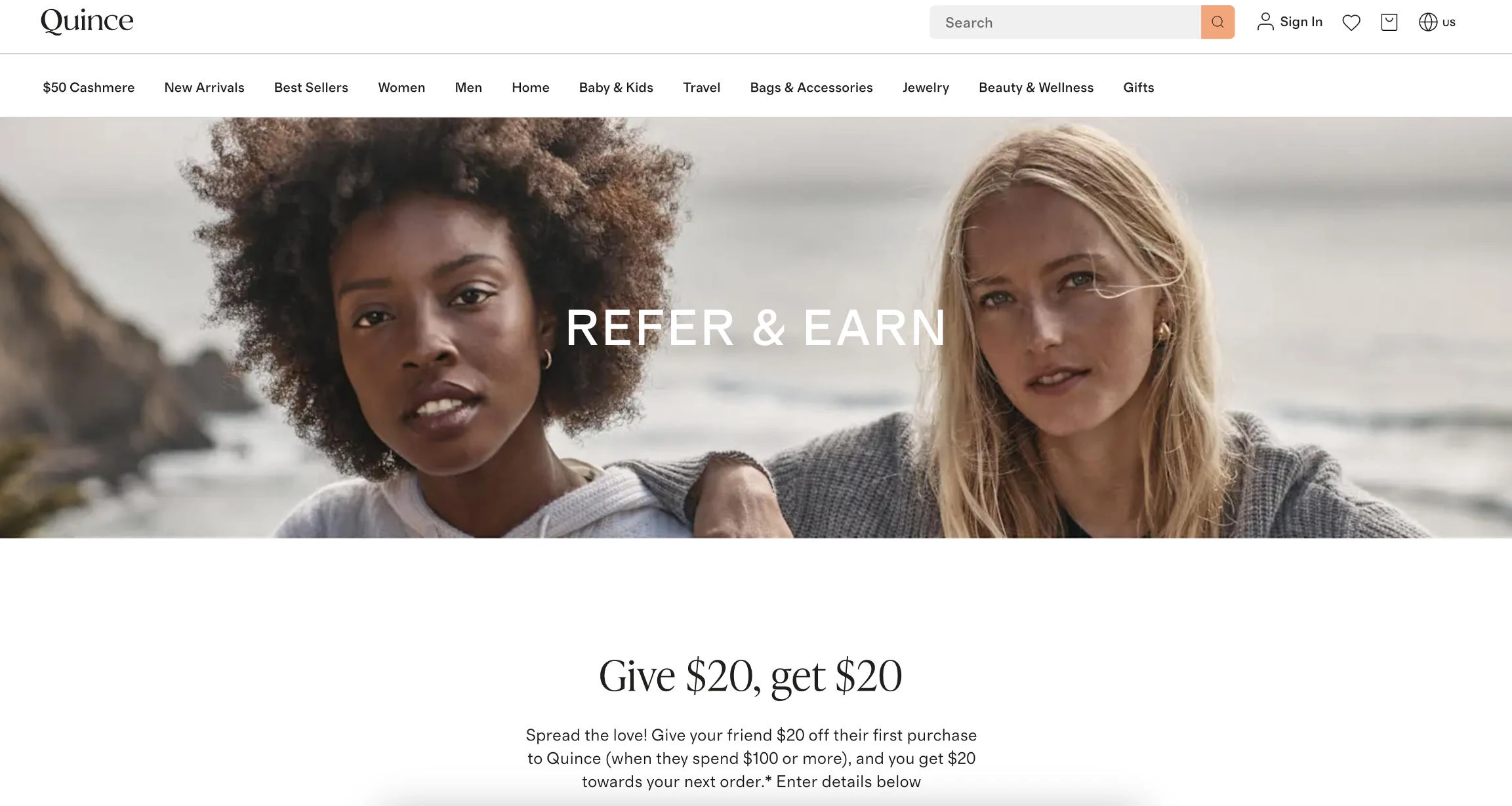
Quince is a direct-to-consumer brand that sells affordable-luxury basics like cashmere and silk at factory-direct prices. Its referral program uses a give-and-get structure: a member shares a link, their friend gets $20 off a first order over $100, and the member earns $20 in credit once that order clears.
Quince builds the program around private sharing. Its terms require referrals to move through direct channels like text or email and block links posted publicly on sites like Reddit or coupon forums. That keeps the recommendation personal and limits the code leakage that drains many referral budgets.
The design suits a value brand that competes on trust, since a private endorsement carries more weight than a public code.
Quince does not publish results for the program, so this entry reflects its design rather than a reported outcome.
10. How WishGarden Herbs Uses Free Gifts to Push Bigger Orders
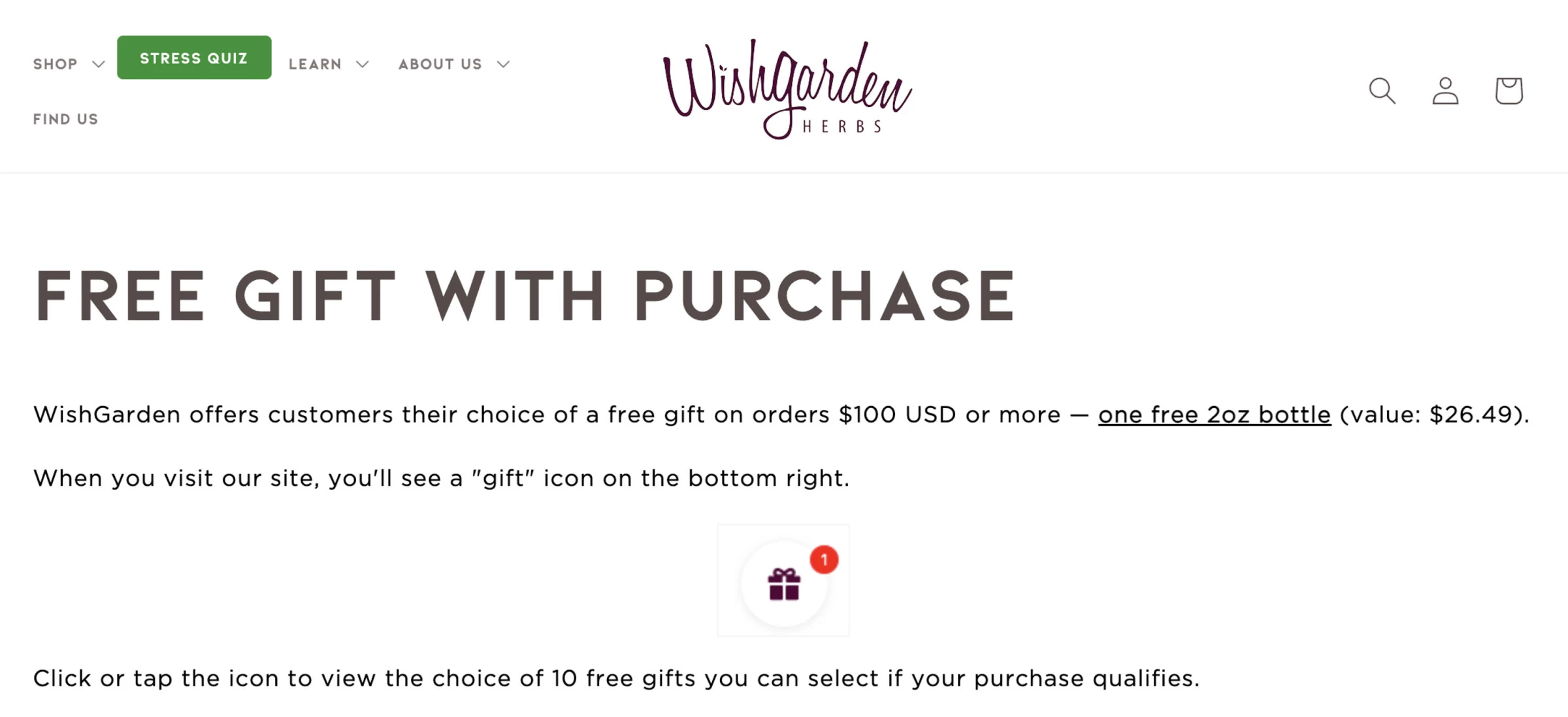
WishGarden Herbs, a woman-owned, family-run herbal supplement brand, uses a free-gift promotion to give customers another reason to increase their cart total. Shoppers who spend $100 or more can choose one free 2 oz. bottle from a selection of 10 products, turning a routine order into an opportunity to try something new.
The promotion works because the reward is tied to a clear spending threshold, while letting customers choose their gift makes the incentive more relevant.
WishGarden has also used tiered versions of the offer, including a $75 threshold for a free hand purifier, $100 for a bottle plus purifier, and $140 for a beanie, bottle, and purifier during its 2025 Black Friday promotion.
WishGarden Herbs does not publish results tied specifically to its free-gift promotion, but the offer shows how smaller brands can use a spending threshold and a relevant reward to encourage larger orders without relying solely on discounts.
6 Traits That Separate Great Promotions From Forgettable Ones
The ten campaigns above span flash sales, loyalty programs, referrals, and cause-driven models, and they range from global retailers to small purpose-led brands.
What the memorable ones share is a short list of common traits. These six separate the promotions people act on and pass along from the ones they scroll past.
- Emotional connection: Memorable campaigns make people feel something. Humor, nostalgia, inspiration, or a sense of belonging gives an audience a reason to care, and that feeling outlasts any product feature.
- Consistency across touchpoints: The strongest brands hold one voice across every channel, so a campaign feels coherent whether a customer meets it in a TV spot, a social post, an email, or on packaging.
- A tangible element: Even in a digital-first market, a physical product or an in-person moment makes a brand feel real and gives customers something they can hold onto and want to photograph.
- A clear call to action: Effective promotions make the next step obvious. The offer states plainly what to do and by when, so a customer never has to work out how to claim it.
- Built for scale: Iconic campaigns run on flexible frameworks rather than one-off ideas, so a format like an annual sale or a flavor contest can repeat across markets and years without losing its identity.
- Shareability built in: The best promotions give people social currency. Sharing the campaign makes the audience look smart or feel entertained, which turns ordinary customers into a distribution channel at no cost.
4 Common Promotional Marketing Mistakes to Avoid
Strong promotions share the traits above. The ones that underperform usually stumble on the same few points. Avoiding these keeps a campaign from creating a short-term spike that costs more than it returns.
- Discounting too often: Frequent markdowns train customers to wait for the next sale and erode margin. Deep first-order deals can also attract one-time bargain hunters who churn before they ever turn profitable.
- Overcomplicating the offer: A promotion that needs explaining loses people. When the reward or the steps to claim it are unclear, shoppers abandon the deal rather than work out how it applies.
- Launching without a metric: A promotion with no success measure set in advance cannot be judged. Decide upfront whether the goal is conversion, average order value, new customers, or repeat purchases, and track that number.
- Matching the wrong promotion to the goal: A discount can lift immediate sales but does little for loyalty, and a points program rewards regulars without winning new ones. Pick the mechanic that fits the outcome.
How to Choose the Right Promotion for Your Goal
The best promotion depends on what you need it to accomplish. A discount can drive a quick sale, but it may do little for retention. A referral reward can bring in new customers, while a loyalty offer is better suited to increasing purchase frequency.
Start with the business outcome, then choose the promotion that naturally supports it:
| Goal | Promotion to consider | Why it works |
| Drive immediate sales | Limited-time discount | Creates urgency and gives shoppers a concrete reason to buy now |
| Increase average order value | Free gift with purchase | Gives customers an incentive to spend more to reach a threshold |
| Acquire new customers | First-purchase offer | Lowers the barrier to trying an unfamiliar brand or service |
| Generate referrals | Give-and-get referral reward | Gives existing customers a reason to introduce new buyers |
| Increase repeat purchases | Loyalty points or bonus-point events | Rewards customers for coming back and gives them a reason to spend again |
| Build engagement | Contest or giveaway | Encourages participation while generating attention and customer data |
| Differentiate the brand | Cause-based promotion | Gives customers an additional reason to choose the brand beyond price |
The mechanics matter, too. A promotion should be simple enough to understand at a glance, with a reward that feels worth the required action.
Set a clear end date or spending threshold when urgency or higher order values are the priority, and make the path to redemption obvious.
Finally, decide how success will be measured before launching. Track the metric tied to the original goal, whether that's conversion rate, average order value, new customers, repeat purchase rate, referral volume, or revenue generated.
That makes it easier to tell whether the promotion actually moved the business forward or simply created a temporary sales spike.
Promotional Marketing Examples: Final Thoughts
The strongest promotions aren't necessarily the biggest discounts. They're the ones designed around a specific business objective.
Amazon used urgency to accelerate purchases, Dropbox rewarded referrals, Starbucks built loyalty, and WishGarden encouraged larger orders with a spending threshold. The common thread is alignment between the incentive and the desired customer behavior.
Before launching any promotion, define the outcome you want to achieve, then choose the format that naturally moves customers toward that action.
Our team ranks agencies worldwide to help you find a qualified partner. Visit our Agency Directory for the top promotional marketing agencies as well as: