
I’ve worked with enough companies to see one pattern: most digital marketing objectives look good in a slide deck but crumble when it’s time to drive revenue. I’ll show you how to align those objectives for real growth.
Digital Marketing Objectives: Key Points
- Tie every objective to revenue, otherwise you risk joining the 70% of business transformations that collapse from poor goal alignment.
- Anchor objectives to ROI tracking or risk joining one-third of companies that waste marketing budgets without proof of return.
- Cut vanity objectives like “go viral” and replace them with measurable revenue goals or you’ll stay busy without growing.
Why Most Digital Marketing Objectives Fail Before They Even Start
I can’t count how many times I’ve seen teams chase impressions without KPIs, and every time it ends in wasted budget and zero growth.
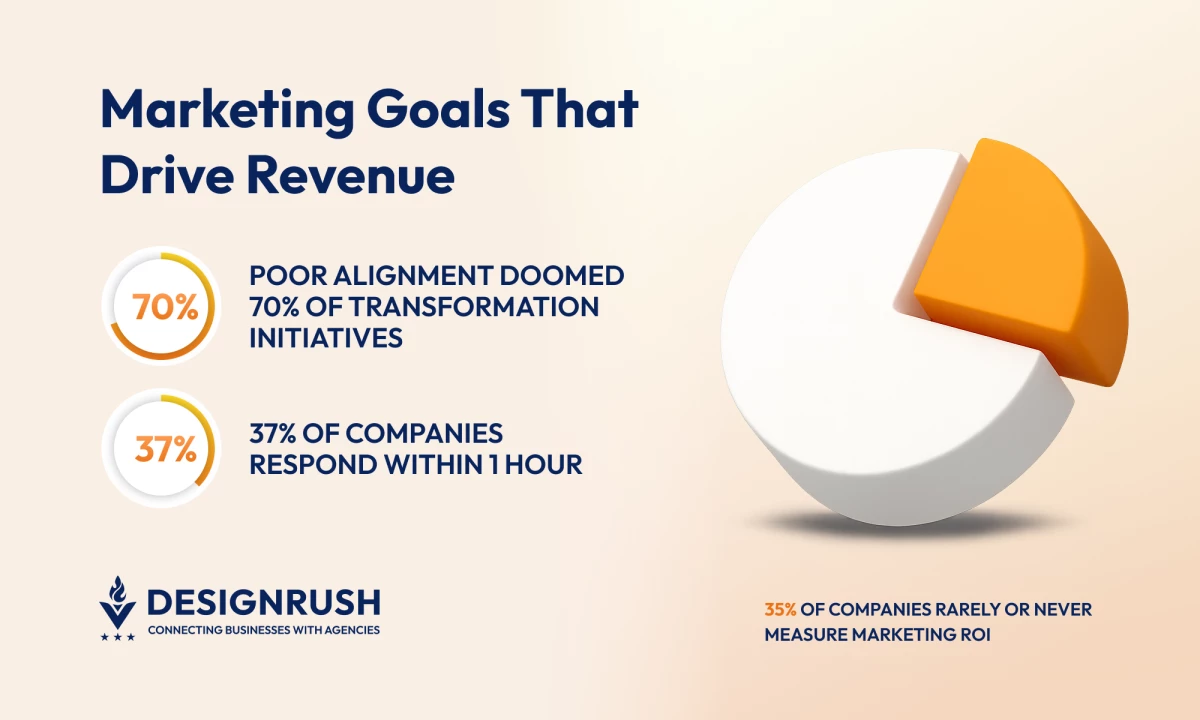
And it shows: 70% of business transformation efforts fail due to poor goal alignment.
If objectives aren’t measurable and linked to revenue or pipeline, the budget gets spent but growth never follows.
As Tom Slocum, Founder of The SD Lab says, “Alignment isn’t just proximity or shared meetings; it’s building systems where both teams own the same outcomes, speak the same language, and use consistent data.”
I learned this the hard way when I realized our weekly alignment meetings were just status updates. Nothing changed until both teams agreed on one scoreboard and stopped playing different games.
Start With the Right Inputs Before Defining Your Digital Marketing Goals
When I set objectives for clients, I never let the agency set the narrative first because they’ll frame success around what’s easiest for them to deliver: clicks, impressions, and traffic.
None of that guarantees revenue.
Here’s what I always collect before objectives ever hit the whiteboard:
- Performance trends (last 6–12 months): Sessions, SQLs, revenue, CAC. One enterprise client came to me saying “lead gen is broken.” Turns out, they were facing a volume issue, not efficiency. That changes everything.
- Sales operations: If your sales cycle is 90 days, no agency should promise “new revenue next month.” Startups often miss this, then blame marketing.
- CRM definitions: Marketing says “MQL,” Sales says “not qualified.” At one SMB I advised, this misalignment led to a 40% reporting gap.
- Creative and cadence: I’ve seen CAC rise 30% simply because ad creatives hadn’t been refreshed in 6 months.
- Tracking setup: If your GA4 isn’t tied to revenue outcomes, your objectives are flawed from day one.
Many companies skip this homework. In fact, over a third rarely or never measure the ROI of their marketing spend. Don’t be that company.



Diagnose Where the Real Marketing Issue Lies
When an agency asks what you want to fix, you should know whether the bottleneck is awareness, consideration, or conversion. Here’s the quick triage I use:
- Awareness: Are brand search impressions declining? Is your paid brand coverage below 95% impression share? If yes, you don’t have enough demand in the market.
- Consideration: Do fewer than 20–25% of sessions reach your product or pricing pages? Is your content-to-product click-through rate under 10%? That signals a messaging or navigation gap.
- Conversion: Is your site-to-lead conversion rate more than 20% below your historical median? Is checkout abandonment over 70%? That’s a conversion or trust problem.
- Sales acceptance: Are fewer than 60–70% of leads accepted by Sales? Is response time to inbound leads over an hour? That’s an operational gap, not a marketing one.
Let's get a bit more tangible here. For example, only 37% of companies respond to leads within an hour. Yet leads contacted within 1 hour are 60X more likely to be qualified than those contacted 24 hours later.
Slow follow-up wastes your demand generation efforts. But you can’t fix that with traffic.
Find More Agency Hiring Resources:
1. Questions To Ask a Digital Marketing Agency
2. Questions To Ask a Web Design Agency
3. In-House vs. Web Development Agency
Translate Business Problems Into Clear Digital Marketing Objectives
Saying “traffic is high but conversions are low” or “customer acquisition costs are rising” doesn’t provide direction.
To make progress, every problem has to be reframed as an objective with a clear metric, a target, and a timeframe.
To make this practical, let's say these are your current numbers as a mid-market B2B SaaS company:
- Monthly sessions: 120,000
- Brand search impressions: 60,000
- New users from target accounts: 1,000
- Site lead conversion: 1.5% → 1,800 leads/mo
- Monthly qualified pipeline baseline: $1.2M
- CAC baseline: $6,000 / closed‑won
- Time to first meeting: 14 days; total stage duration: 90 days
- Available impressions: Brand 50,000; Bottom‑funnel 200,000
- Content → product‑page visits: 8,000; content‑sourced leads: 300
Then, here’s how I'd usually structure the expectations:
| Business Problem | Clear Objective | How Success Is Measured | Typical Timeframe |
| Thin top of funnel | Grow qualified awareness in the right market | Brand search impressions: 60,000 → 84,000–96,000/mo; New users from target accounts: 1,000 → 1,250–1,400/mo | ~90 days |
| Plenty of visitors, few inquiries | Increase engagement with product/pricing content | Sessions reaching product/pricing: 21,600 → 30,000/mo (of 120k total); Leads/mo: 1,800 → 2,340–2,700 (at same traffic) | 60-90 days |
| Leads rejected by Sales | Improve lead quality and acceptance | Of ~2,400 leads/mo sent to Sales: ≥1,680 accepted; ≤480 disqualified | 1-2 sales cycles |
| Pipeline is light or volatile | Generate new qualified pipeline | Monthly qualified pipeline value: $1.2M → $1.8–$2.4M | 1-2 sales cycles |
| Customer acquisition cost (CAC) too high | Improve efficiency without losing volume | CAC per closed‑won: $6,000 → $4,800 while keeping lead volume ~2,500/mo ±5% | 1-2 sales cycles |
| Revenue takes too long to materialize | Shorten time to first meeting/purchase | Lead → first meeting: 14 days → 10–11 days; Total stage duration: 90 days → 68–76 days | 1-2 sales cycles |
| Customers not buying again (eCom/SaaS) | Increase retention and expansion | If you have 10,000 active customers: repeat purchasers 2,800 → 3,300–3,800 per cohort; Or, with $1.0M MRR base: NRR $1.02M → $1.12–$1.22M | 1-2 sales cycles |
| Spending heavily on non-brand, weak capture | Capture all existing demand | Brand terms: of 50,000 available impressions, captured 35,000 → 47,500–50,000/mo; Bottom‑funnel terms: of 200,000 available, captured 70,000 → 120,000–160,000/mo | 30-60 days |
| Lots of content, little traffic | Turn content into pipeline | Product‑page visits from content: 8,000 → 10,400–12,000/mo; Content‑sourced leads: 300 → 375–420/mo | ~90 days |
The key here is turning vague frustrations into objectives that have a metric, a timeframe, and a target that Sales can’t argue with.
Or, as Slocum says, “Build an org chart with Revenue at the top. Everyone sees where they fit, how they impact the funnel, and they’re accountable to it.”
How To Set Digital Marketing SMART Goals That Actually Work
Strong objectives are short, specific, and measurable.
I write them so they answer five questions in one line: who, where, what, how much, and by when, plus a guardrail to keep us from winning on paper while losing in practice.
I use this to brief my team and agencies. It keeps Sales, Finance, and Marketing aligned on the same target and prevents hitting vanity goals while missing revenue.
Here’ a template you can use:
For [audience] in [market], improve [metric] from [baseline] to [target range] within [timeframe], while [guardrail].
In practice, it should look something like this:
- B2B: For US mid-market HR leaders, raise Sales-Accepted Leads from 52% to 70-75% within 90 days, while keeping SQL volume within 10% of baseline.
- eCommerce: For repeat buyers in North America, increase repeat purchase rate from 21% to 28-31% in two months, while maintaining marketing efficiency (MER) at 2.5 or higher.
I never set a single number. I set Good / Target / Stretch, plus a Guardrail to prevent “success” at the expense of volume or revenue.
Typical quarterly improvement bands I see:
- Landing page conversion with conversion rate optimization (CRO): +15-40%
- Sales lead acceptance through better targeting: +10-20 points
- CAC reduction from mix and landing page optimization: -10-25%
Objectives framed this way give you and the agency you work with a measurable target that reflects how growth actually happens, without leaving room for sandbagging or fantasy numbers.
Find More Agency Hiring Resources:
1. How To Plan Your SEO Budget
2. Questions To Ask a SEO Agency
3. In-House vs. Marketing Agency
How To Avoid Vanity Goals That Don’t Drive Growth
I had a DTC brand founder tell me their goal was to “go viral on TikTok.” Cute, but wrong. Vanity goals keep you busy. Growth goals keep you profitable.
Instead of “rank #1 for [broad keyword],” we set:
“Capture 40% CTR on 10 revenue-driving keywords and generate 50 SQLs per month.”
That’s how you make progress Sales can’t argue with.
To make the difference clear, here’s how I contrast the two when setting objectives:
| Vanity Goal (Activity) | Growth Objective (Outcome) |
| Grow Instagram followers | Increase qualified site sessions from target accounts by 30% at a defined conversion rate Vanity goals keep you busy. Growth goals keep you profitable. |
| Publish 4 blog posts per week | Lift non-brand product-page visits by 40% and achieve ≥12% content-to-product CTR |
| Reduce bounce rate | Ensure ≥25% of sessions reach pricing pages and improve site-to-lead conversion by X% |
| Rank #1 for a broad keyword | Capture 40% CTR on 10 revenue-driving keywords and generate X SQLs per month |
Defining Objectives Is the First Step in Hiring the Right Agency
When you hire without objectives, the agency sets them. Usually in impressions or clicks. That’s how six-month retainers end with pretty reports and zero revenue.
But when you walk in saying:
- “Reduce CAC by 20% at stable lead volume,” or
- “Increase repeat purchase rate by 7 points while keeping MER guardrails,”
…you flip the power dynamic. You’re no longer buying reports. You’re hiring growth partners.
I’ve seen both sides. One SMB client hired an agency with no objectives. Six months later: glowing decks, but flat revenue.
Another client came in with pipeline targets. The agency didn’t just accept it, but they fought to beat it. That’s the difference.

Our team ranks agencies worldwide to help you find a qualified partner. Visit our Agency Directory for the top digital marketing companies, as well as:
- Top Digital Agencies
- Top Digital Marketing Agencies For Startups
- Top Digital Marketing Agencies For Financial Services
- Top Marketing Analytics Agencies
- Top Digital Advertising Agencies
Our experts also showcase the most innovative digital marketing and social media projects worldwide. As platforms and strategies evolve quickly, you’ll want to explore our Awards section for the best and latest in digital campaigns.
Digital Marketing Objectives FAQs
1. What are the most important goals of digital marketing?
Awareness, consideration, conversion, and retention. Each has its own metrics: brand impressions for awareness, product/pricing reach for consideration, CAC and SQL→Win for conversion, and repeat purchase or NRR for retention.
2. How do I know if my objective is realistic?
Check baselines from the past 8–12 weeks. Then set ranges: Good, Target, Stretch, and a Guardrail. For example, if your site CVR is 2%, a realistic target is 2.6–3.0% (+30–50%), not 5%.
3. What timeframe should I use for objectives?
Plan for 90 days on leading indicators (CVR, SAL, brand search). For lagging outcomes like CAC or revenue, use 2–3 sales cycles.