
Email remains one of the strongest revenue channels, although returns do vary by business and execution. One report found 35% earning $10 to $36 for every $1 invested. But grabbing attention isn't getting any easier.
AI adds a predictive or generative layer to email automation that helps teams improve targeting, timing, content, and the next action in a customer journey. We’ll look at how businesses can apply AI email marketing automation without confusing it with the rules-based workflows that already underpin the channel.
AI in Email Marketing: Key Findings
- AI email automation adds predictive or generative decision-making to rules-based workflows, but not every automated email is an AI campaign.
- 87% of marketers use at least one AI tool in their email workflow.
- Vendor case studies report a 22% sales lift from personalized recommendations and a 30% CTR increase from AI-selected local offers.
Where AI Fits Into Email Automation
AI email automation uses machine learning, predictive analytics, and generative models to create, target, send, and optimize email campaigns.
Traditional email automation follows rules set by a marketer: when a customer takes a particular action, the platform delivers a predefined response.
AI adds a decision layer, helping determine who to contact, when to send, what content to use, or which action should follow. Not every triggered or personalized campaign uses AI, but these workflows provide the foundation AI can optimize.
AI can help turn email marketing from a static calendar into a more individualized journey that learns from campaign and customer data.


How Does AI Work in Email Marketing?
AI email marketing analyzes data you already have, such as past purchases, website activity, and email engagement, and uses it to support or automate decisions.
Here's what AI does:
- Predicts what each person wants: Predictive analytics estimates who is likely to buy, who might churn, and what content or offers may resonate.
- Generates copy variations: Generative AI can suggest subject lines, preview text, and content blocks tailored to different subscribers or segments.
- Optimizes what works: It can test messages and allocate more sends to the variants performing best.
- Predicts when to send: Rather than using the same schedule for everyone, AI estimates when each subscriber is most likely to engage.
- Adjusts the next action: Depending on the system and available data, AI can recommend or trigger the next message, pause, offer, or promotion.
You still control the strategy and guardrails, while AI decides about who to email, what to send, and when to send it.
The result can be a more relevant, timely experience for subscribers and less manual guesswork for marketers.
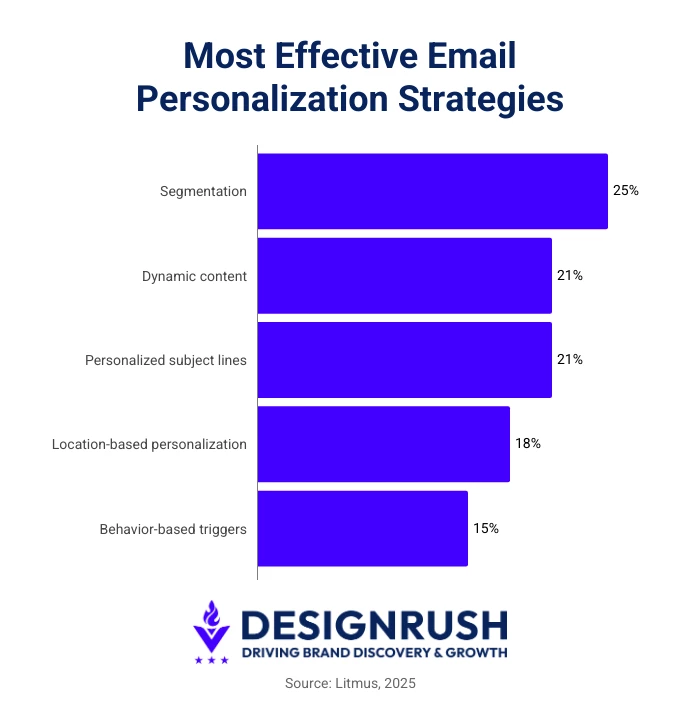
Litmus found that 18% of email marketers considered personalizing email content the most impactful use of AI, while 12% pointed to audience segmentation. That may help explain why 41% reported using generative AI for dynamic written content, including real-time personalization.
 Our own 2026 email marketing benchmark survey put adoption even higher: 87% of marketers now use at least one AI tool in their email workflow.
Some platforms are better than others for copy generation while others shine in predictive targeting, individualized timing, and workflow orchestration. Our comparison of the best AI email marketing tools explains what leading platforms currently offer.
What’s the Difference Between AI Email Automation and Traditional Automation?
Traditional email automation is rules-based in that marketers define the trigger, conditions, and sequence in advance. AI-driven automation can adapt selected decisions, such as timing, audience, content, or the next action, using campaign and customer data.
Factor | Traditional Email | AI-Driven Email |
Segmentation | Fixed lists (e.g., demographics, openers vs. non-openers) | Segments update automatically based on behavior and engagement |
Content | Same message for everyone or a few versions | Dynamic content that adapts to each recipient |
Send timing | Scheduled blasts (e.g., Tuesdays at 10 a.m.) | Personalized timing per subscriber |
Testing | Manual A/B tests | Many variants tested automatically, with traffic shifted to winners |
Optimization | Manual analysis and tweaks per campaign | Continuous optimization as the system learns from results (often using holdout/control groups) |
As Jackie Palmer, VP of Product Marketing at ActiveCampaign, explains:
“Traditional email automation was about drawing boxes and arrows; autonomous marketing is about setting goals and letting AI figure out the next best move.
We’re watching marketers move away from hand-built workflows toward systems that continuously optimize timing, content, and segmentation in real time—turning email from a static schedule into a living, adaptive journey for every contact.”
What Are Core AI Email Automation Use Cases?
- Predictive segmentation & smart targeting
- AI-powered send-time optimization
- Personalized product recommendations
- AI-generated email content & subject lines
- Churn prediction & retention automation
- Automated lifecycle orchestration
1. Predictive Segmentation & Smart Targeting
Instead of grouping subscribers only by static attributes like age or signup source, AI can cluster and score audiences by behavior and intent.
Models can score subscribers on things like conversion likelihood, predicted lifetime value, churn risk, or content preferences, so you create segments such as "likely to purchase in the next 14 days" or "at-risk unsubscribers."
These segments also update continuously as new data comes in, so your targeting stays relevant without manual list maintenance.
In a vendor benchmark based on 3.8 billion cross-channel marketing interactions, Blueshift found that predictive audiences converted 28% better than legacy segmentation. High-propensity audiences were more than 5x as likely to convert as low-propensity groups.
2. AI-Powered Send-Time Optimization
Instead of scheduling a campaign at a fixed time, AI distributes sends across a window based on individual activity patterns.
So, if Alice tends to open emails at 9 a.m. and Bob at 8 p.m., the system can send accordingly within the window and rules the marketer decides.
The impact varies by campaign, so platforms such as Klaviyo use control groups to measure whether personalized timing improves opens, clicks, and orders.
3. Personalized Product Recommendations
AI recommendation engines analyze browsing history, past purchases, and behavior to select product suggestions for individual subscribers.
These blocks often refresh in real time, so each person sees items that match what they're currently interested in. It can be "Customers who browsed X also viewed Y" or "Products you might like."
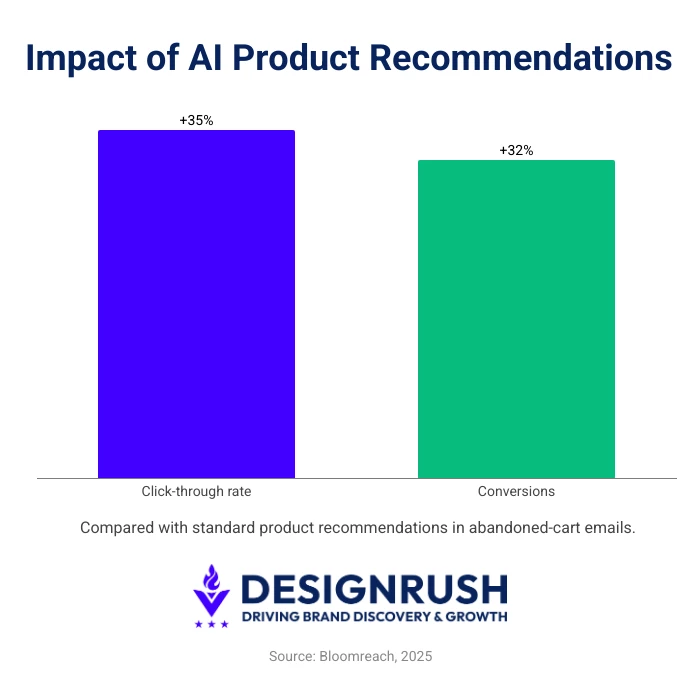 Bloomreach reports that personalized AI product recommendations increased click-through rates by 35% and conversions by 32% in a large furniture retailer’s abandoned-cart emails compared with standard recommendations.
4. AI-Generated Email Content & Subject Lines
GenAI can help draft email copy, subject lines, and preview text from simple prompts. You quickly spin up multiple variations and ideas, which can then be A/B tested.
A Phrasee case study found AI-optimized language produced a 15.8% average open-rate uplift(pdf) and a 31.2% average click-rate uplift for eBay. The program began in 2016, so it’s useful evidence of language optimization rather than a current industry benchmark.
5. Churn Prediction & Retention Automation
AI can identify subscribers who may unsubscribe, lapse, or become inactive by detecting signals such as declining engagement, longer purchase intervals, or reduced website activity.
Once someone crosses a risk threshold, an automated retention flow is triggered. This can be a special offer, re-engagement content, or a survey.
For example, Hydrant used predictive churn modeling to target at-risk subscribers with tailored offers and saw a 260% higher conversion rate on win-back emails and 310% more revenue per retained customer.
6. Automated Lifecycle Orchestration
AI can manage entire email journeys from welcome series and onboarding to post-purchase.
For the ROI side of that lifecycle and which automations earn their place and how to measure them, see how to improve email automation ROI.
Unlike a basic workflow that follows one fixed path, AI can use predicted intent and engagement signals to recommend the next step for each subscriber.
After an onboarding email, for example, it might recommend a tutorial, discount, or survey according to the subscriber's behavior and the controls established by the marketer.
Palmer sees this shift already taking shape:
"In 2026, AI isn’t a ‘nice-to-have’ add-on for email marketers—it’s the baseline. Across our platform, we see teams reclaiming 13+ hours a week as AI agents handle the busywork of building, testing, and optimizing campaigns, while humans stay focused on strategy and storytelling.
The competitive edge now comes from how well you orchestrate AI across the full lifecycle, not whether you use it at all."
AI Agents Extend Lifecycle Orchestration
The next stage of AI in marketing automation involves agents that coordinate connected tasks rather than follow only fixed workflows. Depending on the platform, these agents can analyze data, draft campaigns, and coordinate workflows while marketers retain control over permissions and approvals.
4 Successful Examples of AI Email Campaigns (With Measurable Results)
You’ll see the value of AI email automation when the model changes a specific decision and the result is measured against another approach. The four cases below cover generative AI and campaign production, personalized send times, automated offer selection, and AI-powered product recommendations.
| Brand | Platform | AI Tactic | Vendor-reported result |
| Spark Joy New York | ActiveCampaign | Generative AI and AI-assisted campaign automation | 3× sales volume and 85% faster campaign creation |
| Shady Rays | Klaviyo | Personalized send-time optimization | More than 10% increase in placed-order rates across 30+ email campaigns |
| New York Pizza | Bloomreach | AI offer selection, dynamic assembly, and send-time optimization | 30% higher email CTR and 4% order uplift |
| Five Below | Blueshift | AI-powered product recommendations | 22% sales lift in an A/B test |
Note: These are vendor-reported case-study results. They measure performance improvements rather than complete ROI because implementation, operating, and oversight costs weren't disclosed.AI Email Marketing Strategy: Best Practices for Email Automation
1. ActiveCampaign & Spark Joy New York: AI-Powered Campaigns Triple Sales Volume
Spark Joy New York helps customers declutter their homes through online coaching and courses. As a solopreneur, founder Amy Chinitz struggled to maintain regular contact with prospects because producing a single email campaign could take an entire week.
ActiveCampaign brought lead capture, segmentation, and campaign production into one system. Leads from social ads and webinars enter automated welcome sequences, while tags and behavioral signals determine which follow-up content they receive.
The underlying workflows remain rules-based, but generative AI helps Chinitz draft and build campaigns much faster. Instead of going months without sending new campaigns, she can now produce three AI-assisted emails per week.
ActiveCampaign reports that Spark Joy New York achieved:
- 3× sales volume using AI-powered automations
- 85% faster campaign creation, reducing production time from one week to one day
- Three AI-assisted email campaigns per week
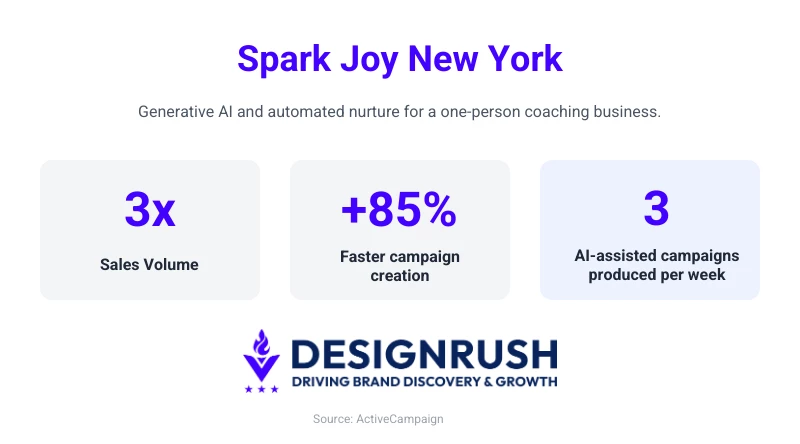
The case separates the two layers clearly: automation manages lead capture, tagging, and follow-up paths, while AI accelerates campaign creation and makes more consistent outreach possible.
2. Klaviyo & Shady Rays: AI Send Times Lift Placed-Order Rates by More Than 10%
Sending every email at the same time assumes subscribers follow similar routines. Shady Rays instead used Klaviyo’s personalized send-time model for campaigns that didn’t depend on a fixed launch or expiry time.
Klaviyo’s model analyzes each recipient’s previous engagement and the behavior of similar customer profiles. It then chooses a delivery time within a window approved by the marketer.
The platform also creates a control group for each campaign that allows the personalized schedule to be compared with a conventional fixed send time.
After testing the feature across more than 30 email campaigns, Shady Rays recorded:
- More than a 10% increase in placed-order rates
- Less manual guesswork around campaign scheduling
- Individualized delivery without changing the underlying campaign content
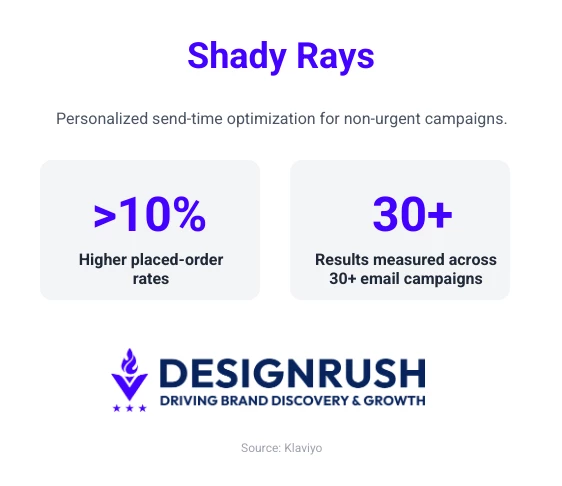 The tactic is great for newsletters, product education, loyalty messages, and other non-urgent campaigns. But flash sales and expiring offers still need a fixed delivery schedule.
3. Bloomreach & New York Pizza: AI-Personalized Emails Lift CTR 30%
New York Pizza operates more than 300 locations, with individual stores choosing which promotions to run. That made generic national emails a poor fit: an offer could be relevant to the customer but unavailable at their preferred location.
The company connected customer and store data through Bloomreach’s Loomi AI. The resulting workflow:
- Identifies the customer’s preferred store, order habits, dietary preferences, and purchase history
- Checks which promotions are currently available at that location
- Selects the offer most relevant to the customer
- Inserts it into the email through a dynamic banner
- Chooses an individual send time within the campaign’s approved window
Bloomreach reports that New York Pizza achieved:
- A 30% increase in click-through rates on locally personalized promotional emails
- A 4% order uplift among customers receiving personalized campaigns
- Automated campaign delivery across more than 300 stores from one workflow
- Several hours of manual creative production removed each week
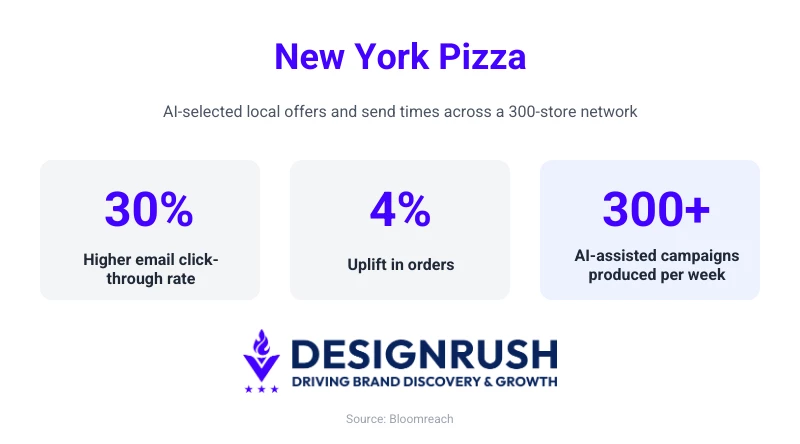 This is closer to full AI email orchestration than a single-point optimization, where the model influences the offer, content assembly, and timing. The marketing team still sets campaign parameters.
4. Blueshift & Five Below: AI Product Recommendations Lift Sales 22%
Five Below wanted to move beyond sending the same promotions to every subscriber without adding more manual work for its two-person digital team.
The retailer brought online and in-store purchase data, browsing behavior, customer personas, and category affinities into Blueshift. Its AI-powered recommendation engine then used those signals to select relevant products for mass emails and automated abandoned-cart, browse-abandonment, and post-purchase flows.
One of the resulting workflows was a three-email browse-abandonment series. Each message showed the product a customer had viewed alongside a different set of related recommendations based on factors such as product category and price.
To isolate the effect of those recommendations, Five Below compared basic image-based emails with emails containing 12 personalized product suggestions. Blueshift reports that:
- The recommendation emails produced a 22% lift in sales
- Personalized recommendations became the most-clicked elements in its campaigns
- The small digital team could build and manage its key lifecycle flows with limited technical support
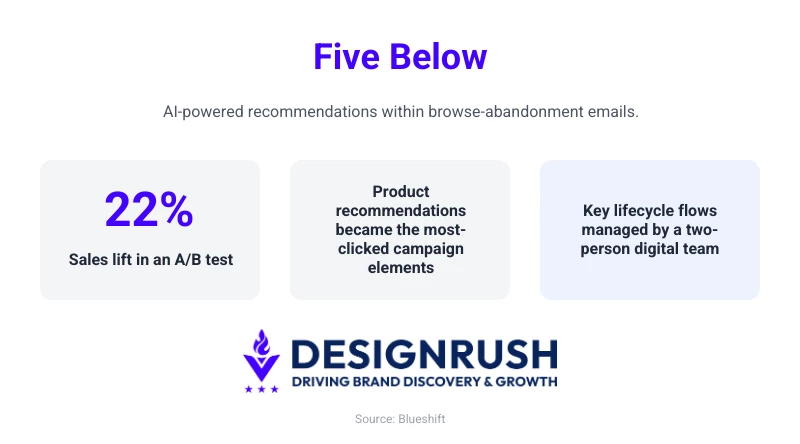 This is a particularly useful example because the AI component was tested against a simpler alternative. The automation still determined when each message was sent, while the recommendation engine improved which products appeared inside it.
AI Email Automation Strategy: Best Practices
AI-driven email requires adapting traditional automation with a clear strategy, relevant data, and human oversight.
- Get your data foundation right
- Automate with care and test often
- Prevent overload and maintain relevance
- Keep human oversight and brand voice
- Measure, learn, and iterate
1. Get Your Data Foundation Right
Before AI can optimize anything, it needs clean, connected data.
Connect your ESP, CRM, eCommerce platform, and analytics tools so first-party signals such as page views, cart additions, purchases, opens, and clicks contribute to a unified subscriber profile.
Then remove invalid addresses and define how inactive contacts should be suppressed or re-engaged to protect deliverability.
Teams that lack the internal CRM, integration, or lifecycle expertise to do this can compare email marketing agencies with relevant implementation experience.
2. Automate With Care and Test Often
Teams should resist the urge to automate everything at once, especially small and midsize businesses.
Will Gordon, Senior Director of Marketing at Nutshell, recommends starting with AI-assisted email sequences, using AI to draft from proven templates while keeping manual control over approvals and workflow logic.
As he puts it, “Small and midsize teams should start with AI-assisted email sequences, using AI to draft from proven templates while keeping manual control over the workflow. The key is to measure success by qualified leads and pipeline impact, not just better-looking email metrics, and only expand AI once those sequences clearly outperform manual ones.”
That kind of measured rollout helps teams test what actually moves revenue before scaling automation further.
It also reflects the broader mindset Leslie Licano, co-founder and CEO of Beyond Fifteen Communications, advocates:
“This rise of AI will continue to make processes all the easier, allowing publicists and marketers across the board more efficient and data-driven. Because AI is not going away, we will need to harness the power of AI carefully and responsibly.”
3. Prevent Overload and Maintain Relevance
Avoid triggering too many emails at once or over-communicating. Cap contact frequency and map workflows so one subscriber is not caught in multiple simultaneous sends.
Balancing personalization with restraint helps protect engagement and unsubscribe rates.
4. Keep Human Oversight and Brand Voice
AI works best when it builds on information your team already knows to be true, not when it tries to sound more familiar than your data supports.
Gordon says the safest and most useful applications rely on grounded CRM context, such as pipeline stage and account history, because that gives AI something real to work from.
But he warns that the line is crossed when automation starts “fabricat[ing] familiarity or assum[ing] uncollected personal details.”
His advice is to treat AI like a junior copywriter: let it produce a strong draft, then keep human review in place so the final send still reflects your brand standards, judgment, and compliance responsibilities.
5. Measure AI Email Automation ROI
Connect email metrics to business outcomes. Successful AI email automation strategies use controls and attribution to determine what the AI changed and whether it produced incremental value.
As Ran Avrahamy, CMO of AppsFlyer, advises:
"Start with the fundamentals: research, testing, and measurement. Then, introduce AI to scale what works.
Once you can identify winning creatives, the next stage is to reveal why they perform, and then extend their impact."
To measure business value rather than engagement alone, compare the incremental profit and labor savings attributable to AI with the total cost of implementing and operating it:
AI email automation ROI = [(incremental gross profit + labor savings − total AI costs) ÷ total AI costs] × 100
Total AI costs should include software, integration, implementation, and ongoing oversight. You should assess ROI alongside unsubscribes, complaints, and discount overuse. Be sure to review model performance and workflow rules as customer behavior, inventory, and seasonal patterns change.
Risks and Limitations of AI Email Automation
As email marketers rely more on AI, it’s important to anticipate the risks alongside the opportunities. Addressing them early helps keep AI useful rather than intrusive or unreliable.
1. Over-Personalization Burnout
Hyper-tailored emails can backfire if they feel invasive, and subscribers may become uneasy or irritated.
Customers may react negatively if AI wrongly infers sensitive details or constantly reminds them of abandoned behavior.
Maintain guardrails on personalization, like no content based on overly personal profiles, and allow easy opt-outs or preference controls to respect user comfort. In short, relevance should feel helpful, not creepy.
2. Data Bias and AI-Generated Inaccuracies
AI is only as reliable as the data and instructions behind it. Biased data leads to skewed targeting, while generative systems produce inaccurate claims or language with harmful stereotypes.
You should use diverse, representative customer and campaign data and carefully review AI-generated content. Regular audits, clear ethical guidelines, and human oversight help keep campaigns fair, accurate, and inclusive.
3. Compliance Drift and Privacy
AI-powered email tools must still comply with GDPR, CAN-SPAM, and applicable consumer privacy laws. A system optimized purely for performance can still produce an unauthorized claim, over-contact a subscriber, or use data in ways the business hasn't properly disclosed.
You’ll need to base AI-driven profiling on lawfully collected and appropriately disclosed data. Document important targeting and suppression rules, review vendor data practices, and give users appropriate control over their preferences
AI in Email Marketing: Final Words
AI is becoming an intelligence layer that can improve decisions across email marketing, from targeting and timing to content and lifecycle orchestration.
A strong automation foundation can already achieve impressive results, as we’ve seen. AI is most useful when predictive or generative capabilities improve a specific decision, and when that improvement is measured against an appropriate baseline.
Use AI carefully to make email more predictive, while people still handle the strategy, judgment, and accountability.