
Email marketing consistently delivers strong returns, but many teams struggle to measure its true impact. Here, I break down how to calculate and evaluate email marketing ROI in a way that supports better decisions.
Measuring Email Marketing ROI: Key Findings
- Email marketing ROI is calculated as (Revenue − Cost) ÷ Cost, but accurate measurement depends on capturing all costs and interpreting results consistently.
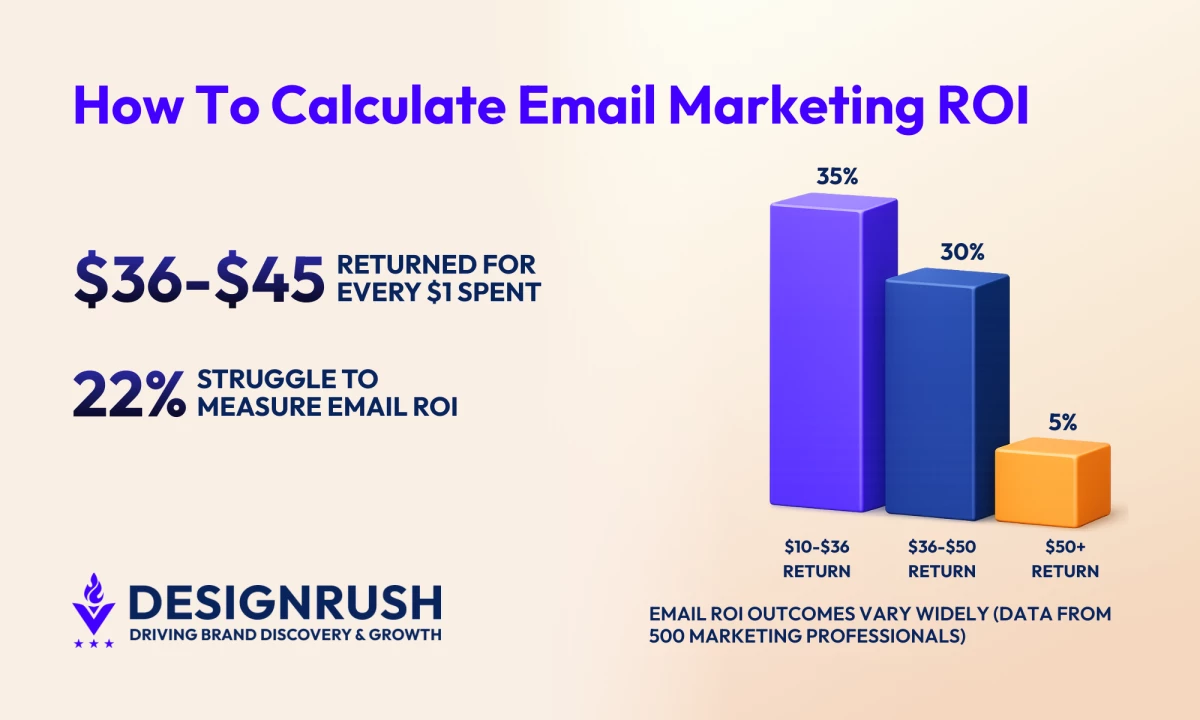
- 22% of teams report challenges measuring email ROI, which is why a consistent method matters more than a perfect one.
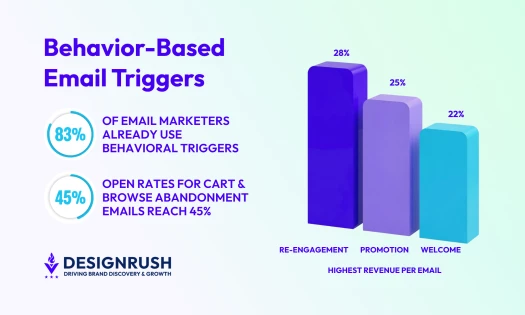
- Behavior-based emails show strong revenue intent, with abandoned cart emails achieving 40-45% open rates and about 21% click-through among opened messages.
Email Marketing ROI: Definition and Benchmarks
Email marketing ROI measures how much revenue your campaigns generate per dollar invested.
Industry benchmarks consistently rank email among the top-performing channels, delivering $36 to $45 in revenue per $1 spent, with conversion rates of around 8%.
That level of return is why it continues to play a central role in revenue-driven marketing strategies.
How To Calculate Email Marketing ROI Step by Step
The steps below break down how to measure email marketing ROI using your own data. By calculating total costs, identifying email-attributed revenue, and applying a consistent formula, you can evaluate performance across your campaigns.
- Step 1: Calculate Your Total Email Marketing Costs
- Step 2: Measure Revenue Attributed to Email
- Step 3: Apply the Formula
Step 1: Calculate Your Total Email Marketing Costs
To calculate email marketing ROI accurately, you need to account for all costs associated with running and maintaining your campaigns.
Many businesses underestimate their spend by focusing solely on platform fees and overlooking other costs.
DesignRush data shows that email marketing projects typically start under $5,000 for 2-6 months and scale to $20,000-$100,000 over 12-24 months as complexity increases.
Programs at the higher end usually include lifecycle automation, CRM integrations, advanced segmentation, and continuous performance testing.
Costs also vary by execution model. In-house email roles generally range from $56,000 to $127,000 per year, while tools alone can cost anywhere from $6.50 to more than $3,000 per month, depending on list size and functionality.
For ROI calculations, your total email marketing costs should include:
- Email platform fees
- Labor, whether in-house, freelance, or agency-based
- Ongoing execution: campaigns, automations, testing, and list management
- Supporting services: design, analytics, or deliverability support
Teams often underestimate email marketing costs and typically forget the following:
- Internal labor time spent maintaining automations and workflows
- Design and copy updates across campaigns
- Deliverability and inbox placement tools
- Time and resources required to manage inactive or unengaged subscribers



Step 2: Measure Revenue Attributed to Email
The second step in calculating email marketing ROI is to identify the revenue generated by email activity. This revenue figure serves as the numerator in your ROI formula, so it should reflect how email drives sales or conversions across your campaigns.
Email-driven revenue generally falls into two categories:
Direct email revenue
This includes purchases or conversions that occur shortly after a recipient clicks through an email.
Direct revenue is most common in eCommerce, promotional campaigns, and behavior-based emails such as abandoned cart or post-purchase offers.
Assisted email revenue
Email also contributes revenue by influencing decisions earlier in the customer journey.
For example, email supports lead nurturing, education, or re-engagement, with the final conversion happening later or through another channel. This type of revenue is common in B2B, SaaS, and longer sales cycles.
Most marketing teams capture email-attributed revenue using a combination of tracking methods:
- UTM-tagged email links: allowing conversions to be associated with email traffic in analytics platforms
- Ecommerce platform integrations: where purchases are logged when users convert after clicking from an email
- CRM and lifecycle reporting: which connects closed deals or conversions back to email touchpoints
For automation-specific ROI tracking, like workflow-level holdout groups, suppression rules, attribution windows, see our email automation ROI guide.
Step 3: Apply the Formula
Once you have your total costs and email-attributed revenue, calculating email marketing ROI comes down to a simple formula:
Email Marketing ROI = (Revenue – Cost) ÷ Cost
Here’s an example calculation. Assume the following for a quarterly email program:
- Total email marketing costs: $12,000
- This includes platform fees, labor, and ongoing campaign and automation work
- Revenue attributed to email: $36,000
- Including both direct and assisted revenue
Using the established formula looks like this:
($36,000 – $12,000) ÷ $12,000 = 2.0
Your email marketing program generated $2 in profit for every $1 spent. To express ROI as a percentage, multiply the result by 100. That equals a 200% ROI.
A positive ROI indicates that email is generating more revenue than it costs to operate. A negative result would show that costs outweigh returns and that further analysis is needed across execution, targeting, or measurement.
What is the average ROI on email marketing? Industry benchmarks often cite returns of 3600% to 4500%, or roughly $36 to $45 generated for every $1 spent.
Those figures provide context, but they are not a substitute for disciplined measurement.
How To Measure Email Marketing ROI Effectively
Measuring email ROI isn’t always straightforward. Litmus’ State of Email 2025 reports that 22% of marketers struggle to measure email ROI.
I treat email like any other performance channel. Measurement should focus on profit, and attribution should inform budgeting decisions.
Actual ROI depends on how costs are defined, how revenue is attributed, and how consistently results are evaluated over time.
Attribution Models and Their Impact on ROI Accuracy
Attribution answers a simple question: which marketing channel gets credit for a sale.
Customers often interact with more than one channel before converting. A buyer might click an email, later return through search, and then complete a purchase.
Attribution models decide how that revenue is credited across those touchpoints. Some models give all credit to the first interaction, others to the last, while multi-touch approaches split credit across the journey.
To show how this works in practice, consider the following illustrative example:
- 100 total orders in a month
- Average order value: $120
- Total revenue: $12,000
- Gross margin: 50%
- Total email program cost: $2,000
Customer journeys for those orders break down as follows:
- 30 orders: Email is the only touchpoint (email → purchase)
- 20 orders: Email first, search last (email → search → purchase)
- 20 orders: Email appears mid-journey (social → email → search → purchase)
- 30 orders: No email interaction
The table below shows how the same revenue and orders are attributed to email under different attribution models:
| Attribution model | How revenue is credited | Email-attributed revenue | Resulting ROI |
| Last-click | 100% credit to the final touchpoint | $3,600 | −10% |
| First-click | 100% credit to the first touchpoint | $6,000 | +50% |
| Linear | Credit split evenly across all touchpoints | $5,600 | +40% |
| Position-based (40/20/40) | 40% first, 20% middle, 40% last | $5,040 | +26% |
| Time-decay | More weight given to later interactions | $5,280 | +32% |
Why This Matters
This example shows how reported email ROI can move from negative to strongly positive without any change in actual sales, simply based on how revenue credit is assigned.
That’s why attribution works best as a budgeting and comparison tool rather than a definitive measure of causation. The most important practice is choosing one attribution approach and applying it consistently across campaigns.
Campaign-Level ROI vs Revenue per Email
Campaign-level ROI measures profitability. It accounts for both revenue and costs, showing whether a campaign generates more value than it consumes.
Revenue per email (RPE) measures efficiency. It helps evaluate creative performance, subject lines, or segmentation by showing how much revenue each delivered email generates.
RPE alone can mislead decision-making. High RPE from small, high-intent segments may look impressive but contribute limited total profit, while broader campaigns with lower RPE can drive far more revenue overall.
Interpreting both metrics together provides a more accurate view of performance.
Factors That Impact Email Marketing ROI the Most + How To Improve It
- Audience Segmentation and Personalization
- Deliverability and Sender Reputation
- Email Design and Mobile Optimization
- Call-to-Action Clarity and Focus
Let’s take a look at the execution factors that consistently determine whether email delivers a strong ROI or underperforms. Improving them requires only better alignment between strategy and execution.
Audience Segmentation and Personalization
Personalization is one of the strongest drivers of email ROI. According to DesignRush’s Mailjet-backed analysis, segmented emails earn 30% more opens and 50% more clicks than generic sends, making relevance a direct contributor to revenue efficiency.
Improving segmentation increases ROI without increasing spend by focusing messages on what recipients are most likely to act on.
Deliverability and Sender Reputation
Deliverability acts as a gatekeeper to ROI. Emails that do not reach the inbox cannot convert, regardless of content quality.
Sender reputation compounds over time as engagement improves, increasing inbox placement and protecting future performance.
Mailjet highlights sender reputation as a compounding factor that improves inbox placement over time as engagement increases.
Key elements that influence deliverability include:
- Sender reputation and authentication
- Subscriber engagement and inactivity levels
- List hygiene and removal or exclusion of inactive subscribers
Maintaining these areas protects both short-term performance and long-term ROI.
As Alex Arnaut, CEO of GlockApps explains:
"Just imagine how your revenue could increase if all your marketing emails get read. I want to emphasize that although content is the king, deliverability can determine the success of your email campaign.”
Email Design and Mobile Optimization
High-performing emails share a few structural traits:
- Clean and uncluttered layouts
- Intentional use of visuals, spacing, and contrast
- Mobile-ready formatting and accessibility considerations
Call-to-Action Clarity and Focus
High-ROI emails are built around a single objective. Effective single-goal emails typically:
- Lead with one primary call to action
- Align copy, visuals, and layout around that action
- Avoid competing links or mixed objectives
This focus improves ROI without increasing send volume.
Final Word: Why Accurate Email ROI Measurement Matters
Accurate email ROI measurement helps teams move beyond surface-level metrics and understand how email contributes to revenue and profitability.
When you measure ROI consistently, email becomes a channel that supports your budgeting decisions and helps you make more confident strategy choices.

Our team ranks agencies worldwide to help you find the right fit. Visit our Agency Directory for the top email marketing agencies, as well as:
- Top UI/UX Design Agencies
- Top Conversion Rate Optimization Agencies
- Top Digital Marketing Agencies
- Top Digital Strategy Agencies
- Top Creative Agencies
Looking for creative inspiration to improve email performance? Explore our Design Awards, featuring the latest winners of best video design.
Email Marketing ROI FAQs
1. How often should email marketing ROI be reviewed?
Typically, email marketing ROI should be reviewed monthly for budget and performance trends, with quarterly reviews used to evaluate longer-term impact from lifecycle campaigns, attribution consistency, and cost structure changes.
2. What is a good email marketing ROI?
A good email marketing ROI is one that is consistently profitable and compares favorably to other channels within your mix, rather than hitting a universal benchmark in a single campaign.
3. How should email marketing ROI be used in budget planning?
Email ROI should guide budget allocation by highlighting which campaign types and programs deliver the most profit relative to cost.