
In 2026, basic email newsletters won’t cut it. To stand out, you need smarter segmentation, AI-driven automation, and lifecycle strategies that turn subscribers into loyal customers.
Email Marketing Tips: Key Findings
- Smaller incentives often earn more. Morphe's smaller signup discount earned 49% more revenue per recipient, and 24S lifted conversion 35% with low-stock alerts instead of discounts.
- Asking beats guessing. thortful's customer-set reminders drive 20% of its sales, and Home Depot Mexico's preference-based content drove 8x the engagement of general content.
- Timing and a second channel close the sale. Woolacombe Bay doubled conversions by adding direct mail to anniversary emails, and e.l.f.'s push reminders helped lift redemptions 58%.
Why Email Still Wins in 2026: 51% of Consumers Prefer It
As ad costs rise and algorithms shift, brands are investing more in channels they own. Email gives you direct access to your audience, full control, and clear ROI.
It's also what customers want. More than half of consumers (51%) say email is their preferred way to hear from brands, ahead of social media and other channels.
To stand out in 2026, brands need to move past batch-and-blast sends and use smarter email marketing strategies using AI, personalization, and lifecycle automation.
Email Marketing Campaign Ideas at a Glance
An email marketing campaign is a planned email or automated series sent to a specific group to prompt one action.
The best-performing ideas include welcome, abandoned cart, product launch, reminder, and loyalty emails. Every example below comes from a published case study.
Here's a quick look at all 10 campaigns and their results.
Campaign idea | Best for | Example brand | Result |
Large lists with a discount-led signup | Morphe | 49% more revenue per recipient from a smaller discount | |
Brands that can't rely on paid ads; products people use up | Goodrays | 40% repurchase rate | |
Luxury or limited-stock retailers | 24S | 35% higher purchase conversion | |
Travel, tickets, and anything with a date | BlaBlaCar | Up to 30% more bookings | |
Launches close to an existing product line | John Frieda | 4.2x average conversion | |
Large catalogs and major sale events | Home Depot Mexico | 8x engagement on personalized content | |
Gifts, cards, flowers, and other occasion-driven purchases | thortful | Reminders drive 20% of all sales | |
Retailers with a rotating daily or weekly offer | KC Tool | 72% open rate; featured tools sell out | |
Loyalty programs with expiring rewards | e.l.f. Beauty | 58% more loyalty redemptions | |
Annual or seasonal repeat purchases | Woolacombe Bay | 2x conversions vs. either channel alone |
Campaigns That Turned Subscribers into First-Time Buyers
A new subscriber is at peak interest for about the first week and a half.
These two campaigns show different ways to convert that interest before it fades:
1. Morphe’s Welcome Email Series: A Smaller Signup Discount Earned 49% More Revenue per Recipient
Campaign idea: Welcome series
Darkroom took over Morphe's email and SMS program in late August 2025. At that point, Shopify sales were down 14.8% quarter over quarter. The welcome series, campaign cadence, and segmentation hadn't been optimized in months.
What they did. Morphe already had millions of subscribers, so instead of growing the list, Darkroom rebuilt the welcome series first and measured it directly against the legacy flow.
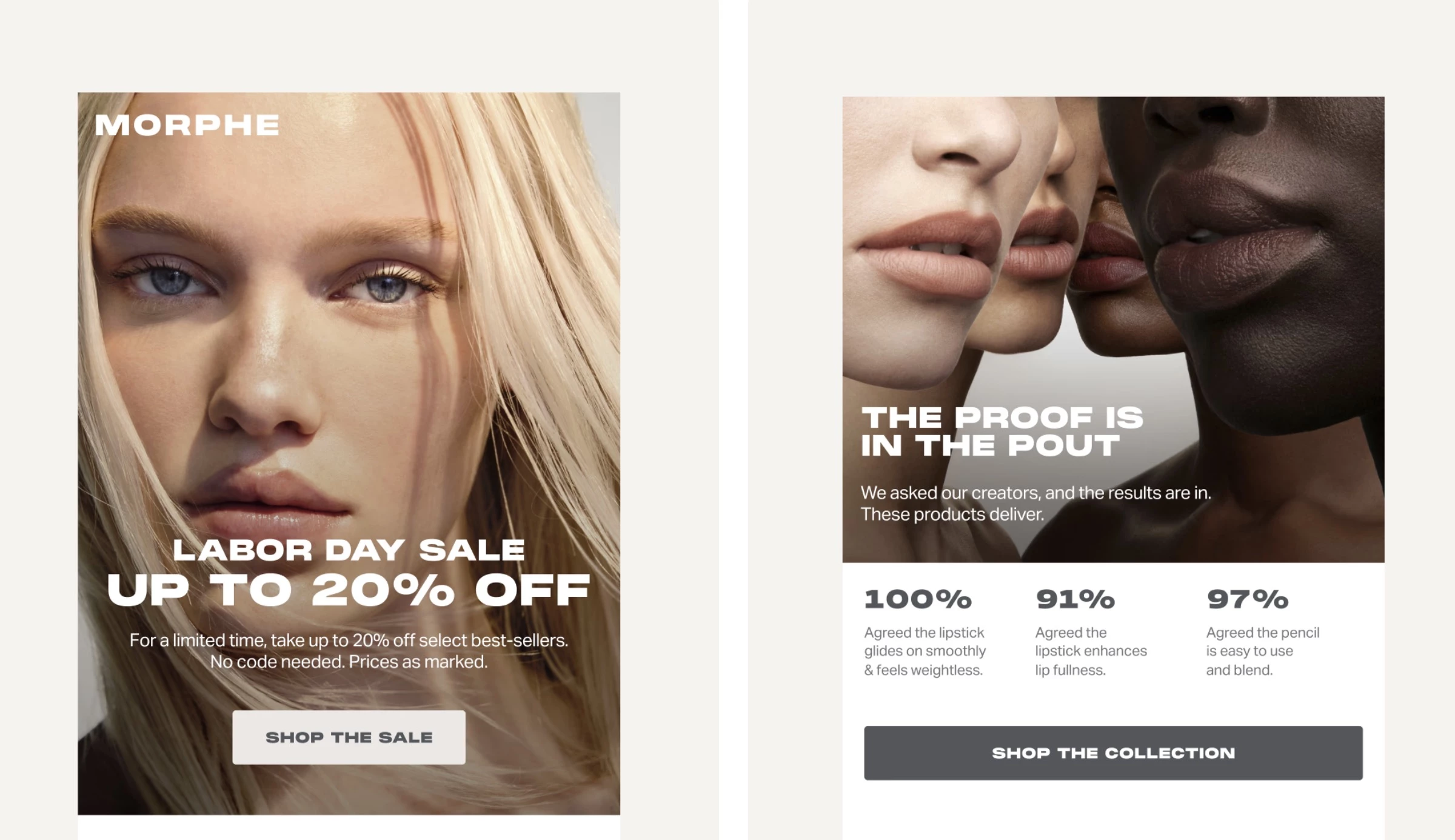
It restructured segmentation to protect deliverability, so more emails reached inboxes. It moved campaigns from a fixed calendar to product launches and promotions.
And it ran A/B tests on revenue per recipient instead of opens, which is why a cheaper discount could win.
The Results:
The rebuilt welcome series beat the old one by 14% on revenue per recipient and 23% on order rate. Darkroom then tested discount depth within the flow, and the smaller offer earned 49% more revenue per recipient.
Retention's share of revenue grew 15% in Q3 even as overall sales fell, and flows now drive 80% of retention revenue.
During Black Friday Cyber Monday 2025, Shopify revenue rose 75% year over year, and email revenue rose 13.4%.
Why it worked (our read):
- Subscribers are already motivated. Someone who just signed up is at peak intent to buy. Make sure your flow catches that moment.
- Deeper discounts mostly subsidize sales you'd get anyway without adding many new orders.
- Test three offers on new subscribers: your current discount, half of it, and no discount with a perk like free samples or early access. Give every offer a real expiry, so people have a reason to act.
- Revenue per recipient captures the trade-off. It accounts for both how many people convert and how much each order brings in. If the cheaper offer won on that metric, any drop in conversion was more than made up by fuller-priced orders.
For subscribers who need a lower price, either let them tell you, or predict it, as Darkroom now does, by adjusting the discount based on each subscriber's likelihood to buy.
2. Goodrays: A 40% Repurchase Rate from Education-Led Emails and Predictive Reorders
Campaign idea: Sign-up form plus welcome, abandonment, and replenishment flows
Goodrays sells premium CBD oils, gummies, and canned drinks in the UK. CBD is regulated there, so the brand can't promote its products through paid search or online advertising. That makes its own channels the main growth engine and makes capturing every site visitor a priority.
Retention matters just as much, since customers typically become regulars after two purchases, and CBD can take 6-8 weeks to work. Many people also wrongly assume CBD will get them high.
What they did. Goodrays optimized its signup pop-up, then sent new subscribers a welcome flow explaining CBD and its products, plus an introductory discount.
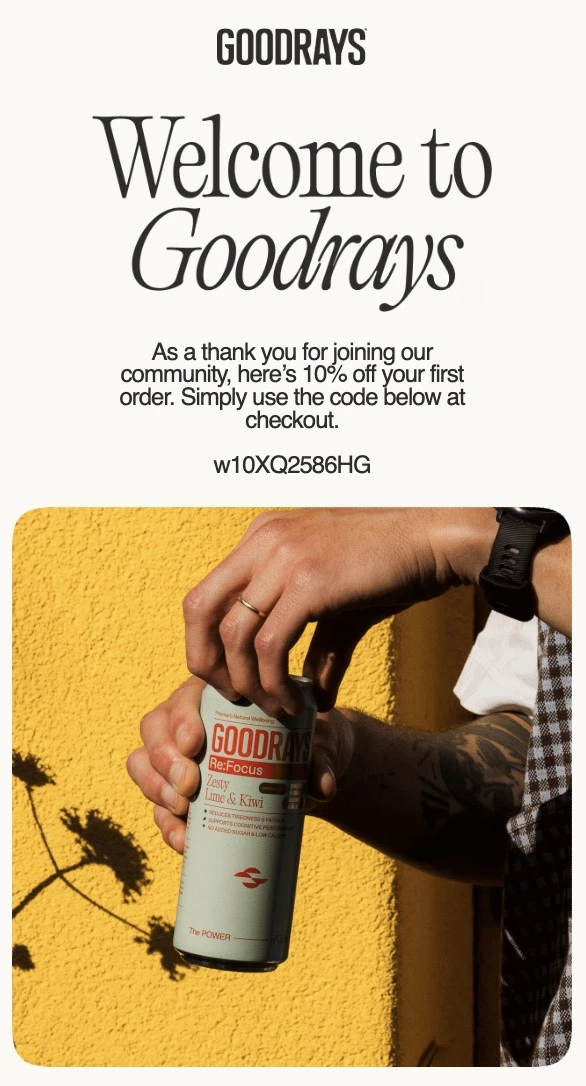
Abandonment emails featured products shoppers had viewed. For reorders, Relo, an AI app synced to Klaviyo, predicted when customers would run low and triggered an email with a pre-filled cart – a glimpse at how AI email campaign ideas are reshaping reorder flows.
The Results
- The pop-up converted 10.2% of the people who saw it, about twice the average, and the list doubled in a year.
- The first welcome email converted at 9.7%.
- The abandoned checkout flow converted at 8.3%.
- Automated flows drove 69% of email revenue, and email drove 53% of online revenue.
- The repurchase rate reached 40%.
Why it worked (our read):
- Every visitor counted, since without paid ads, lost visitors were hard to reach again.
- Education protected the second order by explaining CBD effects and setting realistic expectations. If your product takes time to work, explain in the welcome and post-purchase emails when customers should expect results, and repeat it before the first order runs out.
- Reorder emails arrived at the right time, and the pre-filled cart removed almost all the effort of buying again. Time reorder emails to when customers run low, using a predictive tool like Relo or sending a few days before a typical order runs out


Campaigns That Recovered Abandoned Carts and Bookings
Around 70% of online carts are abandoned, according to the Baymard Institute.
Both of these brands treated an unfinished purchase as a signal and sent a message that matched what the shopper had been doing, not a generic "you forgot something."
3. 24S: Low-Stock Cart Alerts & Back-In-Stock Emails Lifted Purchase Conversion by 35%
Campaign idea: Abandoned cart low-stock alerts and back-in-stock confirmations
24S is LVMH's online luxury retailer, carrying more than 60 brands and aiming to match the personal service of a luxury store.
It wanted more first and repeat purchases, but its email, mobile, and recommendation tools ran on separate systems.
What they did. After moving everything to Braze, it built triggered campaigns around points of friction:
One campaign emails shoppers who abandoned a cart in the past 30 days, but only when an item in it is running low. 24S synced stock levels to Braze so emails only send when stock is low, and excludes select premium brands.
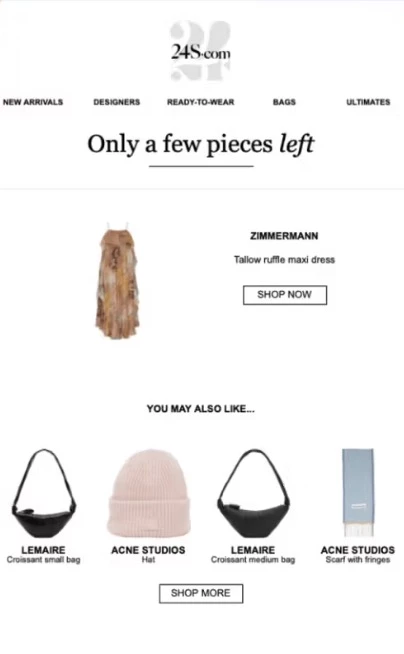
The second adds four AI-picked product recommendations to back-in-stock confirmation emails.
The Results
Over six months, the low-stock campaign raised three-day purchase conversion by 35%, and the back-in-stock confirmation lifted add-to-cart rates by 7%.
Why it worked (our read):
- The alert is true when it arrives. It only sends when stock really is low, so shoppers learn to trust it.
- It reads as a heads-up. Telling someone a piece they liked is almost gone feels like a helpful store associate, which suits a luxury brand better than another "you forgot something" reminder.
- The confirmation email became a sales moment. Most brands send a plain "we'll let you know." 24S used that moment, when the shopper has just shown clear interest, to suggest alternatives they could buy right away.
4. BlaBlaCar: Personalized Abandoned Booking Emails Lifted Bookings by up to 30%
Campaign idea: Abandoned booking flow by email and push, with paid retargeting
BlaBlaCar is a carpooling and bus platform with more than 100 million members in 22 markets. It noticed that many users searched for a trip and left without booking.
Its old tool could only send email, so after moving to Braze, the team built a cross-channel journey treating unfinished bookings like abandoned carts.
What they did. BlaBlaCar waited about an hour before messaging, dropping anyone who booked on their own.
Remaining users were split into carpool, bus, and other searchers, and carpool and bus searchers received an email and push notification naming the location they'd searched for.
Wording matched the real-time search since they browsed; a holdout group measured the program's impact, and users who still didn't book were retargeted through Facebook and Google ads.
The Results
The program significantly lifted bookings against the control group, though Braze’s case study gives no figure.
Personalized messages lifted click rates by up to 48% and bookings by up to 30% compared with basic versions.
Why it worked (our read):
- Wait before messaging. Users who started a booking were held for a short window, about an hour, to see whether they would book on their own. Anyone who did was dropped from the flow.
- Specific beats generic. Users who didn't book were split into three groups: carpool searchers, bus searchers, and everyone else. Each group got its own messages. Personalization drove the largest measured gains.
- Measure against a control. A holdout group received no messages, so the program's effect could be measured. Separate tests compared personalized and basic versions.
- Hand off to paid ads. Users who still didn't book were synced to Facebook and Google audiences for retargeting.
Campaigns That Won Product Launches and Big Sale Events
Both brands decided who got which message before the launch or sale started, instead of emailing the whole list.
5. John Frieda: Early-Access Launch Emails to Similar-Product Buyers Hit 4.2x Average Conversion
Campaign idea: Early-access product launch emails to buyers of a similar product line, supported by paid social
John Frieda, a KAO-owned haircare brand, was launching ULTRAfiller+, a thickening system for thin hair. It wanted to sell direct before the product reached stores like Walmart and learn which customers it suited best.
Blue Wheel, one of several US email marketing agencies known for DTC launch work, built an automated email program, with paid social driving traffic to the site.
What they did. Blue Wheel found that buyers of John Frieda's Volume Lift line were also interested in ULTRAfiller+, so they got an exclusive offer before the retail launch.
A months-long sequence followed, starting with a launch email and two emails comparing the new line with Volume Lift.
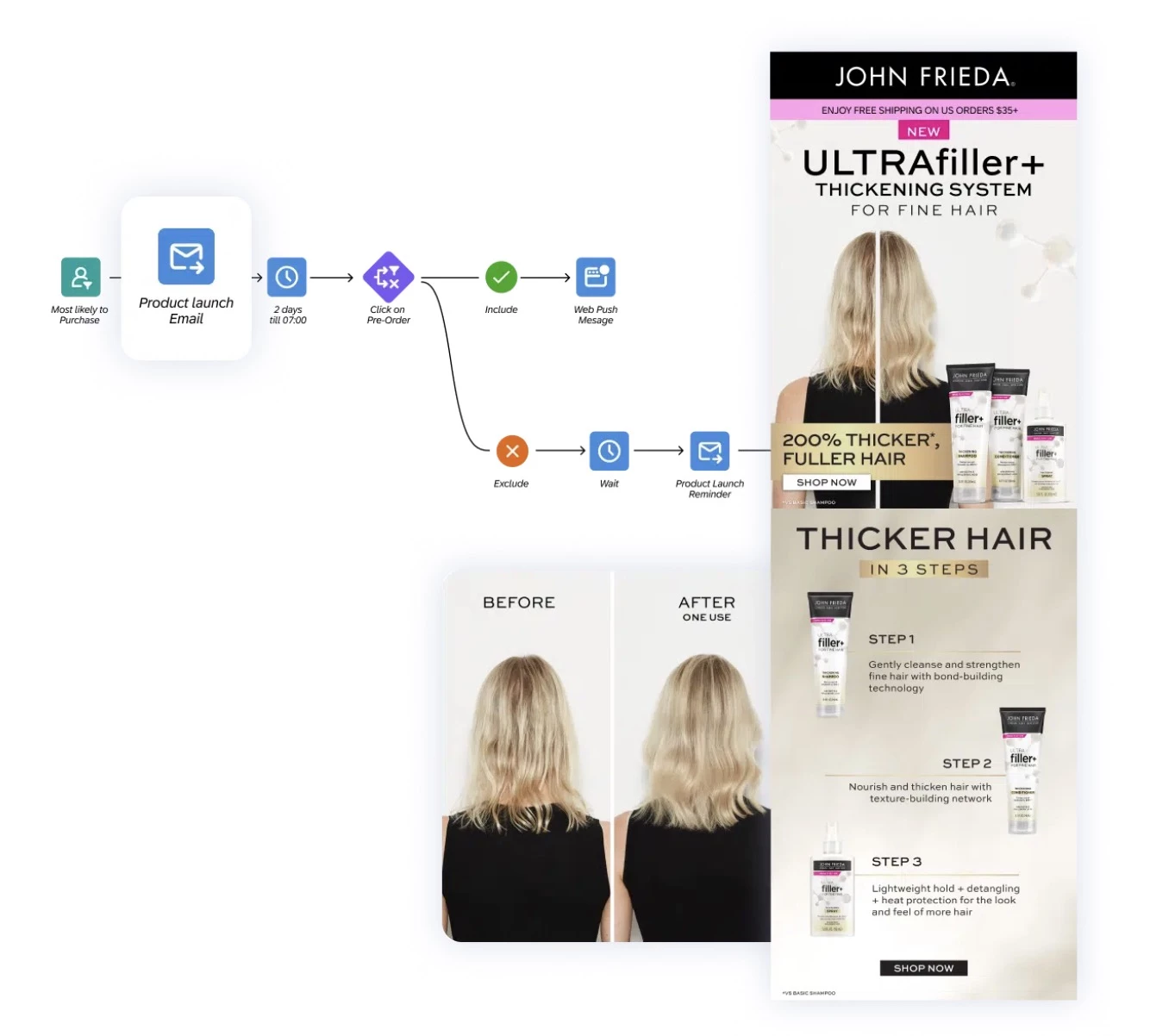
Closer to launch, emails added before-and-after content and a review survey, then replenishment emails pointed early buyers to stores after 30-45 days. Each email placed before-and-after images and short reviews near the top, with one clear call to action.
The Results
Compared with John Frieda's usual emails, the launch emails achieved:
- 4.2x the average conversion rate
- 1.6x the average click rate
- 2x the click-to-open rate of a launch without this build-up
- 4x the usual number of contacts reached
Across the full launch, more than 88% of buyers bought two or more products from the line.
Why it worked (our read):
- Buyers of a similar product were the warmest audience. Volume Lift customers already cared about volume and trusted the brand, so they needed less persuading. Use purchase data to find buyers of the product closest to your new one.
- No purchase history for a category? Ask one question in your welcome or post-purchase email, such as hair concern, skin type, or use case.
- Comparison emails prevented confusion by answering "Why switch?" upfront. If your new product sits near an existing one, explain how they differ and who each is for.
- Early access via email before the wider launch made the offer feel exclusive without a deep discount.
6. Home Depot Mexico: Preference-Based Hot Sale Emails Drove 8x Engagement
Campaign idea: Pre-sale interest form and customer questions for a major sales event
Hot Sale is Mexico's biggest online shopping event, and Home Depot Mexico's sales grow three to five times during it. But many Mexican shoppers were still wary of buying online, worried about safety, ease of use, and delivery.
Home Depot worked with SAP on a plan built around learning what each customer wanted.
What they did. First-time online buyers received a week-long welcome series introducing the company and explaining payment, credit options, and delivery.
Follow-up emails asked about their hobbies, favorite room, and reasons for shopping, then shared project ideas.
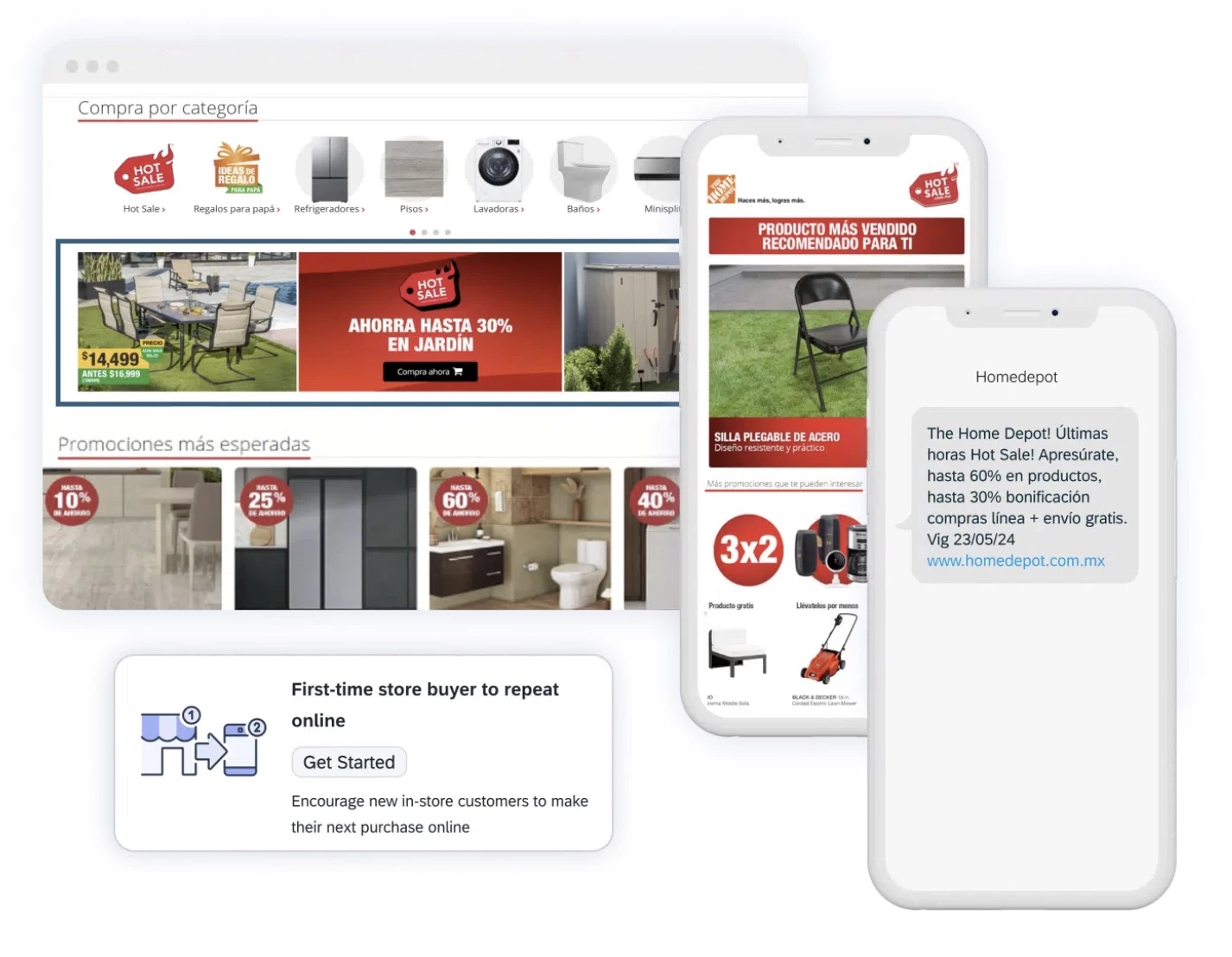
According to SAP's blog, sign-up forms also asked shoppers which categories they wanted for Hot Sale, promising day-one deals in those areas. Customers then received daily emails with personalized content on current trends.
The Result
- Personalized content drove 8x more engagement than general content.
- Conversion rates rose 5% during peak seasons.
- Sales grew by double digits during peak seasons.
Why it worked (our read):
- Asking beats guessing for a huge catalog. Home Depot sells everything from paint to fridges. Without knowing what someone is planning, most deals in a sale email are irrelevant to them.
- Add a category question to your sale landing page and sign-up forms. Send a day-one email for each category, with general deals as a fallback for anyone who didn't choose.
- Profiling started before the sale. Build profiles year-round. Add one or two questions to your welcome series, such as hobbies, projects, or favorite room, so you have data before peak season starts.
- Education built trust. For shoppers wary of buying online, explaining payment, credit, and delivery mattered as much as the deals. Explain the basics to first-time online buyers.
Campaigns That Drove Repeat Sales
Once someone has bought, the job changes from persuading them to giving them the next relevant reason to buy, timed to when they need you.
7. thortful: Self-Set Reminder Emails Drive 20% of Sales
Campaign idea: Customer-requested occasion reminders, preference choices, and purchase-cycle triggers
thortful is a UK online greeting card marketplace that connects customers with independent designers. Its purchase frequency was falling, but cards are bought for specific occasions, so marketing to someone with nothing coming up rarely works.
Timing had to be right, and some dates are sensitive, so the brand needed a way to avoid them without sending awkward opt-out emails.
What they did. thortful built a Reminders Program where customers save important dates, like a partner's birthday, and get a reminder only if they ask for one.
For customers who don't save dates, Bloomreach's AI sends a reminder when they go past their usual buying cycle, using wishlists, purchase history, and searches. Paid ads ran alongside the reminders, and thortful also tested a stamp card to encourage repeat purchases.
The Result
- The Reminders Program drives 20% of all thortful sales.
- Customers have shared 10 million data points about their occasions and preferences.
- The stamp card test group showed 16% higher customer value and 2% higher purchase frequency.
Why it worked (our read):
- A requested reminder is a service, not marketing. It arrives just as the customer needs a card, so the message and the moment to buy line up.
- Ask customers for one date that matters to their purchase, such as a birthday. Let them choose how far ahead to hear from you.
- Silence on sensitive dates protects trust. Letting people quietly turn off occasions they find painful keeps the reminders welcome. Add a one-click way to skip particular occasions.
- The purchase-cycle trigger reaches everyone else. The AI trigger covers people who never did, so the program doesn't depend only on what customers volunteer.
- The data builds up over time. Every saved date is a future sale opportunity that needs no new targeting work.
8. KC Tool: "Tool of the Day" Deal Email Gets 72% Opens and Regular Sellouts
Campaign idea: Automated daily deal newsletter
KC Tool is a hand tool distributor whose older customers often aren't on social media, making email the best way to reach them and send them straight to the store.
The brand needed to promote its "Tool of the Day," a 24-hour sale on one tool, without building an email every morning.
What they did. KC Tool built a template that MailerLite fills in automatically whenever the featured tool changes on the website, then sends it at a set time each day.
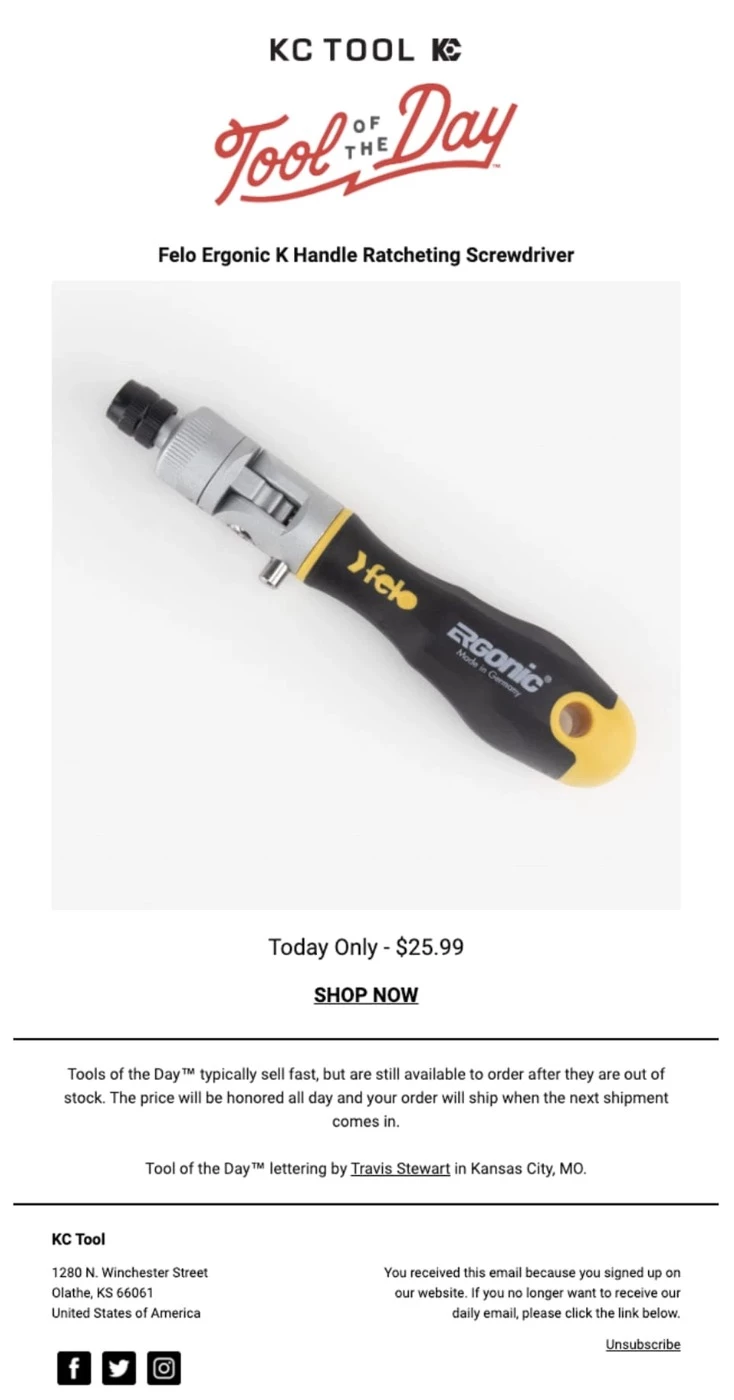
People sign up for it separately and get a welcome email explaining what to expect, with a link to the current deal. Setup took about a week, and it has needed no daily work since.
The Result
The daily email averages a 72% open rate and about a 7% click rate, and featured tools often sell out.
Why it worked (our read):
- Subscribers knew exactly what they signed up for. Every daily send delivered on the welcome email's promise, so readers recognized it instantly.
- Give one recurring email a fixed name and time slot, like "Deal of the Day," with its own opt-in. Use the welcome email to say what's coming and when, and link to the current deal.
- The offer creates real urgency. One tool, one day, limited stock gives people a reason to open today. Base it on something real that changes on your site, such as a daily deal or restock.
- Automation made a daily send sustainable. Fill the email automatically from an RSS or product feed, so it updates whenever the site does.
Campaigns That Brought Customers Back
Customers who drift away rarely come back on the brand's schedule.
These two reached them at the moment they were most likely to return: before a reward expired, and around the anniversary of their last trip.
9. e.l.f. Beauty: Rewards Emails Plus Push Reminders Helped Lift Redemptions 58%
e.l.f.'s Beauty Squad loyalty program has more than 5.3 million members. As of March 2024, members drove almost 80% of website sales and had 166% higher lifetime value than non-members, according to Glossy.
Its monthly rewards recap email took manual work to send each month, which no longer scaled, and e.l.f. wanted to add SMS and push alongside email.
What they did. e.l.f. first used in-app messages to invite engaged app users to turn on push notifications, with up to 23% opting in.
It then turned the recap into a two-step journey for US members: the email goes out first, and a push notification follows a couple of days later, reminding them to redeem time-sensitive rewards.
The Results
Loyalty redemptions rose 58% from 2023 to 2024, with the push follow-up named as one contributing factor.
Why it worked (our read):
- Rewards that expire unused don't build loyalty. The reminder catches members before they lose a reason to come back. Send a second touch two or three days after your monthly rewards email, focused on one reward and its expiry date.
- A different channel gets noticed. Push reaches members who saw the email and forgot to act. Use each member's best channel: push for app users, SMS for text subscribers, short email for everyone else.
- The groundwork made it possible. e.l.f. had already built a base of members opted in to push. Ask engaged customers to opt in to push or SMS, and tell them what they'll get, such as reward alerts.
10. Woolacombe Bay: Anniversary Emails Plus Direct Mail Doubled Conversions
Campaign idea: Purchase anniversary and abandonment emails, paired with automated direct mail
Woolacombe Bay Holiday Parks is a family-owned caravan and camping business with three parks in North Devon, England. Its guests range from budget campers to luxury lodge visitors, so one message for everyone didn't work.
It needed to tailor messages across email, SMS, web, and direct mail without overloading a small team, and its direct mail was still sent manually in batches.
What they did. Woolacombe Bay segmented guests by type, like families or couples, using booking, browsing, and stay history.
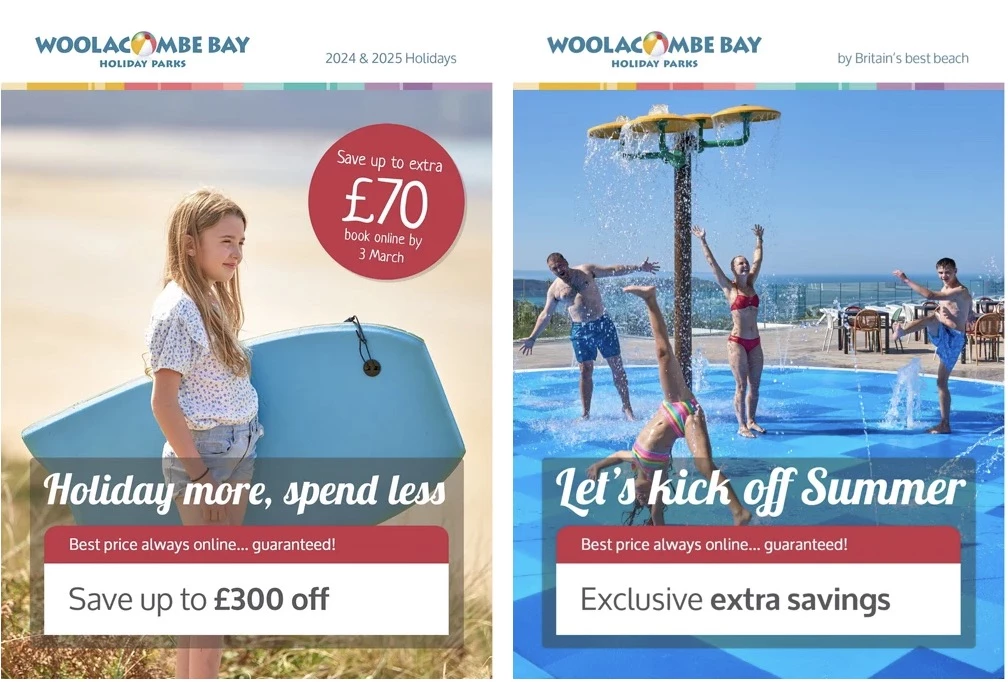
Personalized recommendations appeared across every channel, and direct mail was sent automatically alongside key emails, like purchase anniversary and browse abandonment. Cart abandoners not on the email list got direct mail instead.
The Result
Anniversary campaigns using email plus mail converted at 5.43%, double either channel alone.
Browse abandonment conversion rose from 14.49% with email alone to 23.96% with both, and average order value grew from £544 to £604.
Why it worked (our read):
- The anniversary is a natural planning moment. Families start thinking about this year's trip around last year's dates, so a reminder feels well timed. Find your natural repurchase date, such as a trip anniversary or seasonal purchase, and trigger a campaign before it.
- Mail stays in the house. A mailer on the kitchen counter reaches the whole household, which matters for a shared decision. For high-value customers, add a postcard to the email.
- The backup reaches people email can't. It turns cart-abandoners who aren't on the email list into one of the highest-converting audiences. If a high-value cart abandoner hasn't opted in to email, send a postcard instead.
10 Email Marketing Best Practices To Make Any Campaign Work
A good campaign idea still fails if the email doesn't reach the inbox, can't be read on a phone, or gets judged by the wrong number.
These fundamentals decide whether the campaigns above pay off:
- Segment by pipeline stage
- Personalize beyond the first name
- Write subject lines people recognize
- Give every email one call to action
- Design for the phone first
- Re-engage before you remove
- Set up SPF, DKIM, and DMARC to protect deliverability
- Coordinate channels instead of repeating them
- Build for quality, not volume
- Measure what connects to revenue
1. Segment by Pipeline Stage
Generic emails rarely drive engagement, but segmenting your subscribers by purchase history, browsing behavior, and engagement does.
Will Gordon, Senior Director of Marketing at Nutshell, says the bigger mistake is treating email as separate from sales.
In his view, the strongest segmentation signal is often where a prospect actually sits in the pipeline, because "knowing someone moved to a demo stage is far more valuable than tracking simple email opens."
He adds that when teams use CRM data to trigger journeys based on deal movement, they're much more likely to send the message a person actually needs next.
2. Personalize Beyond the First Name
Personalized emails can boost sales by 22%, but only when they reflect real behavior. For instance, Home Depot Mexico's personalized content drove 8x the engagement of its general content, but only because it reflected what each customer had told the brand.
Use dynamic content to show relevant products or rewards, pair it with compelling visuals, and match the message to each stage of the journey.
A new subscriber needs an introduction, while a repeat customer may respond better to perks.
3. Write Subject Lines People Recognize
Clarity usually beats cleverness. Aim for six to nine words so the line fits a mobile inbox, and use the preheader for extra detail, such as "Plus free shipping over $50" under a sale announcement.
For recurring emails, a predictable subject line builds an opening habit. A/B test one element at a time, so you know what made the difference.
4. Give Every Email One Call to Action
When an email asks for three things, readers usually do none of them.
Guide them toward a single action with specific button text like "Get 20% off" or "Book your spot," which lifts your click-through rate more than a vague "Learn more."
For instance, John Frieda's launch emails each carried a single call to action, placed right after the before-and-after images and reviews.
5. Design for the Phone First
ZeroBounce reports that more than 60% of emails are opened on mobile, so take a mobile-first design approach.
Use a single column, body text of at least 14px, buttons at least 44 by 44 pixels, and a width under 600px.
Optimize images so they load quickly, add alt text, write link text that makes sense on its own, and preview in dark mode.
6. Re-Engage Before You Remove
Gordon says brands should look at what people stopped engaging with before reducing frequency.
As he explains, "If they ignored three product update emails but clicked on an industry insights piece, you should shift them to more educational content."
Instead of a simple stay-or-unsubscribe choice, you adjust the content mix based on actual behavior before the subscriber tunes out. Remove anyone who stays inactive after several attempts.
Timing helps too: Woolacombe Bay's anniversary emails reach past guests at the moment they start planning their next trip
7. Set Up SPF, DKIM, and DMARC To Protect Deliverability
Poor email deliverability leads to low open rates and a damaged sender reputation.
SPF, DKIM, and DMARC let mailbox providers verify your emails. Also, clean your list regularly and use double opt-in.
8. Coordinate Channels Instead of Repeating Them
Promote email-only offers through social media campaigns, retarget non-converters with paid ads, and repurpose content marketing into nurture emails.
Jackie Palmer, VP of Product Marketing at ActiveCampaign, says cross-channel intelligence will define best-in-class email marketing in 2026:
"The highest-performing programs we see no longer treat email, SMS, and WhatsApp as separate channels — they treat them as a single, orchestrated conversation.
Email still carries the narrative and the depth, but real-time signals from SMS, transactional events, and messaging apps feed back into one autonomous system that decides where and how to follow up next."
Give each channel a distinct job, so customers don't get the same promotion by email, text, and push on the same afternoon.
e.l.f. and Woolacombe Bay show this in practice: each second channel, push for e.l.f. and direct mail for Woolacombe Bay, had its own job and reached people the email hadn't.
9. Build for Quality, Not Volume.
Sending too often and rushing work both hurt customer engagement.
Use modular templates to move faster, and before every send, check links and codes, confirm your unsubscribe link and compliance details, and test in at least two email clients.
10. Measure What Connects to Revenue
Open rates have become unreliable since Apple Mail Privacy Protection began registering many emails as opened automatically, so treat them as a rough signal at best.
The email marketing metrics that matter more are click-through rate, conversion rate, revenue per email, and unsubscribe rate.
Gordon says the metrics that matter most connect email to revenue, including "email-to-reply, email-to-meeting, and campaign-attributed deals."
When that data flows into the CRM, sales can see which campaigns drive qualified interest and act faster.
As he puts it, the real shift happens when marketing and sales share a dashboard and measure pipeline impact rather than just email activity.
Morphe judged its discount tests on revenue per recipient, and BlaBlaCar measured its program against a holdout group that got no messages, which is the only way to know the email caused the result.
Getting this right is what separates busywork from email marketing ideas that drive ROI.
Email Marketing Ideas: Final Thoughts
The pattern across these ten campaigns is consistent. The winners didn't send more email or find a cleverer subject line, but they learned something about the reader first, whether that was a preference, a date, a stock level, or a purchase history, and then sent the message that matched it.
Pick the group above that matches your biggest gap, copy the mechanism rather than the design, and measure the result against a comparison group so you know the email did the work.
Building that kind of program takes strategy, data, and testing discipline, which is why many brands bring in an experienced email marketing agency.