
We’ll break down what businesses spend in 2026, including real pricing ranges, hourly rates, timelines, and hidden costs, so you can determine the right investment for your goals.
SEO Budgeting: Key Findings
SEO Costs: A Quick Breakdown
1. SEO Services for Small Businesses
2. SEO In-House vs. Outsourcing
3. How to Define SEO Goals
4. How To Maximize SEO ROI
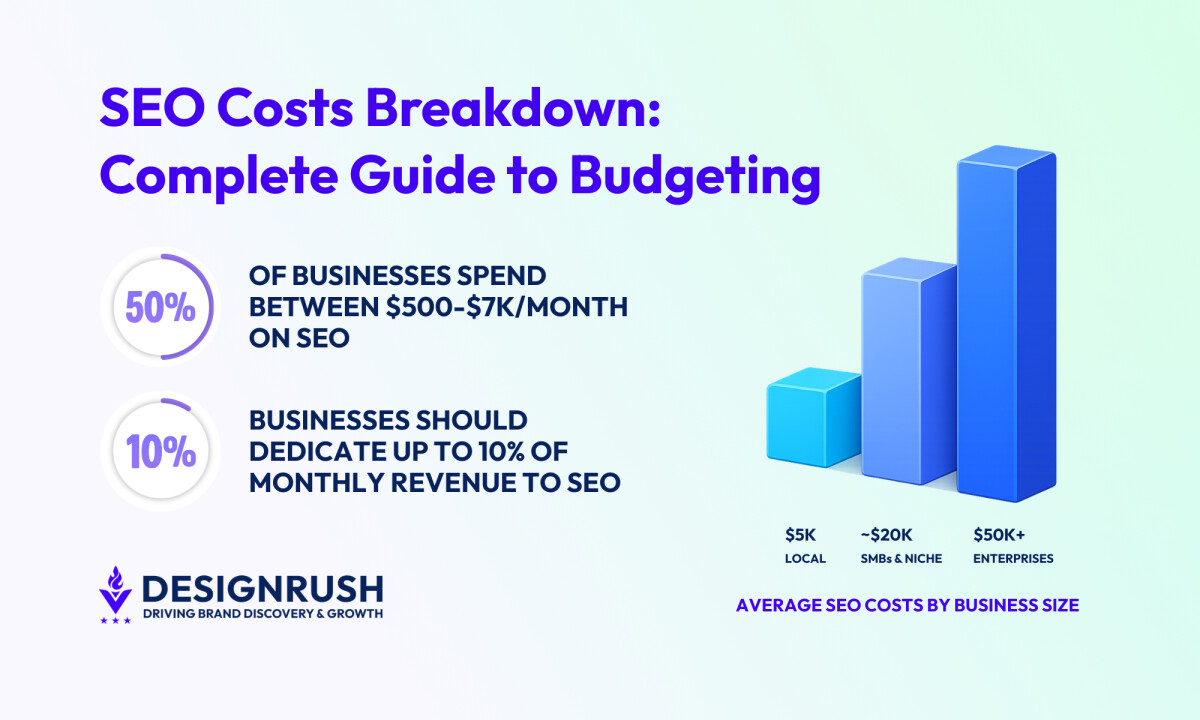
In 2026, 50.8% businesses spend between $500 and $7,500 per month on SEO.
Budgets can range from a few hundred dollars per month for small local campaigns to six-figure monthly retainers for global enterprises.
In practice:
What Determines SEO Costs?
1. Service Model: In-House vs. Agencies
Who manages your SEO strategy significantly impacts pricing. Businesses can choose between SEO agencies or in-house teams, each with different costs and expertise.
In-House Costs
Hiring internally gives you control and brand knowledge, but it comes with high fixed costs that go far beyond salaries:
- Top SEO specialists earn between $65,000 and $100,000 annually.
- Benefits and taxes add another 30% on top of base salaries.
- Software licenses, hardware, legal and administrative fees, and even small office stipends can add 10–25% costs.
- SEO tools alone can run $500–$1,500 per month per user (JVG Labs).
You should also expect at least three to six months before a new hire delivers ROI.
Turnover is another hidden cost. Losing a specialist mid-project can delay campaigns by months and cost half a year’s salary to replace.
Not to mention, even after paying for salaries and tools, most companies still rely on freelancers or agencies for specialized tasks like link-building or technical audits.
SEO Agency Costs
Agencies work differently. Instead of fixed salaries, you pay for immediate access to expertise and execution. This is across content, technical SEO, and link-building. You can also scale up or down without taking on new salaries.
The main drivers of agency costs are scope, speed, content volume, technical complexity, and specialization.
Here’s what we’ve gathered from our data:
Business Size | Budget Range | Avg. Hourly Rate | Avg. Timeline |
Local & small businesses | Under $5K | ~$40/hr | ~6 months |
SMBs & niche brands | $5K–$20K | ~$75/hr | ~7 months |
Mid-market / specialized brands | $20K–$100K | ~$115/hr | ~10 months |
$100K–$250K | ~$125/hr | ~12 months |
The downside is that they have less familiarity with your brand, and quality can vary depending on the team assigned.
Side-by-Side Comparison: In-House vs. Agency Costs
The right choice depends on whether you need speed and expertise immediately or tight integration and control.
Category | In-House SEO | SEO Agency |
Cost model | High fixed salaries + overhead | Flexible retainer or project-based fees. 75% of SEO agencies use monthly retainers
|
Typical cost |
| $5K–$250K depending on scope and business size |
Tool costs | $500–$1,500/month per user | Included |
Time to ROI | 3–6 month ramp-up | Immediate execution |
Turnover risk | High disruption and replacement cost | Managed internally by agency |
Expertise | Usually one primary specialist | Multi-person specialist team |
Best For | Long-term integration and strategic control | Speed, breadth of expertise, and flexible growth |
2. Industry Competition and Niche
SEO is relative. Meaning, your results depend on what competitors are doing.
In “easy” niches with little content competition, a modest SEO effort can yield quick wins.
In contrast, markets like legal, finance, or SaaS often demand continuous high-quality content and premium backlinks just to compete.
For example, local plumbers might rank on citations alone, but a national tech brand needs an extensive strategy.
Based on DesignRush’s data:
Industry | Budget Range | Median Hourly Rate |
General | Under $5K | $40/hr |
$5K - $20K | $125/hr | |
Construction & Industrial | $5K - $20K | $125/hr |
$20K - $100K | $112/hr | |
SaaS & Tech | $5K - $20K | $125/hr |
$20K - $100K | $125/hr | |
$20K - $100K | $125/hr | |
Entertainment & Media | Under $5K | $38/hr |
The market dictates investment. And so, underfunding SEO in competitive industries results in stagnation, while overfunding without a strategy risks waste.
3. Scope of SEO work
SEO is a bundle of services. It involves systems working together, including technical optimization, content creation, authority-building, conversion optimization, and analytics.
A simple local package including GBP management and some page optimizations costs much less than a full-scale program that needs deep technical audits, 15+ monthly blog posts, PR-driven link-building, etc.
Budget Range | Focus Areas |
Low ($5K–$20K and Under $5K) |
|
Mid ($20K–$100K) |
|
High ($100K–$250K) |
|
Bundling everything costs more initially, but it also ensures no gaps. Many businesses end up spending piecemeal and getting piecemeal results.
4. Website Size and Content Needs
The size and complexity of your website directly affects how much work is required. A 10-page brochure site is relatively simple to audit and optimize.
According to DesignRush’s data:
Website | Budget | Hourly Rate | Timeline |
Small store / Shopify site | $5K–$20K | $50–$90/hr | 3–6 months |
Medium e-commerce/niche store | $20K–$100K | $125/hr | 3–6 months |
Large e-commerce/high-product inventory | $20K–$100K+ | $125/hr | 6–11 months |
A 10,000-product e-commerce store requires careful management of crawl budgets, internal linking, faceted navigation, and structured data.
More pages mean more on-page work, more internal links to manage, and often more content to create or refresh.
5. Current SEO Health and Technical Debt
A website’s technical foundation impacts how well it ranks on search engines.
If a site has a messy codebase, slow speed, or crawling errors, fixing these technical issues can require significant developer time, which can increase SEO costs.
- Well-structured websites: Less hands-on cleanup on technical SEO, such as on-page optimizations, schema markup, and internal linking.
- Websites with technical issues: Need site audits, speed optimizations, mobile-friendliness improvements, and backend fixes, leading to higher costs.
Even the best content and outreach efforts will underperform on a site with foundational technical issues.
Investing in fixing technical debt may seem costly upfront, but it compounds results over time, making all subsequent SEO work more effective.
6. Geographic Targeting
Targeting a single city is cheaper than a national or multi-country campaign.
Local SEO often focuses on Google My Business, local citations, and a handful of “city+service” landing pages, typically a few hundred to a couple thousand dollars per month.
Now, going national or international, however, means scaling content, links, and technical optimizations across multiple markets and languages. Naturally, these drive costs up.
From our data, we highlight these figures:
Geo Scope | Typical Budget | Typical Timeline |
Local or single-city | Under $5K – $20K | 1–4 months |
Regional or national | $5K – $100K | 6–12 months |
Multi-region or multi-market | $20K – $100K+ | 3–12 months |
Multilingual | Under $5K – $20K | 8–12 months |
7. Timeline and Urgency
SEO is inherently a slow-build strategy, designed to compound over time instead of producing instant results.
- Standard SEO (6+ months): Organic growth through steady content creation, backlink acquisition, and optimization over time.
- Accelerated SEO (3–6 months): Must front-load labor for faster execution, such as aggressive link-building, frequent content updates, and intensive technical SEO.
Pushing for speed usually means spending more and sometimes compromising on quality and undermining long-term sustainability.
If you have a tight deadline or aggressive targets, plan on a larger budget to match.
Our data shows the average timeline and budget range for varying projects:
What Do SEO Services Include?
When budgeting, know what you should get for your money. A thorough SEO package usually covers one or more of these services:
1. Technical Audit & Fixes
A technical audit checks your site’s infrastructure, including its load speed, mobile usability, crawlability, and issues like redirects, sitemaps, or security headers.
These are foundational, because if Google can’t access and understand your site, your other efforts can be wasted.
2. Keyword Research & On-Page Optimization
Keyword research identifies which search terms attract your potential customers and how competitive those terms are.
On‑page optimization then realigns titles, headers, meta descriptions, internal links, and page copy to target those keywords in a natural, user‑friendly way.
3. Content Strategy & Creation
Content creation involves writing blog posts, landing pages, guides, and resource content that search engines and humans alike find valuable.
A strong strategy maps out what topics to cover and how to organize content over time. Good content builds authority over time and is rarely cheap.
4. Link Building & PR
Backlinks signal trust and authority to search engines. The quality of links matters far more than the count in this case.
A few well‑placed mentions from authoritative industry sites can outweigh dozens of low‑value directory links.
Many agencies bundle link outreach in monthly packages, though heavy campaigns often require additional budget.
5. Local SEO
If your business depends on local customers, optimizing for local search, including platforms like Google Business Profile, citation listings, and localized content, is a specialized subset of SEO.
Packages typically run $5,000–$20,000 per project, depending on how many locations and how competitive the area is.
6. Ongoing Analysis & Reporting
This involves tracking rankings, traffic, and conversions, and iterating your strategy.
Most retainers include monthly or quarterly reporting as part of the package. Good agencies, however, report results tied to leads or sales, not just raw traffic numbers.
How To Set Your SEO Budget Strategically
Most businesses start with the wrong question: “What’s the average cost of SEO?”
A better question is: “What level of investment do you need to compete in your market, and what return justifies that investment?”
Here’s how to think about it more strategically.
- Step 1: Anchor your budget to revenue
- Step 2: Measure SEO’s revenue contribution
- Step 3. Align budget with competitive reality
- Step 4: Define the outcome first
- Step 5: Phase investment to reduce risk
- Step 6: Reassess and reallocate
Step 1: Anchor Your Budget to Revenue
Before deciding on a number, calculate your financial capacity and upside.
Most businesses should dedicate 5-10% of their monthly revenue to marketing, with a significant portion going toward SEO, as Mateo Beltroy, Founder of Triton Digital, suggests:
“A business should determine its SEO budget based on its annual revenue and the lifetime value of each customer.
Depending on the type of business, we recommend allocating 5-10% of its monthly revenue toward marketing, and about half of that should go toward long-term marketing strategies such as SEO.”
So, if your business earns $50,000 per month, that’s roughly $2,500–$5,000 toward marketing. If half supports long-term growth, SEO could justify $1,250–$2,500 monthly.
Step 2: Measure SEO’s Revenue Contribution
Next, evaluate performance, as not all channels perform equally. Some businesses rely heavily on referrals or paid ads, while others depend on organic search as a primary driver.
Charlotte Tomlinson, Head of SEO & Content at Distinctly, advises grounding budget decisions in actual contribution
“Evaluate how much revenue SEO generates compared to other channels and how big an opportunity it presents based on market, user, and competitor research.
If SEO is a bigger revenue driver than other channels, it makes sense to apportion more budget accordingly.”
If SEO already generates 40% of your qualified leads, underinvesting in it constrains growth.
Conversely, if organic traffic converts poorly, the issue may be strategy and not necessarily the budget size.
Step 3. Align Budget With Competitive Reality
SEO budgets often fail when the scope of work doesn’t match the competitive reality. If your competitors are investing heavily in content and technical infrastructure, a $600/month plan won’t close the gap.
That’s because underfunded SEO moves slowly, and slow movement rarely changes market position. SEO works, but only when funded at the level required to show actual results.
João Aparício, Founder of Digital24, cautions against focusing solely on price:
“Talk with your agency, ask them questions until you feel comfortable with the investment, and don't go cheap here.
Why? The ROI will surprise you if you are patient and don't expect yesterday's results.”
Step 4: Define the Outcome First
Clarify what you are trying to achieve:
- If you want to maintain rankings, focus on consistency and monitoring.
- If you’re entering new markets, expect to invest in new content, stronger authority, and technical improvements.
- If you want to double lead flow, you’ll likely need more content, better conversion paths, and stronger backlinks.
Your goal and budget should move together. If your goal is market leadership, your investment must reflect the scale of that objective.
Step 5: Phase Investment to Reduce Risk
Strategic SEO budgeting often works best in phases.
Begin with a full audit and foundational fixes. If technical issues suppress rankings, correcting them often unlocks faster gains than producing new content.
Once the foundation is stable, test a focused content campaign and then measure traffic quality, conversions, and ranking. Scale only when results validate the direction.
Randy Johnson, President and CEO of Mobile OPZ, has seen this firsthand:
“Since each client has a different budget, we start with what they can afford, typically $500-$1000 monthly.
And once the client sees the value and fully understands the process, they will start putting all their marketing budget into SEO.
We have SEO clients allocating from $500 to $30,000 a month, and most have been with us for 5+ years.”
Step 6: Reassess and Reallocate
Finally, revisit and review your budget quarterly. If SEO is delivering a solid return, reinvest and accelerate. If progress stalls, tweak your strategy or seek fresh expertise.
The most effective SEO budgets evolve alongside results. Don’t treat as a fixed expense but as an investment that ties directly to revenue impact and competition.
Red Flag Pricing: Avoiding Cheap SEO Traps
Beware of offers that sound too good to be true. Common red flags include:
1. Guaranteed Rankings
As we mentioned, no one can ethically promise a #1 spot on Google for any keyword. Rankings depend on competition, site quality, ongoing effort, and ever-changing algorithms.
Legit SEO focuses on improvement and transparency. Quality SEO is steady, transparent, and built to last. It requires time and consistent effort.
2. Pressure Tactics
Offers with “limited-time” deadlines or high-pressure sales pitches are often scams. Google rankings don’t improve faster if you sign today.
A reputable provider will give you time to compare proposals, ask questions, and understand their plan.
3. Ultralow Flat Fees
If it sounds unbelievably cheap (like $100 or $300 per month for full SEO), it probably is.
Those packages usually include little more than automated directory listings or AI-written content. They won’t move the needle and may even risk penalties.
SEO Trends That May Affect Your Budget
SEO costs don’t rise randomly. They increase when search engines change what they reward, when competition intensifies, or when user behavior shifts.
If you understand the cause behind each shift, you can predict where your budget will need reinforcement and where you might overspend without realizing it.
- AI content inflation raises the cost of quality
- Search shifts from keywords to comprehensiveness
- Brand signals are influencing rankings
- Zero-click and AI-generated results change ROI estimates
1. AI Content Inflation Raises the Cost of Quality
More organizations are investing in AI platforms to scale content production.
But, while it can accelerate output, AI content still requires substantial oversight and human editing to ensure quality and optimization.
In costs, this could mean:
- Platform subscription costs for AI tools
- Editorial costs for human review and optimization
- Quality control expenses to avoid thin or duplicate content penalties
- Expect higher spend on content tooling and skilled editors
2. Search Shifts from Keywords to Comprehensiveness
Search engines now evaluate how thoroughly a site covers a subject, not just whether it targets the right keyword. That change increases planning costs.
View this post on Instagram
Instead of publishing isolated blog posts, businesses must build topic ecosystems: pillar pages, supporting articles, internal links, and updated content hubs.
As ranking depends on authority within a topic, content strategy becomes more complex, and hours increase. You may publish fewer pieces, but each one requires more investment upfront.
3. Brand Signals Are Influencing Rankings
Beyond backlinks, search engines now also look at credibility signals.
Mentions, branded searches, consistent messaging, and real-world recognition influence how algorithms assess trust.
That means SEO is no longer isolated from PR, content marketing, or brand building.
If your brand is unknown, you may need to invest in digital PR, partnerships, or thought leadership to strengthen authority signals.
4. Zero-Click and AI-Generated Results Change ROI Estimates
Search engines increasingly answer queries directly within results pages. When users get answers without clicking through, traffic opportunities shrink for informational content.
The impact is lower click volume, and that shifts budget toward:
- High-intent, conversion-focused keywords
- Brand-driven searches
- Content that cannot be easily summarized by AI
As organic clicks become harder to earn, the focus shifts from traffic volume to conversion efficiency, which may require CRO improvements alongside SEO.
SEO Costs: Final Words
SEO in 2026 requires thoughtful investment. Your budget should align with your goals, competition, and industry, especially as the evolving landscape around SEO adds many new considerations.
Emerging trends like AI content, topic expertise, brand signals, and zero-click search now influence the effort, quality, and cost required to achieve results, guiding where your SEO budget is best spent.

Our team ranks agencies worldwide to help you find a qualified partner. Visit our Agency Directory for the Top SEO Agencies as well as:
- Top SEO Consultants
- Top On-Page SEO Companies
- Top Startups SEO Companies
- Top Enterprise SEO Companies
- Top Local SEO Companies
And don’t miss our Awards section, where we celebrate the most innovative projects in design — from logo and app design to print and packaging.
SEO Budgeting FAQs
1. Is it worth paying for SEO?
Yes, SEO is a valuable investment. It improves search visibility, drives organic traffic, and builds long-term credibility.
When done right, it delivers a strong return on investment and supports sustainable business growth.
2. How much should you spend on SEO?
It depends on your goals, site size, and competition. Local campaigns can start under $5K, mid-market projects run $20K–$100K, and enterprise or multi-market programs often exceed $100K.
3. What hidden costs do CEOs often miss with in-house SEO?
Beyond salary, there’s a lot that sneaks up: implementation lag (every month delayed is lost SEO value), tool and software subscriptions, and turnover costs.
These hidden line items can blow your budget if you’re not careful.
4. How do agency and in-house costs compare in practice?
Generally, agencies bring breadth at a lower fixed cost, while in-house gives control at a higher fixed cost
Agencies often report higher ROI per dollar than equivalent in-house spend, assuming both execute effectively.
However, if an in-house team works faster (more throughput per dollar), it could outperform.
5. How can RFP templates help?
Templates save you time and clarify expectations.
A good SEO RFP template ensures proposals break down deliverables, timelines, and measurable results so you can compare apples to apples and spot red flags before signing anything.