Discover the leading visual effect companies whose technology turns raw footage into visually consistent worlds that define modern storytelling. Our experts have curated a list of top VFX companies that use advanced rendering engines to deliver immersive digital realism to your project.
Organic rankings are determined by five factors: top services, reviews, portfolio, awards/press, and team expertise. Sponsored listings pay for a placement that appears above organic positions. Sponsorship does not affect star ratings or review content - read more on our methodology page.

Groove Jones
Award WinnerRecipient of a Best Design Award for outstanding work.Award-Winning AR / VR / XR / AI / WebGl Experiences
Groove Jones transforms businesses by delivering immersive digital experiences for leading brands like Amazon, Samsung, and McDonald’s. Our customized approach ensures top-tier results for video production, from 360° capture to post-production and interactive content that drives engagement...
Top Services:
- VR/AR
- Software Development
- Mobile App Development
- Web Development
- Web Design
- Show more
- Location
- Dallas, Texas
- Number of Employees
- Under 49
- Average Hourly Rate
- $150/hr
- Minimal Budget
- $50,000 & Up
- Portfolios Count
- 26 Projects Listed
Data sourced from the agency's DesignRush profile, its website, and other relevant accountsGroove Jones Services
Data sourced from the agency's DesignRush profileToyota Amazon MasterCard Intel HP Comcast FX Networks Samsung AT&T Ford
Groove Jones Reviews & Testimonials

VR/AR Review from Sam Rogers
The fine folks at Groove Jones really delivered with this project!See for yourself at https://4-h.org/clover/activities/rockets-to-the-moon/Our organization had worked with them before, but this was my first time...and my first time working with an AR project at all. Giving all the stars in all the categories isn't something I do much of, but in every way Groove Jones earned it.From the beginning, they got the intention and guided us through the choices needed to keep us within our fixed budget and immovable timeline. The team consistently delivered what we needed to get approvals from our internal and external stakeholders, and worked with us when we faced unexpected delays and technical surprises. We're just launched and already looking for the next opportunities to work with Groove Jones again! Totally professional, and totally fun :) They really made our team and our brand look good.

VR/AR Review from Amy Chao, CMP
The client had an exceptionally positive experience with Groove Jones. The agency delved into new technology boosting user experience, ensuring it aligned with the existing environment and was multi-channel compatible. Groove Jones in less than 90 days unveiled an interactive platform that was not only visually captivating but also had a striking impact. Throughout the journey, it remained communicative, promptly addressing modifications and infusing their unique insights. (verified via email)
VR/AR Review from Alan Fletcher
The client collaborated with Groove Jones on a challenging initiative, marked by a lofty yet vague objective and a pressing deadline. Discovered through online research and having no prior association, the collaboration swiftly took off. In merely three months, Groove Jones conceptualized and constructed a 20x16x10 Holodeck for the client's participation in the MWC event in Barcelona. (Verified via email)
Reviews verified by DesignRush and sourced from the agency's profile View All ReviewsAI-native film production, held to a theatrical standard.
StarTrail is an APAC-based AI-native content studio making live-action film, television and commercials. Our difference is control: a proprietary performance system that drives real character acting rather than generic facial motion, plus a light-and-material layer that keeps a world physically coherent...
Top Services:
- Video Production
- Creative Services
- Advertising
- Location
- Singapore, Singapore
- Number of Employees
- 50 - 99
- Average Hourly Rate
- $125/hr
- Minimal Budget
- $50,000 & Up
- Portfolios Count
- 1 Project Listed
Data sourced from the agency's DesignRush profile, its website, and other relevant accountsStarTrail Services
Data sourced from the agency's DesignRush profileTencent Video iQIYI Youku

Explore Video Production Specializations
Popular Services
Everything You Need to Know Before Hiring Visual Effects Companies
What can VFX companies do for businesses?
They can help turn abstract ideas into clear, persuasive visuals that sell products, explain services, and strengthen storytelling across websites, campaigns, investor presentations, and commercials.
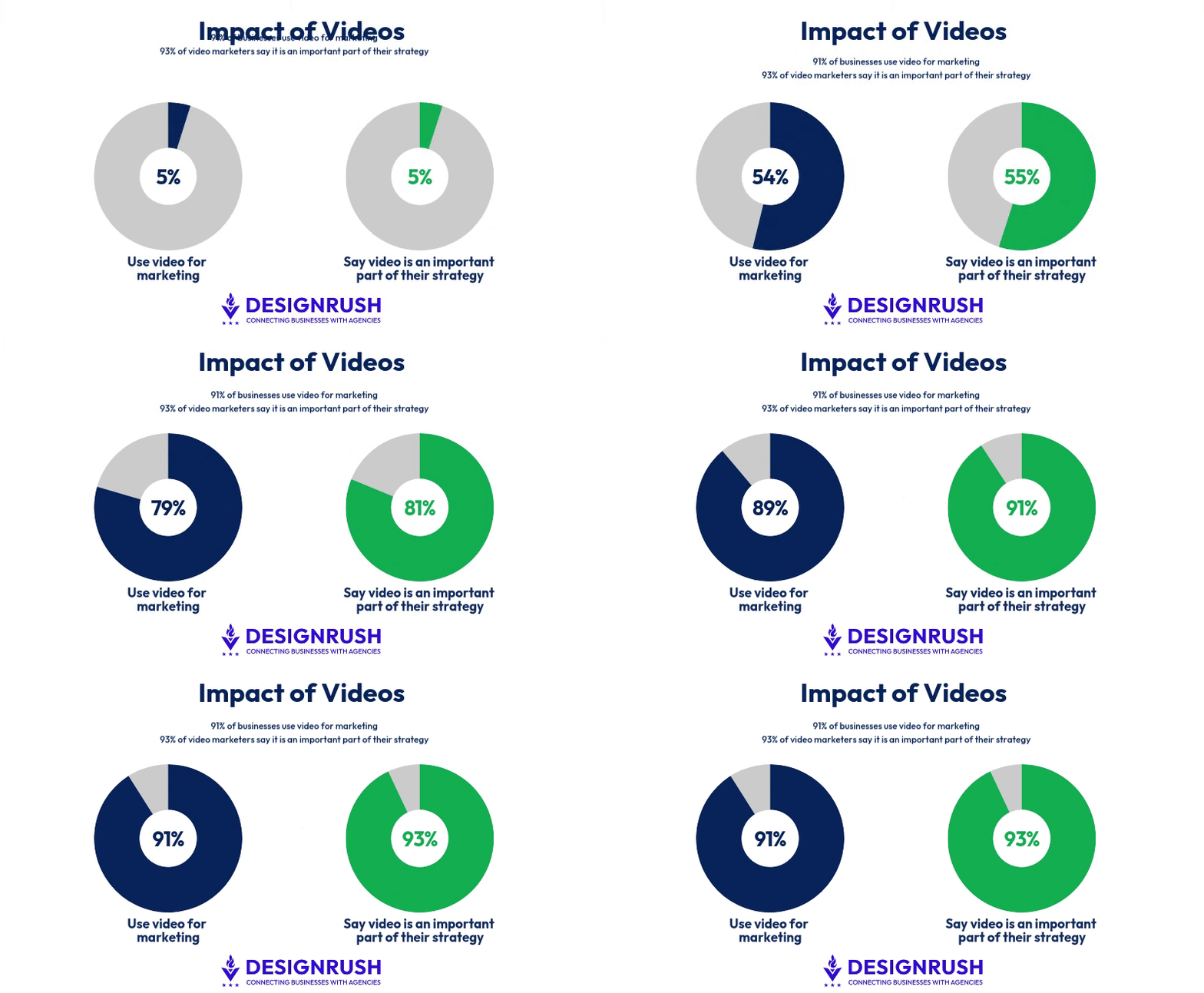
That matters because video is now a mainstream business tool, considering 91% of businesses use video as a marketing tool, and 93% of video marketers say it is an important part of their strategy.
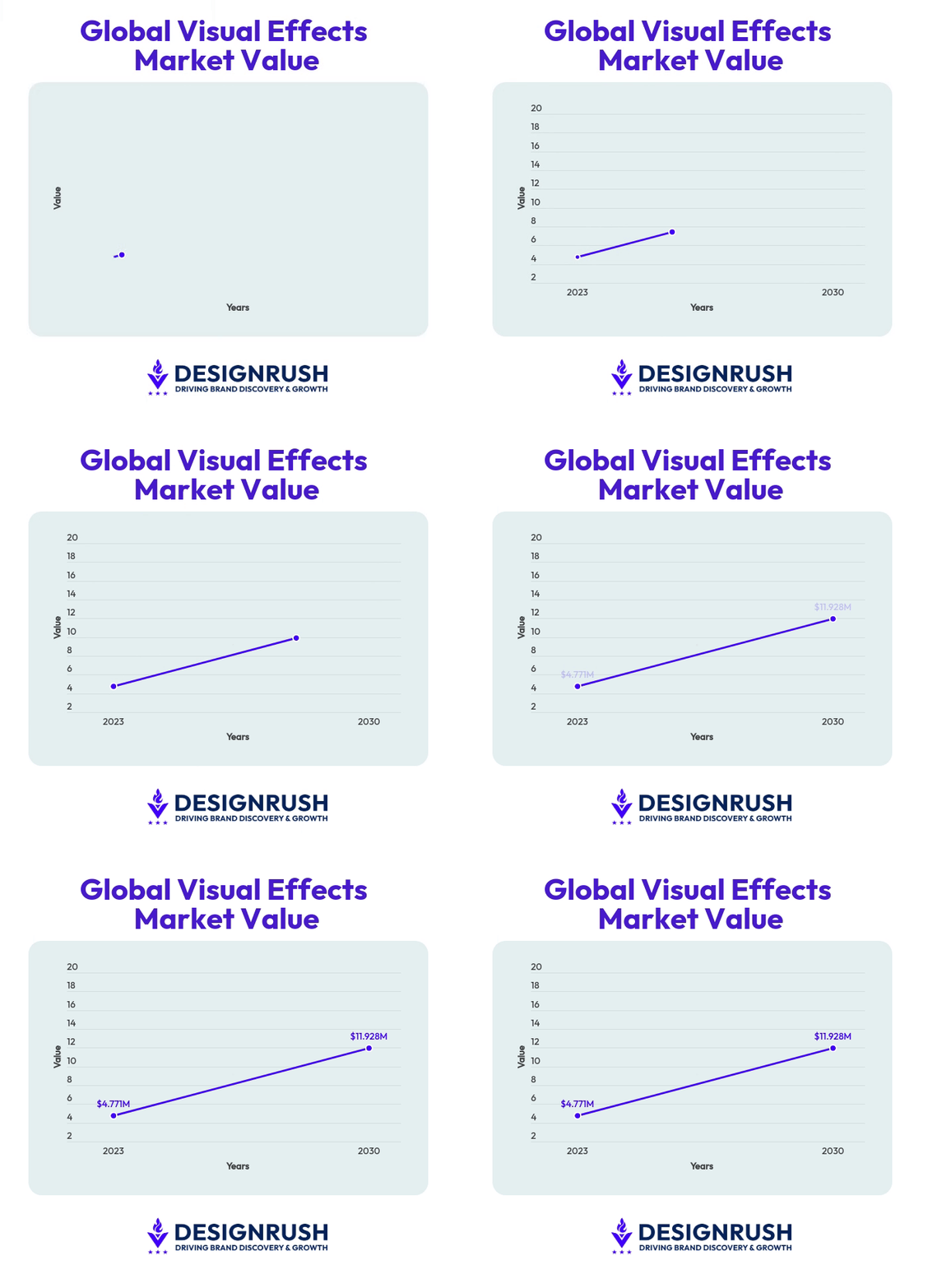
The global visual effects 3D animation market size was valued at $4,771.8 million in 2023 and is estimated to grow at a compound annual growth rate (CAGR) of 14.1% from 2023 to 2030.
A VFX studio can help businesses visualize what is difficult, expensive, or impossible to film in real life, such as product demos, technical process videos, digital environments, architectural visualization, simulation, and immersive brand experiences.
Visuals can create immersive environments and provoke emotional responses, boosting audience engagement.
Studies show that people process visual information 60,000 times faster than text, which is why businesses use a visual effects company to simplify technical or abstract ideas through visuals rather than long explanations.
Visual content also significantly impacts conversion performance.
Landing pages with video can increase conversions by up to 80%, which makes high-quality commercials and branded content a direct driver of revenue.
Businesses use visual effects to modernize live production and premium content. VFX can be more cost-effective than building large sets, renting locations, or staging dangerous practical stunts.
With virtual production, a talented team can build controlled digital environments that reduce location costs, speed revisions, and improve consistency for global campaigns.
Virtual production can reduce production costs by around 20-30% in certain cases, according to Deloitte-cited industry analyses. It allows companies to produce premium content with more control and fewer logistical constraints.
How do VFX studios support storytelling?
They help businesses visualize ideas that would otherwise be impossible, too expensive, or too complex to produce physically.
A skilled studio translates creative concepts into compelling visuals, whether that means building entire worlds, enhancing real footage, or guiding the viewer's emotional experience through subtle effects.
ILM's StageCraft work on The Mandalorian is a good example.
During that project, over 50% of season 1 was filmed using the LED volume workflow, which allowed the team to create multiple planets and environments on one stage and eliminated the need for location shoots.
VFX companies also help preserve realism even when the subject cannot be filmed directly.
For Apple TV+'s Prehistoric Planet: Ice Age, the production shot across 15 countries and combined practical puppets with CG to make extinct animals feel as if they had been captured in a real wildlife documentary.
What industries benefit most from visual effects?
The film industry remains the primary driver of demand for visual effects, especially in large-scale feature film production.
Today, it is common for blockbuster films to include over 1,500 VFX shots, with some exceeding 2,000 shots per project, making visual effects companies central to modern production pipelines, according to American Cinematographer.
The growth of streaming has significantly expanded the role of visual effects in television shows.
According to Ampere Analysis, global spending on original content by streaming platforms surpassed $240 billion in 2023, with a large portion allocated to high-end productions that depend heavily on effects.
This shift has brought film-level VFX quality into episodic television, increasing demand for experienced VFX companies.
Advertising is another major beneficiary.
In the United States, digital video advertising spending reached $61.2 billion in 2024, according to the IAB.
Brands increasingly rely on motion graphics, CGI, and animation to create high-impact commercials that capture attention and communicate value quickly in competitive markets.
The gaming and interactive sector also benefits from techniques developed by VFX studios, particularly as real-time rendering becomes more advanced.
The global video game market generated over $184 billion in 2023, according to Newzoo.
Cinematic visuals and immersive environments were often built using visual effects workflows, which played a key role in user engagement.
Beyond entertainment, the architecture, engineering, and manufacturing industries use visual effects to visualize complex systems and products.
How important is location when hiring these companies?
Location still plays a meaningful role when choosing between VFX companies, but it is no longer the limiting factor it once was.
One of the biggest factors is financial incentives.
In the United Kingdom, film and high-end television productions can receive up to 25% tax relief on qualifying expenditures through the Film & TV Tax Relief program, according to BFI.
Similarly, regions in the United States, such as California, offer state-level incentives that can cover 20-30% of production costs, depending on the project.
These incentives are a key reason why major productions often choose specific locations or partner with studios that have a presence there.
Location also impacts access to talent.
Global hubs such as Los Angeles, New York, and San Francisco are home to some of the most experienced visual effects studios.
For example, New Zealand's screen sector generated over NZD $3.5 billion in revenue in 2023, driven in large part by high-end visual effects work and international productions.
This concentration of expertise often translates into higher-quality output and more efficient workflows.
At the same time, emerging markets are becoming increasingly competitive.
South Korea is investing $1 billion to support the growth of the country's animation sector through to 2029.
What questions should I ask a VFX agency before signing a contract?
Ask VFX artists the following questions before you sign the contract:
Relevant Background
- What types of projects have you worked on that are most similar to ours?
- Can you share detailed case studies or breakdowns of your previous work?
- What industries or clients do you specialize in?
- Who will be the key team members on our project, and what is their experience?
Services and Processes
- Which services do you handle in-house, and which do you outsource?
- What does your production pipeline look like from concept to final delivery?
- How do you manage timelines, milestones, and project communication?
- What is your process for revisions, feedback, and approval?
Related to Your Project
- How would you approach our project creatively and technically?
- What challenges do you foresee with our scope or concept?
- What is the estimated timeline and budget range for this type of work?
- How do you ensure data security, asset management, and long-term storage?
Sources
DesignRush sustains a directory of over 40,000 agencies categorized by service category, location, expertise, and reviews. We build our database in two ways:
- Our dedicated team of agency experts actively searches the web for top-performing companies. We then pull information from their websites, online presence, and client testimonials to verify their status and qualifications prior to listing.
- The agencies listed get notified of their profiles on the website, and they can choose to claim them or not, which suggests their availability for more collaborations.
Agencies can also reach out to DesignRush and must go through the verification process prior to being listed.

Why companies trust DesignRush
Every agency is independently vetted before it can be listed or ranked
 4.8
4.8 4.8
4.8Some agencies pay for sponsored placement, clearly labeled and held to the same vetting standards.
5 Frequently Asked Questions About VFX Companies
What services do visual effects companies offer?
They provide a wide range of technical and creative services that transform raw footage into immersive visual experiences across film, television shows, commercials, and digital content.
A typical VFX company delivers end-to-end production support, including:
- CGI and animation: Creating digital characters, environments, and simulations.
- Compositing: Combining multiple layers of footage into a seamless final shot.
- Motion capture and tracking: Translating real-world movement into digital assets.
- Matte painting and environment design: Building large-scale digital worlds.
- Atmosphere visual effects: Smoke, fire, water, weather, and particle simulations.
- Motion graphics: Visual elements for commercials, branding, and digital campaigns.
- Post-production editing and enhancement: Refining shots for consistency and realism.
These services are essential to modern production, as around 80% of top-grossing movies rely heavily on visual effects, and over 3,000 films globally used VFX in 2023 alone, according to Market Growth Reports.
Leading VFX companies go beyond post-production and support the entire creative pipeline:
- Virtual production: Real-time environments using LED stages and game engines.
- Previsualization (previz): Planning scenes digitally before filming.
- Digital doubles and de-aging: Recreating actors or modifying performances.
- AI-assisted workflows: Speeding up rotoscoping, rendering, and compositing.
The rise of virtual production is particularly significant, with the market projected to grow from $2.9 billion in 2024 to nearly $13 billion by 2034, reflecting how quickly studios are adopting real-time workflows.
How much does it cost to hire a VFX studio?
The price of hiring VFX studios varies widely based on the project scope, complexity, and the level of visual effects required. It can go from $5,000 to $50,000 for independent projects to millions for feature films.
According to various sources, VFX experts price their work based on complexity:
- Simple effects (cleanup, basic compositing): a few hundred to $1,000 per shot
- Mid-level work (environment extensions, animation): $2,000-$5,000 per minute
- High-end shots for a feature film: $10,000-$60,000 per shot
- Complex blockbuster sequences can exceed $100,000 per shot
The overall cost of hiring visual effects studios depends heavily on the type of content:
- Commercials and branded content: From $1,000 to $20,000 per minute, depending on complexity.
- Independent film projects: Often allocate between $5,000 and $25,000 total for VFX work.
- High-end film and television shows: Visual effects typically account for 20-25% of the total production budget.
- Blockbuster productions: Entire films can reach budgets of $65 million+, with a significant portion dedicated to VFX.
What kind of portfolio should these companies have?
A VFX studio’s portfolio should clearly demonstrate technical capability, creative artistry, and the ability to support high-quality storytelling across different formats.
- Diverse work across formats and industries
VFX companies should showcase projects across feature films, television shows, streaming content, high-end commercials, and digital campaigns. - High-quality, realistic visual effects work
A credible studio should highlight seamless compositing and integration, advanced atmosphere visual effects, photorealistic CGI and animation, and clean breakdowns showing before-and-after shots. VFX studios like Sony Pictures Imageworks and Moving Picture Company are known for delivering large volumes of complex shots. Some productions exceed 2,000 VFX shots per film, demonstrating scale and consistency. - Evidence of innovation and modern workflows
A modern portfolio should reflect innovation, including the use of virtual production pipelines, real-time rendering tools, and AI-assisted compositing and automation. - Recognized work and industry credibility
Look for indicators of quality, such as credits on major film or television productions, collaborations with well-known companies, and recognition like an Academy Award or related nominations. A VFX agency tied to franchises influenced by George Lucas and Star Wars, for example, has historically set benchmarks for the best visual effects, raising expectations across the industry. - Strong storytelling and creative direction
Beyond technical execution, their portfolios should show how visual effects enhance narrative through emotional impact in key scenes, cohesive visual style across sequences, and support for brand messaging in commercials.
What is the process for working with a VFX company?
The process of working with VFX companies includes the following phases:
- Discovery and project briefing: Define goals, scope, budget, and timelines with the studio, including the type of visual effects, target audience, and deliverables.
- Concept development and planning: The studio creates initial concepts, references, and previsualizations to align storytelling, style, and technical approach.
- Bidding and scope approval: Detailed cost estimates are provided based on shot complexity, with clear breakdowns for film, television shows, or commercials.
- Pre-production setup: Planning for shoot requirements, data capture, and workflows, such as virtual production or integration with special effects.
- Production collaboration: VFX studios may support on-set supervision to ensure footage is captured correctly for VFX integration.
- Post-production and execution: VFX artists handle compositing, animation, motion graphics, and atmosphere visual effects, often across multiple review stages.
- Review and feedback cycles: Iterative approvals ensure quality, with clients reviewing versions and refining details to achieve the best visual effects.
- Final delivery and optimization: The completed shots are delivered in required formats, optimized for platforms like television, digital, or theatrical release.
- Data security and archiving: The studio ensures protection of assets and personal information, especially for high-profile or unreleased content.
What is the difference between visual effects and special effects?
Understanding the difference between visual effects and special effects is essential when planning a production, as each plays a distinct role in creating and executing scenes.
While top VFX companies often combine both approaches, knowing when each is used can help optimize budget, safety, and overall storytelling quality.
| Aspect | Visual effects | Special effects |
| Definition | Digital effects created in post-production | Physical effects created on set during filming |
| Creation stage | After filming | During filming |
| Techniques |
|
|
| Flexibility and safety | Highly flexible, safer for complex scenes | Less flexible, can involve physical risk |
| Role in production | Widely used across feature film, television shows, and commercials | Often combined with VFX to enhance realism |
Latest Trends Related to Visual Effects
Video Production
Are AI Video Agents Worth It? I Tested 5 Tools for Avatars & AI-Generated Videos
7,665