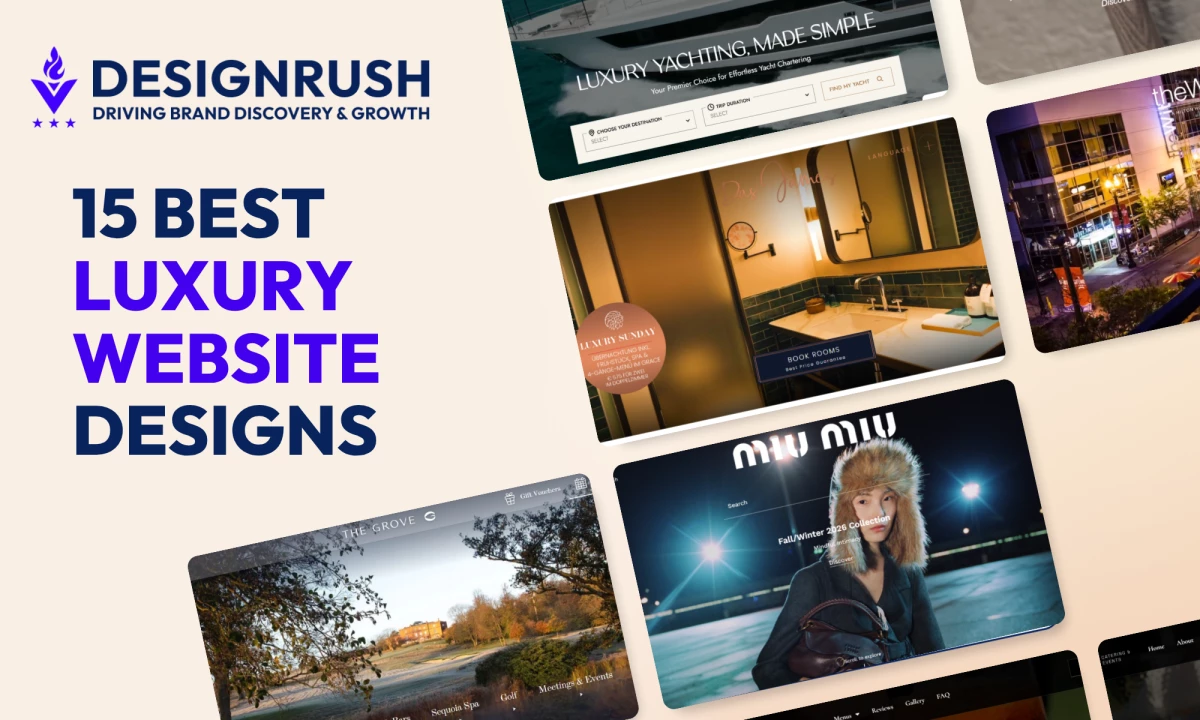

Luxury buyers expect your online presence to feel effortless and highly deliberate from the moment they arrive.
We collected 15 standout examples to show you how top agencies build these digital environments where every design choice persuades high-ticket clients to trust your brand before they ever speak to a representative.


What Makes a Good Luxury Website Design?
A good luxury website design gives a high-ticket buyer enough evidence to shortlist the brand. The strongest ones share four traits: typography that carries the brand before the photography loads, copy specific enough for an AI summary to repeat, one saturated accent reserved for the action, and a route to a person.
# | Website | Built by | Segment | Standout feature |
1 | Die Visualisten | Harbor hotel | Navy and copper editorial layout | |
2 | UP Hotel Agency | Country estate hotel | Teal and coral two-color system | |
3 | 97 Switch | City hotel | Date picker on the homepage | |
4 | Focus Online | Private safari houses | Five sub-brands under one menu | |
5 | Positive Design | Yacht charter | Homepage led by one yacht's history | |
6 | Digital Silk | Yacht charter | Prices on every fleet card | |
7 | Immersive Studios | Concierge and real estate | Neon green on a white canvas | |
8 | Artrivo | Event catering | Brands and awards above testimonials | |
9 | Bapple UX | Fine jewelry | Google rating shown sitewide | |
10 | NexusBond | Architectural leather | Separate routes for trade and retail | |
11 | Passionate | Spirits | Founding story from 1850 | |
12 | Metalogics | Custom tailoring | Appointment as a service card | |
13 | NEO Web Agency | Furniture | Collections sorted by room | |
14 | Hedera | Heritage furniture | Four-way sofa filters | |
15 | HNDRX Ltd | Interior design | Project count in the first scroll |
How These 15 Luxury Website Designs Were Selected
We read every site against four questions, in this order:
- Does the copy name things? A material, a place, a year, or a price gives a buyer something concrete to check, which a page of adjectives can't offer.
- Where does the enquiry sit? A booking field, an appointment card, or a WhatsApp button on the page where someone decides does more than a contact page three clicks away.
- How does the build carry its media? Luxury sites ship more photography and video than most categories, so contrast and mobile weight both counted.
- Can an AI tool summarize it? Text in the page source is text a buyer's assistant can repeat, while text locked inside images or animation stays invisible to it.
All 15 are featured in the DesignRush luxury website design collection, a curated selection maintained by the DesignRush design team.
Designs submitted to the monthly Design Awards are scored against four weighted criteria under the published evaluation process, and award winners appear under the collection's Award Winners filter.
Criterion | Weight | What it measures |
Design | 30% | Visual execution: layout, typography, color, and imagery |
Usability | 30% | How well the site achieves its purpose for the person using it |
Creativity | 30% | Originality in technique, tools, and concept |
Content | 10% | Quality and accuracy of the copy and media |
Each submitted design is scored independently by three or more jurors. The reviews behind this list come from the DesignRush design team, including Branko Dimitrijević, a senior designer with 33 design awards and more than 165 web projects across a 12-year career.
1. Das James Hotel by Die Visualisten
Standout Features:
- Navy and copper palette
- Serif with script wordmark
- Three-language header toggle
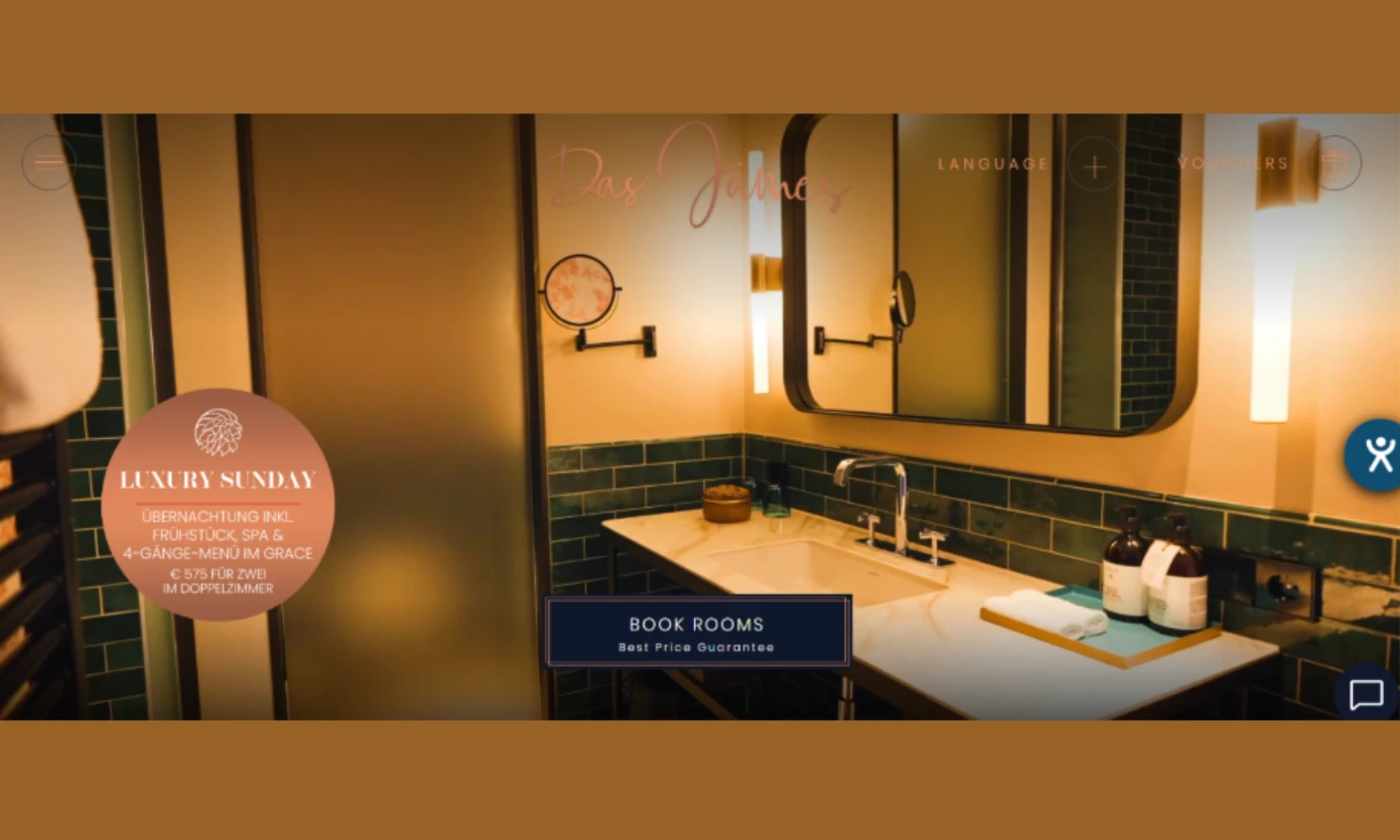
Das James is a hotel at Flensburg Sonwik in northern Germany, with a Michelin-starred restaurant called Das Grace, a rooftop pool, and a program of dated yoga and wine retreats. Die Visualisten, a Hamburg agency, was briefed to carry British charm, fine cuisine, and a destination spa in one site.
Deep navy anchors every page, and warm copper accents mark the details. An elegant serif pairs with a handwritten script wordmark, and split layouts crop the photography asymmetrically so each section reads like a magazine spread.
Branko Dimitrijević credited the site with "prioritizing atmosphere over persuasion" in his DesignRush review. Room and amenity pages pair short descriptive lines with structured detail lists, and the header switches between German, English, and Danish.
Why it works: Bain and Altagamma's June 2026 update found consumer sentiment toward luxury experiences outpacing sentiment toward goods. A hotel whose homepage lists dated retreats and a named restaurant is selling the experience a buyer is already leaning toward.
Read the complete Das James Hotel website design breakdown.
2. The Grove by UP Hotel Agency
Standout Features:
- Teal and coral stylesheet
- La Fabrique and Gill Sans Nova
- Question-led second heading
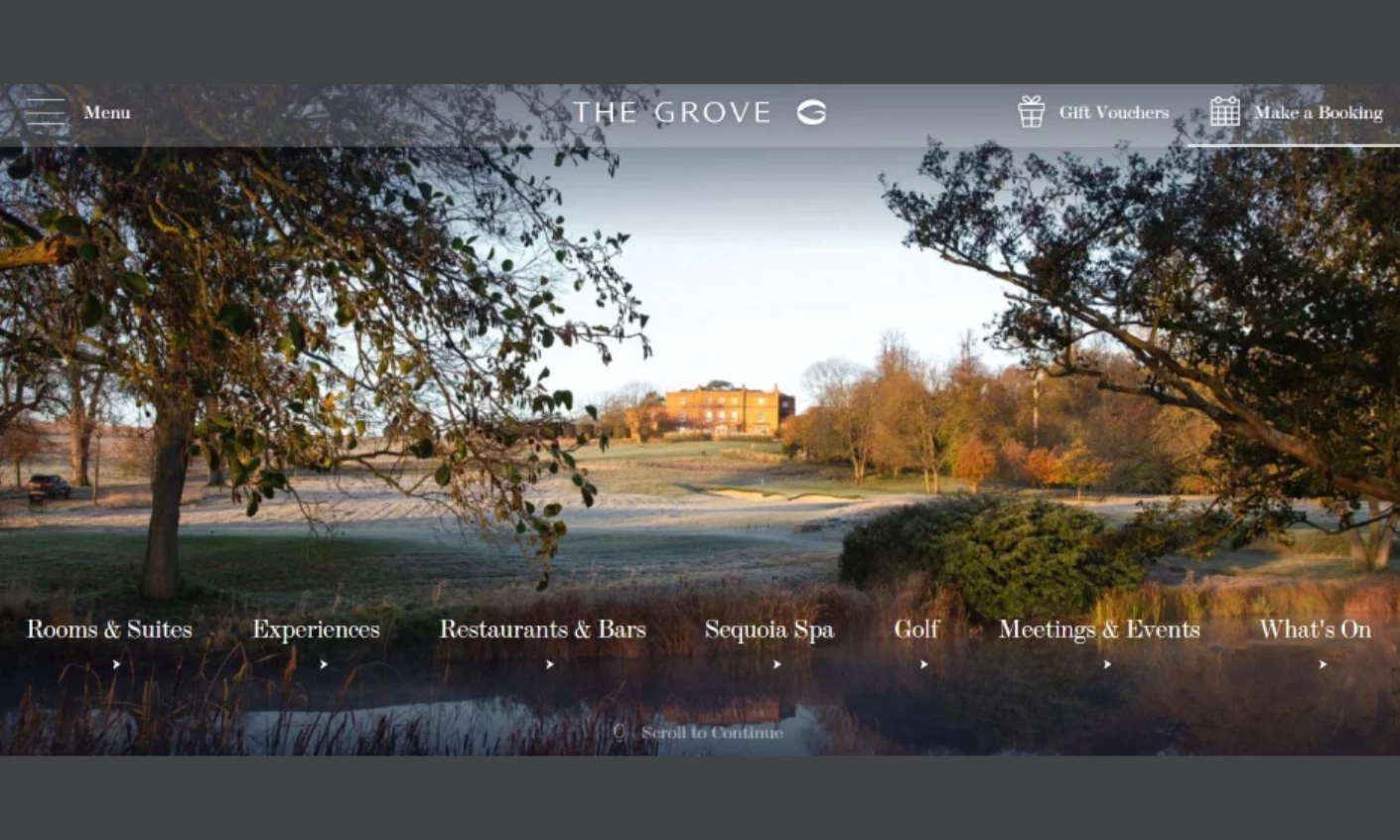
The Grove is an estate hotel at Chandler's Cross in Hertfordshire, with an 18-hole golf course, a spa, and event venues. Its homepage heading calls it "London's Country Retreat," and the meta copy places it 18 miles from Central London.
UP Hotel Agency built the stylesheet on two colors: a deep teal (#1F434D) and a coral (#DB5942) over a warm off-white. The type system pairs La Fabrique with Gill Sans Nova, and neither is a system default.
Below the hero, a second heading asks "What shall we do today?" and routes into golf, spa, dining, and events. A guest arriving for one reason finds the other three on the same screen.
Why it works: HTTP Archive's 2025 Web Almanac, covering 17.2 million websites, put the median desktop home page's image weight at 1,059 KB. A photography-led hotel homepage starts heavier than that, and a two-color stylesheet keeps the page legible while the media loads.
Explore the The Grove luxury website design in full.
3. theWit Hotel by 97 Switch
Standout Features:
- Date picker above the fold
- Black and white base
- Theater district positioning
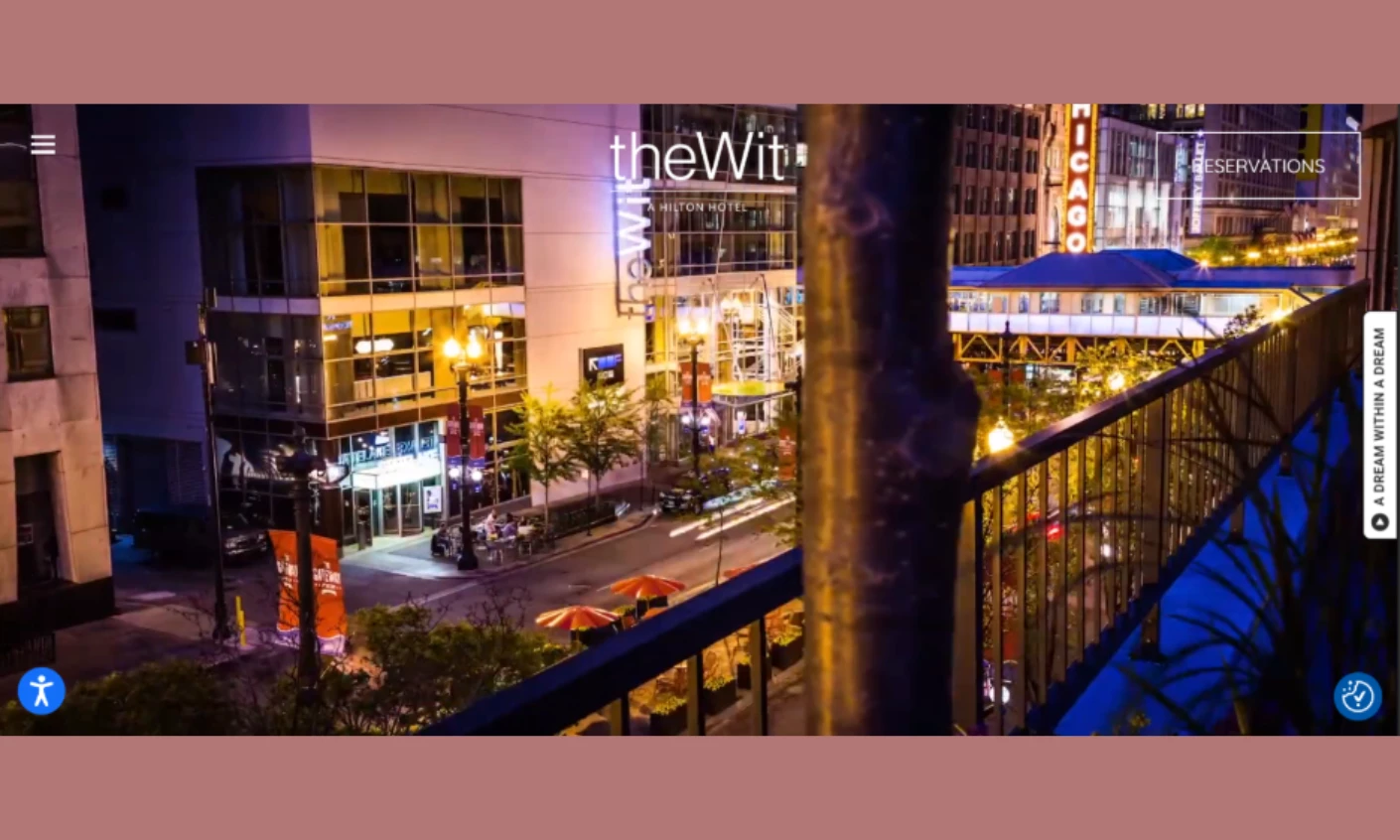
theWit is a Hilton hotel in the Chicago Loop, in the city's theater, arts, and shopping district, with a rooftop bar. 97 Switch, a Chicago agency, has built and maintained theWit's websites for more than a decade.
The homepage puts a "Select Dates" booking field in the first screen, set in Montserrat and Quicksand. The stylesheet runs almost entirely on black, white, and grey.
That palette gives the photography no competition. The booking field is the one interface element a visitor has to read before seeing a rate.
Why it works: Contentsquare's 2025 Digital Experience Benchmark, drawn from 90 billion sessions across 6,000 websites, found the cost per visit rose 9% in a year. A date picker in the first screen turns more of those paid visits into a rate check before the visitor leaves.
Read the complete theWit Hotel website design breakdown.
4. Sirai House by Focus Online
Standout Features:
- Five sub-brands, one menu
- Location line under each name
- Repeated "Plan your trip" action
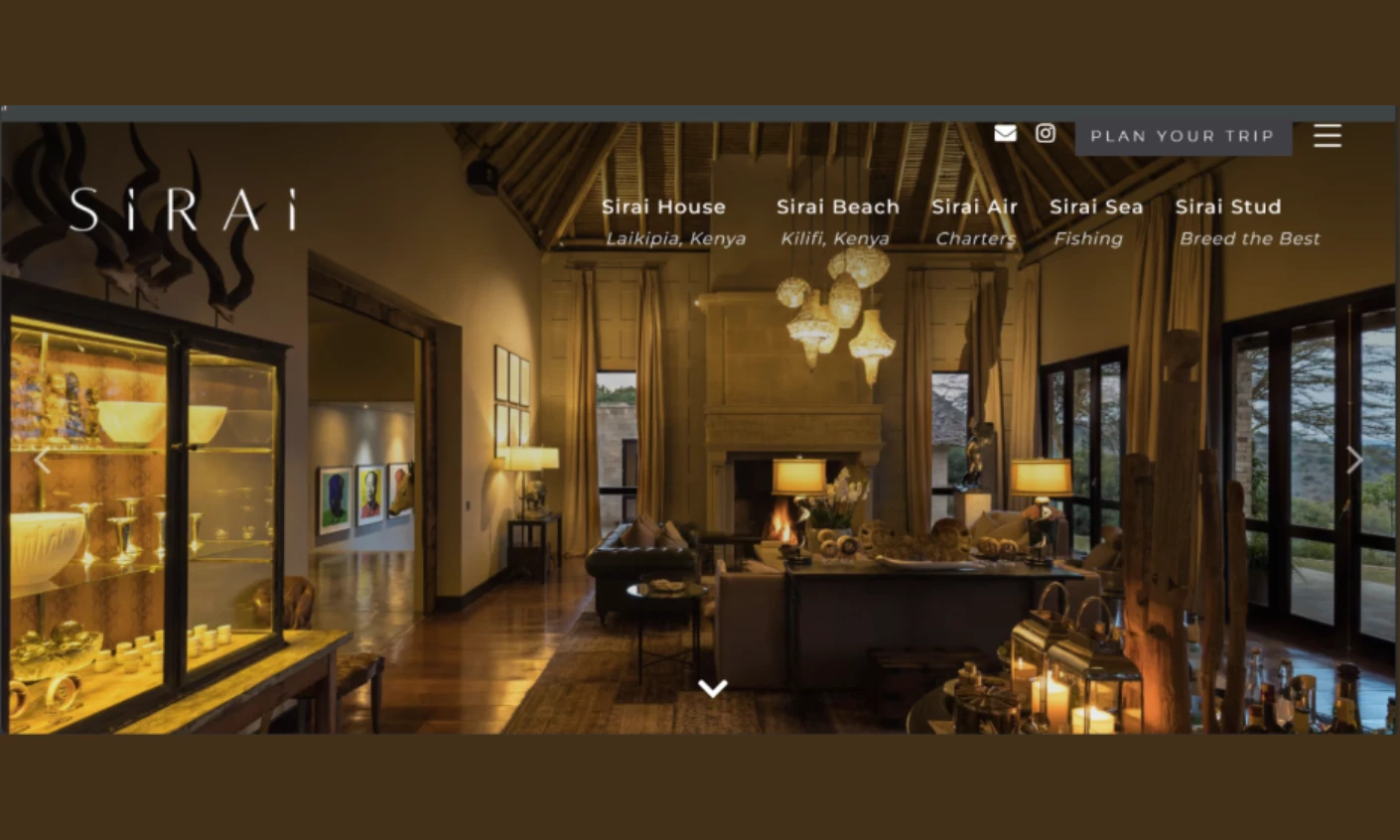
Sirai runs private luxury houses and experiences in Kenya: Sirai House in the Borana Conservancy in Laikipia, Sirai Beach at Kilifi on the Indian Ocean, private air charters, fishing charters, and a stud farm. Focus Online built the site.
The site handles five businesses without five homepages. Each sub-brand sits in the main menu with a one-line descriptor underneath, "Laikipia, Kenya" or "Charters," so a visitor knows which one they want before they click.
Each sub-brand carries its own accommodation, dining, experiences, gallery, and contact pages. A single "Plan your trip" action repeats across all five, so the booking route never changes shape.
Why it works: Bain and Altagamma reported immersive bookings across dining, leisure, and entertainment up 30% on the previous year, and travel beyond traditional hotspots up 20%. A traveler booking Laikipia is buying the whole trip, and one menu that sells the flight, the house, and the fishing sells all of it.
Explore the Sirai House luxury website design in full.
5. Morley Yachts by Positive Design
Standout Features:
- One yacht leads the homepage
- Kiona and Nexa pairing
- Owners and guests routed apart
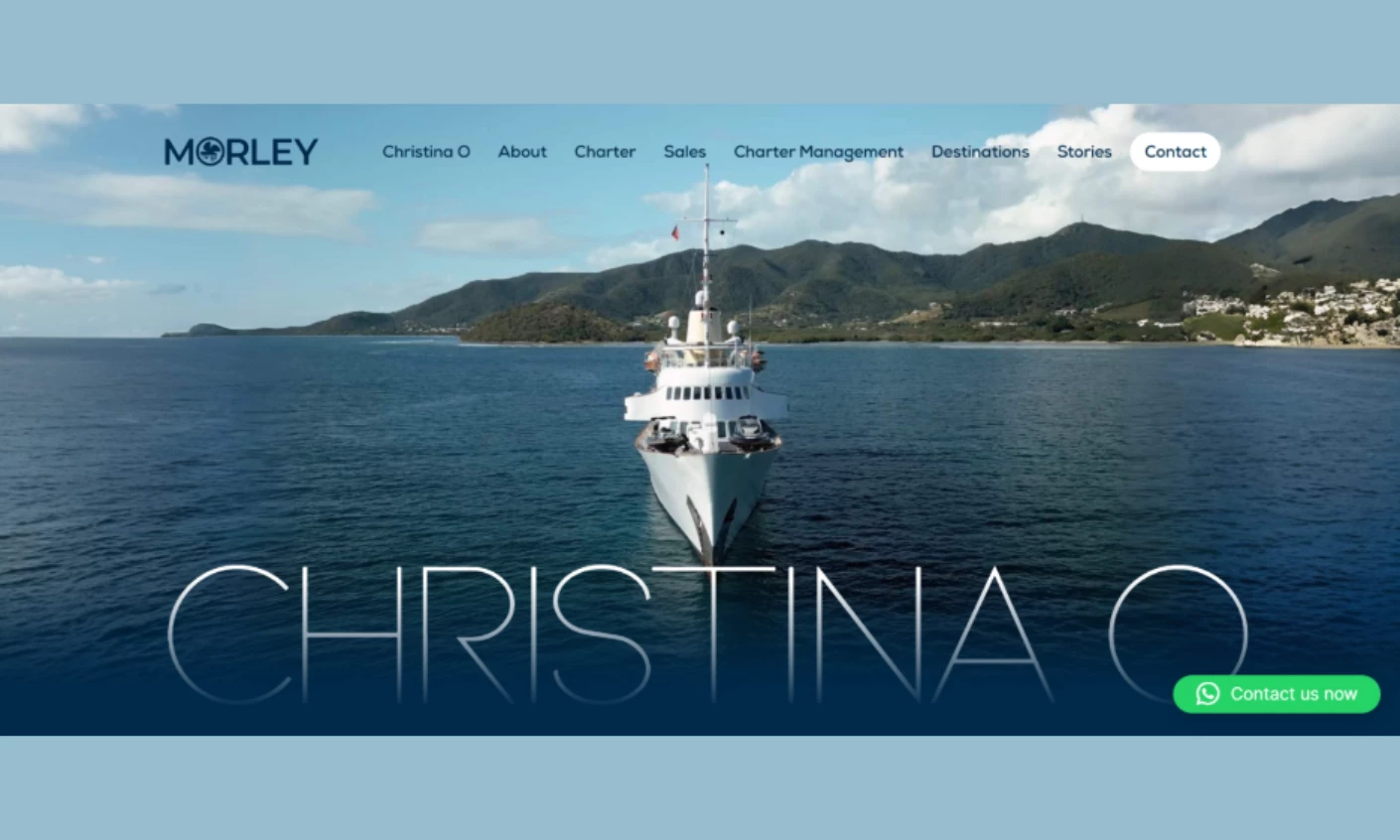
Morley Yachts handles charter, sales, and charter management across the Mediterranean, and its site leads on Monaco expertise. The homepage opens on one vessel, Christina O, with a paragraph on the yacht's history with Aristotle Onassis, Maria Callas, Jacqueline Kennedy, and Winston Churchill.
Positive Design paired the typefaces Kiona and Nexa over a navy (#002949) and white palette. The main menu splits into About, Charter, Sales, Charter Management, Destinations, and Stories, so an owner and a charter guest leave the homepage by different doors.
The copy below the hero runs several paragraphs on Mediterranean itineraries and the crew on board, including five chefs and 40 crew in total. Morley puts the story ahead of the fleet listing.
Why it works: Bain and Altagamma found about half of luxury consumers already use AI somewhere between discovery and purchase. A homepage that states the crew count, the yacht's history, and the cruising regions in plain text gives a buyer's assistant specific facts to repeat back.
Read the complete Morley Yachts website design breakdown.
6. Yacht Luxe by Digital Silk
Standout Features:
- Prices on every fleet card
- Destination and duration search
- WhatsApp charter specialist button
Yacht Luxe charters yachts out of Miami, Fort Lauderdale, Palm Beach, and Nassau. Digital Silk built the site and also holds sponsored agency placements on DesignRush.
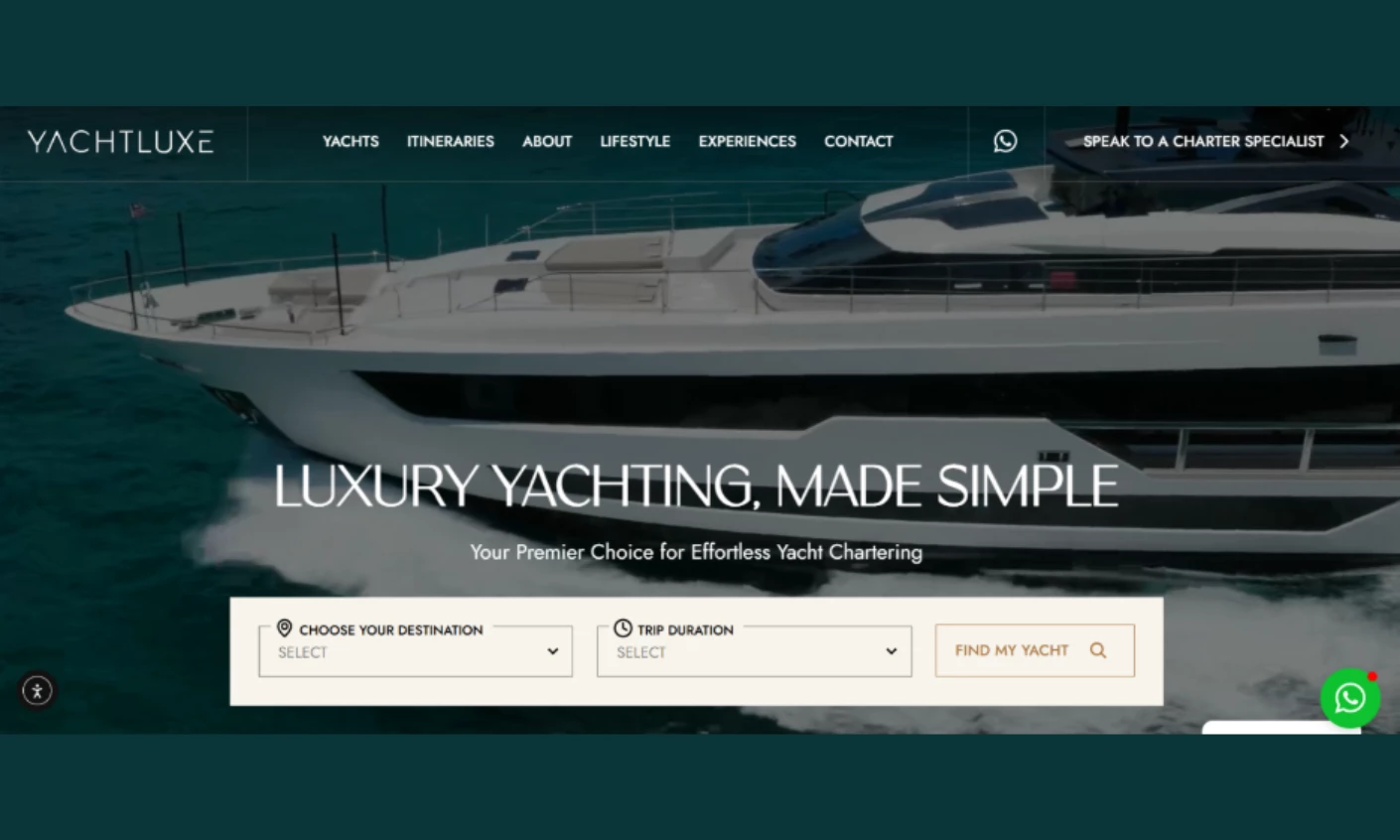
The hero carries a two-field search, destination and trip duration, with "Find My Yacht" as the only action. Below it, each fleet card states length, model, guest count, location, and a starting price: an 88-foot Sirena from $9,990 for four hours, a 118-foot Azimut from $29,900 for eight.
The type is Jost throughout, with a copper accent (#AE7640) on a near-black and white base. A WhatsApp button labeled "Speak to a Charter Specialist" sits in the header.
Why it works: Bain and Altagamma found two in three AI-using luxury consumers use the tools to compare products. A published "from" price on each card is the one number a comparison needs, and a charter site that withholds it drops out of the running.
Explore the Yacht Luxe luxury website design in full.
7. SuperLuxury by Immersive Studios
Standout Features:
- White monochrome canvas
- Neon green action color
- Map-based property search
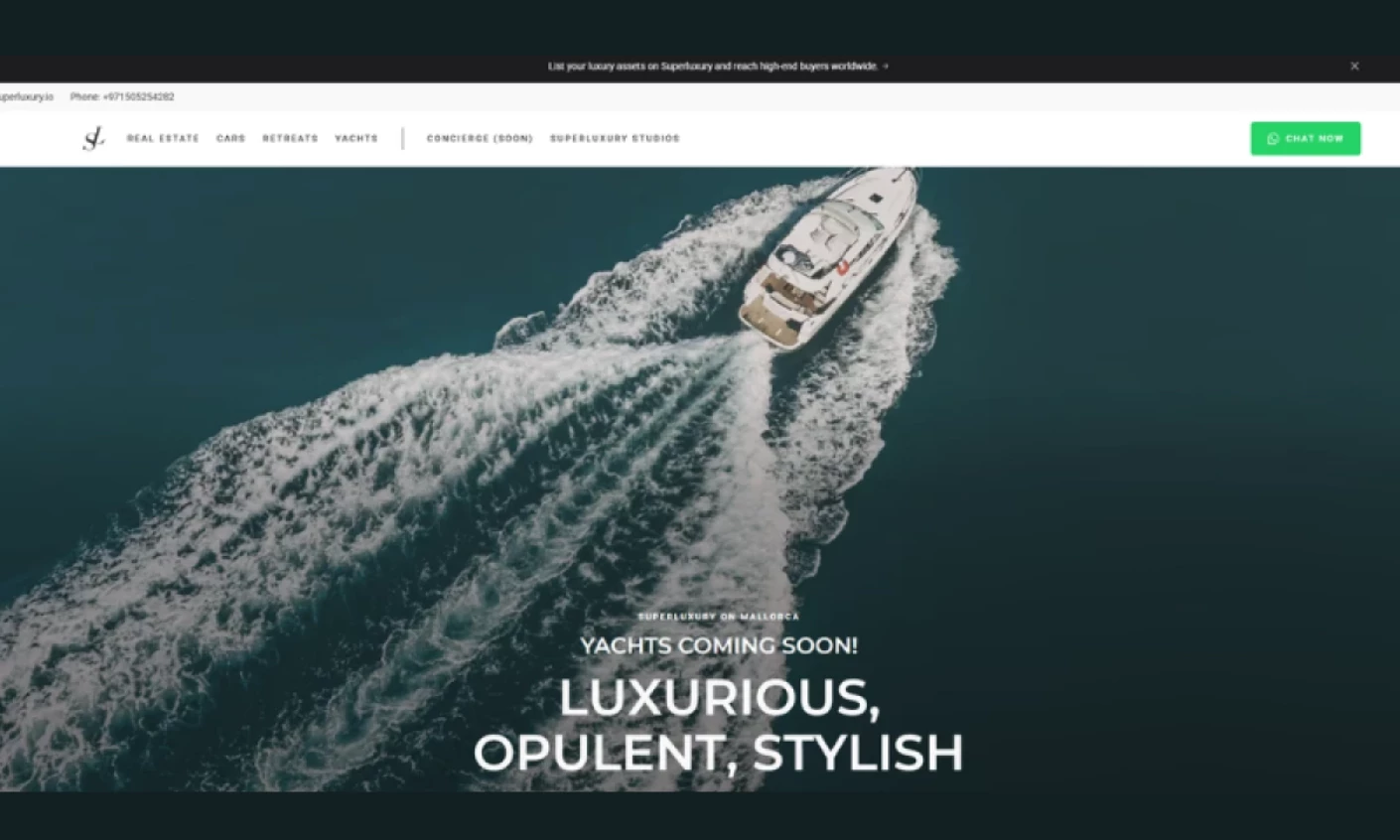
SuperLuxury sells travel, real estate, and concierge services to clients in Monaco and beyond. Immersive Studios built the site on a white interface with full-bleed photography of yachts and the Monaco coastline, and black or white type laid over the images.
Headlines use a tall, tightly tracked sans-serif, and the body copy follows the same modern family at a smaller size. The one exception to the monochrome is neon green, which appears only on calls to action.
The real estate section embeds a map for property search, and a modular grid lets media and text sit in asymmetric blocks. A visitor moves from a yacht to a villa to a concierge request without the layout changing its rules.
Why it works: in Margariti and colleagues' 2025 experiment with 118 participants, white-space-dominant sites raised perceived luxuriousness through classical aesthetics, and the effect carried through to purchase intention. SuperLuxury pairs that white canvas with a single accent color that no photograph can hide.
Read the complete SuperLuxury website design breakdown.
8. Cacao Catering & Events by Artrivo
Standout Features:
- Client brands before testimonials
- Awards section on the homepage
- Menus as a top-level route
Cacao Catering & Events runs bespoke event catering in London for weddings, private parties, and corporate clients. Artrivo, a creative agency, is credited on the site.
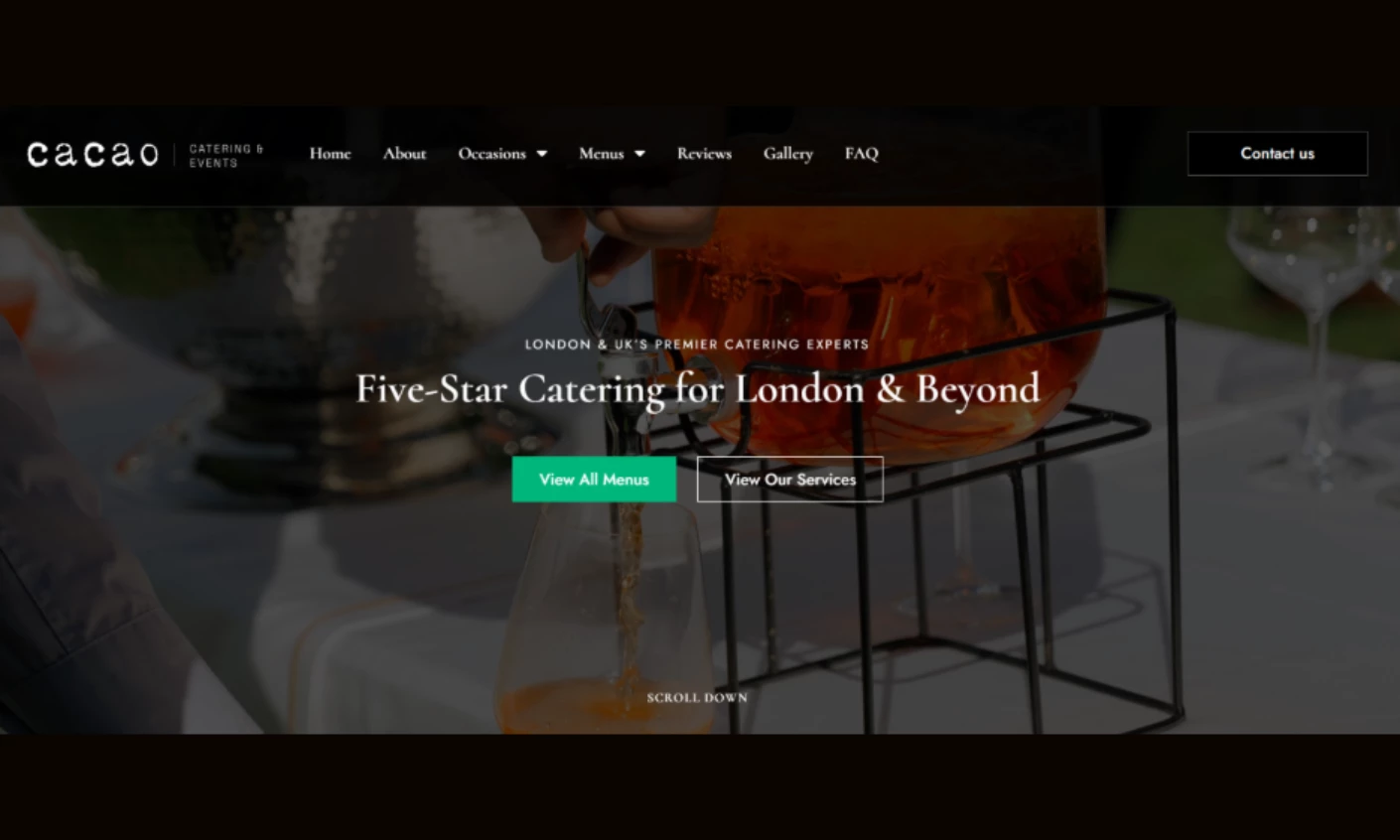
The homepage stacks its proof in a deliberate order. A row headed "Brands We Have Worked With" comes first, then the menus, then a testimonial block, then an "Awards and Accolades" section, all set in Jost on a white base.
The headline, "Award-Winning Luxury Catering & Bespoke Events in London," names the service and the city in one line. It tells a planner what the company does, at what level, and where.
Why it works: Bain and Altagamma found over 70% of customers who have stepped away from luxury intend to return, though not necessarily to the same brands. A caterer competing for a returning client wins on checkable proof, and client logos plus named awards are exactly what a planner can verify.
Read more about this luxury website design in the full Cacao Catering & Events website design analysis.
9. Larsen Jewellery by Bapple UX
Standout Features:
- Google rating shown sitewide
- Two-layer sticky navigation
- Top 10 rings as a named list
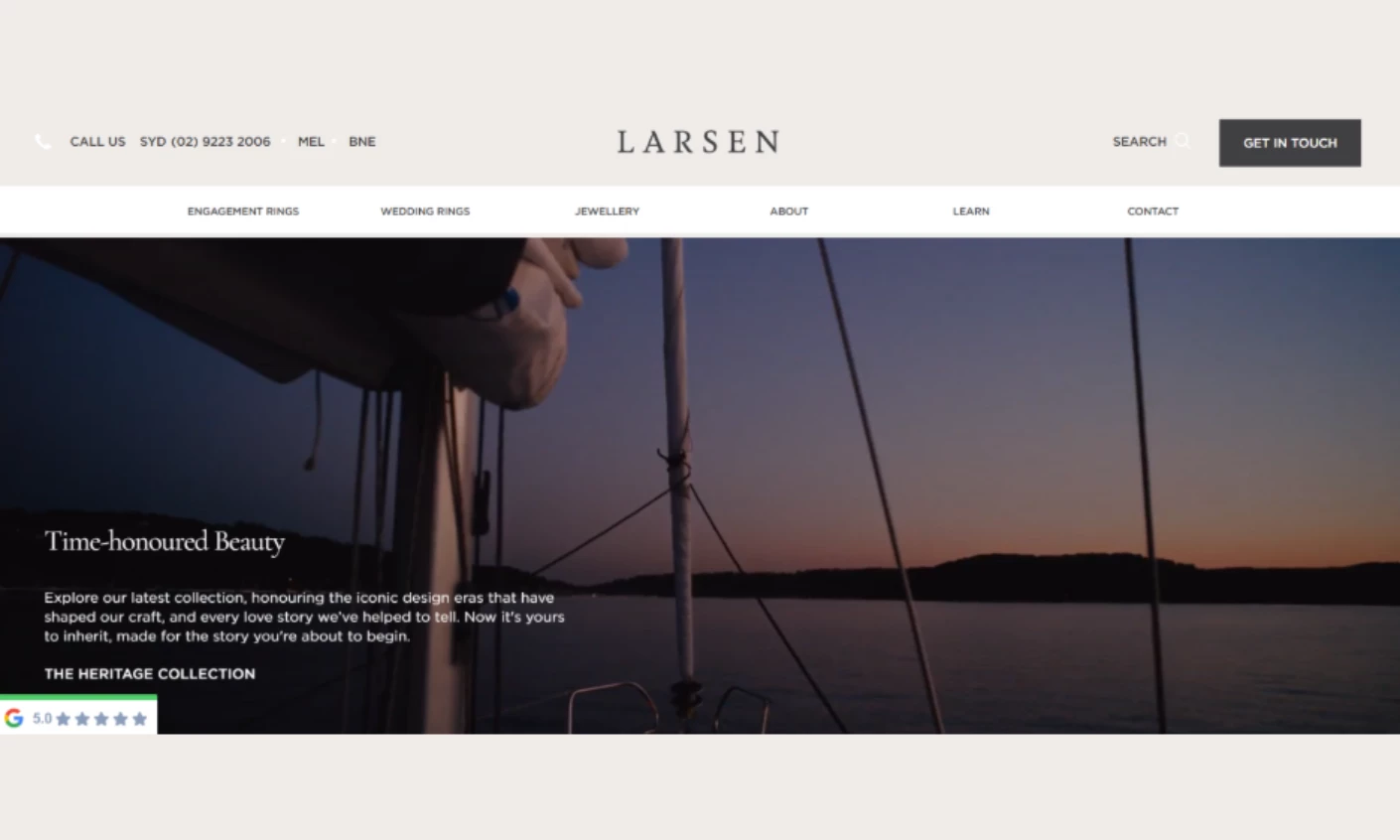
Larsen Jewellery makes bespoke engagement rings, wedding rings, and fine jewelry in Sydney, Melbourne, and Brisbane, and the homepage marks 20 years of craftsmanship. Bapple UX, an Australian branding and UX agency, designed the site.
The Google rating appears on every page, so a buyer never has to leave to check reviews. The navigation runs in two layers: a top strip with contact details, store locations, and a "Get in Touch" button, and a fixed main bar for engagement rings, wedding rings, and jewelry.
Cormorant Garamond sets the headings and Gotham sets the interface, over a charcoal (#414042) and warm cream (#EFECE9) palette. A section titled "Our Top 10 Engagement Rings" gives an undecided buyer a shortlist in place of a full catalog.
Why it works: Bain and Altagamma found roughly half of luxury shoppers check the secondhand market before buying new. A buyer weighing a new ring against a resale one is already comparing, and a rating visible on every page answers the trust question before they open another tab.
Read the complete Larsen Jewellery website design breakdown.
10. Alma 1938 by NexusBond
Standout Features:
- Trade and retail routes split
- Leather acoustics as its own line
- Black and white product grid
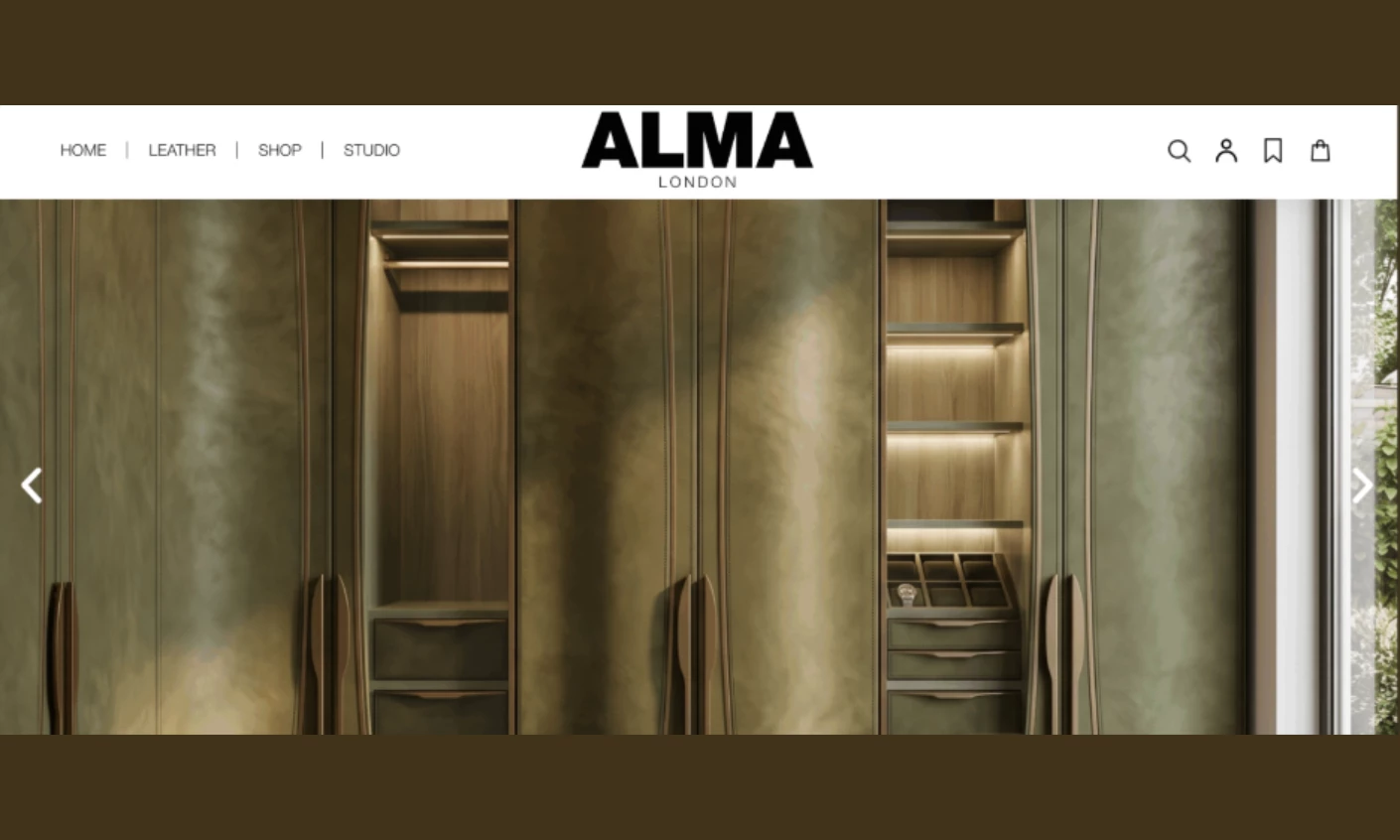
Alma is a Central London leather house founded in 1938, supplying hides and architectural leatherwork for floors and walls, and selling furniture and accessories. NexusBond pulled what had been a fragmented online presence into one site with an integrated shop.
The top menu separates the three businesses. Leather covers floor, wall, and recycled leather for specifiers, Shop covers accessories and furniture for retail buyers, and Studio covers bespoke commissions.
A product line called Alma Acoustics, acoustic wall surfaces made in leather, gets its own homepage feature. The site runs on WooCommerce with a black and white palette, so the leather itself is the only color on the page.
Why it works: Contentsquare's 2025 benchmark found sites that raised session depth by 10% or more saw an average 5.4% conversion lift. Splitting a specifier from a shopper at the first click sends each one deeper into pages that answer their question.
Explore the Alma 1938 luxury website design in full.
11. Meukow Cognac by Passionate
Standout Features:
- Founding story from 1850
- Gold accent on black and white
- Product slider into the collection
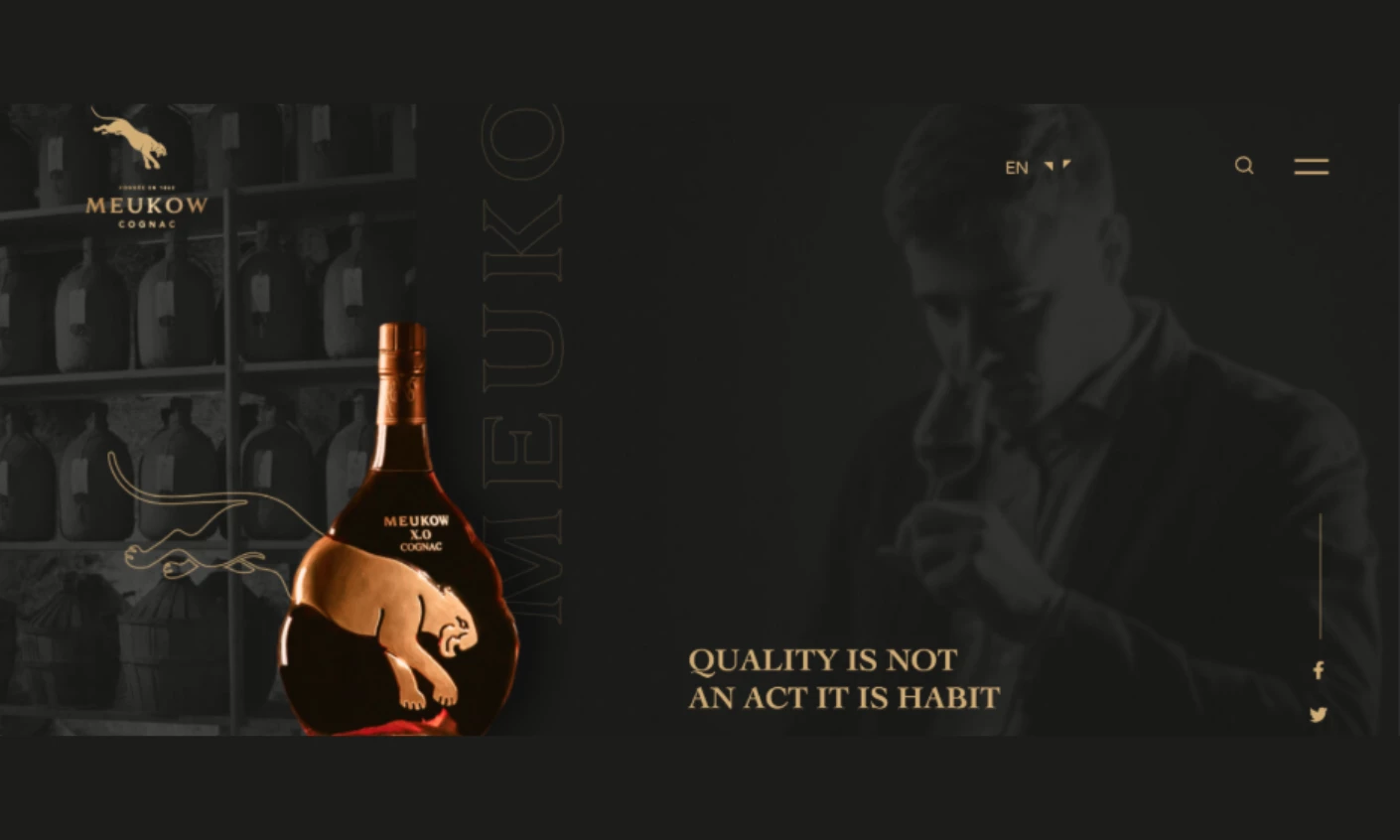
Meukow is a cognac house founded in 1850 by two brothers from Silesia, Auguste-Christophe and Gustav Meukow, who were sent to France to supply eaux-de-vie to the Russian court. The site's line is "Quality is not an act, it is habit."
Passionate built the site in black and white with a single gold accent (#D2AE76). A product slider moves through the bottles and leads into the collection, and cellar photography floats in with the scroll.
The homepage sections are short and named: Collection, Maison Meukow, Our Tours, and Mixology. That last one gives the brand a reason to publish recipes, the kind of content a drinker searches for between purchases.
Why it works: Deloitte and Google's Milliseconds Make Millions study (2020), covering 37 brands and 30 million sessions, found a 0.1-second mobile speed gain raised luxury page views per session by 8.6%. Scroll-reactive imagery has to load within that budget, or the motion costs the page views it was meant to earn.
Read the complete Meukow Cognac website design breakdown.
12. Self-Made Couture by Metalogics
Standout Features:
- Fabric-texture hero crop
- Gold serif headline
- Appointment as a service card
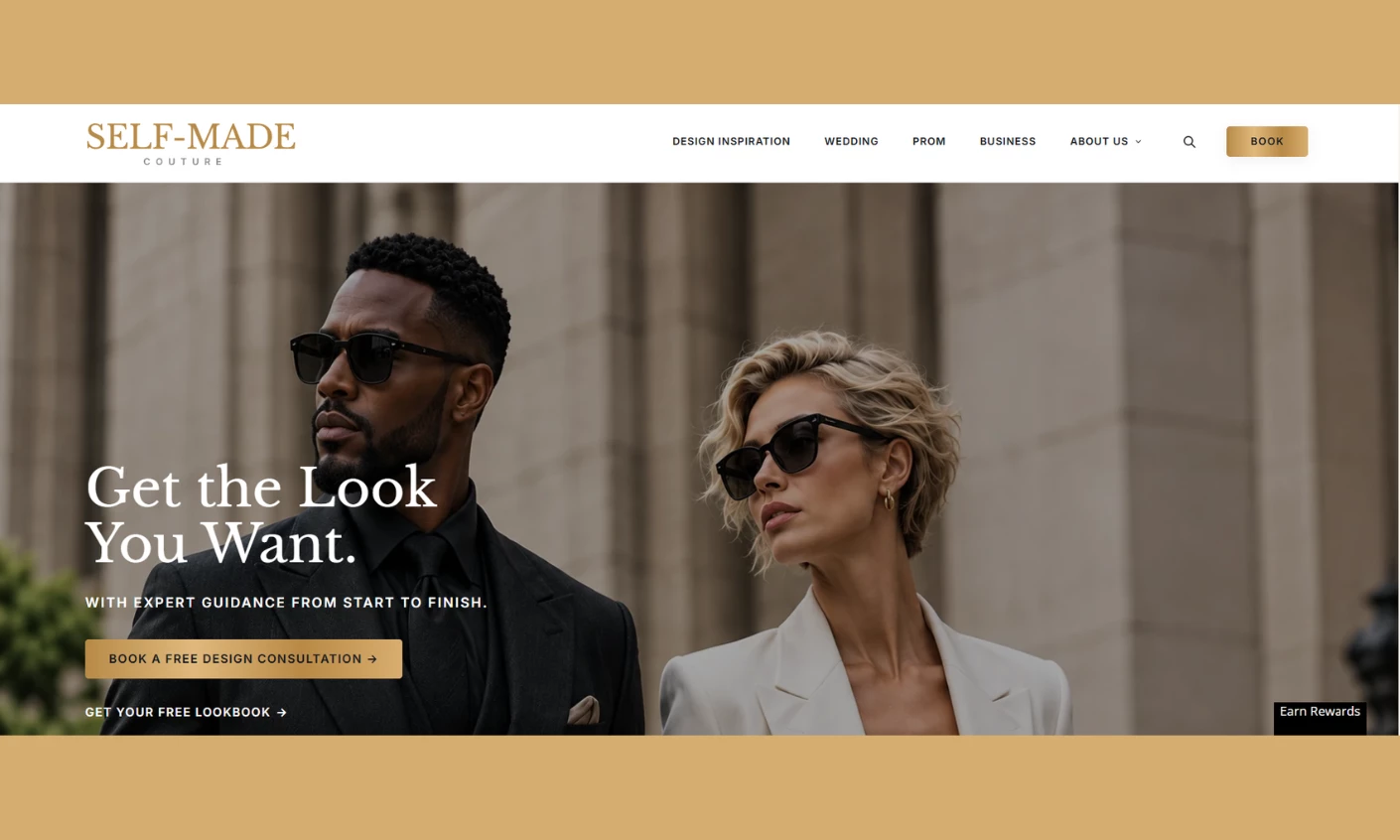
Self-Made Couture makes custom clothing and made-to-measure suits. Metalogics cropped the hero photograph tight on fabric texture and set the headline "Custom Clothing" in a gold serif over it.
A serif headline with a clean sans-serif body carries through the site. The services section is a two-column card grid, where Appointment and Tailoring each get a black line icon and a short description on white.
An interactive product grid below the services lets a visitor browse finished work. The appointment sits as a service in its own right, level with the tailoring itself.
Why it works: custom tailoring can't be bought from a product page, so the real conversion is a fitting. Listing the appointment as a service card gives that first step the same weight as the finished suit.
Explore the Self-Made Couture luxury website design in full.
13. BANCCI by NEO Web Agency
Standout Features:
- Collections sorted by room
- Named product codes
- Two-word headline
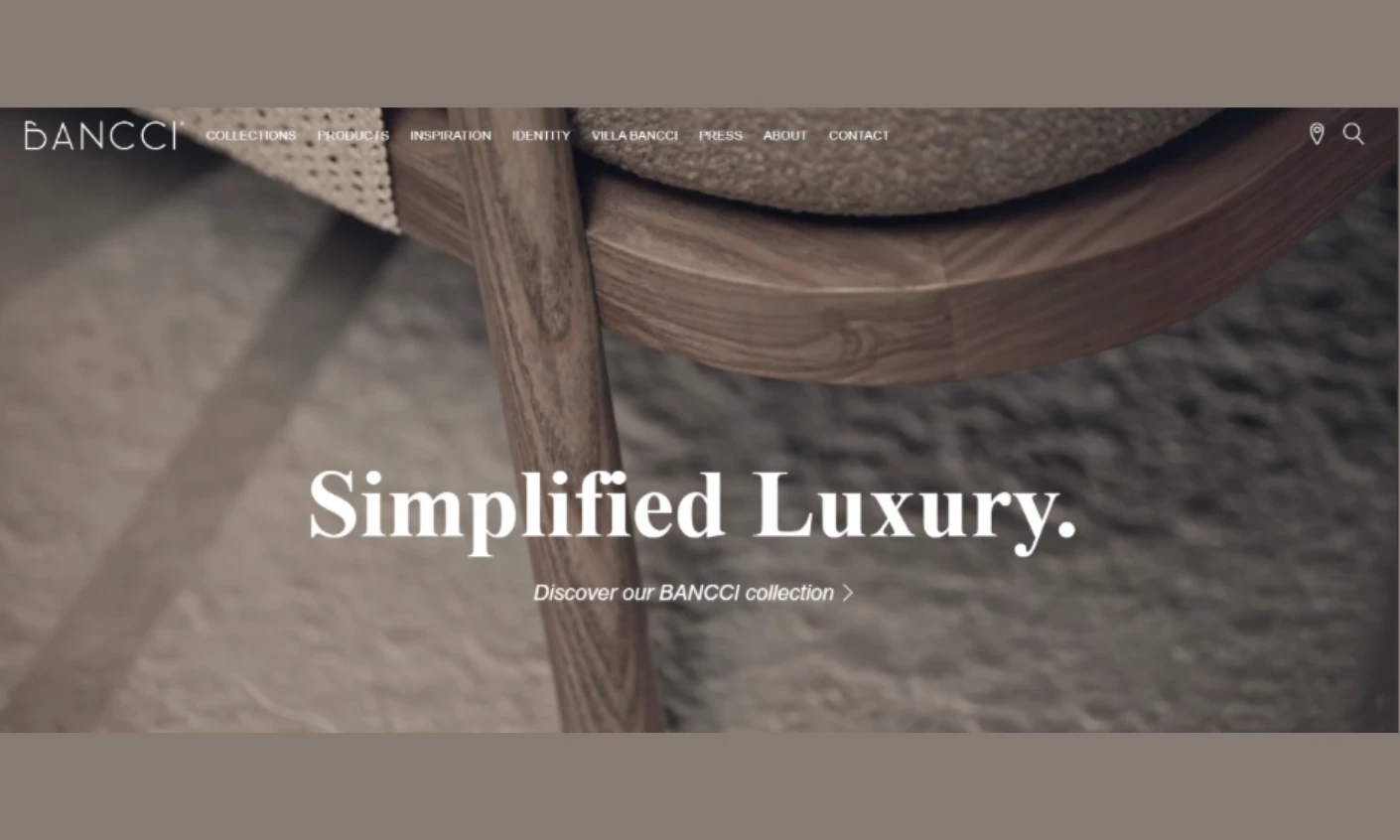
BANCCI manufactures luxury furniture in the UK, and its homepage opens on two words: "Simplified Luxury." The brand line that follows explains the design language in one sentence about the pleasure of the curve.
NEO Web Agency sorted the collections by room: Living, Study, Dining, Outdoor, and Bedroom. A buyer furnishing a dining room goes straight to Dining and meets products by name, DC-01, DC-02, and DS-01, with the Curva and Hydra lines under Living.
The menu gives Villa Bancci its own item, alongside Identity and Press. Brand material sits one click from the catalog, so a buyer moves between the two without losing their place.
Why it works: A buyer furnishing one room at a time thinks in rooms, and a room-first menu matches the brief they arrived with. Short product codes then give a designer or client something exact to quote in an enquiry.
Read the complete BANCCI website design breakdown.
14. Fleming Howland by Hedera
Standout Features:
- Four-way sofa filters
- Named color families
- Materials knowledge section
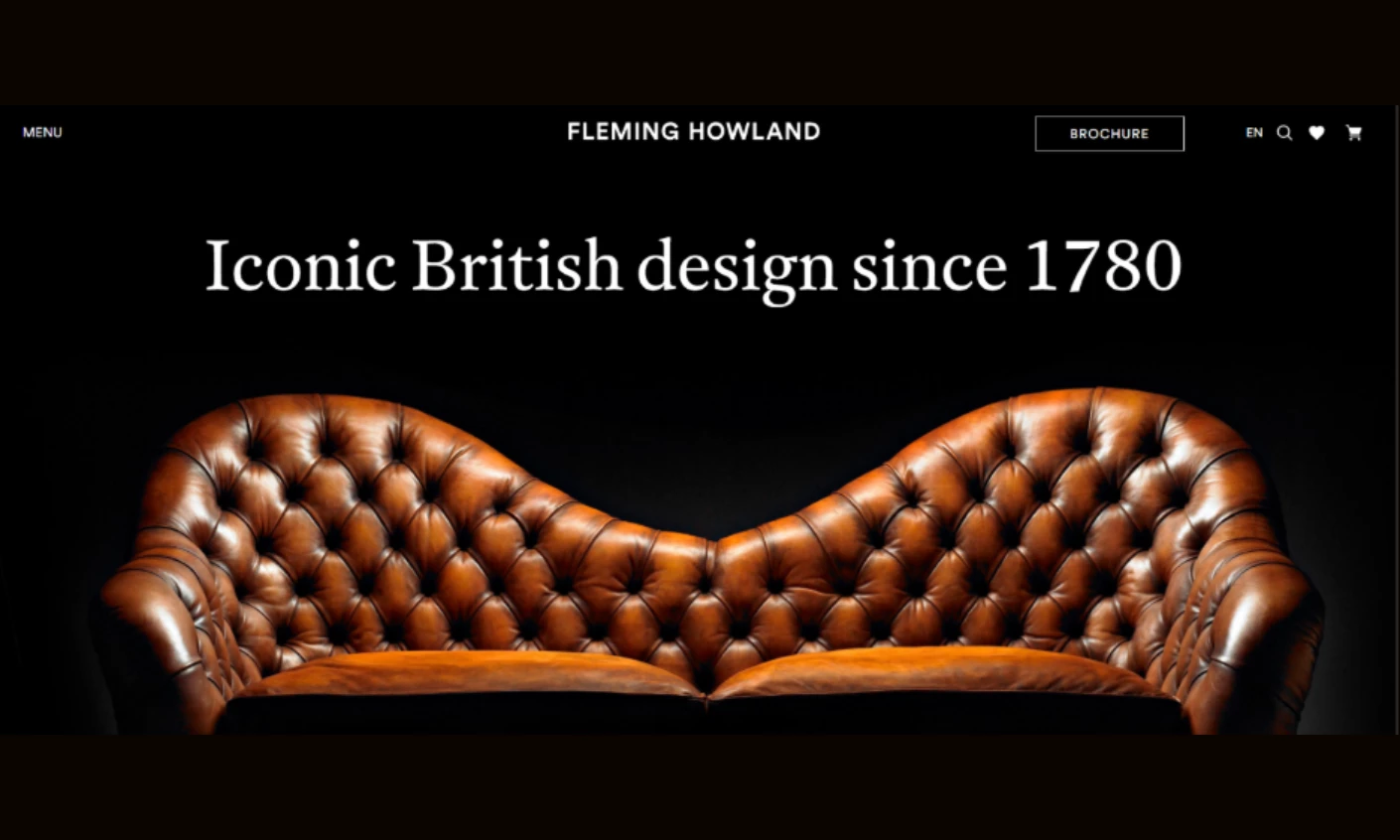
Fleming Howland has made Chesterfield sofas in Britain since 1780. Hedera, a studio in Lancaster, was briefed to deliver heritage storytelling and modern luxury appeal through better UX.
The sofa menu filters four ways: by style, size, color, and material. The color families carry names a buyer recognizes, such as Red-Oxblood and Tan-Brown, and a Materials section explains leather, cotton velvet, mohair velvet, and wool before anyone orders a swatch.
Branko Dimitrijević wrote that the site's easy movement from brand history to product collections positions it as "both an archive and a shop window" in his review. History, Philosophy, and Certification sit under Company for buyers who want the provenance first.
Why it works: A Chesterfield buyer decides on leather, color, and size before model, so a menu that filters on those answers the questions in the order they arrive. Named color families and a materials guide handle questions that would otherwise come by email.
Read the complete Fleming Howland website design breakdown.
15. Elicyon by HNDRX Ltd
Standout Features:
- Project count in first scroll
- Terracotta accent color
- Sector-split project index
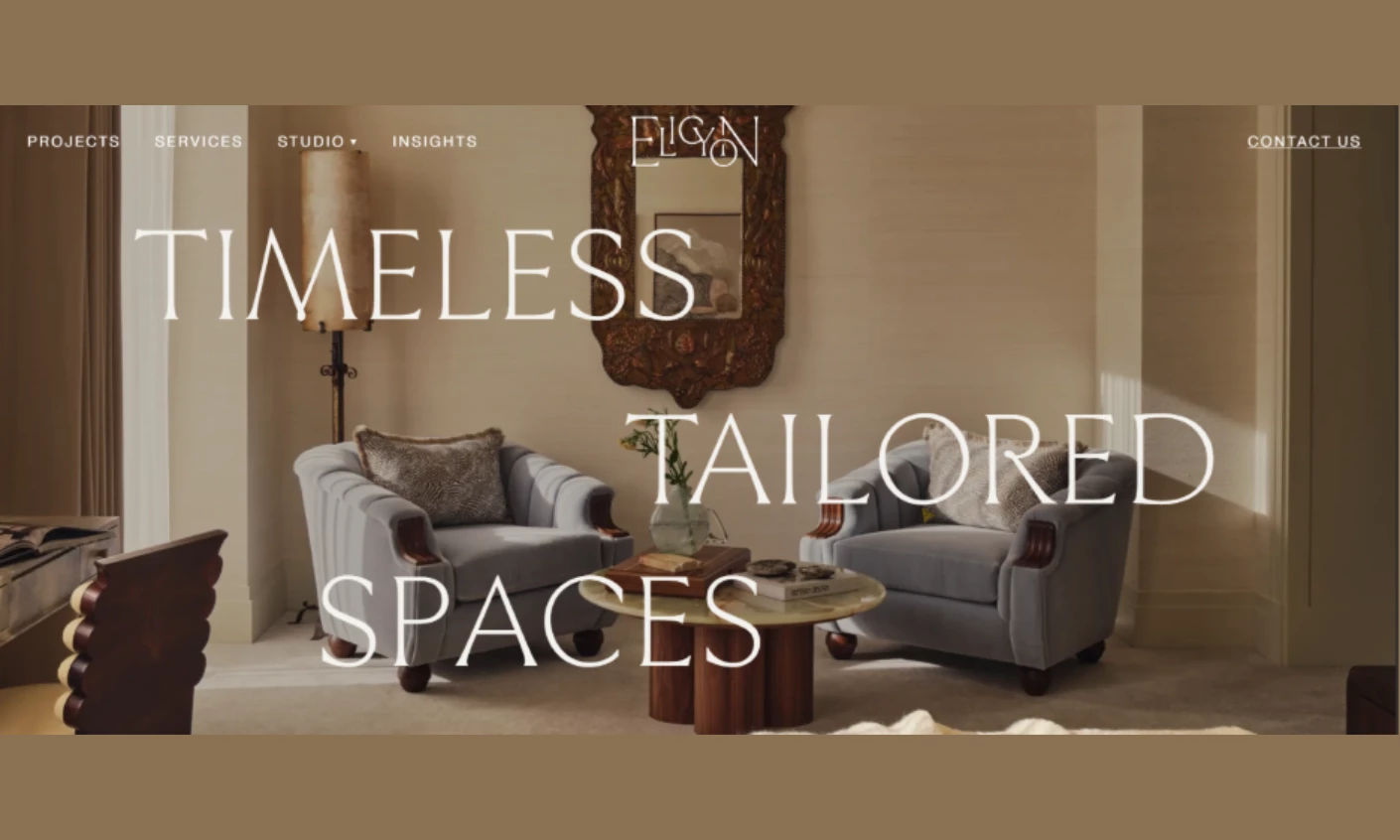
Elicyon is a London interior design studio working on residential, commercial, and landmark development projects worldwide. HNDRX Ltd, a New Zealand studio, rebuilt the site as Elicyon prepared to expand into new markets.
HNDRX describes the approach as strong typographic systems paired with understated motion. Page transitions run slowly, and a terracotta accent (#8D5D52) marks the details against the photography.
The projects section opens with a count, "over 135 projects worldwide," then splits the index into Residential, Development, and Commercial with one named project each: 60 Curzon Apartment, Chelsea Barracks, and Wigmore Private Office. A buyer sees the studio's scale and range before scrolling further.
Why it works: an interior design client is hiring judgment they can't test in advance. A stated project count and three named addresses give them evidence of range, and a named address is something a client can check.
Explore the Elicyon luxury website design in full.
3 Famous Luxury Websites Worth Studying
The 15 above are commissioned work for independent luxury brands. The three below belong to names most buyers already know.
1. Aesop by Work & Co
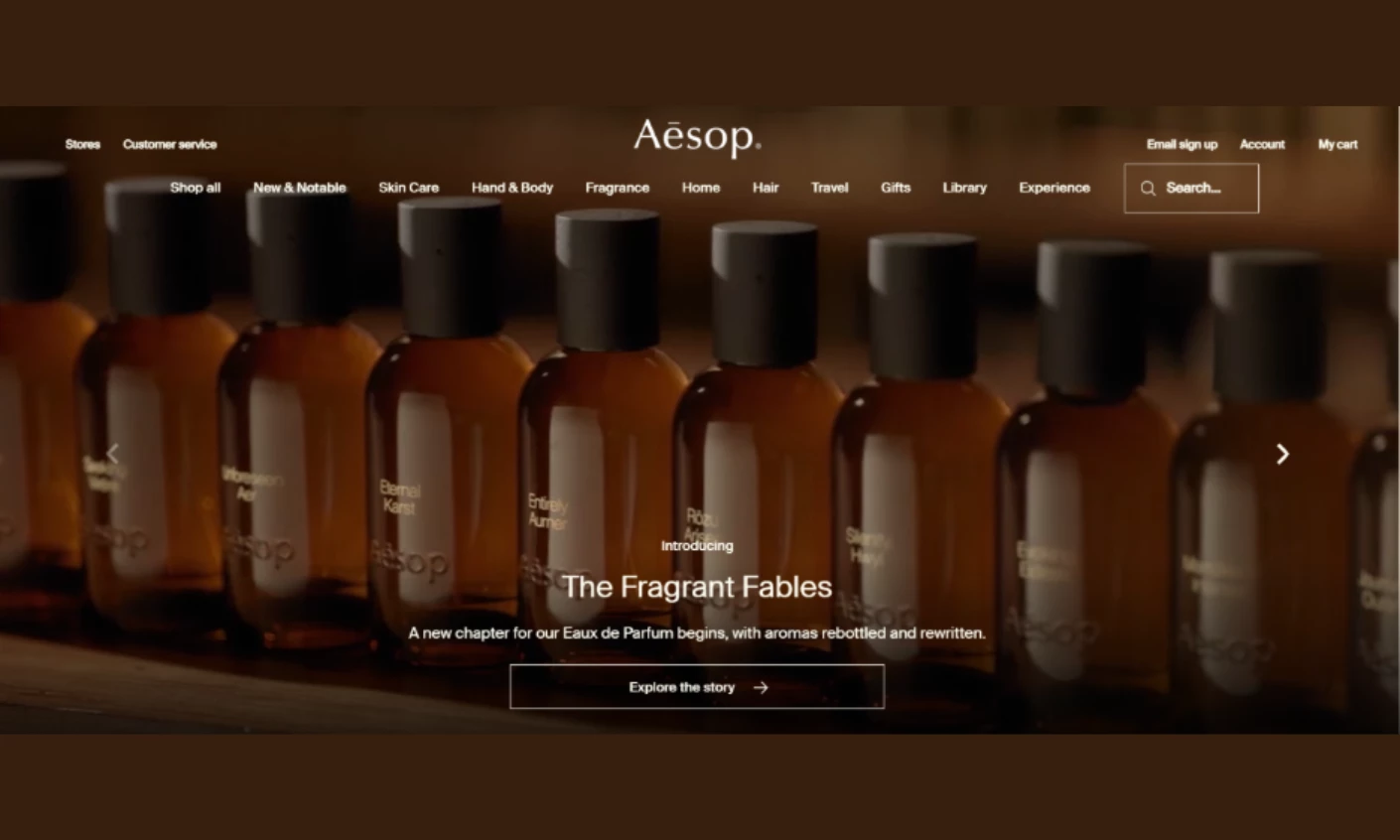
Aesop had spent two decades building a following without advertising when it brought in Work & Co to design, build, and ship a new e-commerce site. Work & Co documents a 10-month engagement that launched in the US in mid-2017, then rolled out to Australia, Europe, Canada, and Asia.
Two decisions carry the design. A "shoppable navigation" lets a loyal customer restock in a few taps while a newcomer digs into product detail, and the product-page content mirrors the consultation an Aesop store associate gives in person. The redesign went on to win a HOW International Design Award.
2. The Explora Journal by Skywire
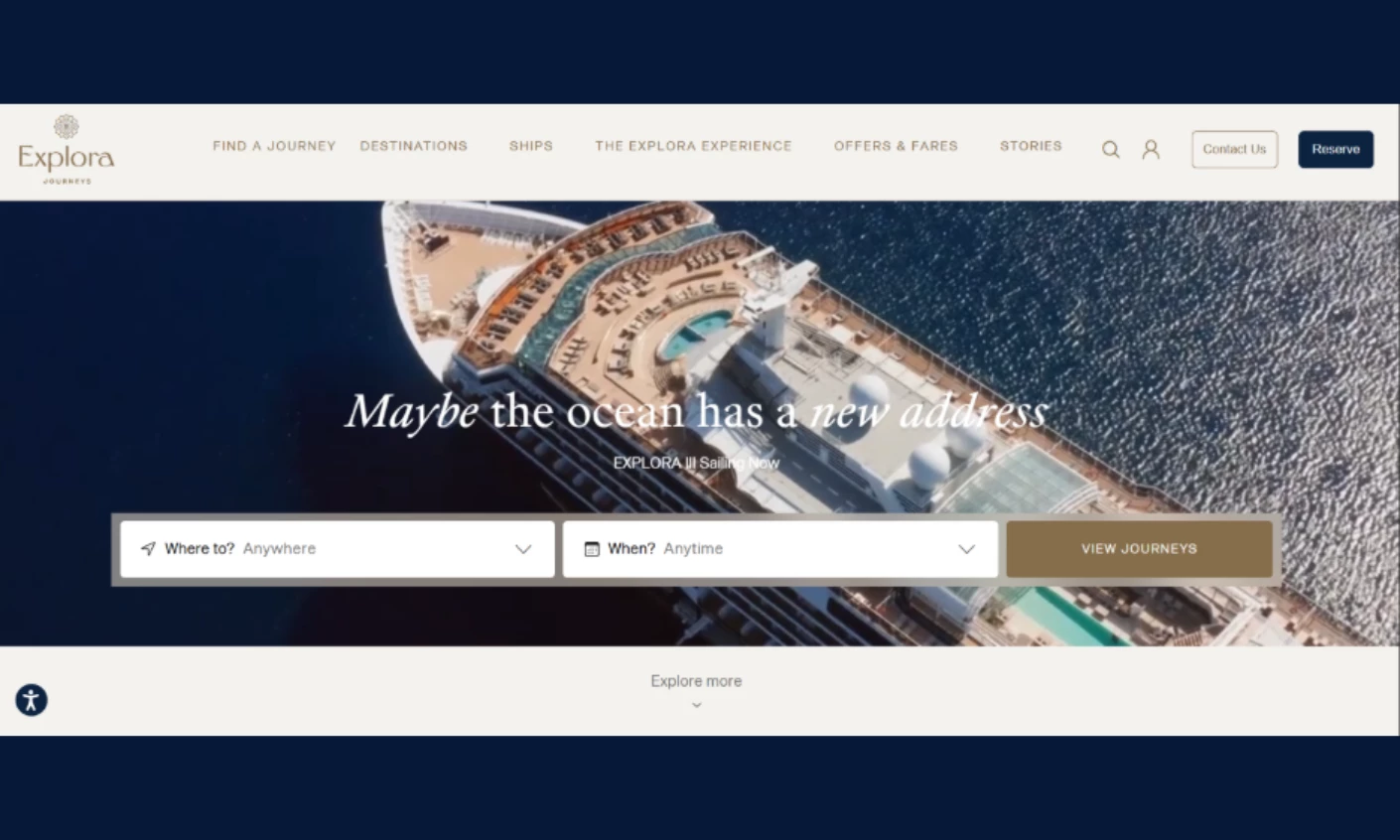
Explora Journeys is a luxury ocean cruise brand, and The Explora Journal is the magazine built into its site. Skywire designed Explora's full digital experience from scratch, before the ship was even built.
The journal answers the questions a first-time cruise buyer types into a search bar, with titles like "First-Time Tips: Top Things to Know Before Your First Ocean Journey" and "What to Pack for an Alaska Ocean Journey." Each article gives the brand a page an AI assistant can cite when a buyer asks the same thing.
3. Miu Miu "A House That We Shaped" by Merci-Michel
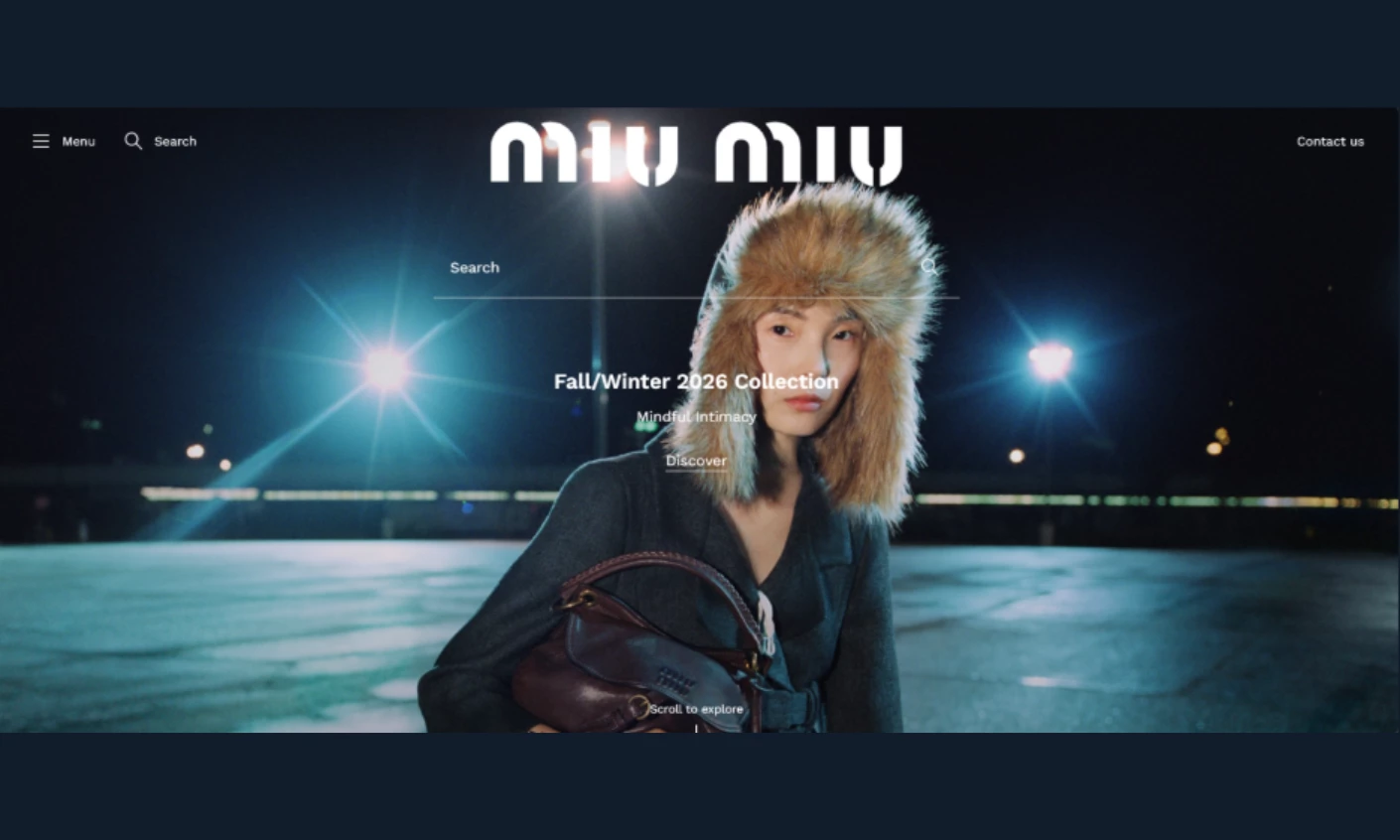
Miu Miu's 2026 Arcadie and Wander bag campaign runs on its own microsite, with navigation built around interaction.
The site opens on a slow pan toward a Parisian house, then lets a visitor pick up a notebook and explore room by room, with a sequence built on matelassé, Miu Miu's quilted leather. The type pairs SometypeMono, BiroScript, and Work Sans over cobalt blue (#265ADF) and cream (#FCF5E6).
A campaign microsite carries almost no product copy, the trade the brand made for immersion, and it holds up because the main store handles everything the microsite skips.
5 Design Patterns Behind the Best Luxury Website Designs
Strip away the palettes and these sites converge on five decisions. Each comes with the number that justifies it.
1. Copy That Names Things
Morley Yachts leads with Christina O and a crew of 40. Fleming Howland names its color families, and Meukow opens on two brothers from Silesia in 1850. None of the three leans on the word "luxury" to make the point
The number: Margariti and colleagues' 2025 experiment with 118 participants found text-dominant luxury sites raised perceived luxuriousness through perceived informativeness. Informative copy was a third route to luxury, alongside white space and imagery.
2. One Accent Color, Reserved for the Action
SuperLuxury uses neon green only on calls to action. Meukow holds its stylesheet to black, white, and one gold, and The Grove holds its to teal and one coral, so a visitor learns the color system on the first screen.
The number: WebAIM's 2026 Million found low-contrast text on 83.9% of the top million homepages, up from 79.1%. Gold and pale grey on white are the two luxury defaults most likely to fail that check, so test the accent before it goes into the design system.
3. Prices Published Where the Comparison Happens
Yacht Luxe puts a starting price on every fleet card. Elicyon publishes no price at all and sells on a project count and named addresses instead, which suits a studio whose fee depends on the brief.
The number: Two in three AI-using luxury consumers use the tools to compare products, according to Bain and Altagamma's June 2026 update. Publish a "from" figure where a comparison is likely, and hold it back only where the price depends on the brief.
4. Routes Split by Buyer Before by Product
Alma 1938 separates specifiers from shoppers at the first click. Sirai lists five sub-brands with a location under each, and Morley Yachts splits charter guests from owners.
The number: Contentsquare's 2025 benchmark of 90 billion sessions found a 5.4% average conversion lift for sites raising session depth 10% or more. A visitor routed to the right division reads more pages of it.
5. Motion With a Weight Budget
Elicyon's transitions run slowly, and HNDRX calls the motion understated. The Grove and Das James lead with video and full-bleed photography, and both hold everything else on the page to two or three colors.
The number: Only 48% of mobile origins pass all three Core Web Vitals in HTTP Archive's 2025 Web Almanac. Deloitte and Google's 2020 study measured an 8.6% lift in luxury page views per session from a 0.1-second mobile gain, so every animation draws on a budget the page can't afford to overspend.
What AI Search Changes for a Luxury Website
Bain and Altagamma's June 2026 update found about one in four luxury consumers use AI for brand and product discovery, and Bain warns that brands without AI-native relevance risk being left behind. An AI assistant builds its answer from the text on the page, so anything a luxury site says only in photography, video, or animation is invisible to it.
Elicyon shows the risk in its own page source. The section labels Residential, Development, and Commercial are each split into one HTML element per letter so they can animate a character at a time, which leaves any tool that reads the page element by element with 11 one-letter fragments.
The fix costs little. Keep one plain-text version of every heading in the markup, hide the animated copy from screen readers, and write product and room pages in sentences that name the material, the size, and the place.
The shift runs deeper than markup. Julie Michael, chief executive officer of Team One, told DesignRush that "anything that smells elitist or uninclusive is an anti-strategy these days", and a site written plainly enough for a buyer's assistant is also more open with the buyer.
What a Luxury Website Design Costs and How Long It Takes
Most luxury builds fall into the eCommerce and Retail band or the Travel and Hospitality band, depending on whether the site sells products or stays.
Industry | Cost Range |
SaaS & Tech | $10,000 to $100,000+ |
Financial Services | $10,000 to $80,000+ |
Healthcare | $7,000 to $70,000+ |
Media & Entertainment | $7,000 to $50,000+ |
eCommerce & Retail | $5,000 to $50,000+ |
Travel & Hospitality | $5,000 to $45,000+ |
Real Estate | $5,000 to $40,000+ |
Professional Services | $3,000 to $30,000+ |
Nonprofits | $3,000 to $20,000+ |
Source: DesignRush web design pricing data.
The band rarely decides the budget. Three things push a luxury build toward the top of it: product photography and video at a quality most brands commission fresh, an integration with a booking engine or product catalog, and custom typography licensing.
Project type | Typical luxury equivalent |
Simple, 1–5 pages, no CMS | Campaign microsite or single-villa site |
Small business, 5–15 pages, CMS | Boutique hotel or bespoke tailor |
Mid-complexity, 15–40 pages, custom CMS | Multi-property travel brand |
Complex, custom features and integrations | Jewelry or furniture store with configurator |
Enterprise or custom platform | Multi-market fashion or spirits house |
Source: DesignRush web design pricing data, US agency projects. Luxury equivalents are DesignRush editorial mapping.
The hours behind those bands run to 138 for a simple build, 261 for mid-complexity, and 500 or more for complex work, at a US blended rate of $145 an hour. Additional pages run roughly $1,500 templated and $2,500 custom, which is the figure to hold in mind before agreeing to a page for every collection.
Overrun cause | Typical increase | Why it hits luxury builds |
New features mid-project | 15–30% | A configurator or appointment booking added after wireframes are signed |
Integration complexity | 10–25% | A booking engine or ERP catalog that does not match the assumed data |
Client content delays | 10–15% | A product shoot scheduled after the build starts |
Excess revision rounds | 5–15% | Brand approval running through a founder or a parent company |
Rush premium | 25–50% | A launch pinned to a collection drop or a season opening |
Source: DesignRush web design pricing data.
Content delay is the cost luxury brands underestimate most. A site designed around photography can't launch on placeholders, so book the shoot before the contract is signed.
Comparing an agency quote against a solo designer is a separate calculation, covered in DesignRush's breakdown of freelance versus agency cost.
Luxury Website Design Mistakes These 15 Sites Avoid
Each mistake below carries a check you can run today and a fix with an effort estimate. They run cheapest first, so work down the list until the budget runs out.
1. Gold or Grey Text That Fails Contrast
Check: Run your homepage through a contrast checker, starting with any gold, beige, or light grey text and any type set over a photograph. WebAIM found low-contrast text on 83.9% of the top million homepages in 2026, so assume you have it until a tool says otherwise.
Fix: Half a day. Darken the accent a step or add a scrim behind hero type, then write the corrected values into the design tokens so new pages inherit them. Watch the click rate on the hero call to action.
2. Headings the Page Source Cannot Read
Check: Open your homepage source, or paste it into a plain-text reader, and search for your section headings. If they show up as single letters, or only as text inside an image, neither an AI assistant nor a screen reader can read them.
Fix: One day. Keep one plain-text heading in the markup and mark the animated version as decorative for assistive technology. Watch whether AI assistants start describing the section correctly when asked about your brand.
3. Adjectives Where the Facts Should Be
Check: Read your homepage copy aloud and count the facts a stranger could verify: a year, a place, a material, a number. Morley Yachts, Meukow, and Fleming Howland each carry several in the first screen.
Fix: One to two days of copywriting. Replace each unverifiable adjective with the fact behind it, and give every product or room page two or three sentences naming what it's made of and where. Watch scroll depth on the rewritten pages.
4. Hiding Every Price by Default
Check: Time how long a stranger takes to find what your product or stay costs, then check whether your closest rival publishes theirs. A buyer who can't price you in a comparison drops you from it.
Fix: An hour per template. Publish a "from" figure where rivals do, as Yacht Luxe does, and state the reason for holding it back where the price depends on the brief. Judge the change on enquiry quality before enquiry volume.
5. Video With No Weight Budget
Check: Run your homepage through a Core Web Vitals report on mobile and note the image and video payload. HTTP Archive put the median mobile home page at 2,362 KB in 2025, and a luxury homepage with a video header usually starts above that.
Fix: Two to three days. Compress the hero video, serve a poster frame first, lazy-load everything below the fold, and put a file-size ceiling in the photography brief. Watch Largest Contentful Paint on mobile.
6. Rebuilding Before the Cheap Fixes Run Out
Check: Name the specific problem a redesign would solve, then check whether the five fixes above have already handled it. A redesign without a named problem reproduces the old one in a new palette.
Fix: Four to six months and $30,000 to $80,000 for a complex build under DesignRush pricing data, plus the overrun bands above. Copy the mechanism from the site you admire, since Miu Miu's microsite works only because the main store carries the product copy it skips.
Where the underlying problem is the brand, a redesign won't fix it. The directory of luxury branding agencies is the better starting point for that work.
These patterns aren't confined to luxury. The best modern website designs roundup tracks the same moves across other categories.
Best Luxury Website Designs: The Takeaways
High-end digital spaces in 2026 succeed by prioritizing the browsing experience over aggressive persuasion techniques. You achieve this balance through intentional white space and subtle tactile textures because these visual choices replicate the physical weight of premium goods on a digital screen.
Typography now carries the primary architectural burden for modern luxury brands. Replacing heavy visual clutter with large and expressive fonts allows your core message to dictate the visual hierarchy. This structural shift demands strict attention to legibility and typeface selection because the words themselves serve as the main interface.
You must also evaluate the organizational flow of your offerings. Grouping information into clean modular blocks helps your visitors scan complex portfolios without experiencing cognitive overload. This direct method respects the user's time while presenting your brand story in a highly digestible format.
Premium websites win by merging raw simplicity with flawless execution. Building a memorable online presence requires stripping away unnecessary decorations to let the true value of your service command the screen.

Our design experts recognize the most innovative and creative designs from across the globe. Visit Design Awards to see the:
- Best Logo Designs
- Best Website Designs
- Best Video Designs
- Best Print Designs
- Best Packaging Designs
- Best App Designs
Our team also ranks agencies worldwide to help you find a qualified agency partner. Visit our Agency Directory for the top Logo Design Companies, as well as:
- Top Web Design Agencies
- Top Video Production Companies
- Top Print Design Companies
- Top Packaging Design Companies
- Top Mobile App Development Companies