Your accounting firm will either save you money or cost you more than their fee. Our directory helps you find Florida-based firms with the right industry experience and state-specific expertise, and the benchmarks to tell the difference before you commit.
Best Accountants in Florida
77 Companies-Rankings updated: September 13, 2026
DesignRush evaluates FL accounting firms based on verified client reviews, portfolio quality, and demonstrated expertise. Some placements may be paid.
Protiviti is a global consulting firm that offers deep expertise, objective insights, and tailored solutions to empower leaders in tackling future challenges. With a comprehensive range of services spanning finance, technology, operations, data, analytics, governance, risk, and internal audit, we serve...
Meeting with your accountant. On your list of favorite things to do on a regular basis, meeting with your accountant probably falls somewhere near the bottom. If it makes the list at all. Not a surprising fact, since preparing for those meetings usually saps virtually all of your time. Time you could and...
Clark Outsourcing is a Philippines-based outsourcing company providing reliable offshore staffing and remote workforce solutions to businesses worldwide...
Baker Tilly USA is a privately-owned, trusted project management, tax consulting, and business advisory firm that helps public and large private enterprises navigate complex tax and financial regulations everywhere in the world...
Scaling teams, delivering software, and managing payroll worldwide
Scaling teams, delivering software, and managing payroll worldwide
DevRank enables companies to scale fast by providing top-tier tech talent, full-cycle software development, and global payroll solutions. With 5,000+ professionals across the US, LATAM, Europe, and Asia, we help businesses build stronger teams, deliver projects faster, and expand globally without operational...
A leader in providing Medical Credentialing, Licensing & Billing services nationwide. Our mission is to simplify the administrative challenges faced by healthcare providers. We provide services for physician group practices, medical laboratories, skilled nursing facilities, telehealth & more...
EY offers Accounting, Business Consulting, and IT Services with a mission to build a better working world. It provides insights and quality services that instill trust in global capital markets and economies. EY focuses on developing exceptional leaders who deliver on their commitments to all stakeholders...
Bay Forward is a multinational ecosystem service provider and technology consulting firm specializing in Enterprise Resource Planning (ERP) implementations, artificial intelligence, and financial management. They help businesses automate operations and scale by providing fractional CFO services, bookkeeping...
Boost productivity & profitability by outsourcing to the Philippines with STAFFVIRTUAL
Boost productivity & profitability by outsourcing to the Philippines with STAFFVIRTUAL
Customer service, back office, and IT outsourcing are the areas of expertise of STAFFVIRTUAL, an American business process outsourcing (BPO) firm with offices in the Philippines. Additionally, we offer Employer of Record (EOR) or Professional Employer Organization (PEO) solutions. It is simple for your...
The Peak Hire helps busy founders and growing teams reclaim their time with dependable virtual assistants matched to their actual workflows. Our remote professionals support administration, customer service, sales, recruiting, operations, bookkeeping, CRM management, scheduling, inbox management and lead...
Professional Accounting Solutions for Business Growth
Professional Accounting Solutions for Business Growth
Centaur Digital Accounting supports small business owners with expertly tailored tax and accounting solutions. The firm offers personalized tax strategies and innovative tools like Gusto and QuickBooks Online to maintain accurate financial records and maximize savings. Centaur Digital Accounting builds...
Miami Business Tax Help, located in Homestead, Florida, offers comprehensive tax and accounting services for businesses and individuals across all 50 states. The firm leverages secure client portals and virtual communication tools to provide efficient, high-quality service while saving clients time and...
Anchin is a premier accounting and advisory firm celebrated for its innovative approach and industry expertise. The firm delivers tailored solutions to foster growth and navigate economic complexities. Its expert team provides clarity and strategic insight to help clients achieve sustainable financial growth...
H&CO is a premier accounting and business advisory firm specializing in international tax, audit and assurance, and global outsourcing solutions. With a mission to empower clients globally, H&CO provides tailored solutions that drive monetary success and operational efficiency. The firm's extensive experience...
Greenlight Financial delivers tailored accounting solutions for small to medium-sized businesses, focusing on maximizing cost efficiency and financial strategy. With over 30 years of collective experience, the firm provides expert bookkeeping, tax planning, and international business transition services...
Engineered Tax Services maximizes tax benefits through advanced consulting and accounting practices. The firm offers expert services in cost segregation, research and development (R&D) tax credits, and various energy-related tax incentives. With decades of experience, Engineered Tax Services provides tailored...
Dannible & McKee provides comprehensive accounting, tax, forensic, and advisory services to help businesses make informed financial decisions. With a blend of deep expertise and global reach through GGI Global Alliance, the firm delivers tailored solutions that inspire confidence and drive success. Clients...
212 Tax specializes in back tax resolution for clients across New York, Florida, and New Jersey. With expertise in eliminating tax issues and providing tailored tax strategies, the firm helps clients reduce stress and regain control of their finances. 212 Tax's direct approach ensures clients collaborate with...
Ratafia & Company specializes in providing comprehensive accounting and bookkeeping services tailored to meet the unique needs of businesses. By offering outsourced solutions, the firm allows clients to focus on their core operations while ensuring financial accuracy and compliance. With a commitment to...
Fiske & Company is a leading forensic accounting firm offering business accounting, tax services, and litigation support. With extensive experience in forensic accounting, Fiske & Company assists clients with fraud investigations, business valuations, and legal disputes. Its professionals deliver trusted...
FairValue Advisors offers expert forensic accounting and business valuation services for family businesses and Fortune 500 companies. With offices in Atlanta, Orlando, Jacksonville, Tampa, and St. Simons, FairValue Advisors provides comprehensive commercial litigation and dispute resolution support. Its...
Weinberg & Company provides expert accounting, auditing, tax, and consulting services to public and private companies, entrepreneurs, family offices, and high-net-worth individuals...
Northside Tax Services specializes in modern, accurate, and timely tax preparation, with a focus on individual and small business returns, complemented by a worry-free accuracy and low-price guarantee...
A Clearwater-based firm offering specialized tax, payroll, and bookkeeping services, with Enrolled Agents authorized to represent taxpayers before the IRS. The firm combines technical expertise with a commitment to delivering exceptional client support...
DiMercurio Advisors is an accounting firm dedicated to helping small business owners by simplifying complex financial issues. With innovative tax, accounting, and advisory solutions, the firm empowers clients to make informed decisions and focus on what matters most...
Ace Cloud Hosting offers secure, flexible, and scalable cloud solutions tailored to modern accounting needs. With over 15 years of experience, they specialize in cloud hosting for QuickBooks Desktop, application hosting, and managed security services...
6 Frequently Asked Questions About Accounting Firms in Florida
Do I need a local Florida accountant?
For most businesses operating in Florida, yes, and the reason is state-specific complexity that generalist or out-of-state firms routinely miss.
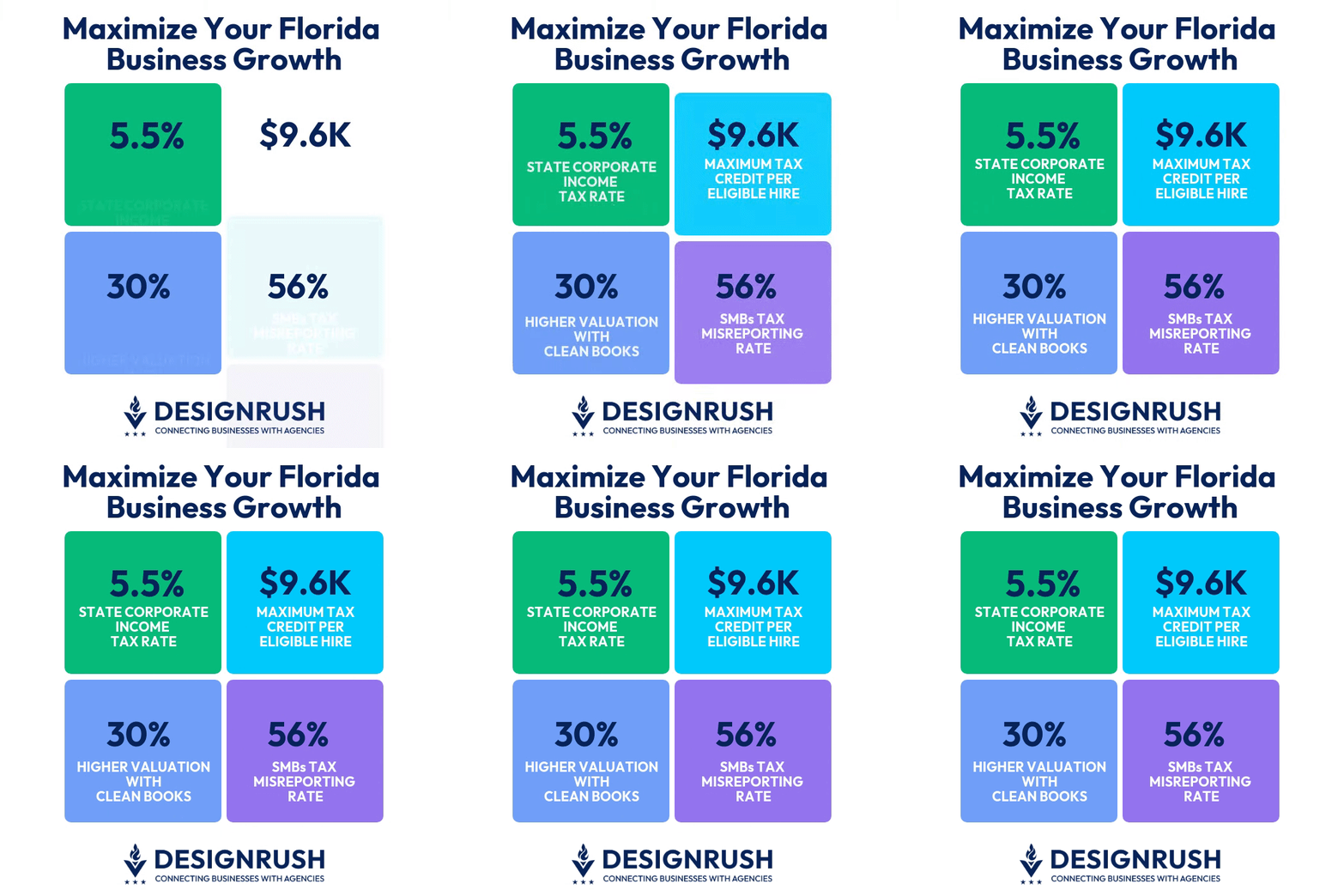
Florida has no state income tax, but it does have a corporate income tax, a sales tax structure that varies by county, documentary stamp taxes on real estate transactions, and reemployment tax obligations that catch businesses off guard.
A firm that isn't fluent in these doesn't know what they don't know.
Beyond compliance, Florida's business market has its own dynamics: a heavy concentration of real estate, tourism, hospitality, and international trade, particularly in markets like Miami, Tampa, and Orlando.
A local firm brings pattern recognition from working with businesses in the same regulatory environment and economic conditions as yours. That context is hard to replicate remotely.
If your business has any Florida-specific footprint, employees, property, revenue, or licenses, accounting firms in FL are worth the premium.
What red flags should you watch for when interviewing a Florida accounting firm?
The biggest red flag is a firm that can't speak fluently to Florida-specific obligations. If they're vague about documentary stamp tax, county-level sales tax variations, or Florida's corporate income tax rules during the interview, that vagueness will show up in your filings too.
Watch for these warning signs before you sign anything:
They have no clients in your industry Florida's major sectors (real estate, hospitality, tourism, healthcare, and international trade) each carry distinct tax and compliance requirements. A firm without relevant industry experience is learning on your dime.
They can't name the Florida Department of Revenue by processes Firms that handle Florida businesses regularly know the DOR's audit triggers, filing deadlines, and penalty structures. Generic answers signal generalist experience, not Florida fluency.
The engagement letter is vague on scope Florida businesses often need help across multiple areas, such as sales tax, payroll, entity structuring, and real estate transactions. If the contract doesn't define what's included and what triggers additional fees, expect surprises.
They're slow to respond before you're even a client Florida's tax calendar has firm deadlines. A firm that takes days to return a call during the sales process will not move faster once you're paying them.
One partner sells you; a junior staffer handles your account Ask directly who will manage your account day to day. In Florida's larger markets, such as Miami and Tampa, this bait-and-switch is common among mid-size firms chasing growth.
How much do accounting firms in Florida charge?
Florida CPA fees typically range from $150 to $400 per hour, depending on the service and firm. Here's how it breaks down by service type:
Tax preparation: $150 to $350 per return
Bookkeeping: $40 to $100 per hour
Audit and assurance: $250 to $400 per hour
Advisory and consulting: $200 to $350 per hour
Accounting services for small businesses typically range from $100 to $5,000, depending on the services needed and the type of professional hired.
Factors that affect the price include firm size, the seniority of the person who handles your account day to day, the complexity of your financials, and whether you bundle services. Bundling tax, bookkeeping, and advisory together typically gets you a better effective rate than buying each separately.
One cost most buyers don't anticipate is scope expansion. An engagement that starts as annual tax prep can grow fast if you hit an IRS notice or need audit support. Budget a reserve beyond the core retainer.
Do top accountants in Florida offer services beyond tax preparation?
Yes, and for most businesses, tax preparation is the least valuable thing a good firm does for you.
There's an important distinction worth knowing: not every accountant is a CPA.
A CPA (Certified Public Accountant) has passed the Uniform CPA Exam, meets Florida Board of Accountancy licensing requirements, and carries legal accountability that unlocks services a general accountant cannot provide, including audits, financial statement attestation, and representation before the IRS.
Top Florida CPA firms typically offer:
Tax planning: Proactive strategy year-round, not just filing season
Audit and assurance: Required for certain lenders, investors, and government contracts
Bookkeeping and controller services: Ongoing financial management for businesses without in-house finance staff
Payroll services: Including Florida reemployment tax compliance
Business advisory: Entity structuring, succession planning, and M&A support
International tax: Especially relevant in South Florida, where cross-border business with Latin America is common
The distinction matters when hiring: if you need an audit, a reviewed financial statement, or IRS representation, confirm the firm has licensed CPAs handling that work, not just accountants or bookkeepers operating under a CPA's name.
What records do I need to keep?
Florida businesses are subject to both federal IRS requirements and state-specific obligations, so recordkeeping isn't one-size-fits-all. A good Florida accounting firm will tailor this to your business structure and industry, but here's the baseline every Florida business should follow:
Tax records
Federal and state tax returns: 7 years minimum
Supporting documents (receipts, invoices, bank statements): 7 years
Employment tax records: 4 years from the date the tax was due or paid
Business financial records
General ledgers and journals: Permanently
Annual financial statements: Permanently
Bank reconciliations and statements: 7 years
Florida-specific obligations
Sales tax records: Florida requires businesses to retain sales tax records for 3 years from the date of filing, but if you're audited, the Department of Revenue can look back further if fraud is suspected
Reemployment tax records: 5 years
Documentary stamp tax documentation: Keep with the underlying transaction records, typically 7 years
Payroll and HR records
Payroll records: 4 years federally, but Florida recommends 7 for state audit purposes
I-9 forms: 3 years from hire date or 1 year after termination, whichever is later
The practical rule most accountants use: when in doubt, keep it for 7 years. That covers the IRS's standard audit window and most Florida Department of Revenue lookback periods.
Your Florida accounting firm should conduct a recordkeeping review when you first engage; if they don't, ask. Gaps in documentation are among the most common and avoidable reasons Florida businesses lose audit disputes.
How often should I meet with my accountants in Florida?
For most Florida businesses, quarterly meetings are the minimum, aligned with tax deadlines and estimated payment schedules that hit four times a year.
Here's a practical meeting cadence by business type:
Monthly: Active payroll, complex multi-county sales tax filings, or fast-changing financials
Quarterly: The standard for most small to mid-size businesses; aligns with estimated tax payments and financial reviews
Annually: Only workable for very simple structures, like a sole proprietor with straightforward income and no employees
Key Florida dates to build your calendar around:
January 31: W-2s and 1099s due; Florida reemployment tax Q4 filing
March 31: Florida sales tax annual filing deadline (if applicable)
April 15: Federal individual and business tax filing deadline; Q1 estimated tax payments due
April 30: Florida reemployment tax Q1 filing
June 15: Q2 estimated federal and Florida corporate tax payments
September 15: Q3 estimated payments; extended partnership and S-corp federal returns due
October 31: Florida reemployment tax Q3 filing
December 1: Florida corporate income tax return due for calendar-year filers
Florida businesses have more recurring deadlines than most buyers realize. A firm you can reach quickly between scheduled meetings, when an IRS notice arrives, or a real estate transaction changes your tax position, is worth more than one you see on a perfect schedule but can't get on the phone when it matters.































 Proposals