
From $20/month SaaS tools to $20,000 pilots and million-dollar enterprise rollouts with hidden compliance costs, this guide shows you exactly what AI will cost for your business in 2026.
You'll get real benchmarks by industry and company size, plus the overlooked expenses that quietly inflate budgets. So, if you're budgeting AI this year, read this first.
AI Pricing: Key Findings
- Most small businesses can launch AI for under $5,000 or $20–$100 per month per user using off-the-shelf tools instead of custom development.
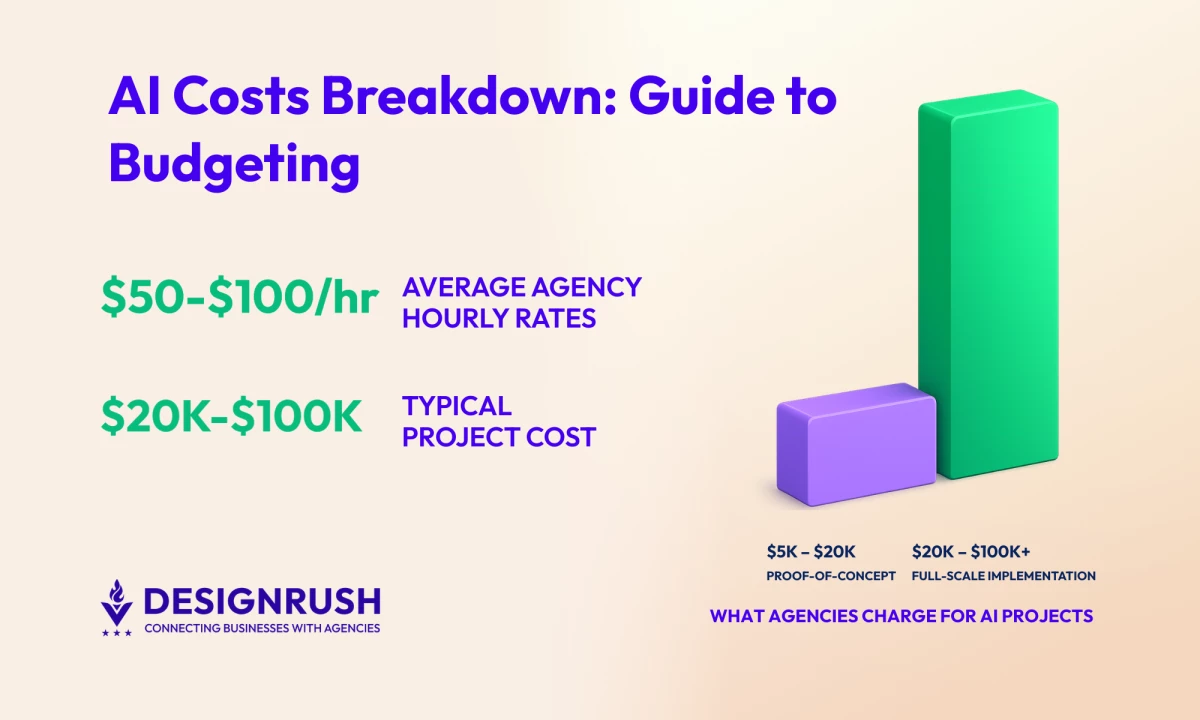
- In-house AI specialists cost $80K–$180K per year plus 30%+ overhead, making agency pilots ($5,000–$20,000) a lower-risk entry point.
- Regulated industries like healthcare and finance rarely spend under $20,000 per project, due to compliance, audits, and security requirements.
What Does Artificial Intelligence Cost in 2026?
1. How To Use AI for Business
2. Ways To Use AI in Web Dev
3. 25+ Most Popular AI Tools
4. AI Statistics & Trends
How much does AI cost once implementation, compliance, and long-term maintenance are included? AI pricing shifts based on use case, infrastructure, vendor, and how fast your adoption scales.
Here's a quick view to set your expectations across different AI initiatives:
AI Costs by Project Type
Typical budgets vary by application, but the ranges are more grounded than most suggest.
Here's what we're seeing in our data based on real project budgets and agency quotes:
|
Project Type |
Hourly |
Budget |
Ave. Timeline |
|
Process automation & document workflows |
$25–$50/hr |
$5,000–$100,000 |
5.5 mo |
|
Analytics & dashboards |
$25–$25/hr |
$5,000–$100,000 |
4 mo |
|
Chatbots & voice agents |
$40–$60/hr |
Under $250,000 |
5.5 mo |
|
Generative/creative experiences |
$25–$200/hr |
$20,000–$1,000,000 |
3 mo |
|
Healthcare AI (e.g. diagnosis monitoring) |
$50–$85/hr |
$20,000–$100,000 |
6 mo |
|
ML platforms & tools |
$49–$50/hr |
$20,000–$250,000 |
6 mo |
|
$20–$25/hr |
$20,000–$100,000 |
12 mo |
In general, projects with simple objectives and off‑the‑shelf tools cost far less than those that demand custom development.
Costs also don't rise in a straight line. Each new feature, like voice support, multi‑language, or extra integrations, will multiply cost and time accordingly.
AI Costs by Company Size
Here's what our data at DesignRush shows:
|
Business size |
Hourly |
Budget |
Timeline |
|
Small business |
$25–$49/hr |
$5,000–$20,000 |
1–3 mo |
|
Micro / Startup |
$40–$40/hr |
Under $5,000 |
6–24 mo |
|
Mid-market |
$25–$200/hr |
$100,000–$250,000 |
4–11 mo |
|
Enterprise |
$100–$200/hr |
$500,000–$1,000,000 |
12–24 mo |
Startups and small businesses often rely on affordable SaaS AI tools that save time, many of which start at a few dozen dollars per month.
Mid-market firms often formalize AI budgets, typically budgeting $20,000–$100,000 annually as adoption spreads, and they build integrations with existing systems.
At the enterprise level, spending expands materially. It's common for large companies to allocate hundreds of thousands per year on AI licenses, infrastructure, and internal teams.
AI Costs by Industry
In heavily regulated sectors such as healthcare, finance, or government, AI projects almost always cost more because they must also budget for compliance, security, and validation.
By contrast, tech, media, and consumer sectors can often experiment faster and at lower cost. With fewer regulatory barriers and shorter approval cycles, they can prototype, test, and iterate with less compliance overhead.
According to our data, here are the typical AI budget ranges by industry:
|
Industry |
Hourly |
Budget |
Timeline |
|
$25–$150/hr |
$5,000–$100,000 |
4 mo |
|
|
$25–$85/hr |
$20,000–$100,000 |
6 mo |
|
|
Automotive |
$45–$50/hr |
$20,000–$100,000 |
4 mo |
|
Industrial & compliance |
$40–$49/hr |
$20,000–$100,000 |
9 mo |
|
$25–$150/hr |
$20,000–$100,000 |
5 mo |
|
|
Enterprise operations |
$49–$49/hr |
$5,000–$20,000 |
3 mo |
|
$25–$25/hr |
$100,000–$250,000 |
11 mo |
|
|
Tech platforms |
$49–$49/hr |
$20,000–$100,000 |
9 mo |
A healthcare app, for example, might require a compliant cloud setup and extensive audits. That can push into the $20,000–$50,000 range even for an initial build.
Financial services, similarly, need extra governance for fraud detection or risk modeling. So even early-stage projects often run in the mid‑five to six figures.
Compliance requirements can greatly increase AI implementation costs in regulated industries.
That said, it’s worth reiterating that the spend more often than not justifies the end results.
Take for instance Knapsack, an AI-powered platform for financial advisors built by Cheesecake Labs.
It uses a hybrid local-and-cloud architecture with SOC II Type 2 compliance built in from day one, demonstrating what shipping AI products to that compliance bar actually requires: additional infrastructure, governance, security controls, and long-term operational planning.
AI Costs by Solution Provider
The cost of AI as a solution can range from low monthly subscription fees for off-the-shelf tools to large enterprise contracts that include infrastructure, support, security, and custom integrations.
First, it’s important to know how vendors structure artificial intelligence pricing.
How AI Vendors Actually Charge Businesses
AI pricing models vary depending on the provider and deployment model. Enterprise deployments often combine licensing, infrastructure, support, and custom integration costs into larger annual contracts.
| Pricing Model | Common Examples | Best For | Cost Predictability |
| Subscription | ChatGPT Plus, Copilot | SMB teams | High |
| Usage-based | OpenAI API | Flexible workloads | Medium |
| Token-based | Generative AI APIs | High-scale AI apps | Low |
| Enterprise licensing | Custom AI vendors | Large organizations | Medium–High |
Here’s how the most common AI pricing models break down by provider type.
- Subscription AI and automation tools
- Cloud and generative AI services
- Custom AI development and consulting
1. Subscription AI and Automation Tools
These are the lowest entry points. They are ready-to-use platforms for individuals or teams.
They include productivity tools like ChatGPT Plus and Microsoft Copilot, as well as workflow automation platforms like Zapier, Make, or enterprise RPA suites like UiPath.
Their pricing ranges are:
|
Category |
Example Tools |
Pricing (Starting from) |
|
Small SaaS tools |
$20/month |
|
|
$18/month (yearly) |
||
|
Specialized platforms |
Billed yearly:
|
|
|
Billed yearly:
|
||
|
Enterprise RPA
|
|
|
|
Custom pricing |
Budgets at this level are very predictable. You simply multiply the per‑user fee by headcount for subscription tools. And for automation, costs grow with the number of automated processes.
For small teams, this means AI costs start in the low tens of dollars per user per month.
2. Cloud and Generative AI Services
These are usage-based platforms for AI APIs, compute, and managed services. They include general cloud AI for vision, speech, and predictive modeling, and generative AI like LLMs for text, images, and code.
Some known providers are AWS AI Services, Google Cloud AI, Azure AI, OpenAI, and Anthropic.
|
Category |
Example Providers |
Typical pricing |
|
Small pilot/Proof-of-concept |
$20-$100/month |
|
|
Production-grade workloads |
Pay-as-you-go; Google AI cloud storage: $8-$250/month |
|
|
Generative AI APIs |
OpenAI GPT, Claude, Google Gemini |
Usage-based, depends on requests, tokens, or compute hours |
Small pilots may cost a few hundred dollars per month, but production workloads can quickly reach thousands or tens of thousands monthly.
3. Custom AI Development & Consulting
When ready-made tools no longer fit, companies invest in custom AI. It costs more upfront, but at this stage, you're paying for expertise, integration, and long-term capability, not just software.
Teams either build in-house or work with agencies, each with different costs and trade-offs. Here's how they compare.
In-House Costs
Skilled AI specialists command high salaries per specialization:
- AI engineers: $112K - $178K per year
- AI specialist: $84K - $149K per year
- AI content editor: $73K - $136K per year
And that's before added overhead. Benefits and taxes can increase base salaries by around 30%, while administrative costs and office stipends may add another 10–25%.
Ongoing training and upskilling further add to long-term costs.
Agency Costs
If your team doesn't have the right AI expertise, hiring an agency is often the faster option.
Agencies have a team of specialists that can deliver end-to-end services, from strategy and model development to integration and deployment.
This can lower execution risk and help you move quicker, especially for complex projects.
Based on DesignRush data, typical costs are:
Here are some of the top AI agencies in our directory:
|
Agency |
Minimal Budget |
Average Hourly Rate |
Best For/Specialty |
|
$10,000 - $25,000 |
$40/hr |
|
|
|
$50,000 & Up |
$55/hr |
|
|
|
$1,000 - $10,000 |
$55/hr |
|
What Determines the Cost of an AI Project?
- Project scope and complexity
- Off-the-shelf tools vs. Custom
- Usage volume and scale
- Data requirements and readiness
- Integration, maintenance, and long-term support
1. How Project Scope and Complexity Affect Your Budget
As we've noted earlier, the broader or more complex the project, the higher the cost. A simple proof-of-concept with narrow goals and limited scope, such as classifying emails, can be implemented quickly and inexpensively.
But a project with many features, a large user base, or real‑time requirements is far more expensive.
Similarly, tasks that demand advanced AI capabilities, such as interpreting legal documents, require more sophisticated models and more engineering effort.
2. Off-the-Shelf Tools vs. Custom AI Development
Using existing AI products can dramatically reduce costs. Many business problems can be solved with off-the-shelf tools for tasks like content generation, workflow automation, customer support, or meeting transcription.
By contrast, custom AI requires additional development, integration, testing, and long-term maintenance. For example, subscribing to a chatbot service may only involve a monthly fee, while building a bespoke conversational AI system can require hundreds of engineering hours plus cloud infrastructure costs.
In practice, most companies exhaust pre-built tools before investing in custom models.
Build vs. Buy: When Custom AI Is Worth the Cost
The real decision is often whether to build custom AI or adopt existing platforms.
Generally speaking:
- Off-the-shelf AI tools are best for common productivity and automation use cases
- Custom AI helps with proprietary workflows, deep integrations, or industry-specific compliance
Healthcare, finance, and enterprise operations often outgrow generic AI tools because they require stronger governance, secure infrastructure, and workflow-specific automation.
While custom AI requires higher upfront investment, it can offer greater flexibility, scalability, and long-term operational control.
3. Usage Volume and Scale: How Adoption Drives Cost
Most cloud-based AI services charge on a pay-as-you-go basis, so costs increase with usage.
A small pilot with few users might cost next to nothing, but if the project goes enterprise-wide, costs can climb significantly.
For example, a customer support bot might be cheap in beta, but if 10,000 customers use it daily, the cumulative inference calls will increase cloud costs.
Many organizations underestimate this. They budget for development but not for heavy usage once deployment goes live.
4. Data Requirements and Readiness
AI needs good data. If your data is messy or siloed, you must budget time and money for cleaning, labeling, and consolidating it. Data engineering can easily consume as much effort as modeling itself.
For instance, if you have decades of unstructured records, converting them into a format the AI can use can be very costly. On top of that, data storage, governance, and compliance obligations add to infrastructure costs.
5. Integration, Maintenance, and Long-Term Support Costs
Deploying an AI model is just the beginning. You must integrate it with your apps, CRM, website, or workflows, which usually needs custom API work.
Once live, models naturally drift as real-world data changes, meaning retraining or updates are needed, typically every 3–6 months.
You also need monitoring systems to check accuracy and guardrails for security and regulation.
These ongoing operational tasks add roughly 15–30% of the initial project cost per year in maintenance.
The Hidden AI Costs Most Businesses Miss (and How to Manage Them)
Even with careful planning, AI projects often carry costs that don't show up in initial budgets. Companies that budget only for the AI software license and initial build frequently get surprised by maintenance bills later.
Here are the biggest hidden AI expenses and how to address them:
1. Data Preparation Isn't Cheap
Companies often overlook the cost of cleaning and labeling data, which, as mentioned, can rival the price of building the model.
Raw data is often siloed or biased, and skipping proper preparation usually leads to retraining cycles, failed pilots, or higher cloud costs.
Solution: Work with specialists like Instinctools to prepare your data for AI transformation or integration.
According to Instinctools, high-quality data preparation directly reduces:
- Training cycles
- Computation time
- Infrastructure costs
They help turn messy data into AI-ready datasets, ensuring it's clean, use-case relevant, and bias-aware. For generative AI, they go further: chunking large datasets and right-sizing context to prevent wasted compute tokens.
2. Duplicate Subscriptions Drain Your Budget
As multiple teams adopt AI tools independently, you can end up paying twice for similar capabilities. This shadow AI spend can silently inflate budgets.
What to do: Conduct a company-wide audit of AI subscriptions and consolidate licenses wherever possible.
Centralize your procurement and track usage to prevent overlapping costs without limiting your teams' access to needed tools.
3. Training and Governance Costs Add Up
Rolling out AI safely requires training employees on new systems and implementing governance policies on ethical use and compliance. These programs have labor and operational costs that are often overlooked.
How to manage: Plan governance and training from the start via onboarding programs, clear policies, and ongoing staff education.
4. Energy and Hardware Are Bigger Than You Think
Intensive AI workloads consume a lot of power.
For perspective, U.S. data centers consumed 176 terawatt-hours (TWh) in 2024 (over 4.4% of the country's electricity), and AI-related water usage is projected to reach 32 billion gallons annually by 2028.
Solution: Optimize models for efficiency and use managed cloud services.
Whenever you can, use pre-trained models. They're less demanding on compute and can help keep your bills and your carbon footprint in check.
Future AI Trends That May Affect Your Budget
Looking ahead, several trends will shape AI spending:
1. Companies Are Moving Away From “One Model for Everything”
Early AI adoption relied heavily on large models for nearly every workflow. But rising inference costs and growing GPU demand are pushing companies to prioritize efficiency over maximum capability.
Increasingly, businesses use smaller, lower-cost models for tasks like summarization, tagging, search, and customer support, while reserving expensive frontier models for complex reasoning and generation.
For example, IBM advises that a smaller tuned model can often match performance at a fraction of the cost.
Techniques like model quantization, LLM routing, where you send easy queries to cheap models and hard queries to expensive ones, and prompt engineering to reduce token usage can compound savings.
2. AI Optimizing AI
Ironically, AI tools themselves are helping drive down AI costs.
AI‑assisted coding and DevOps can produce more efficient algorithms and cloud setups. Google reports code optimizations that reduce energy consumption by up to 50%.
Jordan Brown, Founder and President of Omnie, advises:
"Begin by identifying the most repetitive and time-consuming tasks, such as answering FAQs or tracking orders, and implement lightweight AI tools like chatbots or automated email responses.
These solutions are cost-effective and can deliver immediate results."
3. Compliance Adds Overhead
Regulatory pressure on AI is increasing globally. For instance, the EU AI Act introduces new compliance obligations for certain AI systems, particularly in high-risk categories.
That translates into budget for documentation, logging, audits, and governance tooling. Companies should expect compliance budgets to rise, especially in finance, healthcare, and the public sector.
Final Words: Is AI Expensive?
AI can pay off substantially when done right, but it also has hidden and emerging considerations that make it a potentially volatile line item.
Throwing money at AI without clear objectives usually leads to overruns and minimal gains. So, the amount you spend should always correlate with the business value you get.
AI isn't inherently expensive, but poor planning will undoubtedly drive costs up. Carefully pilot projects, measure outcomes, and scale responsibly to keep budgets in check.

Our team ranks agencies worldwide to help you find a qualified partner. Visit our Agency Directory for the Top AI Companies as well as:
- Top AI Marketing Companies
- Top AI Automation Agencies
- Top AI App Development Companies
- Top AI Web Design Companies
- Top Generative AI Companies
And don't miss our Awards section, where we celebrate the most innovative projects in design — from logo and app design to print and packaging.
AI Pricing FAQs
1. How much does AI cost per month?
Entry-level tools are relatively affordable. ChatGPT Plus is $20/month, while GitHub Copilot typically runs $10–$20 per user per month.
More advanced AI platforms or enterprise copilots can range from $100 to $500 per seat monthly.
Enterprise deployments often exceed $10,000/month once you factor in licenses, cloud compute, monitoring, and support.
2. Is AI expensive for small businesses?
Not necessarily. To know how much does AI cost a small business, the best way to find out is to start with a small pilot and measure the savings, efficiency gains, and ongoing usage costs over time.
For most SMBs, off-the-shelf tools are sufficient and cost-effective.
3. How do companies control AI spending?
Cost control comes down to planning and governance. Best practices include:
- Defining clear ROI metrics before starting
- Capping budget for pilots
- Scaling only after proving value
- Usage tracking (API calls, GPU hours, token consumption)
- Alerts for cost spikes
Finally, assign responsibility: have a team or manager own the AI budget and report on outcomes regularly.
4. Is open-source AI really cheaper?
It can reduce licensing fees, but it's not free. Using open models such as Meta's Llama family removes API fees, but you still pay for infrastructure, GPUs, storage, security, and engineering time.
For organizations with large workloads, owning infrastructure can be cheaper than cloud fees in the long run. But for occasional use or smaller teams, managed cloud services may still be more cost-effective.
5. What's the cheapest way to use AI?
Take advantage of free tiers and use existing services. Start with open or freemium tools to cover experimentation and light workloads.
Then, use smaller or local models for routine tasks, and reserve premium APIs for complex problems.
And prioritize tasks that save you money, like automating repetitive work, so that even a cheap AI solution pays for itself quickly