
Marketing’s ultimate goal hasn’t changed: connect with customers, drive engagement, and build loyalty. What has changed, and dramatically, is how we do it, thanks to AI.
By learning from customer behavior, AI allows brands to deliver a market-of-one experience, tailoring offers, content, and journeys to each individual in real time.
Artificial Intelligence in Marketing: Key Findings
- Deploy AI for real-time personalization. Teams report 1.5× higher CTR and 30% faster conversions when offers and content adapt instantly.
- Use AI to continuously optimize spend. AI-managed campaigns achieve up to 1.7× higher CTR by reallocating budgets in real time.
- Scale content without scaling teams. AI boosts marketing productivity by 5–15% of spend and saves marketers 4+ hours per week.
What Is AI in Marketing?
AI in digital marketing allows brands to respond to customer behavior, performance signals, and content needs in real time rather than through fixed campaigns and delayed reporting.
At its best, AI helps marketers move from broad targeting to more adaptive, individualized marketing.
It can surface patterns in customer data and help teams optimize faster while campaigns are still live. Beyond just speed, AI makes marketing more responsive and continuous.
The industry has seen the benefits, with nearly all marketers (94%) allocating budget to AI in 2024, and 75% increasing that spend in 2025, according to Canva’s State of Marketing & AI report.
So, where does this actually make a difference? Let’s get into it:
Core Benefits of AI in Marketing
1. One-to-One Customer Experiences
AI enables true one-to-one experiences. Models analyze unified customer profiles and predict exactly what content, offer, or message will resonate.
Generative campaigns can automatically adapt copy, creative, and pricing for thousands of micro-segments in real time, with no extra headcount, driving far higher relevance than traditional segmentation.
Nielsen reports that marketers see AI as the most impactful trend in driving customer engagement:
- 59% say AI-powered personalization or optimization will make the biggest difference by 2025.
- In fact, 42% of companies are already using AI for personalization and 44% for customer segmentation.
2. Decisions Backed by Real-Time Insights
Instead of static dashboards, AI continuously analyzes data and prescribes actions.
In practice, campaigns using generative assistants report faster conversions and higher click-through rates. For example, Microsoft saw 1.5× higher CTR and ~30% faster conversions.
As Leslie Licano, co-founder and CEO of Beyond Fifteen Communications, points out:
“The rise of AI will continue to make processes easier, allowing publicists and marketers to work in more efficient, data-driven ways. Because AI isn't going away, we need to harness its power carefully and responsibly.”
3. Scaling Creativity Faster Than Ever
Generative AI significantly multiplies creative capacity. It can produce vast variations of copy, imagery, and video almost instantly.
For example, AI can auto-generate ad variants in multiple languages, formats, and tones to match different audiences.
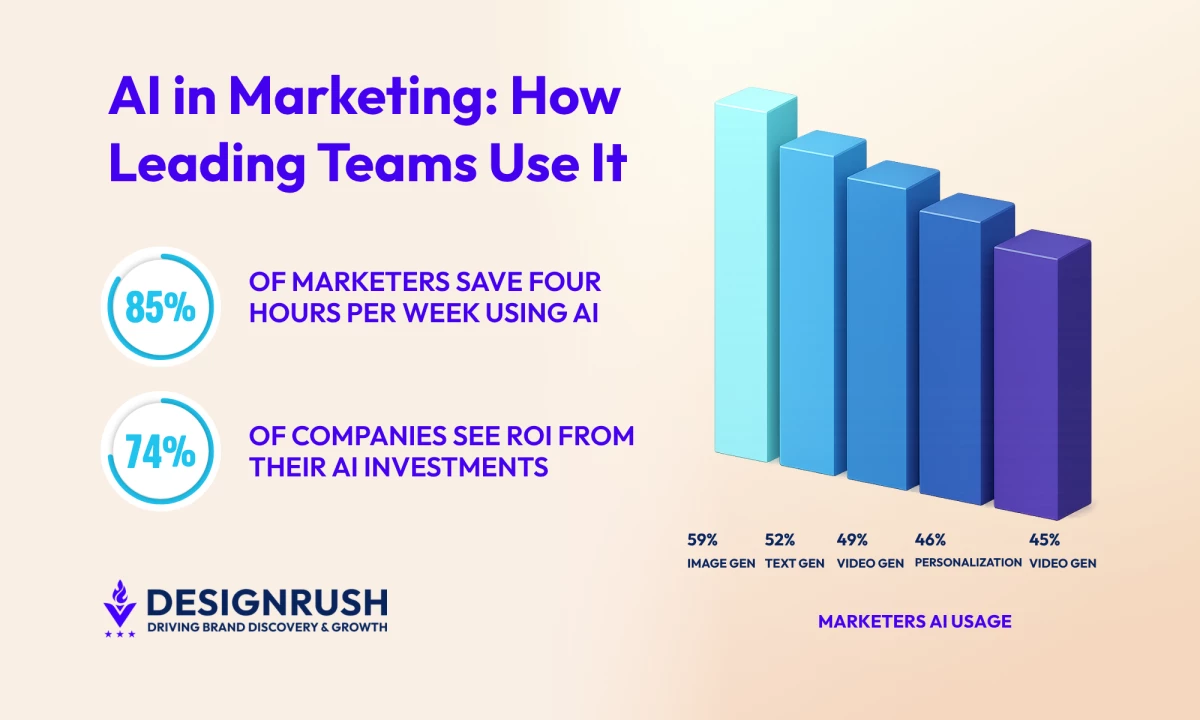
In fact, 85% of marketers save at least four hours per week (Canva), which is equivalent to over five full workweeks annually.
4. Continuous Optimization for Better ROI
Campaigns run with AI optimize continuously, reducing waste and lifting performance.
Ad bidding platforms like Google Performance Max or Meta Advantage+ automatically adjust bids, creatives, and placements in real time.
In Google’s study, 86% of companies deploying generative AI in production saw at least 6% revenue growth in one year, while 74% are seeing ROI from their AI investments within 6 months of deployment.



AI Marketing Examples: Where Is AI Having the Biggest Impact?
These are the areas of marketing where AI outperforms manual workflows and where teams are seeing real gains:
- SEO & discoverability
- Content creation & creative production
- Predictive analytics & audience segmentation
- Customer journey & personalization
- Media & programmatic advertising
- Commerce, pricing & recommendations
- Social listening & sentiment analysis
- Marketing workflow automation
1. SEO & Discoverability
Gartner predicts traditional search engine traffic will drop by 25% by 2026 as generative chatbots and AI assistants handle more queries.
Leading brands now treat AI search as its own channel and optimize for synthesized answers and featured snippets.
This means SEO strategy must move from ranking on keywords to being cited by AI answer engines. AI tools help marketers align content with real user intent, identify new question-based keywords, and produce authoritative answers.
Brandi AI, for example, shows how a brand appears across ChatGPT, Google AI Overviews, and Perplexity, highlighting real buyer questions, citation rates, and messaging gaps.
It also guides teams in optimizing existing content and creating AI-ready assets that earn mentions across languages and regions.
Tools to use:
- Brandi AI – Tracks AI citations, analyzes prompts, and guides AI-ready content.
- Surfer SEO – Optimizes content for search and featured snippets.
- Frase – Generates question-based content and AI answers.
2. Content Creation & Creative Production
Generative text, image, audio, and video tools now automate large parts of the content workflow. In fact, 47% of companies use AI to create content (Nielsen).
Teams use AI to draft ad copy, social posts, email variants, and even simple animations. For example, a marketer can input a campaign goal into a tool and instantly get dozens of banner ads, social posts, and email subject lines.
This makes large-scale testing practical. AI can generate dozens of headlines, CTAs, and layouts in minutes, while human marketers curate the strongest performers.
Critically, brand and compliance checks still happen before anything goes live. High-touch creative, such as flagship brand campaigns and sensitive storytelling, remains human-led.
Tools to use:
- Jasper.ai – Marketing-focused content generator with brand voice controls.
- Canva Magic – Quickly create visuals and short animations.
3. Predictive Analytics & Audience Segmentation
Real-time AI models track customer behavior and infer intent or sentiment as it happens. Modern AI models link together data from websites, CRM systems, social media, customer support, and more to create a unified view of the customer.
For instance, a sudden burst of activity on a product page might trigger the AI to recommend a special offer or alert a sales rep with a personalized pitch.
Platforms like Amplitude or Adobe Analytics now embed AI that surfaces why conversions rose or fell, while CRM systems like Salesforce Einstein or HubSpot AI suggest next best actions or even draft personalized follow-up emails based on the lead’s history.
Tools to use:
- Amplitude – Tracks customer behavior and patterns.
- HubSpot AI – Suggests next steps for marketing and sales engagement.
4. Customer Journey & Personalization
AI connects marketing, sales, and service into a single journey. In fact, 46% of marketers use AI to generate personalized content (Canva).
For instance, a high-intent product page browse might trigger a contextual chat or dynamic pop-up. If a customer still drops off, an AI agent passes full context, like viewed content, signals, and likely objections to sales.
This end-to-end AI-driven routing increases conversions and NPS.
In a real-world example, in 2025, Delta Airlines launched an AI-powered concierge in its mobile app to craft personalized travel moments like customized boarding alerts and lounge offers for each flyer.
Tools to use:
- Salesforce Einstein – Connects touchpoints and recommends actions.
- Drift – Personalizes chats and routes leads with context.
5. Media & Programmatic Advertising
Media buying and bidding are now largely AI-optimized. Platforms like Google Performance Max automatically adjust bids, creatives, and placements in real time.
In one study, an AI-powered full-funnel advertising strategy delivered 1.5× higher CTR on personalized display ads for targeted audiences.
And when ads run automatically, unused budgets can be reallocated on the fly to better channels. In tests, advertisers saw 1.7× higher CTR using AI campaign optimization versus traditional keyword campaigns.
Attribution has also improved. AI can better isolate which channels and creatives actually drove conversions, allowing budgets to be reallocated more intelligently.
Tools to use:
- Google Performance Max – Automates ad targeting across multiple platforms.
- Albert.ai – Adjusts budgets, bids, and creatives automatically.
6. Commerce, Pricing & Recommendations
In e-commerce and retail, recommendation engines powered by AI can deliver personalized product bundles and upsells in real time.
AI-driven dynamic pricing also adapts to supply, demand, and individual price sensitivity, ensuring offers stay both relevant and profitable.
For example, AI can identify high-LTV customers who are less price-sensitive and sparingly apply discounts to them, while focusing promotions on shoppers who need an extra nudge.
The result is smarter offers at every moment, meaning higher conversions without sacrificing margin.
Tools to use:
- Dynamic Yield – Suggests products and bundles in real time.
- Wiser – Adjusts pricing dynamically based on demand.
7. Social Listening & Sentiment Analysis
AI analyzes large volumes of data across social platforms, forums, and review sites to surface patterns in public perception.
Using natural language processing (NLP), it can detect not just sentiment (positive or negative), but also intent, urgency, and emerging themes.
Brands can identify early signals, respond faster, and even adjust messaging based on real-time audience feedback.
Tools to use:
- Brandwatch – Tracks brand mentions and detects sentiment trends across social, news, and forums in real time.
- Meltwater – Monitors media coverage and social conversations
8. Marketing Workflow Automation
AI powers end-to-end automation from lead nurturing to cross-channel campaign execution.
AI chatbots handle queries, CRMs trigger follow-up tasks, and smart workflows adapt as prospects move through the funnel.
As prospects move through the funnel, workflows adapt in real time, ensuring more relevant touchpoints without increasing manual effort.
Tools to use:
- Zapier – Automate cross-app workflows by triggering actions between tools based on user activity or events.
- HubSpot – Use AI to score leads, personalize email sequences, and automate campaigns based on lifecycle stages.
What Risks Does AI Bring to Marketing?
The biggest failures we see in AI come from weak data foundations, unclear ownership, and misplaced trust in automation.
AI moves closer to the customer, these risks start showing up in brand damage and compliance issues.
- Data silos and quality: Fragmented data is still the biggest blocker. Canva found only about 52% of companies consistently measure AI’s impact. Without proper A/B tests and controls, it’s hard to know if performance gains are real.
- Governance and privacy: Training AI on customer data raises real consent and compliance risks. Brands need clear permissions, strong controls, and privacy-safe techniques. Without them, AI can easily cross legal or brand boundaries.
- Bias and hallucinations: AI can generate biased, misleading, or outright false content. Left unchecked, it may reinforce stereotypes or invent claims. Mitigation requires explainability, content filters, and consistent human review.
- Homogenized creativity: 72% of marketers are concerned that overusing AI leads to generic output (Canva). The fix is proprietary data, custom style rules, and clear brand guardrails.
How To Use AI in Marketing: Strategies for Businesses
Many marketing teams have AI tools, but few are seeing consistent results. These strategies show how to use AI in marketing successfully:
- Tie AI to business outcomes
- Establish the right technology & data backbone
- Create an AI brand & style guide
- Launch high-feedback pilots
- Implement governance & safety nets
1. Tie AI to Business Outcomes
Start by defining the business result you want, such as revenue, retention, or efficiency. Tie each AI use case to measurable impact and define measurable KPIs and guardrails.
For example, run a pilot email campaign where a portion of the audience gets AI-personalized content and a control group gets standard content. Only scale up once real lift is proven.
Executives should align early on what success looks like to stop AI from being a sandbox project.
2. Establish the Right Technology & Data Backbone
Ensure you have clean, unified customer data and the right tools to feed models. Here’s how to achieve this:
- Feature stores and experiment logs ensure models learn from consistent signals and outcomes.
- Model and prompt registries create accountability, so teams know what’s running, why, and on which data.
- Real-time event streaming enables AI to respond in the moment.
- Privacy-first infrastructure protects trust and keeps AI deployable at scale.
This foundation is what separates scalable AI from brittle ad hoc pilots.
3. Create an AI Brand & Style Guide
Develop guidelines so AI outputs remain on-brand. Include approved terminology, banned phrases, claims checklists, and tone examples.
Provide marketing teams with reusable prompt templates and negative prompt lists. This ensures that multiple AI-driven campaigns feel consistent.
4. Launch High-Feedback Pilots
AI learns fastest where feedback is immediate. Pick use cases where results are measurable quickly.
For example, AI-powered email subject lines, social ads, or landing page copy. Run these as controlled experiments.
Always include control groups or canaries. This is how you separate real lift from noise and build confidence quickly. When a pilot works, scale it fast to prove value; when it doesn’t, shut it down just as quickly.
As Ran Avrahamy, CMO of AppsFlyer, explains:
“Start with the fundamentals: research, testing, and measurement. Then, introduce AI to scale what works.
Once you can identify winning creatives, the next stage is to understand why they perform, and then extend their impact.”
5. Implement Governance & Safety Nets
Parallel to launching pilots, establish AI guardrails. This includes content policies, brand style guidelines, and automated filters for sensitive outputs.
- Always include human reviews for public content on day one.
- Define what AI is allowed and not allowed to do.
- Audit for bias and unsafe outputs.
- Build A/B testing and holdout logic into every rollout so you can detect failures early
Governance is what lets you move faster without breaking trust. In fact, 94% of organizations still have humans vetting AI-generated content for accuracy and brand fit (Canva).
What’s Next for AI Marketing in 2026?
The trends emerging in 2026 reflect pressure points where early AI wins are creating new constraints, new roles, and new responsibilities.
- Proprietary AI models: Marketing is moving from public LLMs to brand-trained models. Fine-tuning on first-party data protects IP, preserves brand voice, and reduces hallucination.
- Agentic AI (partial autonomy): AI agents that rebalance budgets or manage creative fatigue are emerging. Experts estimate these agents could handle 20% of marketing work soon. Success requires small rollouts and clear stop-loss rules.
- Emotion & context awareness: Personalization is expanding beyond demographics to mood and context. AI can adapt messaging based on real-time signals, but ethical use depends on consented, non-invasive data.
- Workforce rebalancing: When AI handles routine work, human talent moves upstream. Winning organizations will reskill early, redefine roles, and formalize AI governance and oversight.
- Evolving roles & skills: New roles around AI, such as AI Strategists, are emerging, while traditional roles evolve (copywriters become AI editors). 92% of marketers believe AI literacy will become a core skill in 2-4 years (Canva).
- Sustainable, cost-aware AI: Rising compute costs are pushing teams toward smaller, efficient models, caching, and synthetic data. “Green AI” is becoming a practical consideration in 2026.
AI for Digital Marketing: Final Words
Beyond faster content or smarter targeting, the real shift underway is the ability to sense what a customer wants and respond instantly using AI.
The most advanced businesses are also rethinking roles and processes. AI handles repetitive tasks and routine optimizations, while humans focus on strategy and governance.
Our team ranks agencies worldwide to help you find a qualified partner to implement the latest AI solutions. Visit our Agency Directory for the Top Digital Marketing Agencies as well as:
- Best Digital Marketing Agency in Los Angeles
- Top AI Companies
- Top AI Marketing Companies
- Top AI Automation Agencies
- Top AI App Development Companies
Our design experts also recognize the most innovative design projects across the globe. Visit our Awards section for the best & latest.
AI in Marketing FAQs
1. Do companies need proprietary AI models to succeed in marketing?
Not initially. Many teams start with public or fine-tuned models to move quickly.
However, as AI becomes more central to customer-facing work, proprietary or brand-trained models become important to protect data, preserve brand voice, and reduce hallucinations.
2. How does AI personalization differ from traditional segmentation?
Traditional segmentation groups customers into broad buckets.
AI personalization operates at the individual level, using real-time signals to tailor content, offers, and journeys, often adjusting decisions moment by moment rather than campaign by campaign.
3. How can marketers use AI without risking brand trust or compliance?
Successful teams implement governance alongside deployment. This includes consent tracking, clear usage policies, bias testing, human review for high-risk content, and stop-loss mechanisms for autonomous systems.
4. Will AI replace marketers?
Not likely. AI is a tool to augment marketing teams, not replace them. The fastest adopters use AI to handle repetitive tasks so that human marketers can spend more time on strategy, creativity, and supervision.
Some routine roles will shift, but roles that require critical thinking, brand vision, or deep customer understanding remain human-driven.
5. How do we measure the success and ROI of AI in marketing?
Measure AI marketing the same way you would any other test: set clear KPIs upfront, compare results against a control, and track both performance and efficiency.
Look at outcomes like conversions, lead quality, revenue per visitor, cost per lead, and time saved through automation.
6. How can small businesses start using AI in marketing on a budget?
Small teams don’t need custom models to benefit from AI. Many free or low-cost AI tools exist.
For example, ChatGPT can draft blog posts or ad copy, image generators like Midjourney and Dall-E can create visuals, and services like Mailchimp offer AI-powered email personalization even for small budgets.