Our directory features the top HR outsourcing companies in the USA. Our directory, backed by five ranking criteria, 12 expert reviewers, and 140+ verified client reviews, to help you confidently identify the best HR outsourcing services for your needs.
Organic rankings are determined by five factors: top services, reviews, portfolio, awards/press, and team expertise. Sponsored listings pay for a placement that appears above organic positions. Sponsorship does not affect star ratings or review content - read more on our methodology page.
AGENCY LISTING COMING SOON.
HR Outsourcing Companies by City
HR Outsourcing Companies by State
HR Outsourcing Specializations in the US
Popular Services
Hiring Guide: How to Choose the Best HR Outsourcing Services in the US
How do I choose the right company for my business?
To choose the right outsourcing company for your business, consider these steps:
- Define your needs
Map out the exact HR functions you want to delegate, your specific requirements and business policies, budget, and engagement timeframe. - Shortlist experts
Look for HR outsourcing providers with sector-specific knowledge, ask for client references in your industry, and review case studies showing measurable results. - Evaluate provider credentials
Assess client and employee reviews, list of awards and recognitions, and necessary certifications to confirm the company’s reliability and credibility. - Send a request for proposal (RFP)
Provide your top candidates with a detailed project brief together with your budget and time constraints, so they can work within your requirements. - Schedule an interview
Meet the team working with you, and ask about compliance, security, and scalability. Prioritize those who can expand with you without requiring a complete platform change. - Choose your provider
Take time to compare at least three providers, examining their technology platforms, service level agreements, and pricing models before committing.
Need help finding an HR outsource provider for your business? Visit our Marketplace and tell us what you need. We'll curate a list of the top companies for free!
What should I prepare before contacting an HR outsourcing provider?
Start with your current employee headcount and projected growth over the next 12-24 months.
Document all locations where you have employees, because each state or country adds compliance complexity that affects pricing.
Gather your existing payroll structure, including pay frequencies, overtime policies, and any special compensation arrangements like commissions or bonuses.
List your current benefits offerings and note whether you want the provider to source new plans or administer existing ones.
Compile your compliance requirements. Are you subject to industry-specific regulations? Do you have government contracts requiring certain HR practices? Have you faced any compliance issues or audits recently? Understanding your risk profile helps providers recommend appropriate service levels.
Finally, establish your budget expectations and decision timeline. Providers appreciate knowing whether you're exploring options or ready to move quickly.
According to a 2025 Paychex study, 64% of companies spend 570 hours annually on HR administration, so quantify your own time investment to understand your potential ROI from outsourcing.
When does HR outsourcing make more sense than building an in-house HR team?
While both HR outsourcing and building an in-house team bring their own advantages, the decision will depend on your specific business needs.
According to Deloitte's Global Outsourcing Survey, these are the top reasons why businesses are outsourcing functions, including HR:
- Improved access to talent: 42%
- Spend optimization: 34%
- Improved quality/performance: 33%
- Adoption of global delivery model: 33%
- Better alignment to business strategy and operating model shifts: 27%
- Need for flexible and scalable talent model: 23%
In other words, HR outsourcing makes more sense when:
- HR operations are detracting you from core business functions
- Building a full-time, in-house HR team is too expensive
- You’re experiencing high employee dissatisfaction and churn rates
- You need specialized expertise
- You need help navigating labor laws and sector-specific regulations, especially for multi-state and international operations
How involved does management need to be when using these types of services?
Outsourcing HR doesn't mean eliminating internal people management, but it means redirecting your focus from administration to strategy.
Your leadership team remains responsible for organizational culture, performance expectations, hiring decisions, and employee development priorities.
The HR outsourcing provider handles execution, compliance, and day-to-day administration.
Expect regular check-ins with your provider. Most start with weekly or biweekly touchpoints during the first few months, transitioning to monthly reviews once processes stabilize.
You'll approve payroll runs, review compliance reports, and make final decisions on employee relations matters.
The provider brings expertise and recommendations; you make the calls, ensuring that everything aligns with your company's values and goals.
How do I measure whether HR outsourcing is delivering value?
To measure if the HR outsourcing company is delivering value to your business, start by defining your expectations and service level agreement (SLAs).
This includes your measurable business objectives, performance metrics, and current benchmarks.
Here are some of the most common HR outsourcing benchmarks to consider:
- Time to complete: Average time it takes for the provider to complete a task, such as filling in a position or processing payroll
- Employee satisfaction: Assesses how employees feel about HR services and can be tracked via turnover rates, exit interview feedback, and employee surveys
- Payroll accuracy rate: Monitors the percentage of error-free payroll transactions filed by the provider and determines their reliability
- Administrative time savings: Calculates the time previously spent on HR functions that are now being outsourced
- Cost savings: Measures the amount of money saved by outsourcing HR functions
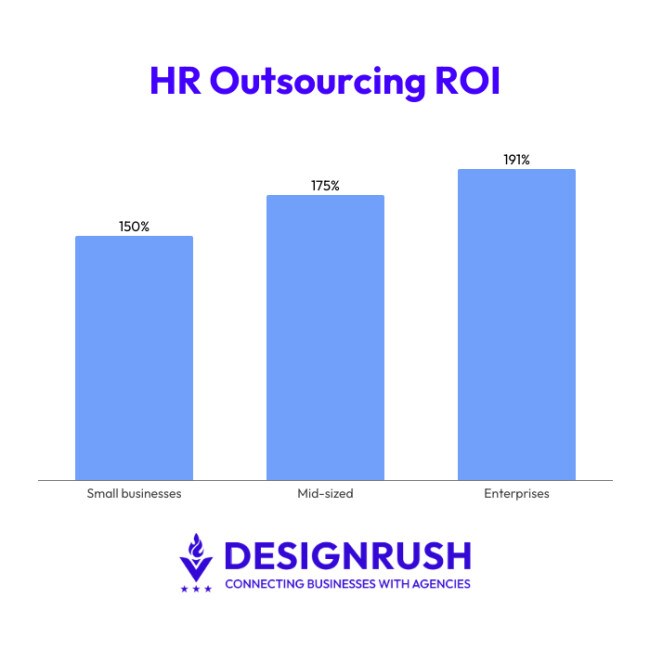
Small companies with 25 employees and a monthly HRO cost of $120-$200 can expect an average return on investment (ROI) of 150%.
Mid-sized businesses with around 100 employees and a monthly HRO of $430-$500, on the other hand, can experience an ROI of 175%.
For large enterprises with over 500 employees and an HRO of $2,000-$3,000 per month, the average ROI is 191%.
Sources
DesignRush sustains a directory of over 40,000 agencies categorized by service category, location, expertise, and reviews. We build our database in two ways:
- Our dedicated team of agency experts actively searches the web for top-performing companies. We then pull information from their websites, online presence, and client testimonials to verify their status and qualifications prior to listing.
- The agencies listed get notified of their profiles on the website and they can choose to claim it or not, which suggests their availability for more collaborations.
Agencies can also reach out to DesignRush and must go through the verification process prior to being listed.
Latest Trends Related to HR Outsourcing