Accenture, Cognizant, Capgemini, IBM, Tata Consultancy Services - these are among the top system integrators enterprises select to unify technology ecosystems, streamline operations, and implement scalable infrastructure solutions that support secure and efficient business growth.
Organic rankings are determined by five factors: top services, reviews, portfolio, awards/press, and team expertise. Sponsored listings pay for a placement that appears above organic positions. Sponsorship does not affect star ratings or review content - read more on our methodology page.

Webisoft
VerifiedVerified by the DesignRush team for authenticity and credibility.Custom software, ERP, AI and automation for growing companies
Custom software, ERP, AI and automation for startups and enterprises...
Top Services:
- Software Development
- Blockchain
- ERP Consulting
- Mobile App Development
- AI Development
- Show more
- Location
- Montreal, Canada
- Number of Employees
- Under 49
- Average Hourly Rate
- $100/hr
- Minimal Budget
- $1,000 - $10,000
- Portfolios Count
- 21 Projects Listed
Data sourced from the agency's DesignRush profile, its website, and other relevant accountsWebisoft Services
Data sourced from the agency's DesignRush profileExmar Quebecor Biron Spartan Solar Proprio Direct Genium 360 Bell Media Edigo Styllar Spafax
Webisoft Reviews & Testimonials

Web Development Review from Raj Sardana
After working with Webisoft for a few months, I'm really pleased with the caliber of support and output I've had. I manage a little business, so I'm highly involved. I am aware that I have managed previous marketing companies a little too poorly in the past. However, Webisoft has shown me a great deal of patience and has taken the time to comprehend my unique demands and create a plan to address them.

Blockchain Review from Trevor Ogata
Our team hired Webisoft to build out our alpha version of our to ticketing platform. Webisoft did an incredible job providing excellent customer service, reliability, communication, and adaptability. Webisoft was recommended by colleagues in the industry and did an incredible job given the difficult time constraints they had to work within. They were a great partner and we hope to work with them more in the future. (Verified via email)

Mobile App Development Review from Pier-Olivier Beaupré
Pixel Guru, a mobile solution, helps dealerships have more online car sales by increasing inventory turnover. It hired Webisoft to develop its iOS & Android applications and the management system. The project was executed using React Native and Django. Webisoft's approach was marked by flexibility, professionalism, and punctuality. The agency's project management style was excellent, equipping Pixel Guru with essential tools and feedback for seamless tracking. (Verified by email)
Reviews verified by DesignRush and sourced from the agency's profile View All ReviewsConnect Your AI To Real Business Systems
Guru Cloud & AI builds production AI that plugs into the tools a business already runs: inbox, CRM, ERP, chat, and data warehouses. We specialize in MCP integrations, citation-backed RAG, and multi-agent automation with human oversight. Enterprise clients include Diversified Energy Company (NYSE: DEC), where...
Top Services:
- AI Development
- Software Development
- Web Development
- Cloud Consulting
- Big Data Analytics
- Show more
- Location
- Isabela, Puerto Rico
- Number of Employees
- Under 49
- Average Hourly Rate
- $150/hr
- Minimal Budget
- $1,000 - $10,000
- Portfolios Count
- 20 Projects Listed
Data sourced from the agency's DesignRush profile, its website, and other relevant accountsGuru Cloud & AI Services
Data sourced from the agency's DesignRush profileDiversified Energy Company (NYSE: DEC) Polity Inc. (GovToKnow) A3 Environmental Consultants ChemMasters
AI automation, AI agents and CRM integrations for service businesses, live in weeks
Ratech is an AI automation agency for service businesses in the US, Canada and Europe. We map how work moves through your team, then streamline business processes with AI agents, RPA and CRM integrations. Recent builds went live in 2 to 5 weeks: 325 hours a year back for a contractor...
Top Services:
- Business Consulting
- AI Development
- CRM Consulting
- IT Services
- Show more
- Location
- Kyiv, Ukraine
- Number of Employees
- Under 49
- Average Hourly Rate
- $50/hr
- Minimal Budget
- $1,000 - $10,000
- Portfolios Count
- 12 Projects Listed
Data sourced from the agency's DesignRush profile, its website, and other relevant accountsRatech Services
Data sourced from the agency's DesignRush profileBlackCore Capital Levtone Webpromo French.etc OnHires Voice Marketing Playroom GetLeads Loona Agency Incode Group
Ratech Reviews & Testimonials
bill beard's Review Sourced from Google
Good parts, went to the place locally and they would not sell any parts, that's a shame 😞
Reviews verified by DesignRush and sourced from the agency's profile View All ReviewsBusiness automation and AI for UK construction and law firms
Severus is a UK business automation and operations partner for construction companies and law firms. We connect the systems you already use and add AI where it saves real hours. Offices in London and Tallinn...
Top Services:
- Business Consulting
- IT Services
- AI Development
- Software Development
- ERP Consulting
- Show more
- Location
- London, United Kingdom
- Number of Employees
- Under 49
- Average Hourly Rate
- $85/hr
- Minimal Budget
- $1,000 - $10,000
- Portfolios Count
- 7 Projects Listed
Data sourced from the agency's DesignRush profile, its website, and other relevant accountsSeverus Services
Data sourced from the agency's DesignRush profileCustomsClear Smart GP Payroll DollarMetro MyPay Nippon Metro Volt Europa
We build the systems that run your business
DeepRock Solutions is a Tbilisi software and AI studio for companies held back by spreadsheets, paperwork and manual routines. We build custom web, mobile and desktop systems, and add AI where it pays off: reading documents, checking them against your rules and taking routine decisions off your team. Every...
Top Services:
- Software Development
- AI Development
- Web Development
- Mobile App Development
- IT Services
- Show more
- Location
- Tbilisi, Georgia
- Number of Employees
- Under 49
- Average Hourly Rate
- $50/hr
- Minimal Budget
- $1,000 - $10,000
Data sourced from the agency's DesignRush profile, its website, and other relevant accountsDeepRock Solutions Services
Data sourced from the agency's DesignRush profileGeorgian Vending Group TBS Taxi Raillk
What We Commit, We Deliver.
Leeway builds and runs the systems operational teams depend on. From Paphos and Beirut, we implement and rescue Odoo ERPs, connect platforms with governed middleware, and deliver custom software and web applications for organisations across Europe and the Middle East. Our largest deployment serves 163+ daily...
Top Services:
- ERP Consulting
- Software Development
- IT Services
- AI Development
- Web Development
- Show more
- Location
- Paphos, Cyprus
- Number of Employees
- Under 49
- Minimal Budget
- $1,000 - $10,000
- Portfolios Count
- 2 Projects Listed
Data sourced from the agency's DesignRush profile, its website, and other relevant accountsLeeway Services
Data sourced from the agency's DesignRush profileCOAR Global Medi Afric Offshore CARE International Unicarton Modessa Couture
Keep I.T. Simple
inTech Consulting is a Washington-based managed IT and cybersecurity provider helping businesses across the Pacific Northwest navigate compliance frameworks like CMMC, HIPAA, and DFARS while keeping day-to-day technology secure and reliable. We work with manufacturers, healthcare organizations, and other...
Top Services:
- IT Services
- Cybersecurity
- Managed Services
- Cloud Consulting
- IT Compliance Solution
- Show more
- Location
- Kent, Washington
- Number of Employees
- Under 49
- Average Hourly Rate
- $200/hr
- Minimal Budget
- $1,000 - $10,000
- Portfolios Count
- 4 Projects Listed
Data sourced from the agency's DesignRush profile, its website, and other relevant accountsinTech Consulting Services
Data sourced from the agency's DesignRush profileCRG SLH SP
inTech Consulting Reviews & Testimonials
Cindy Rimbey's Review Sourced from Google
We had another company that was horrible. In Tech had to come in and clean up a huge mess. We are very satisfied with them and would recommend them to anyone needing their services.
Michelle Graunke's Review Sourced from Google
Thank you, Karm! I appreciate you taking immediate action and walking me through the process several times in my case. EEK! It's always a challenge for me with new updates but I really appreciate your calm demeanor and effective resolution of this blip in my day.
Loujean Jackson's Review Sourced from Google
Kyle is awesome! I had an issue that had previously been "addressed". Kyle actually took the time to investigate the issue and resolved it in a timely manner so that I was able to get back to work! Thank you for yet another fantastic job!
Reviews verified by DesignRush and sourced from the agency's profile View All ReviewsSan Antonio's Trusted Managed IT Services Partner Since 1999.
ASAP Computer Services is a San Antonio managed IT services provider delivering corporate IT solutions, network installation, engineering and support since 1999. Backed by in house Microsoft, Security + and Bisci certified credentials our team cover the entire OSI stack. We specialize in proactive managed...
Top Services:
- Managed Services
- IT Services
- Location
- San Antonio, Texas
- Number of Employees
- Under 49
- Average Hourly Rate
- $120/hr
- Minimal Budget
- $1,000 - $10,000
- Portfolios Count
- 1 Project Listed
Data sourced from the agency's DesignRush profile, its website, and other relevant accountsASAP Computer Services Services
Data sourced from the agency's DesignRush profileSamsung Google Primoris Bcomm Future Infrastructure Verizon Charter Frontier Gabriels Lancer Worldwide
ASAP Computer Services Reviews & Testimonials
Grace Hernandez's Review Sourced from Google
I was having a hard time loading the printer driver on my laptop at work and ASAP was awesome in quick about getting me up and printing. Spent less than 30 minutes with them, watching every step they were doing. It was great. Thank you ASAP.
Christopher Flores's Review Sourced from Google
Great company they were professional and whole crew was respectful , they were fast and efficient, they were in and out and all work they did was excellent . No complaints
Logan Tavel's Review Sourced from Google
ASAP is one of the best companies that we have used for hands on technical work. Their work is thorough, clean and they always deliver. I highly recommend
Reviews verified by DesignRush and sourced from the agency's profile View All ReviewsCorporate IT Support, Networks & Cybersecurity in Rio de Janeiro
Resolve Tecnologias provides corporate IT support and managed technology services for businesses in Rio de Janeiro. We combine on-site and remote support with networking, Microsoft 365, cybersecurity, backup, structured cabling, servers and IT consulting to keep business environments secure, reliable and...
Top Services:
- IT Services
- Managed Services
- Cybersecurity
- Cloud Consulting
- Staff Augmentation
- Show more
- Location
- Rio de Janeiro, Brazil
- Number of Employees
- 100 - 249
- Average Hourly Rate
- $50/hr
- Minimal Budget
- $1,000 - $10,000
- Portfolios Count
- 3 Projects Listed
Data sourced from the agency's DesignRush profile, its website, and other relevant accountsSuporte de TI - Resolve Tecnologias Services
Data sourced from the agency's DesignRush profileClub de Regatas Vasco da Gama Corpo de Fuzileiros Navais da Marinha do Brasil Exército Brasileiro GSO Exames Bueno's Pizza
Suporte de TI - Resolve Tecnologias Reviews & Testimonials
Sidnei Santos's Review Sourced from Google
Como escritório de advocacia, não podemos perder um prazo por falha no sistema. A Resolve assumiu nosso suporte de T.I corporativo e a diferença foi imediata. Acabaram as quedas de internet e os problemas com certificados digitais. O melhor suporte técnico de T.I no Rio de Janeiro para quem lida com alta demanda e sigilo. Uma empresa de informática no RJ extremamente confiável e profissional!
Genesis Viana's Review Sourced from Google
Nossa empresa sofria com quedas constantes no sistema até contratarmos a Resolve para a gestão de servidores. O monitoramento deles é em tempo real e qualquer instabilidade é resolvida antes mesmo de percebermos. Um suporte técnico de T.I no Rio de Janeiro que entrega o que promete. Melhor parceiro de informática no RJ para quem não pode parar de faturar por falhas técnicas!
Aline Melo's Review Sourced from Google
Nossa empresa cresceu rápido e a TI virou uma bagunça. A Resolve chegou com uma consultoria de TI completa, padronizou nossos computadores e organizou todos os acessos. É um suporte técnico de T.I no Rio de Janeiro que pensa no negócio como um todo, não só em consertar máquinas. Sem dúvida, a melhor escolha em informática no RJ para empresas que buscam escala com organização!
Reviews verified by DesignRush and sourced from the agency's profile View All ReviewsWe Build AI-Powered Automations
AXIS AI builds custom automation systems for B2B companies on Make.com, n8n, and custom APIs. We handle the workflows your team repeats every day: lead response, CRM updates, follow-ups, onboarding, invoicing, reporting...
Top Services:
- AI Development
- IT Services
- Business Consulting
- Managed Services
- Show more
- Location
- Mansoura, Egypt
- Number of Employees
- Under 49
- Minimal Budget
- $1,000 - $10,000
Data sourced from the agency's DesignRush profile, its website, and other relevant accountsAXIS AI Services
Data sourced from the agency's DesignRush profileCorporate Services Industry Professional Services Industry Software & IT Services Industry
Consider IT Handled
Founded in Chicago, 7 Layer Solutions was built on the belief that technology should be a strategic advantage, not a business obstacle. What started as a commitment to reliable IT support has grown into a full-service technology partnership delivering managed IT, cybersecurity, cloud, compliance, application...
Top Services:
- Staff Augmentation
- Managed Services
- IT Services
- Cybersecurity
- IT Compliance Solution
- Show more
- Location
- Schaumburg, Illinois
- Number of Employees
- 50 - 99
- Average Hourly Rate
- $275/hr
- Minimal Budget
- $1,000 - $10,000
- Portfolios Count
- 1 Project Listed
Data sourced from the agency's DesignRush profile, its website, and other relevant accounts7 Layer Solutions Services
Data sourced from the agency's DesignRush profileProfessional Services Industry Manufacturing Industry Finance Industry
AI That Executes
Boldr AI is an AI execution partner that helps mid-market companies transform manual workflows into automated AI-powered execution systems. The company specializes in deploying practical AI solutions that streamline operations, accelerate revenue processes, and improve customer experience by integrating...
Top Services:
- Business Consulting
- IT Services
- AI Development
- Software Development
- Show more
- Location
- Spring Valley, New York
- Number of Employees
- Under 49
- Average Hourly Rate
- $99/hr
- Minimal Budget
- $1,000 - $10,000
Data sourced from the agency's DesignRush profile, its website, and other relevant accountsBoldr AI Services
Data sourced from the agency's DesignRush profileLubricants and auto parts distributor (Guatemala) Fuel distributor (Guatemala) Financial services group (Guatemala)
Microsoft 365, Engineered. Not Just Resold.
IT Partner is a Microsoft Solutions Partner that has spent twenty years on the part of Microsoft 365 that resellers skip: the engineering. We merge tenants after acquisitions, split them on divestitures, migrate companies off Google Workspace and on-premises servers without a day of downtime, and set up...
Top Services:
- Cloud Consulting
- IT Services
- Managed Services
- Cybersecurity
- Big Data Analytics
- Show more
- Location
- Tallinn, Estonia
- Number of Employees
- Under 49
- Average Hourly Rate
- $125/hr
- Minimal Budget
- $1,000 - $10,000
Data sourced from the agency's DesignRush profile, its website, and other relevant accountsIT Partner Services
Data sourced from the agency's DesignRush profileM2 Strategy Foster Business Consulting UNCO Chambers Theory Vero Biotech
On Time, Top Quality Always Detartech!
Detartech is a software development partner based in Ümraniye, Istanbul, helping startups and businesses build reliable web, mobile, and AI products. We focus on clear communication, weekly sprints, live demos, and measurable progress instead of unnecessary meetings or vague promises. Our small, experienced...
Top Services:
- Web Development
- SEO
- Mobile App Development
- Software Development
- DevOps Consulting
- Show more
- Location
- Ümraniye, Turkey
- Number of Employees
- Under 49
- Average Hourly Rate
- $38/hr
- Minimal Budget
- $1,000 - $10,000
Data sourced from the agency's DesignRush profile, its website, and other relevant accountsDetartech Services
Data sourced from the agency's DesignRush profileLextum Biletico Spine
Detartech Reviews & Testimonials
Eren ŞEN's Review Sourced from Google
Their technical knowledge and communication skills are excellent. A software company you can work with confidently.
Tolgay Cetinkaya's Review Sourced from Google
They delivered a challenging project, one that everyone was hesitant about, in a very short time and without any problems. I would like to thank them very much for their attention, solution-oriented approach, and professionalism.
Bya Consultancy's Review Sourced from Google
As entrepreneurs, we had serious hesitations when embarking on this path; we spoke with dozens of companies, but we couldn't find the trust we were looking for. When we met Detartech, we felt the difference from the very beginning. They listened to us individually, offered visionary suggestions, and maintained transparent and sincere communication at every stage.In entrepreneurship, trust is the most fundamental key to growth. The Detartech team not only answered all our questions day and night, but also completed the project much faster and with greater value than we had imagined. If you are looking for a professional team that streamlines our business processes, never compromises on honesty, and takes ownership of your project as if it were their own, you've come to the right place. We extend our endless gratitude to the entire Detartech family for their contributions to our growth journey.
Reviews verified by DesignRush and sourced from the agency's profile View All ReviewsData, Cloud, And Automation Delivery You Can Run
Ascendant Systems LLC is a Dallas-based technical delivery firm serving growing organizations, specialist consultancies, and internal teams across the United States. We take on defined data engineering, cloud and DevOps, and business automation problems and deliver them as scoped engagements: an assessment, a...
Top Services:
- IT Services
- Software Development
- Big Data Analytics
- Cloud Consulting
- DevOps Consulting
- Show more
- Location
- Dallas, Texas
- Number of Employees
- Under 49
- Average Hourly Rate
- $125/hr
- Minimal Budget
- $1,000 - $10,000
Data sourced from the agency's DesignRush profile, its website, and other relevant accountsAscendant Systems LLC Services
Data sourced from the agency's DesignRush profileDetego Health Far Star Real Estate Services TapSpec Home
Websites, die Kunden gewinnen
Waldbyte ist ein deutsches Digitalstudio für individuelle Webentwicklung und E-Commerce. Wir realisieren performante Unternehmenswebsites, Webanwendungen und Onlineshops mit TYPO3, WordPress, Shopware, PrestaShop und Magento. Ergänzend übernehmen wir technische Optimierung, Hosting, Wartung und die...
Top Services:
- Web Development
- Web Design
- WordPress Website Design
- eCommerce Development
- SEO
- Show more
- Location
- Stuttgart, Germany
- Number of Employees
- Under 49
- Average Hourly Rate
- $60/hr
- Minimal Budget
- $1,000 - $10,000
- Portfolios Count
- 1 Project Listed
Data sourced from the agency's DesignRush profile, its website, and other relevant accountsWaldbyte Digital Agentur Services
Data sourced from the agency's DesignRush profileBallonswelt Haq Public Shopixo
We build the systems companies actually run on.
Talegen combines enterprise engineering discipline with a practical Small to Medium-sized Business lens: reduce manual work, connect the right tools, and build custom systems only where they create durable value...
Top Services:
- Software Development
- AI Development
- Mobile App Development
- SEO
- AEO
- Show more
- Location
- York, Pennsylvania
- Number of Employees
- Under 49
- Average Hourly Rate
- $150/hr
- Minimal Budget
- $1,000 - $10,000
Data sourced from the agency's DesignRush profile, its website, and other relevant accountsTalegen Services
Data sourced from the agency's DesignRush profileSwept Dating JKBC HoneyFlow
From Bangladesh To The World
Betopia Limited is an ISO-certified global enterprise technology company providing custom enterprise software, AI solutions, and cloud transformation. Powered by 14+ years of excellence and 5,000+ engineers across 80+ countries, we deliver enterprise-grade tech solutions with speed, scalability, and...
Top Services:
- Software Development
- AI Development
- Mobile App Development
- Cloud Consulting
- Cybersecurity
- Show more
- Location
- Dhaka, Bangladesh
- Number of Employees
- 1000 & Up
- Average Hourly Rate
- $40/hr
- Minimal Budget
- $1,000 - $10,000
Data sourced from the agency's DesignRush profile, its website, and other relevant accountsBetopia Limited Services
Data sourced from the agency's DesignRush profileCount Trust Zulio.AI Nutri AI
Zoho, CRM, AI & Automation Specialists
Mason & Co helps organisations improve the way they operate through better-connected business systems. We specialise in Zoho, CRM, AI, automation, integration and business intelligence, combining practical implementation with enterprise architecture thinking to create scalable, well-governed solutions...
Top Services:
- Digital Strategy
- Web Design
- WordPress Website Design
- Web Development
- Software Development
- Show more
- Location
- London, United Kingdom
- Number of Employees
- Under 49
- Average Hourly Rate
- $250/hr
- Minimal Budget
- $1,000 - $10,000
Data sourced from the agency's DesignRush profile, its website, and other relevant accountsMason & Co IT Consultancy Ltd Services
Data sourced from the agency's DesignRush profileCove Teahouse Vape Pod Chelsea Truck Company Veritas Solicitors R&M Consultancy Kahn Design Barrings Law Citizens Advice Parking Eye Granite House
CentraLink provides managed IT services in Pasadena, helping businesses improve performance, security, and reliability through proactive technology management. Services include 24/7 IT support, cybersecurity, cloud solutions, network support, helpdesk services, business continuity, and strategic IT...
Top Services:
- Managed Services
- Cybersecurity
- Cloud Consulting
- IT Services
- IT Compliance Solution
- Show more
- Location
- Pasadena, California
- Number of Employees
- 50 - 99
- Average Hourly Rate
- $150/hr
- Minimal Budget
- $1,000 - $10,000
Data sourced from the agency's DesignRush profile, its website, and other relevant accountsCentraLink - Pasadena Advisory and IT Services Company Services
Data sourced from the agency's DesignRush profileBoeing / Boeing Satellite Systems Airbus Chubb Nationwide Insurance Childrens Hospital Los Angeles QualStaff Resources Goodwin Company
CentraLink - Pasadena Advisory and IT Services Company Reviews & Testimonials
Asun Floresca's Review Sourced from Google
Centralink has been an invaluable IT partner for Goodwin Company for a number of years. Their services include problem solving of day-to-day IT issues to strategic forecasting of the company's future IT needs. But the best part of it all is how helpful, easy to work with and personable the Centralink team is.
Matthew Brooks's Review Sourced from Google
Called asking a General question about catering. The operator said they don't accept these types of calls. I thanked her for her honesty and told her I had one more question. I asked if this company only does It or if they do CRM as well and she just hung up on me. My company is looking for CRM and It support so I wanted to kill two birds with one stone. Even if they do CRM I wouldn't go with them based on the rude operator 4/28/26 11:26 AM
Bryson's Review Sourced from Google
Centralink has offered great service and excellent solutions for me and my team. They have a very friendly, professional, and helpful staff that always provide solutions to the most simple and complex problems. I look forward to continuing working with them in the future!
Reviews verified by DesignRush and sourced from the agency's profile View All ReviewsPCS Managed Services helps businesses strengthen operations with reliable managed IT, cybersecurity, cloud, consulting, network management, help desk, disaster recovery, and unified communications solutions. Serving organizations across industries such as healthcare, finance, manufacturing, legal, and...
Top Services:
- Managed Services
- IT Services
- Cybersecurity
- Cloud Consulting
- IT Compliance Solution
- Show more
- Location
- Memphis, Tennessee
- Number of Employees
- 50 - 99
- Average Hourly Rate
- $150/hr
- Minimal Budget
- $1,000 - $10,000
Data sourced from the agency's DesignRush profile, its website, and other relevant accountsPCS Managed Services - Memphis Managed IT Services Company Services
Data sourced from the agency's DesignRush profileMid-South Internal Medicine Desoto Childrens Clinic Cole Pain Therapy Group Absolute Storage Management Morgan Steel Christ Community Health Services Armil Construction Nathan Baldwin, MD Medical Practice Delta Materials Handling, Inc. Simpson Door & Hardware
PCS Managed Services - Memphis Managed IT Services Company Reviews & Testimonials
Konica Sheffield's Review Sourced from Google
Trisha and Daniel L. took the time to find a solution for what could have been a major barrier in my day-to-day work. Their patience and dedication to finding a solution was admirable. Most service desks would have told us what we wanted to accomplish wasn't possible, so that they could hurry and end the call. This team handled it beautifully.
Kelley Baldwin's Review Sourced from Google
Have been a client of PCS for 30 years. Can highly recommend their company for your IT needs in healthcare. They have excellent customer service and a very stable workforce.
Beth Ponder's Review Sourced from Google
Everyone I've had to speak to at PCS has been incredibly helpful and very nice! They are always happy to help and do so in a very timely manner. Definitely the best IT services you can find anywhere!
Reviews verified by DesignRush and sourced from the agency's profile View All ReviewsIT support and marketing under one roof. Est. 2018.
We're a managed IT and marketing shop with real offices in Sarasota, Clearwater, and St. Charles, Illinois. Most of our clients came to us after getting burned by a provider who was slow to answer the phone. So that's the thing we obsess over: picking up fast, fixing it right, and knowing your setup well...
Top Services:
- IT Services
- Managed Services
- Cybersecurity
- Digital Marketing
- Advertising
- Show more
- Location
- St. Charles, Illinois
- Number of Employees
- Under 49
- Minimal Budget
- $1,000 - $10,000
Data sourced from the agency's DesignRush profile, its website, and other relevant accountsN2 Solutions Services
Data sourced from the agency's DesignRush profilePeerless Fence Plandscape Diversified Waste Solutions
N2 Solutions Reviews & Testimonials
Nick Maldonado's Review Sourced from Google
I used the services of N2 Media for my business cards design and ordering service. They were quick, efficient and super creative! The cards turned out amazing and I will definitely be going back to them when I need more or choose to change up the design. They are also in the works of redesigning the Gym’s website that I work out of and I took a peek at the progress it looks amazing! A total makeover from where it was at before. Definitely recommend for any of your technological needs!
Carolyn Soltesz's Review Sourced from Google
Nina and Nate are so very talented, knowledgeable and super pleasant to work with! They listened to my requests (I had many! ) and built a website for my business that shows off my work and helps clients understand how I can solve their interior design dilemmas. I highly recommend N2 Media for your website and digital marketing needs!!!
Vanessa Winiecki's Review Sourced from Google
N2 Media are great business partners and have helped us lead our industry in technician advancement! Nathan and Nina are experts in what they do and have a collaborative and innovative approach working with their clients. They can take a large, overwhelming project and break it down to the last detail to see it through to implementation. They have been instrumental with helping us find the right solutions to achieve our goals for improving efficiencies within our organization and helped improve our overall customers experience! Highly recommend N2 Media.
Reviews verified by DesignRush and sourced from the agency's profile View All ReviewsUnified IT Services
A Vancouver-based MSP for growing small and mid-sized businesses that want enterprise-grade IT without the enterprise headcount. Glimpse Networks runs the whole stack helpdesk, cybersecurity, backups, cloud, and Microsoft 365 on predictable flat-rate plans, backed by Sophos, Veeam, and Microsoft partnerships...
Top Services:
- Managed Services
- Cybersecurity
- IT Services
- Cloud Consulting
- IT Compliance Solution
- Show more
- Location
- Delta, Canada
- Number of Employees
- Under 49
- Average Hourly Rate
- $160/hr
- Minimal Budget
- $1,000 - $10,000
Data sourced from the agency's DesignRush profile, its website, and other relevant accountsGlimpse Networks Services
Data sourced from the agency's DesignRush profileKrysalix Solutions Healthcraft Clinic Coastal Blue
You never get a level one. Every call goes to someone who can actually fix it.
Managed IT and cybersecurity for privately owned businesses across Central Pennsylvania and nationwide. Headquartered in Mechanicsburg, PA. Founder-run since 2006...
Top Services:
- Managed Services
- IT Services
- Cloud Consulting
- IT Compliance Solution
- Cybersecurity
- Show more
- Location
- Mechanicsburg, Pennsylvania
- Number of Employees
- Under 49
- Average Hourly Rate
- $199/hr
- Minimal Budget
- $1,000 - $10,000
Data sourced from the agency's DesignRush profile, its website, and other relevant accounts3rd Element Consultng Services
Data sourced from the agency's DesignRush profileGovernment Client Law Firm Client Insurance Client
Senior remote DBAs for SQL Server, Oracle and PostgreSQL
RadixTrie provides remote DBA and managed database services for SQL Server, Oracle and PostgreSQL. Senior engineers only, no service desk, 24/7 production cover, and one fixed monthly retainer quoted in USD, GBP or EUR. Based in South Africa, covering US, UK and European business hours...
Top Services:
- AI Development
- IT Services
- Cloud Consulting
- Managed Services
- Big Data Analytics
- Show more
- Location
- Johannesburg, South Africa
- Number of Employees
- Under 49
- Average Hourly Rate
- $50/hr
- Minimal Budget
- $1,000 - $10,000
Data sourced from the agency's DesignRush profile, its website, and other relevant accountsRadixTrie (Pty) Ltd Services
Data sourced from the agency's DesignRush profileStandard Bank South Africa ABSA Woolworths We Buy Cars Altron Healthtech Brightrock Flash Mobile
RadixTrie (Pty) Ltd Reviews & Testimonials
Jacques du Toit's Review Sourced from Google
Strong application ecosystem starts with a strong database foundation.A special thank you to RadixTrie for their continued partnership and expertise in supporting our Oracle, SQL Server, PostgreSQL and MySQL environments. Through proactive performance optimisation, stability management, monitoring and close collaboration with our Infrastructure, Operations, Application Support and Development teams, they help ensure our critical healthcare platforms remain secure, resilient and high performing.Their commitment to operational excellence and continual improvement has made them a valuable extension of our team.Thank you, RadixTrie, for your dedication and support.#DatabaseExcellence #Partnership #ContinuousImprovement #OperationalExcellence
Quentin Terry's Review Sourced from Google
The Radixtrie team has been outstanding in their support of my Oracle / SQL stack. Without their proactive approach to database performance we would not have been in a position to properly support our client base. An exceptional team with a unique skill set.
Wayne Botha's Review Sourced from Google
The team is exceptionally professional and efficient. They know their craft — since they took over our database environment, we've seen a measurable improvement in both uptime and performance. Competent people who deliver.
Reviews verified by DesignRush and sourced from the agency's profile View All ReviewsStrategize. Create. Succeed.
Notionhive is a globally-acclaimed agency that helps brands take their digital marketing game to the next level...
Top Services:
- Digital Marketing
- Web Design
- Social Media Marketing
- Web Development
- SEO
- Show more
- Location
- Dhaka, Bangladesh
- Number of Employees
- 50 - 99
- Average Hourly Rate
- $25/hr
- Minimal Budget
- $1,000 - $10,000
Data sourced from the agency's DesignRush profile, its website, and other relevant accountsNotionhive Services
Data sourced from the agency's DesignRush profileBlack Print Studios UPSL Syncoria
Notionhive Reviews & Testimonials
Md Tanmoy Hasan's Review Sourced from Google
Choosing Notionhive for our digital initiatives proved to be a great decision. What impressed me most was their ability to combine strategic thinking with practical execution. Rather than just completing assigned tasks, they contributed ideas that genuinely improved the final outcome. Their communication was transparent, the workflow was well organized, and every milestone was handled with professionalism. I look forward to collaborating with them again and confidently recommend their services.TanmoySr. Executive EngineerEvermark Limited
Subrata Kumar Paul's Review Sourced from Google
“I am the Chairman of Amar Krishi Private Limited, and we truly appreciate the professionalism, dedication, and quality of service provided by the Notionhive team. Highly recommended for anyone looking for a reliable digital partner.”
Taiyeef Sadman's Review Sourced from Google
I have been working with notionhive for past 9 months. So far they have been very professional, friendly, and flexible. Hope they keep up their consistency in the future.
Reviews verified by DesignRush and sourced from the agency's profile View All ReviewsStop threats. Stay Secure
Vision Quest is a specialized cybersecurity and managed services provider serving the Sacramento professional community. The organization focuses on solving the shortage of high-level technical talent by providing managed detection and response (MDR), endpoint protection, and network security monitoring...
Top Services:
- Cybersecurity
- Managed Services
- IT Compliance Solution
- IT Services
- Cloud Consulting
- Show more
- Location
- Citrus Heights, California
- Number of Employees
- Under 49
- Average Hourly Rate
- $200/hr
- Minimal Budget
- $1,000 - $10,000
Data sourced from the agency's DesignRush profile, its website, and other relevant accountsVision Quest Cyber Services
Data sourced from the agency's DesignRush profileTown of Loomis CFM Equipment Distributors Connect Point Search Group
Vision Quest Cyber Reviews & Testimonials
Gabriel's Review Sourced from Google
VisionQuest Information Services shows strong professionalism and attention to detail, especially in cybersecurity and information protection. Their commitment to secure and reliable service makes them stand out as a top-quality company.
James Hanley's Review Sourced from Google
My office network crashed on Friday. VQIS was there the same day to diagnose the problem. They got it up and running the same day, and recommended a couple upgrades to insure it would not continue happening. They were out the following Monday to repair/replace the equipment.A+ for these guys, all of them know what they are doing and they had me up and running within hours of the initial phone call.THANK YOU VQIS!
Donna McCoy's Review Sourced from Google
Top notch all the way! Professional yet personable. Extremely good at what they do (Mac or PC) and they explain everything in a way I can understand. VQIS does remote monthly maintenance on my work laptop (windows), as well as takes care of my family’s non-work iMacs when we have issues. I trust them so much that I’m willing to drive an hour and a half to bring them my computers if they need to fix hardware issues. Fast turn around with status updates along the way. All with a friendly attitude and a great sense of humor, which is always a plus!
Reviews verified by DesignRush and sourced from the agency's profile View All ReviewsSome problems need more than one kind of engineer
We take on problems that cross more than one discipline, where software, data, AI, hardware and the business around them all have to work together. Research comes before the build, so what we propose is sometimes not what was asked for. We also run Prism, an independent two week engagement for founders...
Top Services:
- AI Development
- Software Development
- Business Consulting
- IT Services
- Mobile App Development
- Show more
- Location
- Bengaluru, India
- Number of Employees
- Under 49
- Average Hourly Rate
- $80/hr
- Minimal Budget
- $1,000 - $10,000
Data sourced from the agency's DesignRush profile, its website, and other relevant accountsTalavishiraaj Groups Services
Data sourced from the agency's DesignRush profileArjun Kamishetty Salma Ruaid Kamran
Innovate Integrate Transform
Since 1993, Orbit Techsol India is a trusted IT solution and system integration company helping businesses modernize their technology with Cloud, Cybersecurity, Networking, Data Center, Managed IT and Digital Transformation. With decades of experience we deliver secure, scalable, and innovative solution...
Top Services:
- Cloud Consulting
- IT Compliance Solution
- IT Services
- Cybersecurity
- Managed Services
- Show more
- Location
- Noida, India
- Number of Employees
- 500 - 999
- Minimal Budget
- $1,000 - $10,000
Data sourced from the agency's DesignRush profile, its website, and other relevant accountsOrbit Techsol India Pvt Ltd Services
Data sourced from the agency's DesignRush profileCairn Oil & Gas Havells India Hero MotoCorp Jindal Steel & Power (JSPL) Suzuki Airtel NDTV GAIL
Outsourcing and BPO Company
InLinkers CX is a Pakistan-based BPO company with 10+ years of certified outsourcing experience. Founded in 2015, we serve businesses across the US, UK, Australia, UAE & Canada. Our services include Call Center Outsourcing, IT Outsourcing, Staff Augmentation, Healthcare BPO, Insurance BPO, Mortgage BPO...
Top Services:
- Web Design
- Web Development
- SEO
- AEO
- Software Development
- Show more
- Location
- Lahore, Pakistan
- Number of Employees
- Under 49
- Average Hourly Rate
- $50/hr
- Minimal Budget
- $1,000 - $10,000
Data sourced from the agency's DesignRush profile, its website, and other relevant accountsInlinkers CX Services
Data sourced from the agency's DesignRush profileAL-Tuaam Catering and Event Planner Etel Sysvations
Inlinkers CX Reviews & Testimonials
Ahad Rasool's Review Sourced from Google
The service was professional and responsive. The team communicated clearly, delivered on time, and provided effective solutions. Overall, I had a positive experience and would recommend their services.
Mubashir Shahid Shahid Ali's Review Sourced from Google
I've had a great experience with InLinkers. The team is professional, responsive, and committed to delivering high-quality recruitment and IT consulting services. They value transparency, strong communication, and long-term relationships. I highly recommend InLinkers to both businesses and professionals looking for reliable and efficient solutions.
Sagheer Sagheer's Review Sourced from Google
Working as a Team-leader from past 2 yearsOur company gives us many opportunities to grow in this fieldEnvironment and management both are extra ordinaryBest working experience
Reviews verified by DesignRush and sourced from the agency's profile View All ReviewsEnterprise IT expertise for growing businesses
BytePro helps growing businesses keep technology simple, reliable and ready for what's next. We provide managed IT support, Microsoft 365 management, infrastructure and network services, endpoint management, meeting room solutions and IT consulting. Our remote-first approach combines enterprise IT experience...
Top Services:
- IT Services
- Managed Services
- Cloud Consulting
- Location
- Bucharest, Romania
- Number of Employees
- Under 49
- Average Hourly Rate
- $133/hr
- Minimal Budget
- $1,000 - $10,000
Data sourced from the agency's DesignRush profile, its website, and other relevant accountsBytePro Services
Data sourced from the agency's DesignRush profileAV Interior Design CBP AV Design
Workflow automation, tested before you pay.
We automate the repetitive work inside finance, operations and support teams across Europe: reading documents and retyping the details, answering routine requests, and moving data between systems that do not talk to each other. Before any code is written, your own staff label a set of real examples. That set...
Top Services:
- AI Development
- Software Development
- IT Services
- Business Consulting
- Big Data Analytics
- Show more
- Location
- Yerevan, Armenia
- Number of Employees
- Under 49
- Average Hourly Rate
- $90/hr
- Minimal Budget
- $1,000 - $10,000
Data sourced from the agency's DesignRush profile, its website, and other relevant accountsI-Team Collage Services
Data sourced from the agency's DesignRush profileFinance team, document checking (under NDA) Customer support operation (under NDA) Operations and reporting team (under NDA)




















































Explore IT Services Specializations
- AWS
- Data Science
- Enterprise Architecture Technology
- Finance
- Google Apps
- Government
- Hadoop Consulting
- Healthcare
- IBM
- IT Consulting
- IT Outsourcing
- Marketing Automation
- Master Data Management
- Microsoft Office 365
- Microsoft SharePoint Consulting
- MongoDB
- NetSuite Consulting
- OpenText
- Productivity & Collaboration
- SAP Consulting
- Startups
Popular Services
Everything You Need to Know About the System Integration Companies
What does a system integrator company actually do?

A system integrator connects all the different software and systems a business uses, so they work as one. Instead of tools operating separately, they make data flow automatically between them.
Most companies use multiple systems at the same time. CRM for sales, ERP for operations, accounting tools, marketing platforms, and inventory systems. Without integration, teams manually move data between them. That creates delays, errors, and duplicate work. System integration service providers remove that friction.
Their work usually happens in stages:
- System integrator companies analyze your current setup. They map all systems, data flows, and gaps. They identify where data breaks, where manual work happens, and what needs to be connected.
- They design how systems should communicate. This includes defining what data moves, how often, and in what format. They decide whether to use APIs, middleware, or custom-built connections.
- After that, they build and implement integration. This can include:
- Connecting systems through APIs
- Creating custom logic to transform data between systems
- Setting up automation so processes run without manual input
- Ensuring real-time or scheduled data syncing
- Once built, they test everything. System integration agencies validate that data flows correctly, systems stay stable, and performance holds under real usage. This step prevents failures after launch.
- After launch, they continue to support and improve the system. They monitor performance, fix issues, update integrations when tools change, and expand the system as the business grows.
What is the difference between a system integrator and an automation company?
A system integrator company connects different systems so they can share data and work together. An automation company reduces manual work by automating tasks and processes.
A system integrator company solves the problem of disconnected tools. An automation company solves the problem of repetitive work. In many cases, automation depends on integration first. If systems are not connected, automation cannot run properly.
Many services overlap, but the core difference is focus. Integration connects systems. Automation uses those connections to execute tasks.
| Factor | System integrator company | Automation company |
| Main goal | Connect systems | Automate tasks |
| Focus | Data flow and system communication | Workflows and processes |
| What they fix | Disconnected tools | Manual, repetitive work |
| Typical work | APIs, middleware, system architecture | Workflow tools, triggers, rules |
| Example | Connect CRM with ERP | Auto-send invoice after sale |
| Dependency | Foundation layer | Built on top of integration |
What can top system integration companies do for your business?
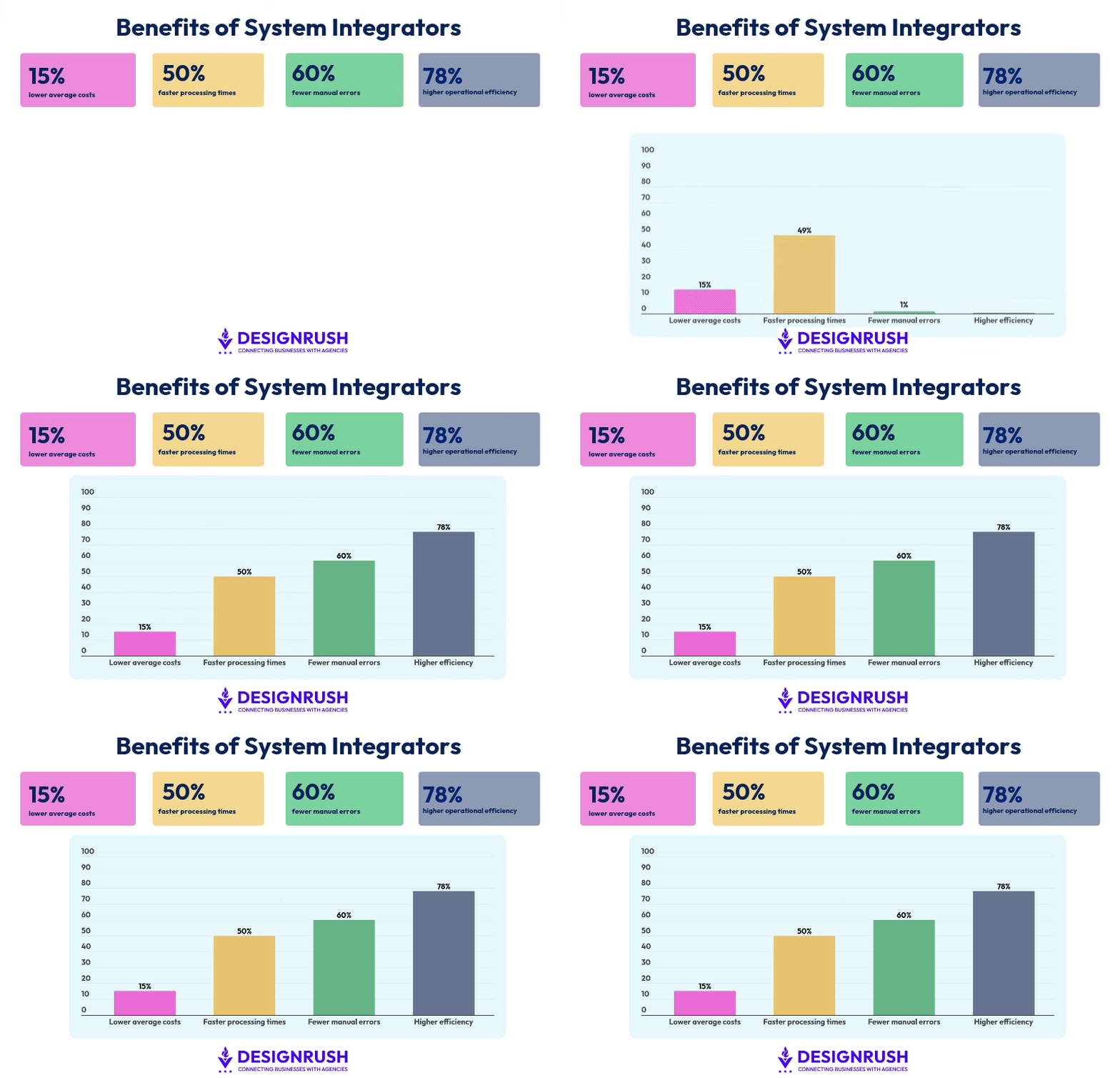
Top system integration companies connect all your systems, so they work as one. They link tools such as CRM, ERP, inventory, and finance, so data flows automatically instead of being entered manually. That removes data silos, reduces errors, and keeps the business running as a single system instead of separate parts.
Here is how system integrators impact your business:
1. Lower operational costs
Disconnected systems create hidden costs through manual work, duplicate tools, and constant fixes. Integration removes that overhead by automating data flow and simplifying your setup.
These improvements show up directly in cost reduction across daily operations:
- 15% reduction in average costs across the organization
- Up to 20% lower administrative costs in sectors like healthcare
- Up to 80% savings in data processing in cloud-based integration setups
2. Higher employee productivity
When systems are not connected, employees spend time copying data between tools. Integration removes that work and speeds up daily operations.
The impact shows in higher output, faster execution, and less wasted time:
- 35% to 45% productivity increase for technical teams by year three
- Up to 78% improvement in operational efficiency with integrated ERP systems
- 50% faster processing times across core business workflows
3. Stronger return on investment (ROI)
Software only delivers value when systems are connected. Integration ensures your tools actually work together and produce measurable business results.
The return shows through higher efficiency, faster payback, and stronger long-term performance:
- 30% improvement in overall ROI from integration projects
- Up to 328% ROI over three years, with payback in 4.2 months
- 10.3x ROI for companies with mature integration compared to fragmented systems
4. Better data accuracy and decision-making
Manual data entry creates errors and delays. Integration creates a single, reliable source of data that updates in real time.
The result is cleaner data, fewer mistakes, and faster access to insights.
- 60% reduction in manual errors in systems like CRM or claims management
- 91% improvement in inventory optimization with integrated systems
- 50% less data engineering effort, enabling 75% faster time-to-insight
How can you choose the right system integrator?
Choosing the right system integrator directly affects whether your project runs smoothly or ends up with delays, budget overruns, and broken systems. The right partner understands both the technical side and your business goals. The wrong one only writes code without understanding how your systems should actually work together.
Follow these steps to make a solid decision:
- Define what you need to integrate
List all systems, tools, and data flows. Be clear on what needs to connect and what outcome you expect. A vague scope leads to wrong estimates and poor execution. - Check relevant experience
Look for companies that have done similar integrations. Same industry, same tools, or similar complexity. General experience is not enough. - Evaluate technical expertise and certifications
Confirm they work with the platforms you use. Check cloud (AWS, Azure), vendors (SAP, Salesforce), and security standards. No proof means higher risk. - Review past projects and case studies
Focus on real results. What systems did they connect, what problems did they solve, and what impact did they deliver? Avoid vague marketing examples. - Assess their integration approach
Strong system integration firms explain how they plan, build, test, and deploy integrations. They should talk about APIs, data mapping, testing, and fallback plans clearly. - Understand communication and project management
Integration projects involve multiple teams. You need structured communication, clear timelines, and defined responsibilities. Lack of this causes delays. - Ask about post-launch support
Systems change over time. Confirm how they handle maintenance, updates, and scaling. No support plan means long-term problems. - Compare cost vs value, not just price
Low cost often means shortcuts in planning, testing, or support. Look at the total cost, including maintenance, delays, and risk. Cheap integrations fail more often.
What questions should you ask system integrator companies before choosing one?
Asking the right questions helps you separate companies that truly understand integration from those that only sell development hours. A good integrator should be able to explain their experience, how they work, and how they will handle your specific case without vague answers.
Relevant background
- What similar integration projects have you completed, and for which industries?
- Which platforms, systems, or tools do you specialize in (ERP, CRM, cloud, etc.)?
- Can you share case studies with measurable results from past integrations?
- What certifications or partnerships do your team members have?
Services and processes
- How do you approach system integration from planning to deployment?
- How do you handle data mapping, transformation, and validation?
- What testing methods do you use before going live?
- How do you manage communication, timelines, and project updates?
Related to your project
- How would you approach integrating our specific systems and tools?
- What risks or challenges do you see in our setup?
- What timeline and cost range do you estimate for this project?
- What kind of support do you provide after launch?
Sources
DesignRush sustains a directory of over 40,000 agencies categorized by service category, location, expertise, and reviews. We build our database in two ways:
- Our dedicated team of agency experts actively searches the web for top-performing companies. We then pull information from their websites, online presence, and client testimonials to verify their status and qualifications prior to listing.
- The agencies listed get notified of their profiles on the website, and they can choose to claim them or not, which suggests their availability for more collaborations.
Agencies can also reach out to DesignRush and must go through the verification process prior to being listed.

Why companies trust DesignRush
Every agency is independently vetted before it can be listed or ranked
 4.8
4.8 4.8
4.8Some agencies pay for sponsored placement, clearly labeled and held to the same vetting standards.
5 Frequently Asked Questions About System Integrator Companies
Who needs system integrator company services?
Any business that uses multiple software systems and needs them to work together needs a system integrator. When systems are disconnected, data duplicates, processes slow down, and errors increase.
Typical use cases:
- Mid-size and enterprise companies that have multiple tools (ERP, CRM, HR, finance) that must share data
- Companies running legacy systems with outdated software that does not connect easily with modern tools
- Fast-growing businesses that are adding new tools quickly and losing control over data and workflows
- eCommerce and retail companies that need to sync orders, inventory, payments, and customer data in real time
- Manufacturing and logistics companies that require tight coordination between supply chain, inventory, and operations systems
- Finance and healthcare organizations that handle sensitive data and need secure, compliant integrations
- Companies undergoing digital transformation that move to cloud systems, automation, or new platforms
Clear signal you need an integrator:
- Data is entered manually into multiple systems
- Reports do not match across tools
- Teams rely on spreadsheets to “connect” systems
- Processes break when one system changes
- Scaling creates more errors instead of efficiency
At that point, integration is no longer optional.
How much do system integrator companies charge for their services?
System integrator services typically cost $15,000 to $1,500,000+, depending on how complex your systems are and how many platforms need to be connected.
Here is how pricing usually breaks down:
- Simple integrations (2 systems): $15,000 to $75,000
- Mid-level integrations (3–5 systems): $75,000 to $300,000
- Enterprise-wide integrations (5+ systems): $300,000 to $1,500,000+
Cost also follows a clear structure across the project:
- Planning and architecture: 10 to 20% of the total cost
- Development and setup: 50 to 70% of the total cost
- Testing and QA: 15 to 25% of total cost
- Training and rollout: 5 to 15% of total cost
There are ongoing costs that most companies ignore at the start. After launch, expect:
- Support and maintenance: 15 to 25% of the initial cost per year
- Cloud, tools, and licenses: Ongoing monthly or annual fees
- API and data usage costs: Depends on volume
Costs increase fast when systems are outdated, data is messy, or real-time processing is required. Legacy systems alone can add 20-50% to cost, and most companies should plan an extra 20-30% buffer for unexpected issues.
What is a typical timeline for system integration projects?
Most system integration service providers require from 3 to 18 months for their projects, depending on the number of systems, data complexity, and business size.
Here is how timelines usually break down:
- Small to mid-size projects: 3 to 9 months
- Large enterprise projects: 6 to 18 months
- Simple integrations (2 systems): 6 to 12 weeks
- Complex integrations (multiple systems): 9 to 18+ months
How system integration companies execute the project also affects speed:
- Phased rollout: 4 to 12 months, lower risk, more stable
- Big bang (all at once): 3 to 6 months, faster but higher risk
Several factors directly impact the timeline:
- Data cleanup and migration can take 15 to 20% of the total time
- Custom features add 3 to 6+ months
- Legacy systems slow everything down
- Testing and go-live add 1 to 2 months if done properly
Delays are common. Around 43% come from technical issues, and 40% from changing scope during the project.
How much downtime does system integration require?
Most system integrations require little to no downtime if planned correctly, but in practice, expect a few hours to a few days of disruption during final switchovers.
Downtime depends on how the company executes the project:
- Parallel integration (best case): Near-zero downtime
The new system runs alongside the old one, and then the switch happens quickly - Phased integration: A few hours at a time
Work is done in small parts during planned maintenance windows - Full cutover (big bang): Hours to several days
The entire system is replaced at once, with the highest risk of disruption
Several factors increase downtime risk:
- Legacy systems: Harder to connect, more failures
- Poor planning: No fallback or rollback options
- High system dependency: If one system fails, others stop
- No testing environment: Issues appear during live use
Strong teams reduce downtime by using backups, testing in advance, and scheduling work during low-activity periods. In well-managed projects, operations continue with minimal interruption.
What kind of support do system integrator companies provide after the project is finished?
System integration service providers do not stop at launch. They provide ongoing support to keep systems stable, secure, and working as expected. Without this, integrations break over time as systems update or data grows.
Post-project support usually includes:
- Fixing errors, broken connections, or data sync issues that appear after launch
- Tracking system health, fixing slow processes, and improving speed as data volume grows
- Adjusting integrations when connected platforms change or update
- Patching vulnerabilities and maintaining data protection standards
- Helping internal teams resolve issues and answering day-to-day questions
- Adding new features, connecting new systems, or expanding integrations as the business grows
- Providing guides and training so teams can use and manage the system properly
Most companies charge ongoing support as 15–25% of the initial project cost per year. Without this support, systems degrade, errors increase, and internal teams take on hidden maintenance work.
Latest Trends Related to System Integrator