
Nearly every marketer believes social media influences revenue. Few can show exactly how much revenue it generates.
A viral post sparks interest. A LinkedIn update starts a sales conversation. A TikTok video drives traffic. Revenue attribution often breaks down somewhere between those interactions and the final sale.
As executives ask tougher questions about marketing performance, teams face growing pressure to connect social media to revenue rather than rely on engagement metrics alone.
How To Measure Social Media ROI: Key Findings
- Consistent UTM tagging gives immediate visibility into which channels and campaigns drive conversions. It’s one of the highest-impact measurement improvements available at virtually no cost.
- Before launching a campaign, define the outcome you're measuring. If a metric can't be connected to a business objective, it shouldn't be used to calculate ROI.
- Short, purchase-driven journeys often work well with linear attribution. Longer B2B sales cycles benefit from U-shaped or W-shaped models that recognize multiple touchpoints.
What Is the Social Media Attribution Gap?
The social media attribution gap is the disconnect between believing social media drives revenue and being able to prove it.
Teams can point to engagement, traffic, and lead activity. Connecting those signals to revenue is much harder without attribution data.
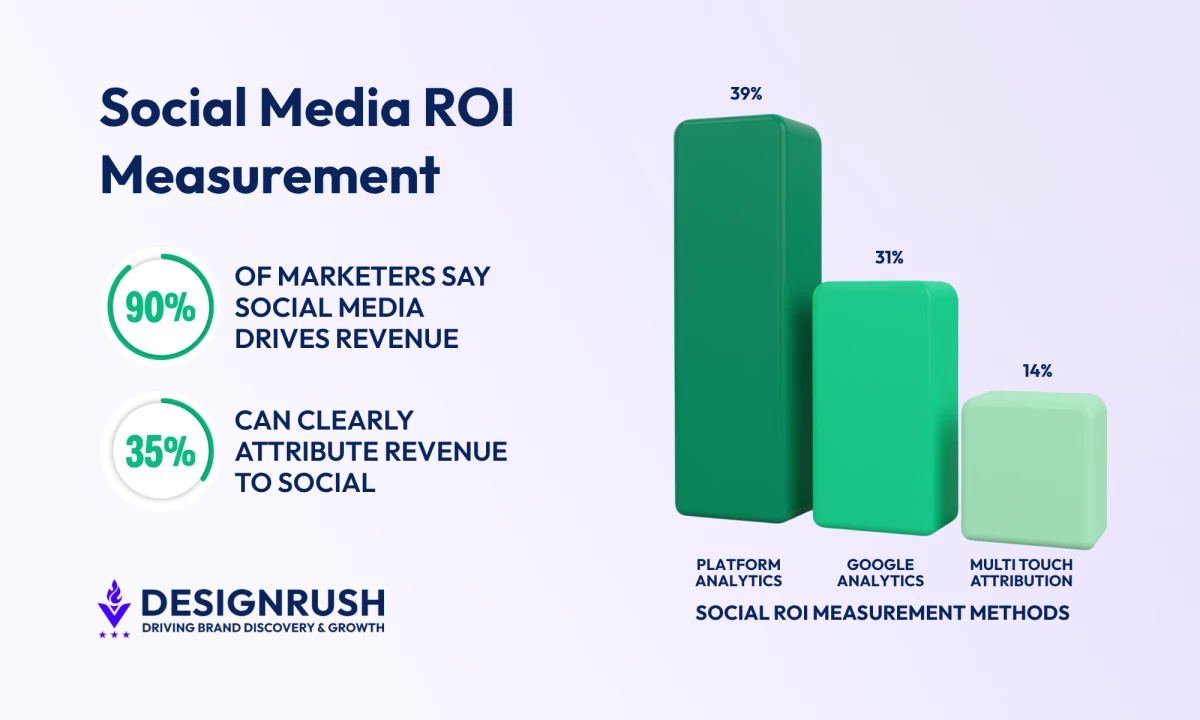
According to DesignRush's 2026 Benchmark Survey of marketing leaders, nearly 90% are confident that social media contributes to their revenue (65.5% "very confident," another 24.1% "somewhat confident).
But few can connect that conviction to revenue with any clarity:
- 35.2% can do it clearly
- 49.7% can do it only partially
- 14.5% can't really do it at all
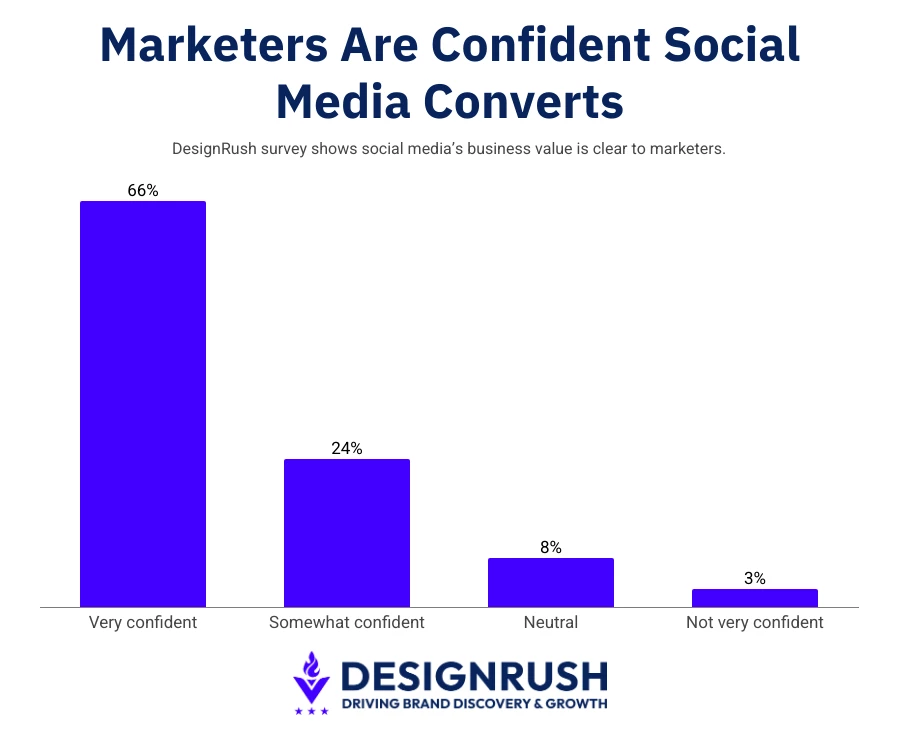
Nearly nine in ten marketing leaders believe social contributes to revenue, yet only 35% can clearly attribute revenue back to social activity.
The survey also highlights a broader social media measurement maturity issue.
Many teams can track engagement and website traffic, but far fewer maintain standardized campaign naming conventions, CRM source fields, or attribution models that connect social activity to revenue.
As a result, reporting often stops at clicks and conversions rather than extending to pipeline and closed revenue.
Why Can’t Most Marketing Leaders Connect Social Media to Revenue?
Survey responses show that most teams still measure social performance with tools designed for engagement reporting rather than revenue attribution.
- 39% of marketing leaders measure social with native dashboards alone
- Only 14% use the multi-touch tools that trace revenue
- For small businesses, attribution tooling competes with hiring
39% of Marketing Leaders Measure Social With Native Dashboards Alone
Platform-native analytics remain the most common measurement method among marketing experts: 39.3% rely on the dashboards built into Instagram, LinkedIn, TikTok, and the rest.
Another 31% use Google Analytics and UTMs (urchin tracking modules), which at least connect social to site behavior.
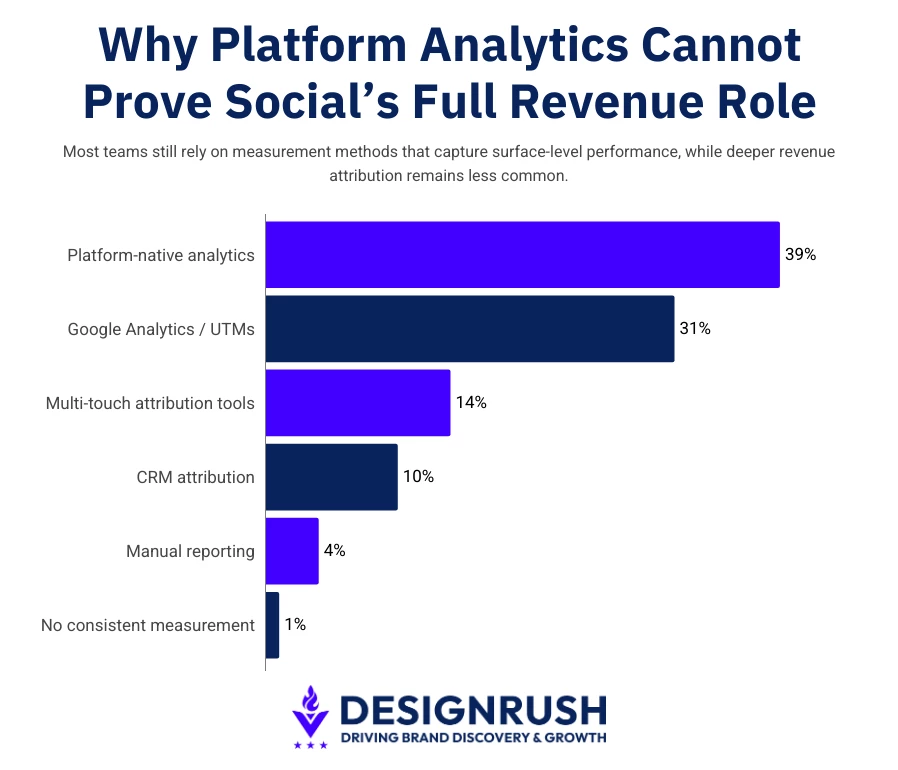
Native dashboards only capture activity inside the platform. They report reach, impressions, engagement, and follower growth, or everything that happens inside the platform.
They can't follow a user out of the app, onto your site, through a sales cycle, and into a closed deal.
Teams can see which posts generated impressions, clicks, and engagement. Revenue data usually lives elsewhere. The measurement stops at the platform's edge, and revenue lives on the other side of it.
Only 14% Use the Multi-Touch Tools That Trace Revenue
The tools that actually trace revenue are the least adopted.
- 14.5% use multi-touch attribution
- 9.7% use CRM attribution
- 4.1% rely on manual reporting
- 1.4% don't measure consistently
Multi-touch attribution and CRM tracking are what let marketing teams say a specific channel or campaign contributed to a specific dollar and connect the social touchpoint to the record where the deal actually closes.
Fewer than one in seven teams use the first, fewer than one in ten use the second. The systems required for social media revenue attribution are still missing in many organizations.
For Small Businesses, Attribution Tooling Competes With Hiring
Cost remains one of the biggest barriers to adoption. For smaller teams, attribution tooling competes directly with headcount for the same budget.
Multi-touch attribution platforms and CRM integrations carry real costs: licensing, setup, and the ongoing analyst time to keep models clean and reports trustworthy. Enterprise organizations can absorb those costs more easily. Smaller teams often weigh attribution software against additional headcount.
When the choice is between an attribution stack and another person who can actually produce the work, the work usually wins.
So, the teams that most need to prove their social ROI to leadership are often the least equipped to, not because they don't understand attribution, but because the math of a small budget keeps pushing it down the list.
What Marketing Leaders Who Can Prove Social ROI Do Differently
Teams that can prove social media ROI tend to have stronger measurement systems and cleaner attribution data.
When we cross-referenced measurement tools against the ability to connect social to revenue, one pattern stood out: the teams using attribution tooling are the ones who can prove their results.
46% of Multi-Touch and CRM Users Report Clear Revenue Attribution, vs. 35% on Platform Analytics
The difference often comes down to data continuity.
When campaign IDs, source fields, and conversion records remain connected across analytics platforms and CRM systems, marketing teams can track how social interactions contribute to opportunities, pipeline, and revenue.
When those connections break, attribution becomes far less reliable.
A caveat worth stating plainly: these are small subsamples (35 and 57 respondents), so this is a pattern, not proof. It also runs in one direction — we can't say the tooling causes the clarity, only that the two travel together.
But the direction is consistent with everything else in the data, and with how attribution actually works: the teams that invest in tracing revenue are the teams that can see it.
Leadership Now Expects Social Media Revenue Proof
Industry research shows leadership has moved past treating social as a brand awareness play. They now want it tied to business outcomes, which raises the stakes on closing the attribution gap.
The data below comes from Sprout Social, whose findings closely mirror our own.
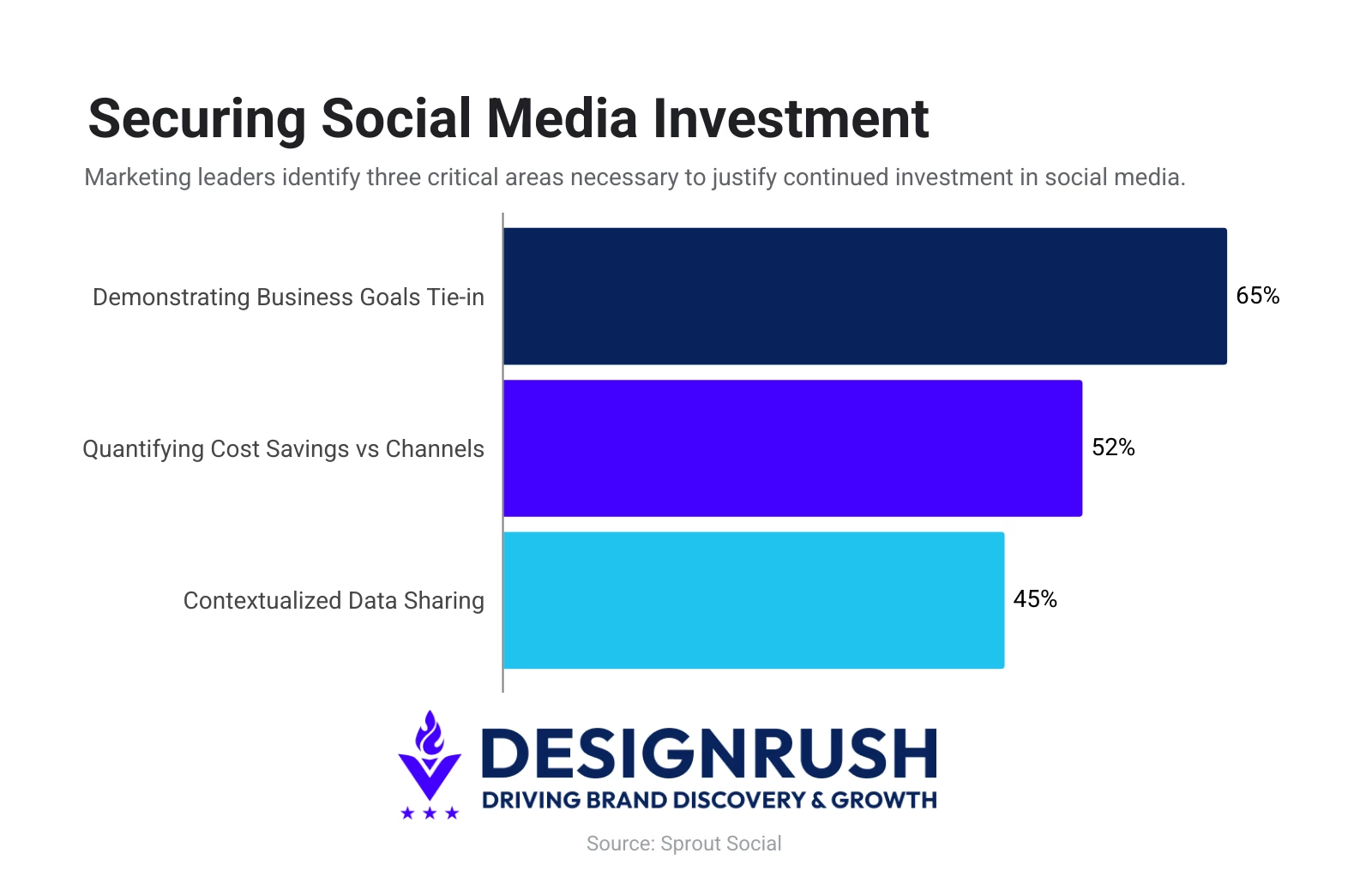
65% of Leaders Want Social Campaigns Tied Directly to Business Goals
According to the 2025 Sprout Social Index, 65% of marketing leaders say demonstrating how social media campaigns are tied to business goals is crucial for securing social investment.
Another 52% want teams to quantify the cost savings of using social compared to other channels.
Budget discussions increasingly revolve around pipeline, revenue, and business outcomes.
Marketing leaders want evidence that social contributes to growth, which means teams must prove social media ROI to leadership with attribution data rather than engagement metrics alone.
Leaders Believe in Social Even When the Metrics Don't Show It Yet
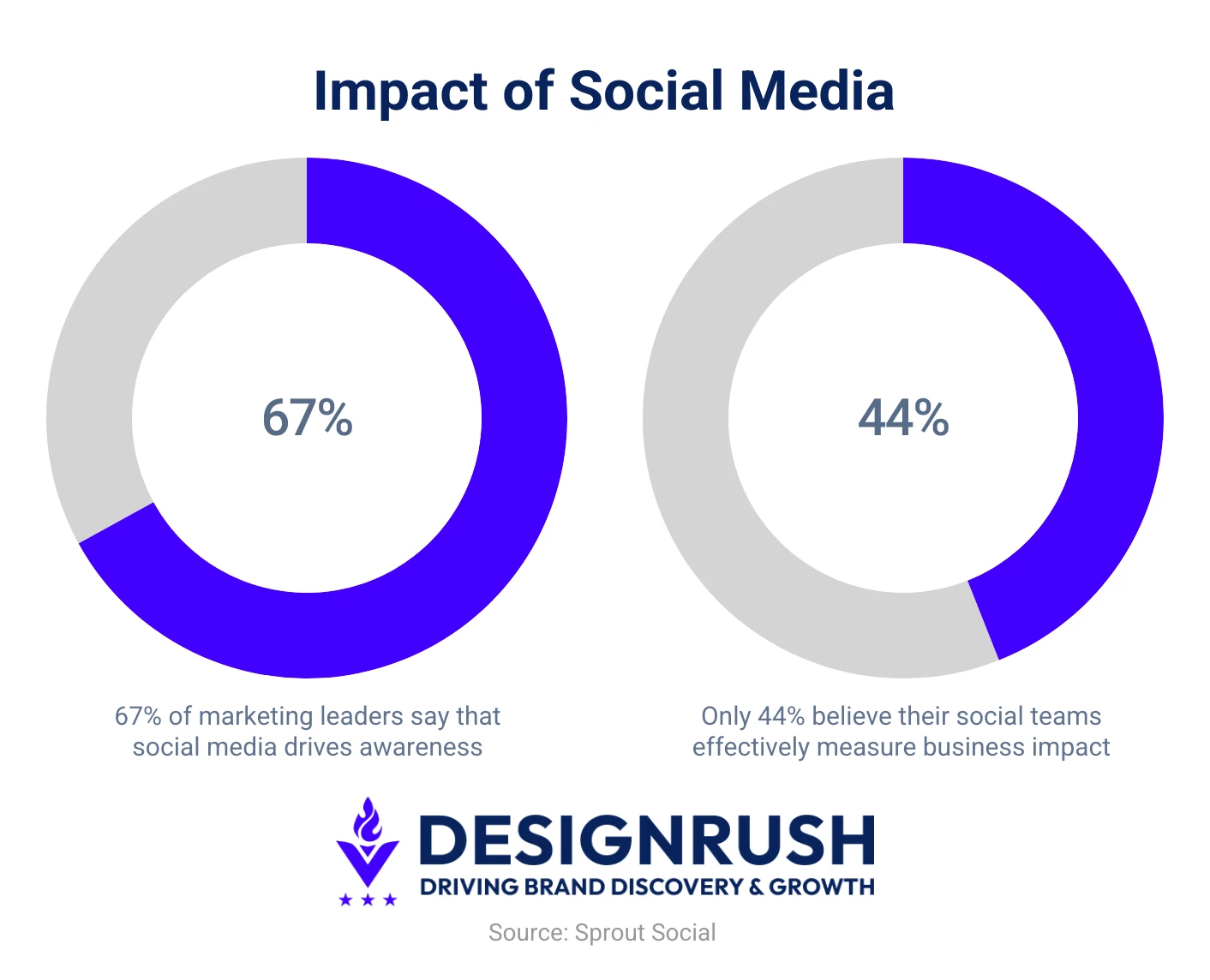
Sprout's 2025 Impact of Social Media Report frames the same tension from leadership's side.
Most marketing leaders are confident social media can influence business goals like revenue and new customer acquisition, even if their metrics don't show it yet. However, they aren't sure their own teams can tie social to those outcomes.
For many organizations, the next challenge is not increasing social investment but improving measurement maturity.
Leadership teams increasingly expect channel-level revenue reporting, campaign attribution, and clear visibility into marketing's contribution to pipeline growth.
Social Media Measurement Maturity: A 4-Step Path to Revenue Attribution
Closing this gap doesn't require an enterprise budget or a data science team. It's a progression: each step adds a layer of revenue visibility, and each one works on its own before you reach for the next.
Teams stuck at platform analytics can start at Step 1 this quarter and climb as resources allow.
- Step 1: UTM discipline on every link
- Step 2: Self-reported attribution at conversion points
- Step 3: CRM source and campaign fields
- Step 4: Multi-touch attribution for social media
Step 1: UTM Discipline on Every Link
The foundation is tagging every link you post with UTM parameters: source, medium, and campaign. This means traffic arriving on your site is traceable to the exact post or channel that sent it. It costs nothing but consistency.
The discipline part matters more than the mechanics. A half-tagged campaign produces data you can't trust, which is often worse than no data, because it invites wrong conclusions.
The strongest teams document campaign naming conventions in advance and apply them consistently across social, email, paid media, and landing pages.
Consistency matters because attribution models depend on clean, standardized data.
Step 2: Self-Reported Attribution at Conversion Points
The next layer captures what tracking can't see: the "How did you hear about us?" field at signup, checkout, or demo request.
This step:
- Captures hidden or untracked influence such as word of mouth or content seen weeks before conversion
- Helps surface channels that UTMs and analytics tools often miss, especially in long B2B buying journeys
- Low-cost to implement since it only requires adding a question to existing forms
Treated as a directional signal rather than precise truth, it fills a real blind spot. It also doesn’t require new software, just a question added where conversions already happen.
Step 3: CRM Source and Campaign Fields
By populating source and campaign fields in your CRM and carrying them through to closed deals, you create a direct record of social media revenue attribution.
CRM field hygiene becomes especially important at this stage. Missing source values, inconsistent campaign names, and incomplete lead records can weaken attribution accuracy even when the underlying tools are in place.
This is where many teams stall, and the survey shows it: only 9.7% use CRM attribution.
The reason is rarely the CRM itself but the operational discipline to populate them consistently and the alignment between marketing and sales to keep them intact through the pipeline.
Teams that clear it gain the ability to report social's contribution in the same system leadership already uses to track revenue, which is exactly the language the budget conversation happens in.
Step 4: Multi-Touch Attribution for Social Media
Multi-touch attribution social media models distribute credit across multiple interactions instead of assigning all value to a single click.
It recognizes that a purchase is usually the result of many interactions (a video view, a retargeted ad, an email, a final branded search) and assigns proportional weight to each.
It's the most demanding step, which is why only 14.5% of marketing teams reach it. It needs clean data feeding in from the rungs below, the tooling to model it, and the analyst time to maintain it.
But it's also what produces the clearest picture of social's true role, and the cross-tab earlier reflects that. The teams using multi-touch or CRM attribution are the ones most able to connect social to revenue. The ladder ends where the proof is strongest.
Which Multi-Touch Model Should You Use?
Multi-touch attribution models split credit across the journey differently:
- Linear spreads credit evenly across every touchpoint, treating each interaction as an equal contributor to the conversion.
- U-shaped weights the first and last touches most heavily — the moment that earned awareness and the moment that closed — with the remaining credit distributed across the middle.
- W-shaped concentrates credit on three pivotal moments: first touch, lead creation, and opportunity creation, making it well-suited to longer B2B journeys with defined funnel stages.
Teams with short, click-driven paths tend toward linear; those with long, sales-assisted cycles lean to U- or W-shaped, where the milestones that matter are easier to see.
How To Measure Social Media ROI: Final Thoughts
Anyone can calculate ROI once revenue and costs are known. The challenge is determining which social interactions influenced that revenue in the first place.
For teams asking how to measure social media ROI, the answer rarely starts with a new dashboard. It starts with better attribution data, cleaner CRM records, and consistent campaign tracking.
| DesignRush Social Media Marketing Benchmark Survey, conducted June 2026. Respondents include agency professionals (74%), brand owners/founders (17%), in-house teams (5%), and freelancers (4%). Primary markets include North America (47%), global markets (42%), and Europe/UK (10%). |

Our team ranks agencies worldwide to help you find a qualified partner. Visit our Agency Directory to find top-rated social media marketing companies, as well as:
- Top Influencer Marketing Agencies
- Top LinkedIn Marketing Agencies
- Best Instagram Marketing Companies
- Best TikTok Marketing Agencies
- Top Facebook Marketing Companies
Our design experts also recognize the most innovative design projects across the globe.
Given the recent uptick in video on social media, you'll want to visit our Awards section for the best & latest in social media videography designs.
How To Measure Social Media ROI FAQs
1. How do you calculate social media ROI?
The standard formula is:
ROI = ((Revenue from Social Media – Social Media Costs) ÷ Social Media Costs) × 100
Costs should include advertising spend, software subscriptions, agency fees, content creation, and employee time.
2. Why is social media ROI so difficult to measure?
Customers rarely convert after a single interaction. They may discover a brand on social media, return through search, subscribe to email, and convert weeks later. This multi-touch journey makes attribution challenging without proper tracking systems.
3. What is the best way to attribute revenue to social media?
The most reliable approaches are multi-touch attribution and CRM tracking, which connect a social touchpoint to the record where a deal actually closes. In the survey, 46% of marketing experts using these tools could attribute revenue clearly, compared with 35% relying on platform-native analytics alone: a pattern that holds across the data.
4. Is platform analytics enough to prove social ROI?
No. Platform-native dashboards report reach, impressions, and engagement, but they can't follow a user out of the app, through a sales cycle, and into a closed deal. They show that a post performed well, not that it earned money.
5. What's the difference between multi-touch and last-click attribution?
Last-click attribution gives all credit for a conversion to the final interaction before purchase, ignoring everything that influenced the buyer earlier. Multi-touch attribution distributes credit across every touchpoint in the journey, which better reflects how social typically works.