How to Hire Video Production Agencies in New York Table of Contents
What should a video production case study prove before I take it seriously? A case study is only useful if it shows a project with a comparable budget, format, and business goal to yours, and tells you what results the video produced. Aesthetics alone prove nothing about fit.
Before you take a case study seriously, it should answer:
What was the client's goal? Brand awareness, lead generation, product launch, and internal training are different briefs with different success criteria.What was the budget range? A case study built on an $80,000 production tells you nothing about how the agency performs at $15,000.What format and platform was it made for? A polished brand film and a social video series require different skills, different crew, and different post-production workflows.What was the measurable outcome? View counts are vanity. Conversion rates, sales lift, or engagement benchmarks relative to past content are meaningful.How do I compare two New York video production companies that look equally strong? When two video production companies in New York look equally qualified on paper, the differentiator is almost always how they price, what they include, and how they handle ambiguity.
Start with the pricing structure. A standard corporate video from a New York video production company typically runs $10,000 to $30,000 for mid-tier work, with high-end productions reaching $50,000 to $100,000+. If both agencies are quoting within that range, the question shifts to what's actually included.
Ask each one to itemize:
Pre-production (scripting, storyboarding, location scouting) Crew size and day rate Post-production scope; specifically, how many revision rounds, whether color grading and sound mix are included, and music licensing terms Raw footage ownership after delivery Beyond pricing, run the same scenario past both: tell them something changed after the shoot. For example, a key message needs to be revised, or you need a cut for an additional platform. How they respond to that question tells you more than their portfolio.
The agency that asks better questions in the briefing stage is usually the better agency. The one that pitches fastest is usually optimized for winning work, not delivering it.
Should I start with a pilot video or commit to a full production package upfront? Start with a pilot if you haven't worked with the agency before, your internal stakeholders disagree on creative direction, or you're entering a new content format. A single well-scoped video tells you more about an agency's working process than any reel or reference call.
A pilot makes sense when:
You have a defined deliverable that stands alone (a product video, a founder story, or one campaign asset) The budget for a pilot is meaningful enough that the agency treats it seriously, typically $1,000 to $50,000 minimum for a NY video production company You have clear criteria for what good looks like before production starts Commit upfront when you already have a working relationship, you need volume (a series of videos shot in one block is significantly cheaper per video than separate productions), or the project has interdependent parts that can't be split without losing coherence.
One thing to watch: some video production agencies in New York discount heavily on package commitments but underdeliver on later videos in the series once the relationship is locked. If you do commit upfront, make sure the contract defines quality standards for every deliverable, not just the first one.
How do I evaluate a video production agency if I don't have a production background myself? You don't need a production background to evaluate a video production agency; you need to evaluate whether they understand your business problem, and whether their process gives you enough control to course-correct before it's too late.
Focus on these signals:
How do they run the brief? A strong agency asks about your audience, distribution platform, success metrics, and internal approval process before they talk about cameras or crew. If the first conversation is about their capabilities, that's a flag.How clear are their pre-production deliverables? Before any shoot, you should receive and approve a script or concept document, a storyboard or shot list, and a production timeline with named milestones. If they can't show you what approval looks like at each stage, you have no control over the outcome.How do they talk about past mistakes? Ask directly what went wrong with a recent project and how they handled it. Agencies with a strong process have good answers. Agencies that optimize for appearing flawless have vague ones.Are their references reachable? Ask for two client references in a format or industry similar to yours and actually call them. Ask if the final video matched what was discussed in pre-production.You don't need to understand lens choices or color grading to know whether an agency is aligned with your goals. The brief, the approval process, and the references will tell you everything you need to know.
How do I know when it's time to switch video production agencies versus giving them another project? Switch when the process is broken, not just when one video misses the mark. A single underperforming video can have a dozen causes, such as a rushed brief, slow internal approvals, or a scope change mid-production. That's not automatically the agency's fault.
The case for switching is clear when:
Pre-production keeps getting skipped or rushed. If the agency consistently moves to production before the brief is locked, it won't improve; it's a process problem, not a bandwidth problem.You're managing their process instead of approving their work. You should be reviewing and approving; you shouldn't be reminding, chasing, or filling in gaps that they should be handling.The work is consistently misaligned with your brief, not just your taste. Creative differences are normal. Delivering videos that ignore the agreed direction is a different problem.They can't tell you why something didn't work. A strong agency reviews performance and brings that back to the next brief. One that moves on without analysis is optimizing for output, not outcomes.Before you switch, have one direct conversation where you name the pattern specifically. How they respond to that conversation is your final data point. If they get defensive or vague, you have your answer.
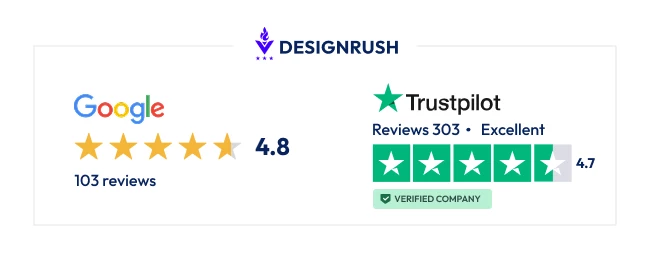
Why Companies Trust DesignRush Rated 4.8 on Google and 4.7 on Trustpilot , DesignRush Agency Directory is a reliable resource for finding video production companies in New York. We owe this to our executive selection team, which follows a strict screening process when featuring agencies on the platform, assessing key performance indicators, like portfolio, client reviews, and industry reputation.
Learn more about DesignRush Agency Ranking Methodology .
Sources DesignRush sustains a directory of over 40,000 agencies categorized by service category, location, expertise, and reviews. We build our database in two ways:
Our dedicated team of agency experts actively searches the web for top-performing companies. We then pull information from their websites, online presence, and client testimonials to verify their status and qualifications prior to listing. The agencies listed get notified of their profiles on the website and they can choose to claim it or not, which suggests their availability for more collaborations. Agencies can also reach out to DesignRush and must go through the verification process prior to being listed.


 Proposals