![How To Write a Video Production RFP in 2026 [+ Free Template]](https://media.designrush.com/articles/951275/conversions/video-production-rfp-details-webp.webp)

In 2026, the difference between an average video and a revenue-driving one can come down to a single document: your RFP.
Done right, it attracts the right partners and turns complex productions into predictable, high-impact results.
Video Production RFP: Key Findings
- Define your inputs before writing anything. Vendors can’t price or plan accurately without clarity on stakeholders, assets, channels, and constraints.
- Specify creative output with precision. List styles, tone, must-haves, deliverables, technical specs, and whether AI workflows are permitted.
- Break down the scope of work in detail. Define pre-production, production, post-production, and all deliverables.
What Is RFP for Video Production?
I’ve reviewed hundreds of video production RFPs over the years: some crystal clear, most frustratingly vague.
Here’s the reality: when your brief is fuzzy, everything that follows — scope, budget, timeline, and creative quality — gets fuzzy too.
With 95% of marketers calling video essential to their strategy and 93% reporting strong ROI, organizations can no longer afford vague briefs, ambiguous expectations, or misaligned production workflows.
Your RFP translates business goals into clear creative and technical requirements, setting the stage for videos that build trust, engage audiences, and perform across channels.
This matters because 91% of consumers say video quality directly affects how much they trust a brand, and 78% prefer to learn about products through short videos (Wyzowl).
A precise video RFP is your first line of defense. It ensures you attract capable partners, avoid costly missteps, and produce content that truly drives results.

Best Practices for Video Production RFP in 2026
A strong RFP starts long before you outline deliverables. The more precise your direction, the stronger (and more relevant) the proposals you’ll receive.
- Gather the right inputs
- Start with an executive summary
- Describe the video output in detail
- Specify scope of work
- Establish realistic timelines and budgets
- Address legal and AI-era requirements
1. Gather the Right Inputs
If you want accurate quotes and realistic timelines, start by organizing the foundational inputs your production partners need.
It’s the difference between rushed RFPs that confuse vendors and credible ones that attract top-tier production partners who deliver high-quality work without inflated bids.
Here’s an overview of what I always put in writing:
| RFP Input Area | What to Specify | Example |
| Stakeholders & Capacity | Owners for Creative, Branding, Legal, and other relevant departments | Creative: Jordan (8-10 wks) Branding: Leo (6-8 wks) Legal: Priya (5) |
| Assets Ready vs. Missing | What’s already approved and what still needs development | Ready: Product shots, brand messaging, rough script outline. Missing: Final script, talent list, shot references. |
| Audience & Channel Strategy | Platforms for distribution and target audiences | ICP: B2B IT leaders, mid-market buyers Primary goal: Product education Channels: LinkedIn, YouTube, website hero, paid retargeting |
| Constraints & Requirements | Must-haves, style guardrails, compliance boundaries | Tone: Confident, modern Compliance: Healthcare claims + accessibility captions |
| Technical Specs | Formats & deliverables | 16:9 hero, 9:16 paid social cuts, 1:1 product highlight, 4-6 short variations |
2. Start With an Executive Summary
A precise Executive Summary is one of the strongest signals that your organization is prepared, professional, and ready for a high-quality production partnership. It sets the tone for the rest of the RFP and the project itself.
I keep the Executive Summary to one page and cover these essentials:
| Area | Do (examples you can copy) | Don't (examples to avoid) |
| Why Now (the trigger or problem) | We need a hero video to support a high-stakes Q3 product launch and campaigns for paid social + sales enablement. | We want a new brand video to stay competitive. |
| Specific Outcomes (success metrics) | 40% view-through rate on YouTube, lift demo requests by 15% by Q4 | Improve awareness and engagement across channels. |
| Scope (Phase 1) |
| We need a full video campaign; final deliverables to be determined later. |
| Constraints (budget, compliance, team bandwidth) | Budget $80–120k; internal approvals within 5 days; all content must have hard-coded captions | Budget still TBD; assume quick approvals from our team. |
| Timeline (milestones, payment terms) | Payments tied to milestones: pre-pro T+2 weeks, shoot T+4, first cut T+6, final delivery T+8 | Launch in 4 weeks; we’ll finalize milestones after selecting a vendor. |
| North Star (most important performance goal) | Deliver a video library with measurable impact on pipeline velocity and mid-funnel engagement. | Track as many metrics as possible: impressions, clicks, likes, shares, and exposure. |
3. Describe the Video Output in Detail
The more specificity you provide, the faster you’ll attract qualified partners and eliminate misaligned proposals.
I always include the following details in this section:
- Style references: Provide links, mood boards, previous brand videos, or competitor samples. These anchor creative interpretations and eliminate the guesswork. If there are styles you absolutely do not want, state them clearly.
- Tone: Describe the emotional and narrative feel: cinematic, documentary-style, UGC-driven, humorous, animated, polished corporate, dynamic tech-forward, testimonial-led, etc. Tone affects lighting, scripting, casting, type of crew, and even licensing needs.
- Mandatories: List every element that must appear or be adhered to: brand guidelines, product feature callouts, legal disclaimers, accessibility requirements, CTA variants, translations, compliance notes, or technical overlays (UI animations, dashboards, data visuals).
If you’re open to AI-generated footage, virtual production (LED volume), synthetic environments, AI-driven animation, or hybrid AI + live-action workflows, say so explicitly.
Many studios now operate AI-first pipelines that can reduce shoot days, VFX costs, and turnaround from weeks to days, but they won’t propose these alternatives unless they know you’re open to them.
Likewise, if you require traditional production methods (union crew, SAG talent, real locations), clarify that up front.
This level of detail ensures vendors quote accurately, recommend the right workflow for your needs, and avoid padding bids with contingencies. It also signals to high-caliber studios that you’re organized, serious, and ready for a professional production partnership.
4. Specify Scope of Work (SOW)
When the SOW is vague, vendors make assumptions, which always show up later as cost overruns, timeline slips, and creative misalignment.
A precise SOW removes ambiguity and tells vendors exactly what they’re responsible for. It also prevents you from paying for “extras” that should have been baked into the quote from day one.
Here’s how I break down the SOW for video production:
Pre-Production
This is where 80% of success is determined. Under-specifying this phase is the #1 cause of missed expectations.
- Concept development/scripting
- Storyboards or animatics
- Casting or talent sourcing
- Location scouting or virtual set design
- Shot list creation
- Previsualization
Production
This is where clarity prevents budget surprises. Vendors need to know the logistical footprint of the shoot.
- Number of shoot days & locations
- Crew size expectations
- Equipment level (cinema cameras, drones, motion control, LED volume, etc.)
- Accessibility requirements (on-screen captions, inclusive casting)
- Safety, compliance & permissions
Post-Production
This is where modern workflows diverge dramatically. The more you define here, the cleaner the proposal.
- Editing, color grading, VFX, motion graphics
- 2D/3D animation requirements
- Music licensing (original vs. stock)
- Voiceover
- AI enhancements (clean-up, upscaling, style transfer, automated deliverables)
Deliverables
Vendors cannot quote accurately without an exact deliverables list. “Just a few cutdowns” can balloon into 25 assets if left undefined.
- Master files (resolution, codec, source files)
- Social cutdowns & aspect ratios
- Captioned versions (burned-in + SRT)
- Versioning or localization expectations
5. Establish Realistic Timelines and Budgets
I've worked with many brands on video production, and I’ve learned this: nothing derails an RFP faster than unrealistic expectations around time and cost.
For context, 53% of marketers still allocate one-third or less of their total marketing budget to video (Wyzowl), despite rising demands for multi-format content, platform-specific cutdowns, and accelerated turnaround cycles.
Poll
This mismatch between ambition and investment is exactly why I push clients to define budgets early and transparently.
You can choose one of three approaches:
5.1. Provide a Budget Range (Recommended)
This consistently yields the highest-quality proposals because vendors can tailor concepts to a realistic financial envelope.
Example: “$75k–$120k total budget, inclusive of talent buyouts and platform-specific deliverables.”
A defined range ensures you attract partners operating at the right tier. You won’t need to handle overbuilt agencies that will overshoot your needs, or low-bid vendors who can’t support your scale.
5.2. Provide a Budget Ceiling
If your organization requires cost control above all else, set a firm ceiling.
Example: “Not to exceed $90k.”
With a ceiling, vendors optimize their workflows and creative scope around a hard limit. This works well for established templates, repeatable formats, or content built within known constraints.
5.3. Ask Vendors to Propose Budgets
I only recommend this for teams with flexible procurement or those deliberately benchmarking the market. Expect proposals to come in wildly varied — sometimes 2–4× apart — because vendors will price based on their own interpretation of your vision.
If you choose this route, prepare to spend more time normalizing bids and clarifying assumptions.
6. Address Legal and AI-Era Requirements
In 2025, 51% of video marketers report using AI tools to create or edit video content, while 49% still use traditional workflows (Wyzowl).
This split means vendors vary dramatically in their capabilities, compliance practices, and rights management. If you don’t address AI usage up front, you risk unknowingly accepting assets you cannot legally use or distribute.
AI Usage Policy
Ask vendors to disclose:
- Whether AI will be used in scripting, casting, VFX, voices, or editing
- What models/tools they rely on
- Licensing terms for AI-generated assets
- Data privacy or training data considerations
Rights & Licensing
You must spell out the usage rights you expect vendors to secure. Include:
- Talent buyouts (geography, duration, media types)
- Music rights
- Stock footage rights
- Ownership of project files (editorial, 3D, AI assets)
Compliance Requirements
In 2026, regulatory scrutiny on video output is higher than ever, particularly around accessibility and synthetic media. Specify:
- Accessibility requirements (WCAG, captions, AD)
- Regional regulations (e.g., EU AI Act compliance for synthetic media labeling)
- Platform-specific constraints
Benefits of a Well-Written Video Production RFP
A well-written video production RFP delivers:
- More accurate, comparable bids: Vendors quote against the same scope, reducing outlier pricing and unnecessary back-and-forth.
- Higher-quality creative concepts: Clear objectives and style cues lead to stronger storytelling and more innovative proposals.
- Less scope creep: Detailed deliverables, formats, and production needs create firm boundaries that protect your budget.
- Smoother execution: Defined timelines and workflows lead to fewer delays and faster approvals.
- Predictable timelines: Review cycles and delivery dates support confident campaign and launch planning.
- Enhanced credibility: A polished RFP signals that your organization is organized, serious, and ready to produce high-quality work.
Best Video Production Agencies to Send RFP to
Video production agencies have the tools and expertise to create high-quality content that effectively communicates your brand’s message and helps achieve its goals.
Here are some of the best ones you can partner with:
1. Waka
- Location: Ingraham St, San Diego, San Diego, California 92109, United States
- Average Hourly Rate: $40
- Expertise: Video Production, Branding, Graphic Design, Creative, Mobile App Development, UI/UX Design
Waka is a creative and digital service agency that offers branding, graphic design, video production, and mobile app development services. It boasts an experienced team that is continually looking to push the limits of creativity to deliver high-end results at competitive prices.
The agency strives for diversity to drive innovation and remarkable growth in all its projects. Its notable clients include Kiwoko, Multifab, Goalbox, and TAI.
2. beholde
- Location: 6855 South Havana St., #610 Centennial, CO 80112, United States
- Average Hourly Rate: Inquire
- Expertise: Video Production, Video Marketing, Branding, Logo Design, Graphic Design, Creative, Web Design, WordPress Website Design, Social Media Marketing
beholde was founded in 2012 on the streets of Los Angeles, gaining experience from Hollywood’s film and TV industry. The company has since expanded to include a team of designers, videographers, web developers, animators, social media experts, and marketing analysts.
This full-service creative agency designs everything from logos to animated videos. Now based out of Denver, Colorado, its goal is to ensure clients are 100% satisfied with designs before delivery.
Notable clients include NBC Sports, ColoradoBiz Magazine, and Toys for Tots.
3. Studio52
- Location: Office 305 and 402 Sobha Ivory 2, Business Bay, Dubai, 80752, United Arab Emirates
- Average Hourly Rate: $20
- Expertise: Video Production and Audio Production
Studio52 is a creative agency that specializes in audio-visual communications. Its team of creatives is adept in digital media production, audio production, voiceover recording, IVR message recording, multilingual dubbing, drone filming and photography, and 2D & 3D production, to name a few.
Notable clients include Weatherford, SNOC, and Mobily.
4. LiFi Media Production
- Location: 146 Chesley Hill Rd, Rochester, New Hampshire 03839, United States
- Average Hourly Rate: $150
- Expertise: Video Production, Commercial Video Production, Documentary Video Production, Corporate Video Production, Explained Video Production, Creative, Video Marketing
LiFi Media Production specializes in creative visual media and production for documentaries, corporate productions, commercials, and explainer videos. It also provides professional assistance with creating digital video marketing strategies to enhance clients’ online presence.
The agency works closely with each client to ensure brand messages are accurately and effectively represented through creative visual media.
Notable clients include Spark Electrician Services, Gray Property Group, and JJ Kane Auctioneers.
5. Brandefy
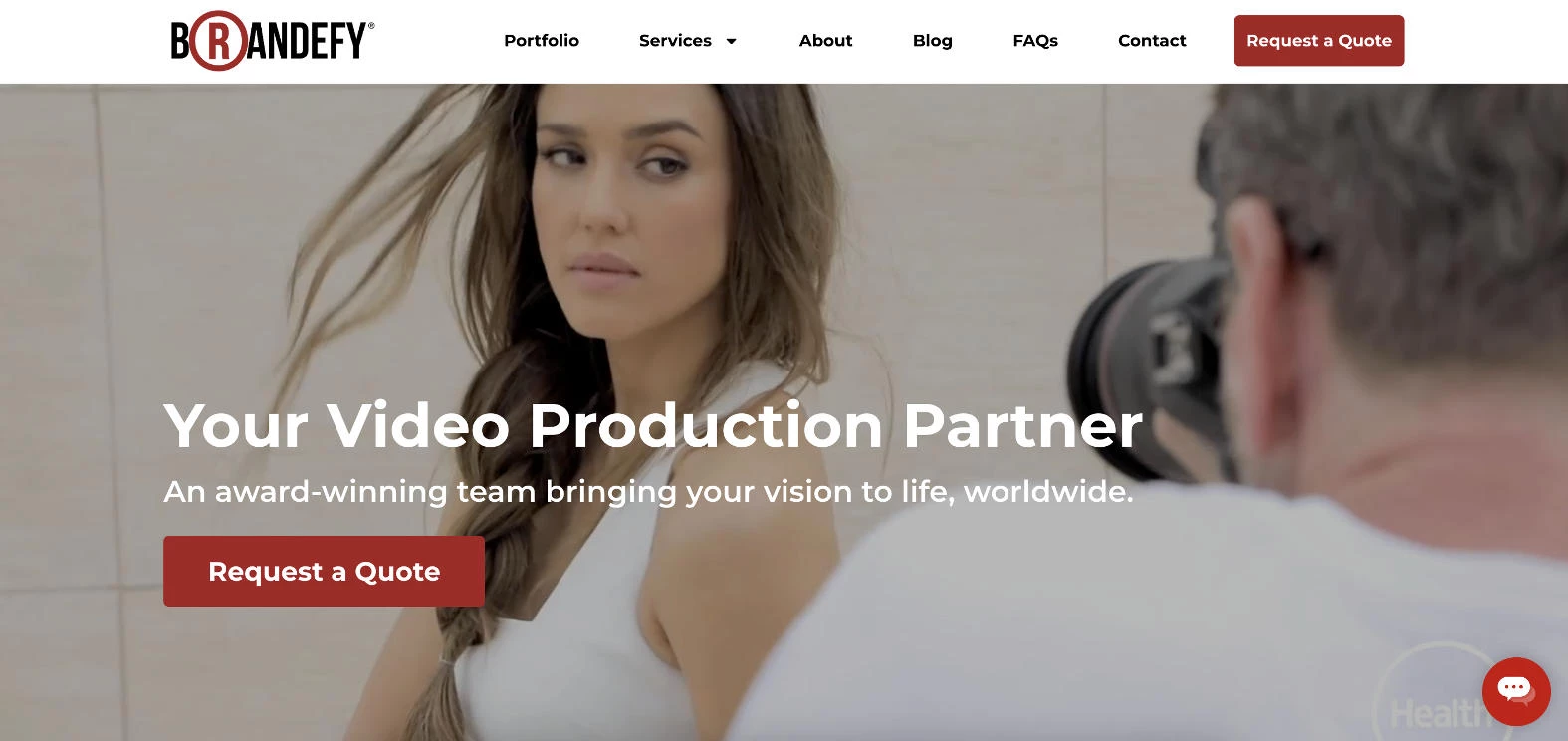
- Location: 2633 Lincoln Blvd #406, Santa Monica, California 90405, United States
- Average Hourly Rate: $125
- Expertise: Video Production and Video Marketing
Brandefy is a full-service video production company with a focus on creating campaigns that produce real results for clients. Its team of highly experienced professionals works closely with clients to create compelling, effective video campaigns tailored to their specific needs and goals.
The agency can guide you from development to distribution so you can focus on what matters: telling your story to the world.
Notable clients include UCLA, the City of Los Angeles, AAA, and Unilever.
Video Production RFP: Final Thoughts
By clarifying your scope and eliminating ambiguity, you will attract partners capable of delivering standout creative on time, on budget, and aligned with your strategy.
A high-performing video RFP sets the entire production up for success.
Find More Agency Hiring Resources:
- Defining Digital Marketing Objectives
- A Clear Guide to Planning Your Digital Marketing Budget
- Questions To Ask a Digital Marketing Agency
Follow these guidelines, and you’ll get sharper proposals, cleaner delivery, and a mobile app that moves the numbers that matter.
Our team ranks agencies worldwide to help you find a qualified partner. Visit our Agency Directory for the top video production companies, as well as:
- Top Branded Video Production Companies
- Top Commercial Video Production Companies
- Top Corporate Video Production Companies
- Top Explainer Video Companies
- Top Training Video Production Companies
Our design experts also recognize the most innovative design projects across the globe. Given the recent uptick in video production, you'll want to visit our Awards section for the best & latest in video designs.
Video Production RFP FAQs
1. How long should a video production RFP be?
Most strong RFPs fall around 5 to 12 pages. Long enough to outline scope and requirements, short enough for vendors to digest without confusion.
2. How many vendors should I send the RFP to?
Three to five is ideal, enough for competitive pricing, but not so many that you overwhelm review cycles or attract vendors outside your scope.
3. Should I require vendors to sign an NDA before receiving the RFP?
If your project involves unreleased products, proprietary data, or confidential messaging, yes. For general brand videos, it’s optional.