Accenture, Cognizant, Capgemini, IBM, Tata Consultancy Services - these are among the top system integrators enterprises select to unify technology ecosystems, streamline operations, and implement scalable infrastructure solutions that support secure and efficient business growth.
Organic rankings are determined by five factors: top services, reviews, portfolio, awards/press, and team expertise. Sponsored listings pay for a placement that appears above organic positions. Sponsorship does not affect star ratings or review content - read more on our methodology page.
Health Tech and Managed IT Services Company
TechMatter is a leading global provider of technology and healthcare solutions headquartered in Glendale, California. The company specializes in enterprise software development, automation, and revenue cycle management, empowering organizations to streamline operations and achieve sustainable growth. With a...
Top Services:
- Digital Services
- Design Services
- UI/UX Design
- Web Development
- Affiliate Marketing
- Show more
- Location
- Glendale, California
- Number of Employees
- 500 - 999
- Average Hourly Rate
- $100/hr
Our experts are ready to meet your business needs and offer customized solutions to help you succeed
Israchem is a dynamic team that combines specialists in such areas as Chatbot development, IoT development, Web?Mobile Development, Recruitment and Games. Whether you're looking to automate communication with chatbots, revolutionize industries through IoT systems, find top-tier talent, or design your own...
Top Services:
- Mobile App Development
- Software Development
- DevOps Consulting
- Web Development
- IT Services
- Show more
- Location
- Hadera, Israel
- Number of Employees
- Under 49
- Average Hourly Rate
- $29/hr
- Minimal Budget
- $1,000 - $10,000
- Portfolios Count
- 5 Projects Listed
Stop Guessing, Start Growing
Retail intelligence software for mid-market FMCG brands. We turn store-level data into weekly decisions deployed in weeks, measured on margin...
Top Services:
- Business Consulting
- Market Research
- Engineering
- AI Development
- Software Development
- Show more
- Location
- London, United Kingdom
- Number of Employees
- Under 49
- Average Hourly Rate
- $25/hr
- Minimal Budget
- $1,000 - $10,000
- Portfolios Count
- 1 Project Listed
The Power of Your Business
With a wealth of experience exceeding 15 years in financial management and strategic planning, our primary goal is to uphold an elevated standard of service delivery for our clients. Our mission is to align with enterprises seeking to expedite digital transformation initiatives for enhanced efficiency and...
Top Services:
- Graphic Design
- Branding
- Digital Services
- Web Design
- UI/UX Design
- Show more
- Location
- Iași, Romania
- Number of Employees
- Under 49
- Average Hourly Rate
- $50/hr
Webs rápidas, tiendas online y Odoo sin intermediarios
Agencia digital de Rute (Córdoba) que construye webs ultrarrápidas, tiendas online y proyectos Odoo para pymes españolas. Trato directo con quien desarrolla, presupuesto cerrado en 48 horas y sin permanencias...
Top Services:
- Web Design
- eCommerce Development
- Web Development
- SEO
- ERP Consulting
- Show more
- Location
- Rute, Spain
- Number of Employees
- Under 49
- Average Hourly Rate
- $30/hr
- Minimal Budget
- $1,000 - $10,000
Your Technology Partner
ONE BCG is a global software consulting firm with over 22 years of experience solving complex problems with technology and delivering innovative solutions. We work together with the brightest minds to deliver comprehensive and scalable solutions focusing on user experience and technical excellence...
Top Services:
- Mobile App Development
- IT Services
- Software Testing
- Software Development
- AI Development
- Show more
- Location
- Scottsdale, Arizona
- Number of Employees
- 100 - 249
We Exist To Help You Get It Right. The First Time.
FUSE3 delivers comprehensive IT services with a focus on proactive solutions and personalized attention. The agency excels in IT support, consulting, outsourcing, and infrastructure design, ensuring scalable and enterprise-quality results. FUSE3's state-of-the-art network operations center enables reliable...
Top Services:
- IT Services
- Managed Services
- Cloud Consulting
- Cybersecurity
- IT Compliance Solution
- Show more
- Location
- Fair Oaks, California
- Number of Employees
- Under 49
- Average Hourly Rate
- $199/hr
- Minimal Budget
- $1,000 - $10,000
Simplifying Your Digital Needs With Unlimited Skills
Protovo Solutions is an experienced and reliable group of digital engineers, problem solvers, thinkers, consultants, and all-around specialists. We believe in providing one-of-a-kind solutions to everyone of our customers, since we are the creators of human experience. Our mission is to simplify the...
Top Services:
- CRM Consulting
- Software Development
- eCommerce Development
- Digital Services
- Web Development
- Show more
- Location
- Bhilwara, India
- Number of Employees
- Under 49
- Average Hourly Rate
- $20/hr
- Minimal Budget
- $1,000 - $10,000
- Portfolios Count
- 4 Projects Listed
AI, Cloud & Digital Solutions For Growing Businesses
DevOps Minders is a remote-first technology solutions company delivering AI, machine learning, cloud, DevOps, web, mobile, and digital solutions for businesses worldwide. We help startups and growing companies build, modernize, automate, and scale reliable digital products through practical technology and...
Top Services:
- DevOps Consulting
- AI Development
- Web Development
- UI/UX Design
- SEO
- Show more
- Location
- Ludhiana, India
- Number of Employees
- Under 49
- Average Hourly Rate
- $45/hr
- Minimal Budget
- Under $1,000
- Portfolios Count
- 9 Projects Listed
Software Development company
Software development company in India building NBFC lending software (LOS/LMS), custom CRM, custom ERP, mobile apps and websites. 10+ years, 100+ in-house team, 500+ projects across 10+ countries...
Top Services:
- Software Development
- Web Development
- Mobile App Development
- Web Design
- eCommerce Development
- Show more
- Location
- Gurgaon, India
- Number of Employees
- 100 - 249
- Average Hourly Rate
- $20/hr
- Minimal Budget
- $1,000 - $10,000
- Portfolios Count
- 8 Projects Listed
ITeSCa is a start-up with its head office in North Rhine Westphalia, Germany. Our focus is to provid
ITeSCa is a pioneering Managed Service Provider (MSP) with its headquarters located in Germany, specializing in delivering vital IT services geared towards preserving business continuity and safeguarding critical data for both small offices and mid-sized enterprises...
Top Services:
- IT Services
- Managed Services
- Cybersecurity
- Cloud Consulting
- IT Compliance Solution
- Show more
- Location
- Voerde, Germany
- Number of Employees
- Under 49
- Minimal Budget
- Under $1,000
Build Your Legacy. Own Your Ecosystem.
A creative digital partner building legacy-driven ecosystems websites, brand identity, SEO, AI automation, and content strategy all owned by you, compounding in perpetuity...
Top Services:
- Creative Services
- Web Development
- Digital Strategy
- Digital Services
- Branding
- Show more
- Location
- Richmond, Texas
- Number of Employees
- Under 49
- Average Hourly Rate
- $75/hr
- Minimal Budget
- Under $1,000
Dominate Your Rankings. Conquer Your Digital Battlefield.
Gladiators Ranking is a Business Growth & Technology Agency helping service-based businesses generate more visibility, leads, conversations, and customers through SEO, Google Business Profile optimization, web development, PPC, social media, AI automation, AI search optimization, and receptionist solutions...
Top Services:
- Digital Marketing
- Web Development
- SEO
- PPC
- AEO
- Show more
- Location
- Denver, Colorado
- Number of Employees
- Under 49
- Portfolios Count
- 1 Project Listed
Custom-Built Fully Yours Veteran Owned
Most dev shops bill hourly and hope projects drag on. We do the opposite. StephensCode is a Marine Corps veteran-owned web development company in Conroe, TX. We build custom websites, API integrations, and business automation all with flat-rate pricing. You know the exact cost before we start...
Top Services:
- Web Development
- eCommerce Development
- Branding
- Digital Strategy
- Web Design
- Show more
- Location
- Conroe, Texas
- Number of Employees
- Under 49
- Average Hourly Rate
- $50/hr
brands you trust, products you love
Achieve your business goals with a leading software development company.As a well-established European software development company, Mendelio has earned the trust of its many customers operating all over the EU. Our team can analyse and fully understand your needs to start delivering the best possible...
Top Services:
- eCommerce Development
- WordPress Website Design
- Web Development
- Software Testing
- AI Development
- Show more
- Location
- Iași, Romania
- Number of Employees
- 50 - 99
- Minimal Budget
- $1,000 - $10,000
Empower Your Business with Top-Rated IT Services & Digital Marketing Agency
Founded with a vision to revolutionize the IT and digital marketing landscape, we have grown to become industry leaders in providing cutting-edge solutions that drive business success. Q-Tech Inc. is your organizations IT-managed services and online marketing partner. We are dedicated to helping you achieve...
Top Services:
- IT Services
- Cybersecurity
- Cloud Consulting
- Digital Marketing
- Social Media Marketing
- Show more
- Location
- Southwest Ranches, Florida
- Number of Employees
- Under 49
- Average Hourly Rate
- $100/hr
- Minimal Budget
- $1,000 - $10,000
Tech Up Your Game
TechQuarter is a custom software development company helping businesses accelerate growth through tailored digital solutions. Since 2014, we've partnered with startups and enterprises across finance, solar, healthcare, and mobility to deliver web and mobile apps, AI/ML systems, cloud infrastructure, and QA...
Top Services:
- IT Services
- Cloud Consulting
- DevOps Consulting
- Cybersecurity
- Product Design
- Show more
- Location
- Cheyenne, Wyoming
- Number of Employees
- 100 - 249
- Average Hourly Rate
- $50/hr
- Minimal Budget
- $25,000 - $50,000
Custom software for Brazilian companies
Epicora is a Brazilian software house based in Chapecó, Santa Catarina. Since 2023 we have delivered more than 60 projects for companies that outgrew spreadsheets, off-the-shelf systems and legacy software nobody wanted to maintain...
Top Services:
- Web Development
- Software Development
- AI Development
- Mobile App Development
- Staff Augmentation
- Show more
- Location
- Chapecó, Brazil
- Number of Employees
- Under 49
- Average Hourly Rate
- $60/hr
- Minimal Budget
- $1,000 - $10,000
Digitizing Dreams, Expanding Horizons.
We are a technology company working on ambitious projects with diversified clients to make enterprises and businesses stand out from the crowd.Step into the world of technological mastery with Softinator TechLabs, where we bring your digital dreams to life. As pioneers in AI, Mobility, Web, Cloud...
Top Services:
- Mobile App Development
- Cloud Consulting
- Software Development
- AI Development
- IT Services
- Show more
- Location
- Mumbai, India
- Number of Employees
- 50 - 99
- Average Hourly Rate
- $25/hr
- Minimal Budget
- $10,000 - $25,000
Custom Software Development Company
Devsynth builds web apps, mobile apps and AI features for startups, and automates internal workflows for enterprises. 20+ products delivered...
Top Services:
- Software Development
- Mobile App Development
- AI Development
- DevOps Consulting
- eCommerce Development
- Show more
- Location
- St. Petersburg, Florida
- Number of Employees
- Under 49
- Average Hourly Rate
- $30/hr
Simple Solutions to Complex Problems
The DV Factory is a premier consultancy specialising in providing industry experts and holistic project and application development teams for the delivery of initiatives in the VOT/OO, Performance Marketing & Data Automation spaces...
Top Services:
- Cloud Consulting
- Managed Services
- DevOps Consulting
- IT Services
- Business Consulting
- Show more
- Location
- London, United Kingdom
- Number of Employees
- Under 49
- Average Hourly Rate
- $75/hr
- Minimal Budget
- $1,000 - $10,000
The Original AI First Company!
The Original AI Company | Generative AI Provider...
Top Services:
- AI Development
- Blockchain
- Mobile App Development
- Software Development
- IT Compliance Solution
- Show more
- Location
- Ahmedabad, India
- Number of Employees
- 100 - 249
- Average Hourly Rate
- $20/hr
- Portfolios Count
- 5 Projects Listed
Turning Business Ambition Into AI-Powered Advantage
DITS is a business consulting and AI transformation company helping startups, SMEs, and enterprises modernize operations, adopt AI, build scalable digital products, and accelerate growth through strategy, engineering, cloud, automation, and global delivery expertise across global markets...
Top Services:
- Software Development
- Mobile App Development
- AI Development
- IoT
- Business Consulting
- Show more
- Location
- Mohali, India
- Number of Employees
- 100 - 249
- Average Hourly Rate
- $30/hr
- Minimal Budget
- $10,000 - $25,000
- Portfolios Count
- 4 Projects Listed
Your Partner in Innovation, Design, and Technology.
Droot is a digital engineering firm founded in 2020 by Mohit Goyal and headquartered in Ghaziabad, Uttar Pradesh, India.The company specializes in end-to-end solutions for enterprise modernization, including ERP/CRM integrations, cloud architecture, cybersecurity, and scalable platforms...
Top Services:
- Mobile App Development
- Software Development
- UI/UX Design
- Web Development
- eCommerce Development
- Show more
- Location
- Ghaziabad, India
- Number of Employees
- Under 49
- Average Hourly Rate
- $50/hr
- Minimal Budget
- $10,000 - $25,000
- Portfolios Count
- 1 Project Listed
We Get It Done!
RMgX serves as your strategic ally in delivering design-driven technology solutions that foster growth and prosperity in the digital realm. Our steadfast dedication to human-centered design distinguishes us, allowing us to effect tangible transformation for businesses...
Top Services:
- Digital Services
- Product Design
- UI/UX Design
- Mobile App Development
- Software Development
- Show more
- Location
- Gurgaon, India
- Number of Employees
- 50 - 99
- Minimal Budget
- $10,000 - $25,000
- Portfolios Count
- 4 Projects Listed
We make technology your competitive advantage.
Assystant specializes in consulting, designing, developing, deploying, and maintaining scalable software solutions, providing comprehensive services to meet your business needs. Our expertise ensures the seamless integration of innovative technologies to drive your organization's success...
Top Services:
- Web Development
- Software Development
- Mobile App Development
- IoT
- IT Services
- Show more
- Location
- Bengaluru, India
- Number of Employees
- Under 49
- Average Hourly Rate
- $25/hr
- Minimal Budget
- $1,000 - $10,000
AI product engineering company in India, for systems in production
CodeDTX is an AI product engineering company in India. We engineer AI into production software — product, backend, data and workflow layers — rather than bolting it on beside what already runs.Enterprise AI still needs screens, APIs, auth, data models and release pipelines. We build those alongside...
Top Services:
- AI Development
- Mobile App Development
- IT Services
- Managed Services
- Cloud Consulting
- Show more
- Location
- Chennai, India
- Number of Employees
- Under 49
- Average Hourly Rate
- $50/hr
Your Technology Partner for Growth
Hilogic Technologies specializes in building scalable digital solutions that drive business growth and operational efficiency...
Top Services:
- Digital Services
- Web Development
- eCommerce Development
- Software Development
- Mobile App Development
- Show more
- Location
- Chennai, India
- Number of Employees
- 50 - 99
- Average Hourly Rate
- $18/hr
- Minimal Budget
- Under $1,000





















Explore IT Services Specializations
- AWS
- Data Science
- Enterprise Architecture Technology
- Finance
- Google Apps
- Government
- Hadoop Consulting
- Healthcare
- IBM
- IT Consulting
- IT Outsourcing
- Marketing Automation
- Master Data Management
- Microsoft Office 365
- Microsoft SharePoint Consulting
- MongoDB
- NetSuite Consulting
- OpenText
- Productivity & Collaboration
- SAP Consulting
- Startups
Popular Services
Everything You Need to Know About the System Integration Companies
What does a system integrator company actually do?

A system integrator connects all the different software and systems a business uses, so they work as one. Instead of tools operating separately, they make data flow automatically between them.
Most companies use multiple systems at the same time. CRM for sales, ERP for operations, accounting tools, marketing platforms, and inventory systems. Without integration, teams manually move data between them. That creates delays, errors, and duplicate work. System integration service providers remove that friction.
Their work usually happens in stages:
- System integrator companies analyze your current setup. They map all systems, data flows, and gaps. They identify where data breaks, where manual work happens, and what needs to be connected.
- They design how systems should communicate. This includes defining what data moves, how often, and in what format. They decide whether to use APIs, middleware, or custom-built connections.
- After that, they build and implement integration. This can include:
- Connecting systems through APIs
- Creating custom logic to transform data between systems
- Setting up automation so processes run without manual input
- Ensuring real-time or scheduled data syncing
- Once built, they test everything. System integration agencies validate that data flows correctly, systems stay stable, and performance holds under real usage. This step prevents failures after launch.
- After launch, they continue to support and improve the system. They monitor performance, fix issues, update integrations when tools change, and expand the system as the business grows.
What is the difference between a system integrator and an automation company?
A system integrator company connects different systems so they can share data and work together. An automation company reduces manual work by automating tasks and processes.
A system integrator company solves the problem of disconnected tools. An automation company solves the problem of repetitive work. In many cases, automation depends on integration first. If systems are not connected, automation cannot run properly.
Many services overlap, but the core difference is focus. Integration connects systems. Automation uses those connections to execute tasks.
| Factor | System integrator company | Automation company |
| Main goal | Connect systems | Automate tasks |
| Focus | Data flow and system communication | Workflows and processes |
| What they fix | Disconnected tools | Manual, repetitive work |
| Typical work | APIs, middleware, system architecture | Workflow tools, triggers, rules |
| Example | Connect CRM with ERP | Auto-send invoice after sale |
| Dependency | Foundation layer | Built on top of integration |
What can top system integration companies do for your business?
Top system integration companies connect all your systems, so they work as one. They link tools such as CRM, ERP, inventory, and finance, so data flows automatically instead of being entered manually. That removes data silos, reduces errors, and keeps the business running as a single system instead of separate parts.
Here is how system integrators impact your business:
1. Lower operational costs
Disconnected systems create hidden costs through manual work, duplicate tools, and constant fixes. Integration removes that overhead by automating data flow and simplifying your setup.
These improvements show up directly in cost reduction across daily operations:
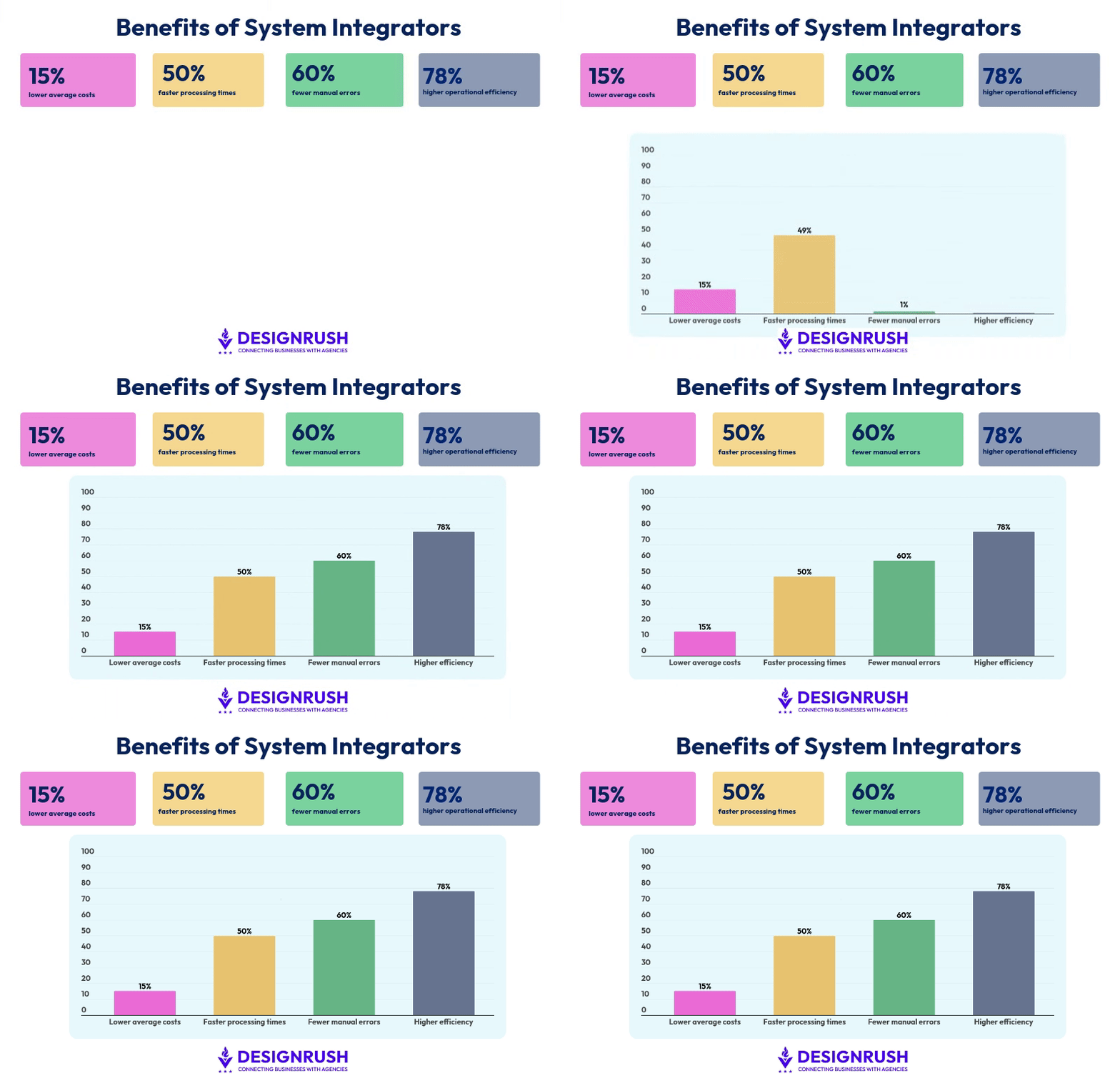
- 15% reduction in average costs across the organization
- Up to 20% lower administrative costs in sectors like healthcare
- Up to 80% savings in data processing in cloud-based integration setups
2. Higher employee productivity
When systems are not connected, employees spend time copying data between tools. Integration removes that work and speeds up daily operations.
The impact shows in higher output, faster execution, and less wasted time:
- 35% to 45% productivity increase for technical teams by year three
- Up to 78% improvement in operational efficiency with integrated ERP systems
- 50% faster processing times across core business workflows
3. Stronger return on investment (ROI)
Software only delivers value when systems are connected. Integration ensures your tools actually work together and produce measurable business results.
The return shows through higher efficiency, faster payback, and stronger long-term performance:
- 30% improvement in overall ROI from integration projects
- Up to 328% ROI over three years, with payback in 4.2 months
- 10.3x ROI for companies with mature integration compared to fragmented systems
4. Better data accuracy and decision-making
Manual data entry creates errors and delays. Integration creates a single, reliable source of data that updates in real time.
The result is cleaner data, fewer mistakes, and faster access to insights.
- 60% reduction in manual errors in systems like CRM or claims management
- 91% improvement in inventory optimization with integrated systems
- 50% less data engineering effort, enabling 75% faster time-to-insight
How can you choose the right system integrator?
Choosing the right system integrator directly affects whether your project runs smoothly or ends up with delays, budget overruns, and broken systems. The right partner understands both the technical side and your business goals. The wrong one only writes code without understanding how your systems should actually work together.
Follow these steps to make a solid decision:
- Define what you need to integrate
List all systems, tools, and data flows. Be clear on what needs to connect and what outcome you expect. A vague scope leads to wrong estimates and poor execution. - Check relevant experience
Look for companies that have done similar integrations. Same industry, same tools, or similar complexity. General experience is not enough. - Evaluate technical expertise and certifications
Confirm they work with the platforms you use. Check cloud (AWS, Azure), vendors (SAP, Salesforce), and security standards. No proof means higher risk. - Review past projects and case studies
Focus on real results. What systems did they connect, what problems did they solve, and what impact did they deliver? Avoid vague marketing examples. - Assess their integration approach
Strong system integration firms explain how they plan, build, test, and deploy integrations. They should talk about APIs, data mapping, testing, and fallback plans clearly. - Understand communication and project management
Integration projects involve multiple teams. You need structured communication, clear timelines, and defined responsibilities. Lack of this causes delays. - Ask about post-launch support
Systems change over time. Confirm how they handle maintenance, updates, and scaling. No support plan means long-term problems. - Compare cost vs value, not just price
Low cost often means shortcuts in planning, testing, or support. Look at the total cost, including maintenance, delays, and risk. Cheap integrations fail more often.
What questions should you ask system integrator companies before choosing one?
Asking the right questions helps you separate companies that truly understand integration from those that only sell development hours. A good integrator should be able to explain their experience, how they work, and how they will handle your specific case without vague answers.
Relevant background
- What similar integration projects have you completed, and for which industries?
- Which platforms, systems, or tools do you specialize in (ERP, CRM, cloud, etc.)?
- Can you share case studies with measurable results from past integrations?
- What certifications or partnerships do your team members have?
Services and processes
- How do you approach system integration from planning to deployment?
- How do you handle data mapping, transformation, and validation?
- What testing methods do you use before going live?
- How do you manage communication, timelines, and project updates?
Related to your project
- How would you approach integrating our specific systems and tools?
- What risks or challenges do you see in our setup?
- What timeline and cost range do you estimate for this project?
- What kind of support do you provide after launch?
Sources
DesignRush sustains a directory of over 40,000 agencies categorized by service category, location, expertise, and reviews. We build our database in two ways:
- Our dedicated team of agency experts actively searches the web for top-performing companies. We then pull information from their websites, online presence, and client testimonials to verify their status and qualifications prior to listing.
- The agencies listed get notified of their profiles on the website, and they can choose to claim them or not, which suggests their availability for more collaborations.
Agencies can also reach out to DesignRush and must go through the verification process prior to being listed.

Why companies trust DesignRush
Every agency is independently vetted before it can be listed or ranked
 4.8
4.8 4.8
4.8Some agencies pay for sponsored placement, clearly labeled and held to the same vetting standards.
5 Frequently Asked Questions About System Integrator Companies
Who needs system integrator company services?
Any business that uses multiple software systems and needs them to work together needs a system integrator. When systems are disconnected, data duplicates, processes slow down, and errors increase.
Typical use cases:
- Mid-size and enterprise companies that have multiple tools (ERP, CRM, HR, finance) that must share data
- Companies running legacy systems with outdated software that does not connect easily with modern tools
- Fast-growing businesses that are adding new tools quickly and losing control over data and workflows
- eCommerce and retail companies that need to sync orders, inventory, payments, and customer data in real time
- Manufacturing and logistics companies that require tight coordination between supply chain, inventory, and operations systems
- Finance and healthcare organizations that handle sensitive data and need secure, compliant integrations
- Companies undergoing digital transformation that move to cloud systems, automation, or new platforms
Clear signal you need an integrator:
- Data is entered manually into multiple systems
- Reports do not match across tools
- Teams rely on spreadsheets to “connect” systems
- Processes break when one system changes
- Scaling creates more errors instead of efficiency
At that point, integration is no longer optional.
How much do system integrator companies charge for their services?
System integrator services typically cost $15,000 to $1,500,000+, depending on how complex your systems are and how many platforms need to be connected.
Here is how pricing usually breaks down:
- Simple integrations (2 systems): $15,000 to $75,000
- Mid-level integrations (3–5 systems): $75,000 to $300,000
- Enterprise-wide integrations (5+ systems): $300,000 to $1,500,000+
Cost also follows a clear structure across the project:
- Planning and architecture: 10 to 20% of the total cost
- Development and setup: 50 to 70% of the total cost
- Testing and QA: 15 to 25% of total cost
- Training and rollout: 5 to 15% of total cost
There are ongoing costs that most companies ignore at the start. After launch, expect:
- Support and maintenance: 15 to 25% of the initial cost per year
- Cloud, tools, and licenses: Ongoing monthly or annual fees
- API and data usage costs: Depends on volume
Costs increase fast when systems are outdated, data is messy, or real-time processing is required. Legacy systems alone can add 20-50% to cost, and most companies should plan an extra 20-30% buffer for unexpected issues.
What is a typical timeline for system integration projects?
Most system integration service providers require from 3 to 18 months for their projects, depending on the number of systems, data complexity, and business size.
Here is how timelines usually break down:
- Small to mid-size projects: 3 to 9 months
- Large enterprise projects: 6 to 18 months
- Simple integrations (2 systems): 6 to 12 weeks
- Complex integrations (multiple systems): 9 to 18+ months
How system integration companies execute the project also affects speed:
- Phased rollout: 4 to 12 months, lower risk, more stable
- Big bang (all at once): 3 to 6 months, faster but higher risk
Several factors directly impact the timeline:
- Data cleanup and migration can take 15 to 20% of the total time
- Custom features add 3 to 6+ months
- Legacy systems slow everything down
- Testing and go-live add 1 to 2 months if done properly
Delays are common. Around 43% come from technical issues, and 40% from changing scope during the project.
How much downtime does system integration require?
Most system integrations require little to no downtime if planned correctly, but in practice, expect a few hours to a few days of disruption during final switchovers.
Downtime depends on how the company executes the project:
- Parallel integration (best case): Near-zero downtime
The new system runs alongside the old one, and then the switch happens quickly - Phased integration: A few hours at a time
Work is done in small parts during planned maintenance windows - Full cutover (big bang): Hours to several days
The entire system is replaced at once, with the highest risk of disruption
Several factors increase downtime risk:
- Legacy systems: Harder to connect, more failures
- Poor planning: No fallback or rollback options
- High system dependency: If one system fails, others stop
- No testing environment: Issues appear during live use
Strong teams reduce downtime by using backups, testing in advance, and scheduling work during low-activity periods. In well-managed projects, operations continue with minimal interruption.
What kind of support do system integrator companies provide after the project is finished?
System integration service providers do not stop at launch. They provide ongoing support to keep systems stable, secure, and working as expected. Without this, integrations break over time as systems update or data grows.
Post-project support usually includes:
- Fixing errors, broken connections, or data sync issues that appear after launch
- Tracking system health, fixing slow processes, and improving speed as data volume grows
- Adjusting integrations when connected platforms change or update
- Patching vulnerabilities and maintaining data protection standards
- Helping internal teams resolve issues and answering day-to-day questions
- Adding new features, connecting new systems, or expanding integrations as the business grows
- Providing guides and training so teams can use and manage the system properly
Most companies charge ongoing support as 15–25% of the initial project cost per year. Without this support, systems degrade, errors increase, and internal teams take on hidden maintenance work.
Latest Trends Related to System Integrator