Partner with the best B2B web design agencies to enhance brand credibility, qualified leads, and conversion rates through streamlined experiences. Compare by expertise and budget.
Organic rankings are determined by five factors: top services, reviews, portfolio, awards/press, and team expertise. Sponsored listings pay for a placement that appears above organic positions. Sponsorship does not affect star ratings or review content - read more on our methodology page.
We believe creative is currency. And we help brands turn it into business growth.
VSA is a brand strategy and creative agency. We believe creative is currency, and we help brands turn it into business growth. By bringing strategy, design and marketing together, we build brand systems and campaigns that deliver speed to market, cultural relevance and measurable performance...
Top Services:
- Branding
- Design Services
- Content Marketing
- Web Design
- Web Development
- Show more
- Location
- Chicago, Illinois
- Number of Employees
- 100 - 249
- Minimal Budget
- $50,000 & Up
- Portfolios Count
- 20 Projects Listed
Data sourced from the agency's DesignRush profile, its website, and other relevant accountsVSA Partners Services
Data sourced from the agency's DesignRush profileGoogle Cloud Chime FactSet BNY Affirm SAPPI Invenergy Northern Trust McAfee Nike
Global boutique consultancy in Digital Strategy and AI
Kocoro is a boutique AI consultancy and digital growth studio. We integrate AI into real business processes — governed and measured — and build B2B growth systems that compound: SEO, GEO, web and thought leadership. Special focus on financial services and M&A firms...
Top Services:
- Web Development
- Digital Strategy
- Public Relations
- Web Design
- SEO
- Show more
- Location
- San Cristóbal de La Laguna, Spain
- Number of Employees
- Under 49
- Minimal Budget
- $50,000 & Up
- Portfolios Count
- 2 Projects Listed
Data sourced from the agency's DesignRush profile, its website, and other relevant accountsKocoro Services
Data sourced from the agency's DesignRush profilePaseo Studio Decimal Studio Pentagram NY

Explore Web Design Specializations
Popular Services
Everything You Need to Know Before Hiring the Best B2B Web Design Agencies
What can a B2B web design firm do for your business?
A B2B web design firm helps your website perform as a revenue asset: improving brand visibility, credibility, and conversion across longer, research-heavy buying journeys. Here is how:
Increase qualified lead flow
According to The State of B2B Site Search Report, 90% of B2B customers research 2-7 websites before making a purchase, highlighting the importance of being discoverable and communicating value quickly.
A reputable B2B design agency builds the foundation for inbound demand by aligning technical SEO, site architecture, and content structure to how potential B2B clients search and compare. This includes responsive design, fast performance, clear navigation, and structured data.
Establish credibility and reduce perceived risk
On average, the B2B buying cycle time lasts about 10-11 months, with about 70% of this time spent on research and evaluation.
Knowing this, leading B2B web design agencies reassure buyers early and often throughout the design, including adding case studies, measurable outcomes, product clarity, and leadership content.
Improve user experience, sales, and conversion
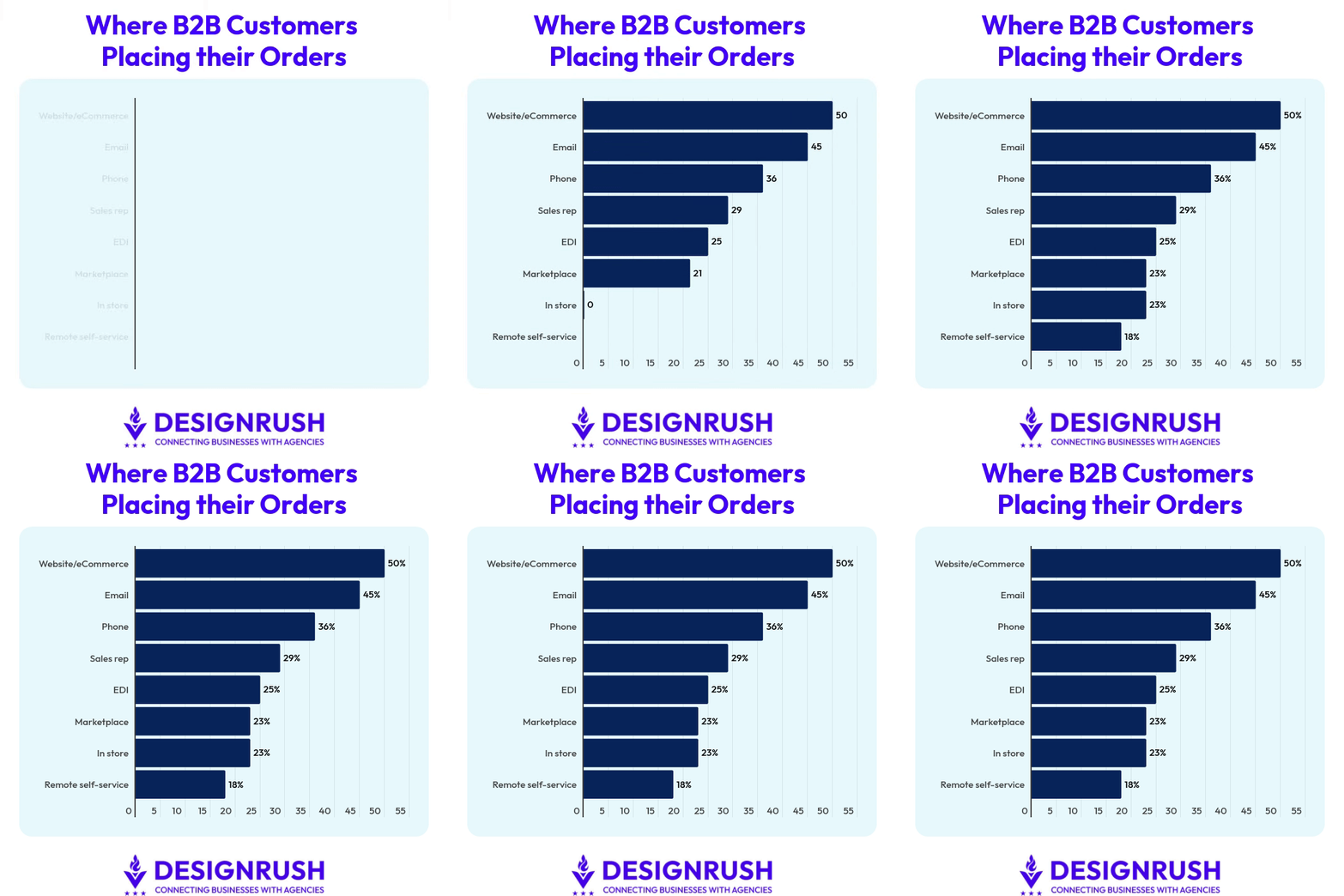
A B2B study by Sana found that 50% of B2B buyers purchase on eCommerce platforms, the highest among all digital and offline sales channels. Moreover, 81% of repeat purchases and 63% of high-value purchases are done online.
However, 94% of customers say they suffer from poor UX due to low product/feature visibility and complex ordering processes.
Top B2B web design agencies create conversion-focused, frictionless user journeys by personalizing user journeys for each persona, aligning CTAs to intent, and simplifying forms and flows.
How much do their services cost?
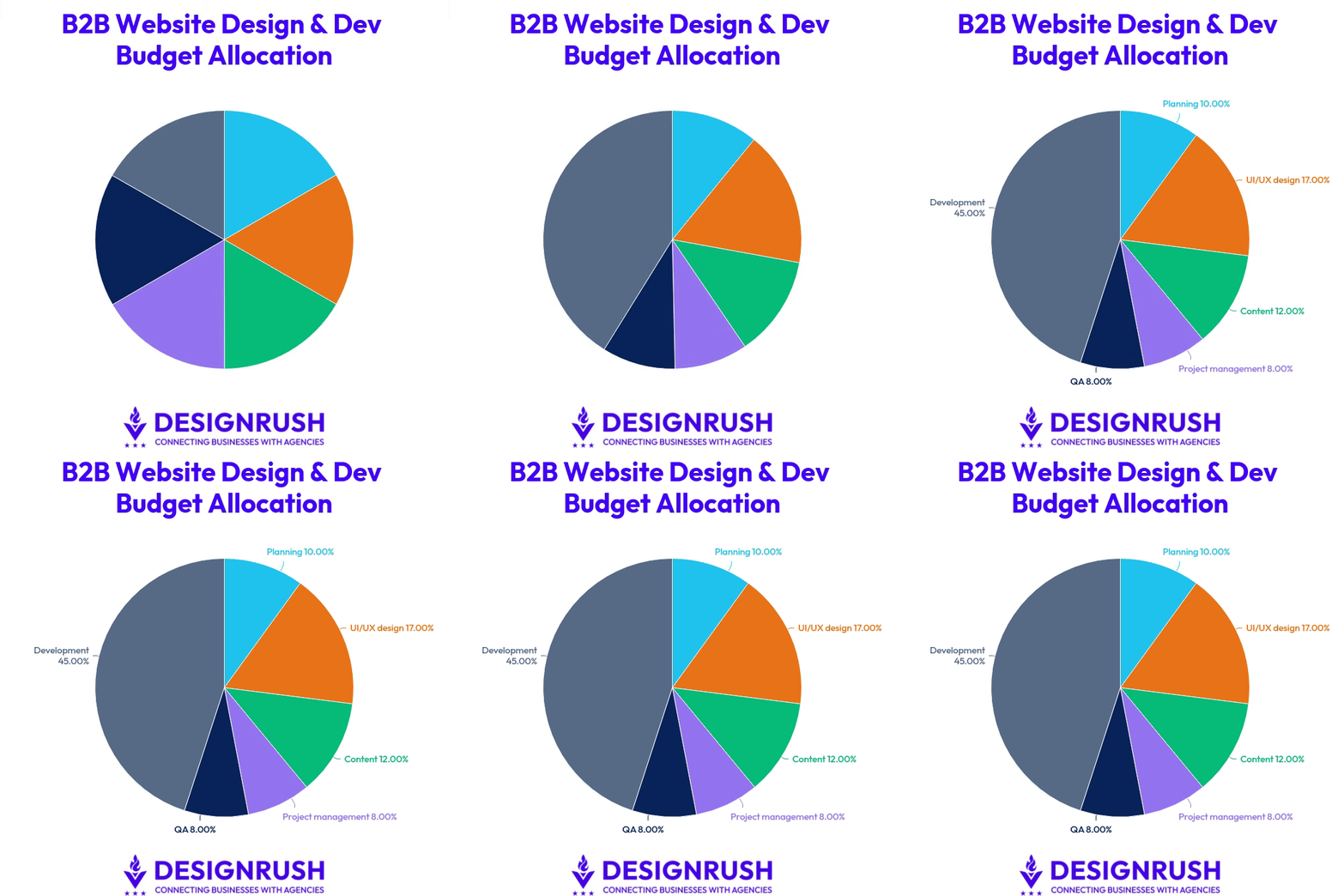
B2B web design services can cost $10,000-$100,000, depending on the design, functionality, system, and compliance requirements. Project turnaround time, agency location, and third-party integrations can also impact overall costs.
Here are how the average hourly rates of B2B web designers:
- North America (Canada and the United States): $65-$150 per hour
- Western Europe: $60-$20 per hour
- Eastern Europe: $35-$70 per hour
- South America: $35-$70 per hour
- Africa: $28-$45 per hour
- Asia and the Pacific: $20-$50 per hour
Based on these rates, here s how much each B2B web design project costs:
- Corporate B2B websites with basic company info, CMS, and a product catalog cost $25,000-$50,000
- B2B customer portals with multiple access control, account management, and order history features range between $50,000-$120,000
- Mid-complex B2B platforms with CRM integrations, custom UX design, and built-in analytics are about $75,000-$50,000
- B2B eCommerce solutions with custom pricing functions, bulk ordering features, ERP and PIN integrations, and secure payment gateways can cost $120,000-$220,000
- Enterprise B2B builds and B2B web apps with multi-vendor features, global deployment capabilities, and multiple integrations start at $200,000
How to choose the best B2B web design agency for your business?
To choose the best B2B web design agency for your business, evaluate its past projects, client reviews, and skills and services against your needs and goals. Here are some steps to guide you in your decision:
- Outline your website goals and requirements, features, functions, target users, desired style, system integrations, success metrics, compliance and security requirements, and internal decision makers for the project.
- Target agencies with proven B2B experience in your industry, target market, and tech stack. Review their case studies to understand their process and the measurable results they delivered to clients.
- Read client reviews and testimonies to assess communication, responsiveness, scope control, timeline discipline, and how the agency handles issues and change requests.
- Request for a proposal together with your business background, creative brief, and project requirements. Compare agency proposals based on scope, assumptions, deliverables, and risk management.
- Interview your top 5 design candidates to learn more about their approach to user research, design and development, QA, and security and compliance.
- Start with a pilot project, such as a website audit, discovery workshop, or prototype, before committing to a full design and development contract to further ensure project and business fit.
What questions should you ask before hiring?
Ask these questions before hiring a B2B web design agency to ensure it has the right expertise and experience for your project:
Relevant Background
- What type of B2B website and platforms do you specialize in?
- Can you share examples of B2B projects similar to ours in scope and complexity?
- What is your experience in my industry and target market? Can you provide 2-3 client references?
Services and Processes
- Who will be on our team and what are their qualifications?
- Can you walk us through your entire design process, from discovery to launch?
- How do you ensure performance, security, accessibility, and SEO are built into the website?
- How do you design for scalability, global privacy compliance, and sector-specific regulations?
Related to Your Project
- How will you validate alignment with our target audiences, brand, and business goals?
- How do you define and measure success? What will reporting look like for my project?
- Who owns the website code, design files, and content assets after deployment?
- What are your post-launch services? Do you provide warranty, iteration plans, and ongoing optimization support?
What red flags should you avoid when looking for a B2B web design agency?
Avoid these red flags when searching for a B2B web design agency to avoid rework, wasted spend, brand risk, and long-term performance issues:
- Unimpressive portfolio: Outdated designs, same templated look for different clients, AI-generated content, broken live sites, or unclear examples of real outcomes can indicate limited capability. While prototypes are not a problem, it is a red flag if they cannot provide complete live solutions.
- Weak process: Without a detailed roadmap, QA and launching plan, and service level agreement, you run the risk of scope creep, project delays, and a website that does not meet requirements.
- Skipping discovery: An agency that does not ask meaningful questions about your brand, audience, positioning, constraints, and competitive landscape may rely on cookie-cutter approaches.
- Inability to tie to business strategy: If the agency cannot connect their design decisions to business goals, you may receive an aesthetically pleasing website that does not perform.
- Unverifiable client references and testimonies: While positive reviews are a good sign, if you cannot trace back the review to a real contact or company, then the agency may have falsified the reviews and testimonies to inflate its reputation.
Sources
DesignRush sustains a directory of over 40,000 agencies categorized by service category, location, expertise, and reviews. We build our database in two ways:
- Our dedicated team of agency experts actively searches the web for top-performing companies. We then pull information from their websites, online presence, and client testimonials to verify their status and qualifications prior to listing.
- The agencies listed get notified of their profiles on the website and they can choose to claim it or not, which suggests their availability for more collaborations.
Agencies can also reach out to DesignRush and must go through the verification process prior to being listed.

Why companies trust DesignRush
Every agency is independently vetted before it can be listed or ranked
 4.8
4.8 4.8
4.8Some agencies pay for sponsored placement, clearly labeled and held to the same vetting standards.
Frequently Asked Questions About B2B Web Design Agencies
What are the typical B2B web design services?
Agencies provide comprehensive B2B web design services, covering the entire website design and development process from ideation to launch. It typically includes:
- Website audit: Analyzing a website's UX design, content, SEO performance, accessibility, and technical health to identify critical issues and opportunities.
- Discovery and strategy: Conducting stakeholder interviews, audience and competitor research, and a website strategy aligned to business goals.
- Information architecture and UX design: Building the sitemap, navigation, user journeys, wireframes, and conversion paths based on user intent.
- UI design: Crafting the website's visual design, component library, and design guidelines to ensure consistent branding.
- Custom B2B website development: Building the website's front-end and back-end, including server-side logic, database management, and content management system (CMS) setup.
- System integration: Connecting the website with the business's existing IT environment, including customer relationship management (CRM), enterprise resource planning (ERP), and product information management (PIM) solutions.
- B2B eCommerce: Developing commerce portals and platforms that streamline procurement flows, manage bulk orders, and enable customized pricing.
- Website maintenance: Providing post-launch maintenance and support to ensure that the website performs optimally, including debugging, security patching, and design refinement.
Many B2B website design agencies also offer digital marketing services, including search engine optimization (SEO), AI-powered search (AEO/GEO), content marketing, conversion rate optimization (CRO), branding, and paid advertising.
What is the difference between B2B web design and B2C web design?
The primary difference between B2B web design and B2C web design is the target audience.
B2B websites target organizations and business executives, supporting the longer, higher-stakes buying journey. In contrast, B2C websites target individual customers, enabling faster and more personal purchases. Here are more details about each:
| B2B Web Design | B2C Web Design | |
| Target audience | B2B client's buying committee (executives, sponsor, and users) | Individual customers |
| Primary focus | Enable evaluation and reduce risk with clarity, proof, and decision support | Drive purchase intent with brand, emotion, and convenience |
| Content and messaging | Business value and ROI, brand differentiation, use cases, and evidence (e.g., case study) | Benefits, lifestyle, social proof, promotional |
| Sales cycle | Long and complex, involving multiple steps and stakeholders | Short and impulsive, involving only the individual buyer |
| Conversion goals | Request demo or quote, contact sales, book a call, download whitepapers | Purchase, add to cart, subscribe, signup |
How long does a B2B web design project take from kickoff to launch?
A B2B web design project can take 1 week to over 6 months, depending on the content availability, tech stack, feedback process, and the complexity of the design, features, and functions.
Below is an estimated timeline of various B2B web design projects:
- Landing pages can take about 1-2 weeks, as they typically require one page and use existing brand assets.
- Startup websites have a timeline of 2-6 weeks for basic visuals and content, but it can take 6-12 weeks if it requires brand strategy and visual identity development.
- Website redesign projects take 3-12 weeks when existing assets are reused but can last 10-16 weeks for a visual identity rehaul, including new logos and branding elements.
- Corporate B2B websites with simple layout, navigation, and features may need 4-10 weeks.
- SaaS marketing websites with multiple use cases, custom UX design, CRM integrations, and SEO may require 8-12 weeks
- B2B eCommerce solutions will need 12-16 weeks and include payment integration, filtering logic for large product catalogs, and role-based access.
- Enterprise platforms and web applications range from 4-6+ months, often having complex features and functions, advanced security controls, cloud infrastructure planning, and multiple system APIs.
Should you build a custom B2B website or use a template?
The answer depends on your goals, requirements, budget, timeline, and how differentiated the user experience needs to be.
Build a custom B2B website if:
- Brand distinction and tailored user experiences are competitive advantages.
- You need unique user flows or functionality beyond what a theme or template can handle (e.g., multi-step forms and complex integrations).
- You require deep technical control over performance, architecture, and future extensibility.
- You have strict compliance, security, or accessibility requirements.
- You expect high traffic, multiple audiences, or frequent iteration, and you want a foundation built for long-term scalability.
Use a website template if:
- You are a startup or small business with a limited budget and want to release a site immediately.
- You are validating product market fit or launching a new offer and want to move quickly.
- The site is simple by design, such as a landing page or brochure site.
How do you know if you need to redesign your B2B website?
When performance, strategy, or technical constraints start limiting your growth, then it is a sign that you need to redesign your B2B websites. This includes:
- KPIs are declining: Organic traffic, rankings, engagement, conversions, and lead quality are down compared to historical baselines, indicating UX friction, slow performance, poor navigation, or mismatched messaging.
- No longer follows modern expectations: Not truly mobile responsive, weak page performance (Core Web Vitals), or lacking accessibility practices aligned to the latest WCAG standards.
- Maintenance is difficult: Simple edits require developer support, CMS is outdated, and inability to integrate with latest systems are making your website difficult to scale.
- Strategy misalignment: A B2B website that has confusing messaging, incomplete services and products, or no longer supports your current go-to-market motions.
A good rule of thumb is that if your team finds the website frustrating (e.g., slow-loading pages, confusing navigation, and poor navigation), then your B2B buyers most likely do, too.
Latest Trends Related to B2B Website Design