
When I advise founders or CMOs choosing a mobile app agency, I tell them: forget buzzwords, look for reasoning. The right partner reveals themselves through how they answer questions.
How to Vet Mobile App Development Agencies: Key Points
Before You Interview: Gather Inputs (So Answers Are Specific)
Before reaching out to potential partners, gather the essentials. Agencies can’t give specific, accountable answers without context.
Here’s what I always prepare:
- Access & analytics: Pull 12 to 18 months of app or web analytics, retention data, and user feedback. It helps agencies understand what’s working and what’s bleeding money.
- Target users & core journeys: Define who you’re building for and outline a few key flows (signup, purchase, re-engagement). Clarity here prevents scope drift later.
- Technical dependencies: List your existing systems (CRMs, APIs, authentication layers, databases) so agencies can spot integration challenges early.
- Budget guardrails: You don’t need a final number, but give a realistic range. It filters out mismatched vendors and keeps conversations grounded in feasibility.
- Success definition: Decide what “success” means in terms of activation rate, revenue, retention, or investor milestones. Every strong proposal ties effort to a measurable outcome.
I've sat on both sides of the table — hiring and being hired — and I can tell you: vague inputs lead to vague proposals.
Ground your briefing in real data, and you’ll turn agency interviews from guesswork into qualified evaluations.
1. Which Platform Path Fits Our Goals and Why?
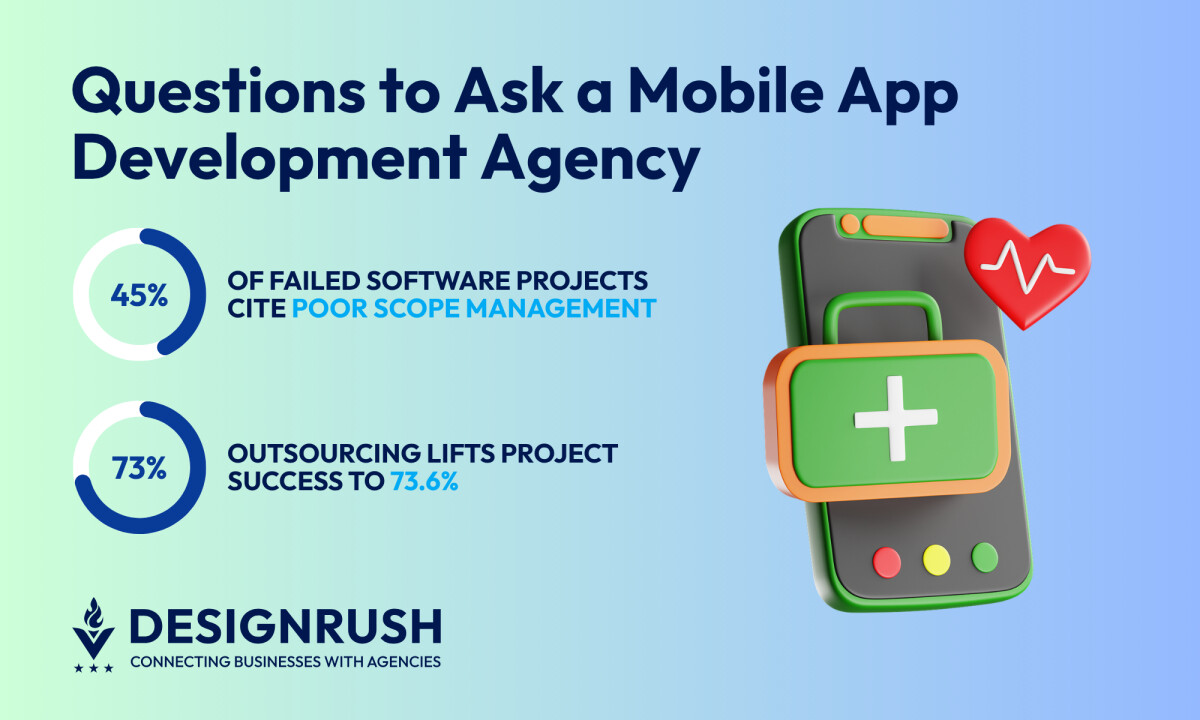
Project Management Institute's 2024 report states that outsourcing lifts project success to 73.6%.
To capture that upside, I begin by asking agencies about platform strategy (iOS, Android, or cross-platform frameworks like Flutter or React Native). It usually tells me what kind of clients they serve and how they think about scalability.
The ideal answer:
“Given your offline and camera needs, we recommend Native for iOS first, Android second. Here’s a device matrix, startup‑time targets, and a POC confirming the camera flow. If you need both platforms on day one, Flutter gets you there faster; here are the trade‑offs.”
This shows judgment and gives me measurable baselines; the POC de‑risks the riskiest feature before I commit serious budget.
Red flag: “We can do anything: Flutter, React Native, whatever you prefer,” with no discussion of trade‑offs.
If they won’t weigh trade‑offs now, I can’t trust their architectural calls later. And rework and delays become almost guaranteed.
Malay Parekh, CEO of Unico Connect, puts it plainly:
“Every framework choice comes with implications for performance, scalability, and long-term maintenance.
Teams that skip this discussion early often face technical debt later, when rebuilding becomes more expensive than building right from the start.”
2. Can You Show Me Real-World Examples in My Industry?
Portfolios are marketing assets that rarely tell the whole story. I always ask for case studies, not screenshots: What was the goal, timeline, and measurable outcome of the mobile apps they’ve launched?
Ideal answer:
“Here’s a logistics app we built that cut delivery confirmation time by 38%. We used Flutter to hit both app stores faster, then integrated real-time driver tracking in phase two.”
For startups, look for product-market fit results. For SMBs, look for ROI metrics. For enterprises, focus on integration depth and compliance proof.
Red flag: If they talk only about visuals (“beautiful UI,” “modern feel”) but can’t quote engagement or retention data, they're talking about design theater.
3. What’s Your UX/UI Process and How Do You Validate It With Users?
According to Forrester, every $1 invested in UX returns up to $100 in ROI, yet 70% of apps still skip early usability testing.
Early in my career, I led a project with a seemingly flawless UX/UI on Figma but tanked post-launch because no one tested it with real users. That mistake cost us six months, and I’ve never repeated it.
Ideal answer:
A strong agency walks through user research, wireframes, interactive prototypes, and at least one usability test round before code starts.
“We run moderated tests with 5–7 target users using Figma prototypes, then iterate before handing designs to engineering.”
Red flag: They can’t name tools, skip usability testing, or treat design as “making it pretty later.” That’s how apps look good but end up performing badly.
4. How Do You Handle App Security and Data Privacy?
Security is a habit, not a feature. So if an agency downplays security, end the call.
Mobile apps are attack surfaces. IBM reported $4.88M as the average cost of a data breach in 2024, and roughly 40% involved mobile endpoints.
Have the team walk through a common mobile app security scenario (e.g., lost device, compromised token, or SDK vulnerability) and show how it would be detected, contained, and remediated.
Ideal answer:
“We follow OWASP MASVS, use AES-256 encryption, enforce certificate pinning, and run third-party penetration tests before release.”
That’s a team who’s handled sensitive data before. A documented security posture reduces breach/regulatory risk and speeds store reviews; prevention costs less than incident response.
How I assess for different teams:
- Startups: ask for secure-by-design patterns and safe SDKs.
- SMBs: demand GDPR compliance and tokenized payments.
- Enterprises: require audit trails, SSO, and IAM integration.
Red flag: “We handle security at the hosting level.” That means they haven’t architected for it. Vagueness here signals inexperience; the first SDK vulnerability or token leak will catch them flat‑footed.
5. What’s Your Approach to API and Third-Party Integrations?
This is where timelines die quietly. Payment gateways, CRMs, and analytics all sound easy until tokens expire or rate limits hit.
I’ve seen more projects delayed by brittle APIs than by bad code. Map every dependency (payments, auth, analytics, CMS, CDP) with owners and versions. Knowing who to call at 2 a.m. is as important as the code.
Ideal answer:
“We define API contracts early, use mock servers, test rate limits, and always build rollback logic for third-party failures.”
That tells me they think like system engineers, not just app coders. Contract tests and failure drills surface edge cases early, while rollback plans turn vendor issues into manageable blips.
Red flag: “We’ll handle integrations later.” That’s budget inflation waiting to happen. This hand‑wave also hides the biggest schedule risks: version drift, rate limits, and webhooks that inevitably fail in production.
6. How Do You Estimate Project Timelines and Manage Scope Changes?
PMI’s 2024 report found 45% of failed software projects cite poor scope management as the root cause. In my consulting work, I’ve seen 6-month builds stretch to 18 because nobody defined scope control.
Don’t run a project on hope. Ask for a range (e.g., $90k to $110k and 4 to 5 months) based on the agency’s past projects, then add a 10% to 20% risk buffer for known issues.
Ideal answer:
They use agile ceremonies, sprint demos, and clear change-request workflows. Their estimates should be milestone-based, not lump-sum guesses.
“We break projects into 2-week sprints, share burndown charts, and track changes through Jira or Linear.”
Use change control: when something new comes up, the team writes it down, estimates cost and time, you approve or decline, then work proceeds. This keeps budget and timeline from drifting.
Red flag: A fixed price with no visible sprint plan or buffer usually means they’ll either cut corners or renegotiate halfway.
7. What Kind of Post-Launch Support Do You Offer?
Your app doesn’t end at launch; that’s when real users start breaking it. I always ask who owns long-term maintenance, bug fixes, and OS updates.
Mobile is a moving target. You can expect OS updates annually, deprecating SDKs, and store policy changes. A detailed maintenance plan, including monthly patches, quarterly dependency reviews, crash‑rate targets, and post‑mortems, keeps quality and ratings stable.
Ideal answer:
They offer structured maintenance tiers (e.g., 20 to 40 developer hours per month) and clear service level agreements for uptime and response.
“We provide 90 days of free stabilization, then move into a support retainer covering crash fixes and store updates.”
Red flag: They say “We’ll help as needed.” That means you’ll be begging for bug fixes later. Reactive support means you learn about issues from angry users, which is how ratings and revenue slide.
My guidance:
- Startups: look for flexible, hourly retainers.
- SMBs: aim for structured maintenance packages.
- Enterprises: demand SLAs tied to uptime and compliance cycles.
8. How Do You Measure App Success After Launch?
If an agency can’t define success, they can’t sustain it.
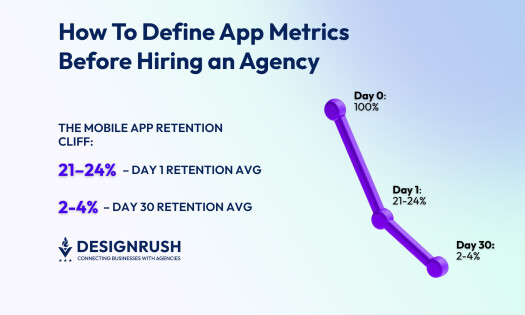
Bain & Company found that a 5% increase in retention can raise profits by up to 95%, so I expect app metrics beyond simple downloads.
Ideal answer:
The agency should mention specific analytics tools (Firebase, Mixpanel, Amplitude) and specific metrics like activation rate, 30-day retention, and average session length.
“We track DAU/MAU, conversion funnels, and crash-free sessions. We also recommend in-app surveys to link UX changes to satisfaction.”
Red flag: They talk only about installs or app store ratings. Those are vanity metrics.
9. How Do You Ensure Code Quality and Ownership?
This question separates professionals from freelancers. I’ve seen CEOs pay for a finished app only to find the agency still owns the repository.
Ideal answer:
“We use code reviews, CI/CD pipelines, and grant you full Git repository access from day one. All IP transfers upon final payment.”
Ask what languages and frameworks they use, how they document handover, and whether you’ll get build scripts.
Red flag: They refuse to share source code or say “we’ll host it for you.” That’s vendor lock-in, not partnership.
10. What Will This Project Realistically Cost and What’s Not Included?
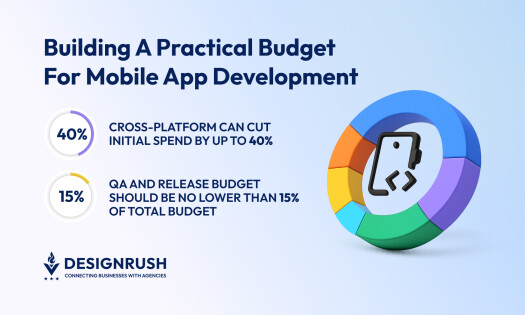
Roughly a third of teams choose cross-platform development to cut costs and ship faster, but budgets still hinge on clarity.
Mature agencies can prove this with clear pricing: separate buckets for app design, development, QA, contingency, and a candid section on exclusions.
Ideal answer:
They’ll give a range ($80K–$120K for an MVP, $250K+ for enterprise) and tie it to scope, platform count, and integrations. They’ll also note what’s excluded — third-party fees, licensing, app store costs, etc.
“We estimate $100K for your MVP, including backend. Anything beyond defined integrations is handled as change requests with time logs.”
Red flag: Flat, round numbers (“$50K all-in”) or overly precise low quotes. Those are either placeholders or traps.
My rule:
- Startups: push for phased budgets tied to validation milestones.
- SMBs: include contingency (10–15%) for unknowns.
- Enterprises: demand itemized cost centers and earned-value tracking.
Mobile App Development Agency Questions: Final Thoughts
When I advise CEOs, I tell them this: Every app agency sounds great until you ask how they think. The right team welcomes scrutiny because they’ve been through failure, iteration, and real business pressure before.
Find More Agency Hiring Resources:
- Building a Practical Budget for Mobile App Development
- When to Hire In-House vs. a Web Development Agency
- Defining Goals and Planning a Website Redesign in 2025
The best agencies welcome tough questions from clients. They know transparency builds trust, and trust builds better apps.

Our team ranks agencies worldwide to help you find a qualified partner. Visit our Agency Directory for the top mobile app development companies as well as:
- Top Android App Development Companies
- Top iPhone App Development Companies
- Top Offshore Software Development Companies
- Top AI App Development Companies
- Top Software Development Companies
Our development experts also spotlight the most groundbreaking app projects from around the world. Visit our Awards section to explore the best in app development.
Mobile App Development Agency Questions FAQs
1. How should I compare proposals from multiple agencies?
Normalize the proposals by scope and deliverables. Compare cost per feature, timeline, and risk controls. Weight factors like communication, transparency, and post-launch support just as heavily as pricing.
2. Should I sign an NDA before initial discussions with an agency?
Yes, especially if you’re sharing proprietary ideas or data models. Most serious agencies will sign a mutual NDA without hesitation.
3. What are signs that an app agency is overpromising?
Unrealistically short timelines, “all-in” flat quotes, and no mention of trade-offs or risks. Experienced agencies talk in ranges, define assumptions, and show historical baselines—not wishful estimates.