Struggling to find a US web development company? Our team of 12 experts reviewed 9,600+ verified client reviews to create a list of trusted partners that build high-performing websites that drive conversions.
Organic rankings are determined by five factors: top services, reviews, portfolio, awards/press, and team expertise. Sponsored listings pay for a placement that appears above organic positions. Sponsorship does not affect star ratings or review content - read more on our methodology page.
Engineering-Led Digital Agency
Boca Raton web design and SEO company that has served South Florida businesses since 2015. We build fast, custom WordPress websites and then do the work that gets them found: SEO, local SEO, Google Business Profile management and Google Ads. Our team runs its own online store, so we build for leads and sales...
Top Services:
- Web Design
- eCommerce Development
- Web Development
- WordPress Website Design
- SEO
- Show more
- Location
- Boca Raton, Florida
- Number of Employees
- Under 49
- Average Hourly Rate
- $80/hr
- Minimal Budget
- Under $1,000
- Portfolios Count
- 4 Projects Listed
Data sourced from the agency's DesignRush profile, its website, and other relevant accountsUltraWeb Labs Inc. Services
Data sourced from the agency's DesignRush profileMike McGilvary Roofing SUCO ESI North America Hines Bending Systems MTS Power Products Hall's Movers Boca Autohaus Access Impact Sintavia DiStefano Law Klimatech
UltraWeb Labs Inc. Reviews & Testimonials
Jeffrey Gray's Review Sourced from Google
Our company has used UltraWeb for over 10 years for web design, SEO, and paid advertising. Damon and Skyler are always very responsvie to your needs. Communication with Ultraweb is clear and informative. Their team also does not rely on pushy sales tactics. Highly recommend
Tamis Oliveira's Review Sourced from Google
My firm has been working with UltraWeb for about 10 years and they are absolutely fantastic! They manage our website and are always on top of everything. They are professional, quick, efficient, and proactive. We couldn’t be happier and we 100% recommend!
Roberta Deutsch's Review Sourced from Google
I've been an attorney for 38 years, but never had a website. I always wanted one, but every time I asked a web designer to create one for me, they produced the same cookie cutter attorney site that I'd seen over and over but never wanted for myself. Then I met Skyler Libkie at Ultraweb Marketing. From the moment he answered the phone, I could sense that he was truly interested in creating what I was looking for. Skyler ended up producing a website that truly expresses what I do and how I do it, and that it is unique. He read everything that I wrote carefully, to educate himself about a field of law I"m sure he knew little about, sought additional information, and then translated that understanding to my site. I am so proud of my website. Skyler is also very compassionate and thoughtful, and his emails responding to an issue, large or small, are lengthy, as he address the issue directly, but then turns to discuss how it affected me, to reassure me, and then to ask what he could do to help. If you want a website that is different, and special, a web designer who takes the time to really know you, so that the site is about you, and not just superimposing you on an existing site, call Skyler Libkie at Untraweb Marketing.
Reviews verified by DesignRush and sourced from the agency's profile View All ReviewsBe Discovered
Founded in 1997, Omni Search Labs pairs senior SEO with web developers on every site. We deliver SEvO (Search Everywhere Optimization) so buyers find you across AI search, Google, and Bing. Work directly with senior specialists through fixed-price managed services with no retainers...
Top Services:
- Web Design
- Web Development
- SEO
- AEO
- PPC
- Show more
- Location
- East Providence, Rhode Island
- Number of Employees
- Under 49
- Average Hourly Rate
- $175/hr
- Minimal Budget
- Under $1,000
- Portfolios Count
- 1 Project Listed
Data sourced from the agency's DesignRush profile, its website, and other relevant accountsOmni Search Labs Services
Data sourced from the agency's DesignRush profileAdler Pollock & Sheehan P.C. Groov-Pin New England Tech University Ocean State Cleantech Orbetron Parkinson Technologies SailTime Northrop & Johnson
We build brands that sell.
Envascale is a results-focused digital agency helping businesses build stronger brands and grow online. We specialize in website design and development, eCommerce, branding, SEO, and digital marketing. From a polished online presence to conversion-focused digital experiences, we combine creative design with...
Top Services:
- Web Design
- Web Development
- eCommerce Development
- WordPress Website Design
- Branding
- Show more
- Location
- Austin, Texas
- Number of Employees
- Under 49
- Average Hourly Rate
- $50/hr
- Minimal Budget
- Under $1,000
- Portfolios Count
- 1 Project Listed
Data sourced from the agency's DesignRush profile, its website, and other relevant accountsEnvascale | Website Design & Development Solution Services
Data sourced from the agency's DesignRush profileKen Okoro Marvina Case Garnette Rose Danielle Glynn Martin Akeem Disu Hannah Tamini Janine Cabrera Magreth Mushi Jimps Jerome
Empowering YOUR STORY
Welcome to G609, Where bold ideas meet cutting-edge digital innovation. we're not just another marketing agency we're your strategic partner in growth. Since day one, we've been redefining what's possible in the digital space, crafting strategies that drive results and experiences that resonate.At G609...
Top Services:
- Digital Services
- Video Production
- Branding
- Digital Marketing
- Media Buying
- Show more
- Location
- Egypt, Alabama
- Number of Employees
- Under 49
- Average Hourly Rate
- $10/hr
- Minimal Budget
- Under $1,000
Data sourced from the agency's DesignRush profile, its website, and other relevant accountsGuardian609 Services
Data sourced from the agency's DesignRush profileChili's Pizza Academy BMC AlMasrya SOLIK JIWAR Kamal Saad WRAP N GO ALKHAT The FitHub Dr.Hesham ElFazzary
Tech Made Simple for Business
Simply IT is a veteran-owned managed IT services and cybersecurity provider in Ocala, Florida, serving small and mid-sized businesses across North Central Florida. We're the one partner for all your technology managed IT and help desk, cybersecurity, Microsoft 365, cloud, VoIP phones, and AI for business. We...
Top Services:
- Managed Services
- IT Services
- Cybersecurity
- IT Compliance Solution
- Cloud Consulting
- Show more
- Location
- Ocala, Florida
- Number of Employees
- Under 49
- Average Hourly Rate
- $125/hr
- Minimal Budget
- Under $1,000
Data sourced from the agency's DesignRush profile, its website, and other relevant accountsSimply IT Ocala Services
Data sourced from the agency's DesignRush profileHabitat for Humanity Humane Society Leopard Medical Transport St Timothy Catholic Church ABIO Corp Live Oaks Community Church O'Cull Electric Total Nutrition and Therapeutics
Simply IT Ocala Reviews & Testimonials
Sarah Whedbee's Review Sourced from Google
Steve helped us with our business computers. I highly recommend his company for your business computer needs make sure you call him to maintain your computers!
Ryan OBlenis's Review Sourced from Google
Simply IT has been our managed IT service provider for several years. They are professional and respond to requests and problems immediately. I highly recommend them for any small to medium sized business that wants professional IT management without having to hire a dedicated resource.
Cin Wynings's Review Sourced from Google
We were looking for a new IT company so we called Steve. He came right over and talked with us about what he offers and price. Very nice and informative. He helped us with the process of changing and he is always available whenever we need him. Great company, awesome service. If you are looking for an IT person Steve is your guy.
Reviews verified by DesignRush and sourced from the agency's profile View All Reviews







Web Development Companies by City
Web Development Companies by State
Web Development Specializations in the US
Popular Services
Hiring Guide: How to Choose a Leading Web Development Company in the US
How do I choose the right website development company for my business?
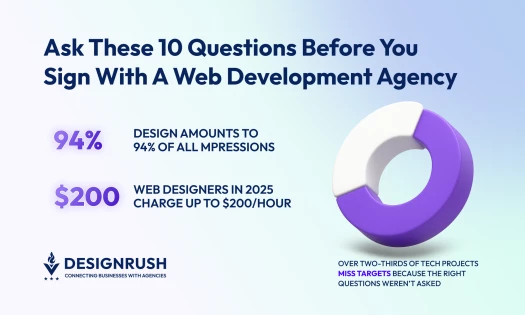
Start by assessing your business needs. Define what you want to build and why before speaking to agencies:
- Website vs. web application
- Core features and integrations
- Target users and scalability needs
- Short-term launch goals vs. long-term roadmap
Precise requirements make it easier to identify agencies that truly align with your objectives.
For instance, an agency might suggest Squarespace, one of the best website builders for visual-heavy sites, for design brands, and WordPress for content-reliant businesses.
Next, evaluate potential website development company candidates:
- Review portfolios, case studies, and past clients
- Look for experience with similar industries, project sizes, or technical complexity
- Check independent reviews and recommendations from your professional network
Then, dig deeper through direct conversations. A strong agency welcomes questions and explains its approach clearly.
What are the benefits of hiring an agency?
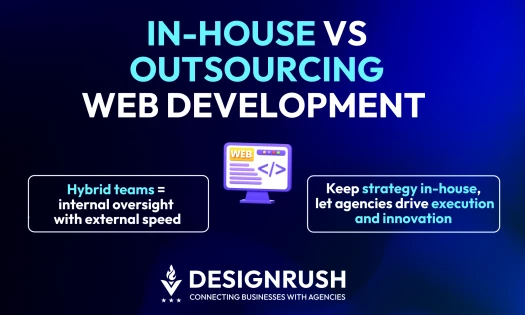
Hiring a web development company may help you access expertise you can’t always build in-house. Here are the types of benefits you can expect:
- Faster delivery and time to market
Agencies bring ready-made teams and proven workflows. Companies using outsourcing complete around 40% more projects per year compared to fully in-house teams, making agencies ideal for MVPs, replatforming, or tight deadlines.
2. Access to specialized skills on demand
Around 76% of companies outsource IT functions such as coding, QA, and UI/UX design because these skills are expensive and slow to hire internally. Agencies immediately fill gaps in areas such as backend, DevOps, mobile, and integrations.
3. Predictable costs and lower overhead
In-house teams come with recruiting delays, onboarding time, benefits, and long-term salary commitments. Agencies offer scoped pricing, clearer timelines, and easier budget control for defined outcomes.
4. Operational acceleration and innovation
According to Deloitte, 78% of companies outsource to accelerate operations and innovation, while 42% do so to access specialized talent. Agencies work across industries, exposing teams to emerging tools and best practices.
5. Flexible team models across growth stages
Startups gain speed without headcount risk, scaling companies add surge capacity, and enterprises use agencies for complex or skill-specific initiatives while retaining strategic control internally.
What questions should I ask web development companies?
Use the following questions to evaluate the agencies you’re considering:
Relevant Background
- Have you worked on projects with similar goals or complexity?
- How many viable approaches do you see for this project, and why?
Services and Processes
- What is your design and development process from start to launch?
- How do you estimate delivery time, and how do you separate contingency from scope?
- How do you manage third-party APIs and existing system integrations?
- How do you handle compliance, security patches, and recovery?
Relevant to Your Project
- What happens if we request changes mid-project?
- Who owns the code, hosting, licenses, and IP after launch?
- Who owns escalation if delivery timelines or budgets slip?
- Who is the day-to-day point of contact?
How long does it take to develop a website?
It takes a website development agency 14+ weeks from planning to launch to build a standard business website:
1. Planning (2-3 weeks)
Teams define goals, features, and technical requirements early. Weak planning often leads to confusing journeys later. According to the Digital Experience Benchmark Report, 39.6% sessions are impacted by frustration, reducing visit value by 15% through higher bounce rates and lower engagement.
2. Content creation (4-6 weeks)
Copy, visuals, and assets are prepared, often in parallel with design. Content delays frequently push timelines beyond initial estimates.
3. Design (2-3 weeks)
Designers create wireframes and responsive layouts. Custom UX and extended review cycles can add time.
4. Development (varies by complexity)
Front-end and back-end work, integrations, and CMS setup happen here. More features mean longer build times.
5. Testing and review (1-2 weeks)
Teams validate performance, usability, and responsiveness.
This stage matters more than ever, as 58% of websites saw session consumption drop. This means users viewed fewer pages and spent less time on-site, making engagement-sensitive testing critical.
How do I know if my website is performing well?
You know your website is performing well when it delivers measurable business impact. Your web development agency will help you track the following metrics:
- Conversion and revenue impact
A healthy website turns visitors into customers or leads. Improvements in UX and speed should translate into higher conversion rates, lower cart abandonment, and more qualified form submissions.
For example, Walmart recorded a 2% lift in conversions for every one-second improvement in load time, showing how performance translates into revenue.
- Speed and performance signals
Page speed, Core Web Vitals, and overall site stability shape how users experience your website and how search engines evaluate it.
When pages load slowly, elements break, or layouts shift unexpectedly, users struggle to complete journeys, and the site stops supporting real business goals.
- Engagement quality, not vanity metrics
Focus on consumption (pages viewed and time spent), bounce rate, and session depth to understand real engagement.
The 2024 Digital Experience Benchmark Report shows that overall digital consumption declined by 3%, meaning users viewed fewer pages and spent less time per visit.
That drop highlights how many websites struggle to hold attention, making engagement trends a stronger indicator of experience quality.
- User experience effectiveness
When a website feels easy and intuitive to use, visitors stay longer, explore more pages, and complete key actions, directly increasing engagement quality and overall visit value.
- Operational efficiency
A strong website reduces support load by answering common questions, guiding users effectively, and enabling self-service, which in turn lowers ongoing operational costs.
How can I find top web development companies on DesignRush that fit my budget?
Rather than researching agencies one by one, DesignRush lets you compare vetted website development companies in the USA based on budget range, expertise, and past performance.
| High budget: $50,000+ |
|
| Low Budget: $25,000-$50,000 |
|
Beyond budget, our agency directory allows you to filter agency profiles by location, area of expertise, agency reviews, client types, team size, and hourly rates.
Sources
DesignRush sustains a directory of over 40,000 agencies categorized by service category, location, expertise, and reviews. We build our database in two ways:
- Our dedicated team of agency experts actively searches the web for top-performing companies. We then pull information from their websites, online presence, and client testimonials to verify their status and qualifications prior to listing.
- The agencies listed get notified of their profiles on the website, and they can choose to claim it or not, which suggests their availability for more collaborations.
Agencies can also reach out to DesignRush and must go through the verification process prior to being listed.

Why companies trust DesignRush
Every agency is independently vetted before it can be listed or ranked
 4.8
4.8 4.8
4.8Some agencies pay for sponsored placement, clearly labeled and held to the same vetting standards.
FAQs About Web Development Companies
What’s the difference between web development and web design?
Web design focuses on the visual aesthetics and the functional user experience, while web development covers the aspect of building and maintaining the technical foundation that allows designs to function smoothly.
- Web design services: layout, colors, fonts, imagery, UI/UX design, accessibility, and responsive design
- Web development services: front-end and back-end coding, database, servers, APIs, scalability, security, and performance.
How do you choose between a custom-built solution and a CMS or low-code platform?
Choose a CMS or low-code platform (e.g., WordPress, Webflow, or Squarespace) when you need to launch your website fast and affordably. These platforms are also ideal for small businesses with lean teams or those that do not have a dedicated development team to maintain a complex site structure.
Consider a custom-built website if you require unique functionality, tight interactions with internal systems, or performance and scalability beyond off-the-shelf platforms. However, highly tailored websites typically require higher budgets and longer timelines.
What are the common hidden fees in a web development proposal?
The most common hidden fees in a web development proposal include hosting and infrastructure, compliance and security (e.g., SSL certificates, security audits, and plugins), and ongoing maintenance. Some companies also bill extra for copywriting, graphic design, and marketing (i.e. SEO and analytics setup), as these are typically out of the developer’s scope.
What red flags should you watch out for when looking for a web development company in the U.S.?
Spotting these red flags early helps protect your time and money:
- Generic packages and fixed pricing, suggesting templated tactics
- You can’t meet the actual team
- Extremely low quotes and unrealistic guarantees
- Inability to explain their development processes and workflows
How much do website development companies in the USA charge?
In the U.S., the agencies typically price website development projects between $12,000 and $150,000. Here's what you can expect depending on what you need:
- UI/UX design: $2,000-$15,000 per project
- Front-end and back-end development: $3,000-$15,000 per project
- Database and CMS integration: $2,000-$25,000 per year
- eCommerce functionality: $2,000-$25,000 per month
What non-negotiables should I require from my web development contract?
Your website development contract should define and specify your project's scope, requirements, and what is out of scope. It should also detail timelines, milestones, payment structures, revision policies, exit clauses, confidentiality, and data protection terms.
Significantly, your contract should clearly state that you own the intellectual property rights, code, design files, accounts, third-party assets, and licenses of the entire project.
What are the best web development companies in the USA?
The best web development companies in the USA that deliver scalable, secure, and reliable websites include:
Latest Trends Related to Website Development
-preview-webp.webp)