
Who should redesign your website: your in-house team or an outside agency? It’s one of the toughest calls you’ll make, and the wrong choice can cost more in time, money, and momentum than the redesign itself.
Agency vs In-house Design Team: Key Points
How to Weigh the Decision
I’ve led redesigns with in-house teams and with agencies, and I’ve seen where both can deliver and where they don’t.
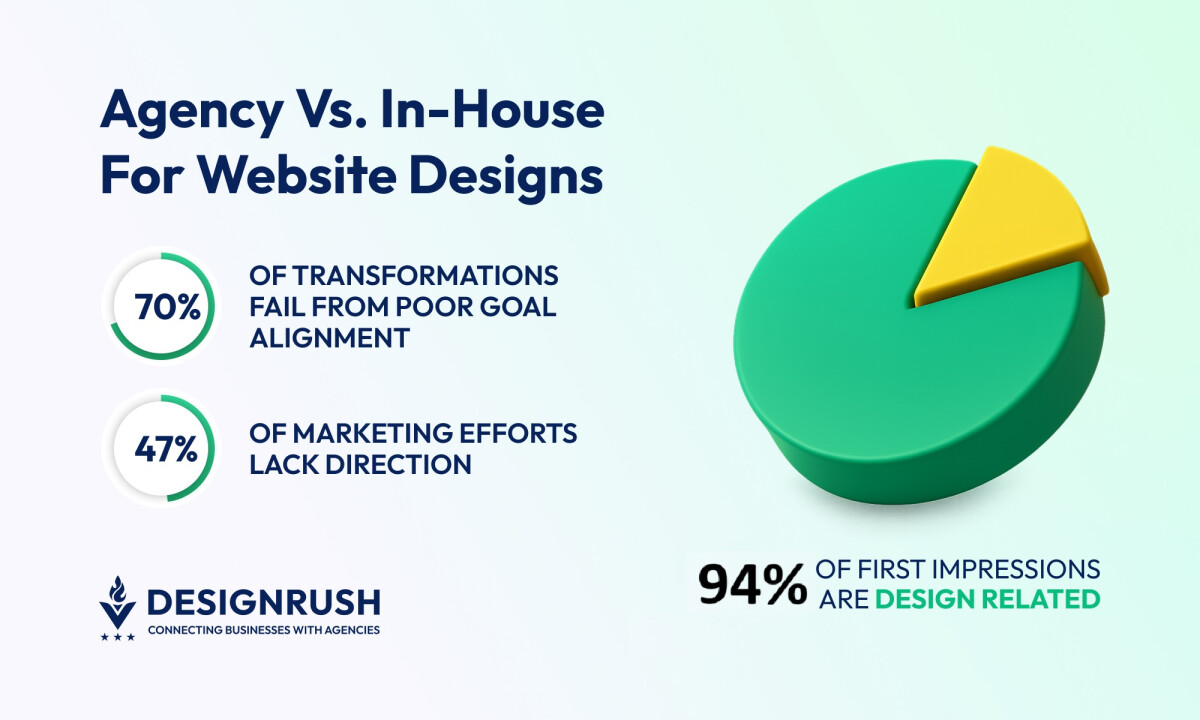
That choice matters because research shows 94% of first impressions are design related.
The differences usually show up in eight key factors you need to weigh before making the call.
Your Website Redesign Checklist
| Situation | Agency | In-House |
| Project Timeline | Urgent, short-term, or fixed deadline | Ongoing or long-term roadmap |
| Project Complexity | Specialized, multi-skill redesigns | Iterative updates, brand-driven adjustments |
| Cost Structure | One bundled fee covering tools + specialists | Lower monthly outlay, but hidden costs |
| Workload Capacity | Can scale fast for peaks and launches | Struggles under spikes without extra hiring |
| Risk and Compliance | Broad/global standards, enterprise security | Deep alignment with internal systems and industry rules |
| Industry | Fast-moving, creative sectors | Regulated or brand-heavy sectors |
1. Timeline
When deadlines are tight, I’ve found agencies usually have the upper hand.
They can pull in extra designers, developers, or specialists and hit the ground running because they’re built to scale quickly. That makes them the safer bet for:
- Urgent, short-term projects
- Launches
- Redesigns with immovable timelines
In-house teams, on the other hand, tend to move slower at the start because of:
- Ramp-up
- Internal approvals
- Learning curve of coordinating across departments
But once they’re in rhythm, they’re often more efficient for long-term work.
If your redesign is part of an ongoing digital roadmap rather than a one-off sprint, in-house can deliver more control and smoother continuity.
 | Agency: Best for urgent turnarounds, launches, and fixed deadlines In-House: Better for long-term, ongoing projects with steady timelines |
2. Complexity
The more complex the redesign, the more I lean toward an agency.
When the project involves specialized tasks like UX research, performance optimization, or a full rebrand, agencies usually have the edge.
They can assemble the right mix of specialists quickly and bring in perspectives shaped by work across industries.
But when the work is less complex and more tied to the company’s DNA, in-house shines. Nobody knows your brand voice, customer nuances, and internal politics better than your own team.
I’ve seen in-house teams run circles around agencies on things like brand-driven updates or small iterations because context matters more than horsepower there.
 | Agency: Best for complex redesigns that need diverse expertise In-House: Better for smaller, iterative updates tied to brand context |
3. Cost
I’ve sat through more than one kickoff where the creative brief was ambitious, but the budget was built for a landing page.
That disconnect happens when teams overlook the hidden costs: the tools, testing, and iterations behind every polished site. Skip that scoping early, and you’ll pay for it twice later.
In-house costs usually come from four places:
- Hiring costs:
In 2025, web designers typically charge between $30-$200 per hour or $2000 per month on retainer-based pricing. That’s before factoring in recruitment expenses, onboarding, and employee benefits. - Tools and software:
Licenses for design and testing tools add up quickly (design suites, analytics platforms, QA software).
For example, Figma is around $16 per month and Adobe XD is around $10 per month.
Agencies bundle these into their fees, but in-house teams absorb them year after year. - Maintenance
For simpler sites, I’ve seen maintenance packages land between $500-$1,000 per year.
But for sites with integrations, frequent updates, or enterprise scale, that number jumps to $6,000-$60,000 per year, depending on
how aggressive your support and performance needs are. - Training and development
If you want your in-house team to keep up with UX patterns, evolving tools, and accessibility standards, bet on spending at least $1,000
-$5,000 per year per designer on courses, conferences, certifications, and new tool licenses.
And even then, you’ll face gaps.
A full redesign calls for specialists in UX research, conversion rate optimization specialist, accessibility, etc. - roles that are expensive to hire
and impossible to cover with one person.
But remember something, agencies look expensive on paper because the fee comes in one big number.
A redesign project might run up to $30,000, depending on scope and complexity.
But that number usually bundles what you’d otherwise pay for separately in-house: tools, processes, and specialized staff already trained and ready to go.
With an agency, you’re paying for:
- A consolidated project fee or retainer
- Access to premium design, testing, and collaboration tools
- A team with varied expertise (UX, CRO, accessibility, QA)
- Scalability (they can add resources fast without you recruiting)
The trade-off is flexibility. You can scale an agency up or down as needed, but you don’t “own” the resource. Once the project ends, so does the relationship, unless you’re on a retainer.
 | Agency: Higher upfront invoice, but bundled tools and talent mean fewer hidden costs In-House: Lower monthly outlay, but hidden costs pile up over time |
4. Workload and Deadlines
I remember a product launch where the timeline suddenly shrank by two weeks. The agency brought in three extra designers overnight, while the client’s internal team was still waiting on approvals to authorize overtime.
When deadlines get tight, agencies can simply pull in extra designers, developers, or QA testers to hit a launch date without burning out their core team.
In-house teams don’t have that luxury. When work spikes, you either stretch your people thin or scramble to hire contractors.
Both options cost time and money, and neither is ideal when the pressure is on.
 | Agency: Scales fast, built for tight deadlines In-House: Struggles during peaks without extra hiring |
5. Risk Management
Risk is where the choice between agency and in-house really depends on your context.
Agencies are usually better equipped for large-scale or multi-industry projects. They’ve seen every compliance checklist under the sun and have formal processes for security and reliability.
If you’re running a redesign that spans geographies or industries, an agency can keep you out of trouble.
I’ve also seen the other side.
In-house teams often know their company’s systems better than any outside partner. They’re closer to the data, the protocols, the quirks of the industry.
That kind of familiarity makes them the safer bet when compliance is niche or when security can’t leave the building.
 | Agency: Best for broad compliance and enterprise-scale security In-House: Best for company-specific security and industry rules |
6. Industry
The industry you’re in influences which execution model makes more sense for a redesign.
What works for SaaS probably won’t cut it for healthcare or e-commerce. The industry you’re in influences which execution model makes more sense for a redesign.
For example, highly regulated sectors like finance, health, or government, compliance and internal data sensitivity often make in-house a safer default.
You want tight control over data, approval chains, and legal oversight. Agencies can still help, but I would ask to see proven experience in your sector.
On the flip side, in fast-moving creative industries (fashion, media, entertainment, tech), agencies tend to shine. They bring external perspective, trend exposure, and innovation that in-house teams may lack.
I’ve seen that the industry you’re in can tip the scales. Some sectors make in-house the safer bet, while others benefit more from agency firepower.
Here’s how I’d break it down:
| Industry | Better Fit | Reason |
| Finance and Healthcare | In-House | Tighter control over compliance, data, and security requirements |
| Retail and eCommerce | Agency | Faster turnaround for seasonal campaigns, promotions, and UX experiments |
| Technology and SaaS | Agency | Multi-market scalability, performance optimization, and cross-industry innovation |
| Media and Entertainment | Agency | Trend-driven creative, storytelling, and omnichannel design execution |
| Luxury and Fashion | Hybrid (In-House core + Agency creative) | In-house maintains brand fidelity, agencies inject fresh seasonal campaigns |
| Government and Education | In-House | Strict compliance, accessibility, and long approval cycles demand closer control |
Whatever your industry, the real risk is copying what others do instead of matching the model to your own constraints.
Hybrid Redesign Teams: The Best of Both Worlds
Some of the best results I’ve seen come from hybrid setups.
The in-house team owns strategy and ongoing brand alignment, while the agency plugs in for heavy lifts like UX research, a rebrand, or performance optimization.
It works when roles are clear: in-house keeps the long-term vision steady, agencies inject specialist skills and speed where needed.
With the right boundaries, you get control and context without losing scale or innovation.
Don't forget to split work by phase: in-house for strategy, agencies for execution sprints.
When It’s Time to Switch Models
I’ve seen some companies stick with the wrong setup for too long, and the result is always wasted time and money.
Here are the signs I look for when it’s time to make a change:
Switch from agency to in-house if:
- You need tighter control over strategy and process
- Long-term agency fees outweigh the value
- Your business demands faster, daily responsiveness
Switch from in-house to agency if:
- You’re scaling fast and need more horsepower
- Specialized skills are missing in your team
- You’ve got a high-stakes project with immovable deadlines
To transition safely:
Start hybrid, phase responsibilities gradually, and make sure documentation and knowledge transfer are locked down before you fully switch. I’ve learned the handoff works best when both sides overlap for a while.
Agency vs. In-House Design: Final Notes
Agencies give you speed, scale, and a breadth of expertise you can’t always build internally. In-house teams bring brand intimacy and long-term efficiency that outsiders can’t replicate.
Find More Agency Hiring Resources:
- Website ROI From a Web Development Agency
- Questions To Ask a Design Agency Before Signing
- Defining Goals and Planning a Website Redesign in 2025
When I lead a redesign, the question isn’t just a simple “agency or in-house?” It’s about which model truly fits the company’s reality.

Our team ranks agencies worldwide to help you find a qualified partner. Visit our Agency Directory for the top web design companies, as well as:
Our design experts also recognize the most innovative design projects across the globe. Visit our Awards section for the best & latest in website design.
Agency vs. In-House Design: FAQs
1. Should I budget for a redesign or an ongoing evolution?
Many CMOs think in terms of “big redesigns,” but today’s best-performing websites evolve continuously. Instead of one massive overhaul every 3 to 4 years, budget for iterative updates and optimizations, whether in-house or through an agency partner.
2. Is it cheaper to redesign a website with an agency or in-house?
It depends on the scope. Agencies often look more expensive upfront, but their fees usually bundle tools, processes, and specialized staff. In-house may look cheaper month to month, but hidden costs like hiring, software licenses, and ongoing training add up.
3. Can I start with an agency and later move in-house?
Yes. Many companies start with an agency for speed and expertise, then transition to in-house once the site is live. The key is planning a safe handoff: document processes, transfer knowledge, and phase responsibilities gradually.