
Nobody buys a house from a website. But it is a deciding factor in whether potential buyers call, and that decision usually happens on a phone at night, with four other properties open in other tabs.
The 20 best real estate website designs here are the ones that hold up in that comparison.
Real Estate Website Design: Key Findings
- DesignRush web design pricing data puts a real estate website project at $5,000 to $40,000+, the lower-middle of ten tracked industries. SaaS and tech runs $10,000 to $100,000+, and healthcare runs $7,000 to $70,000+.
- The National Association of Realtors' 2025 Profile of Home Buyers and Sellers, built on 6,103 responses to 173,250 mailed surveys, puts the median home buyer at 59 and the median repeat buyer at 62, an all-time high.
- WebAIM's 2026 Million found low-contrast text on 83.9% of the top million homepages, up from 79.1%, reversing six consecutive years of improvement.
How These 20 Best Real Estate Website Designs Were Selected
Four things separated a top real estate website design from a simply competent one, and we looked at all four across all 20:
- Which transaction the site is written for. Some sites sort buyers, sellers, tenants, and investors into separate routes. Others pick one and write the homepage for that person.
- Whether the property information earns its space. On the strongest sites, filters, floor plates, and metrics carry something a visitor came for. Motion with nothing behind it counted against a site.
- Where the enquiry sits. A route to a person does the most work on the page where someone decides. Parked on a separate contact page, it does far less.
- How the build carries its media. Property sites ship more photography than almost any other category, so contrast and mobile speed both factored in.
Three of the 20 carry a DesignRush Design Awards status and 17 have a published entry page, alongside the rest of the real estate website design entries.
Criterion | Weight | What it measures |
Design | 30% | How well the design commands attention and elicits action |
Usability | 30% | Whether the design achieves its purpose and improves the user experience |
Creativity | 30% | Whether the design was unique and resourceful in its techniques, tools, and concepts |
Content | 10% | Whether the design was detail-oriented in execution and presentation |
The rest were picked on merit and read against the same four criteria by the DesignRush design team.
That team includes Branko Dimitrijević, a senior designer with 33 design awards and more than 165 web projects behind him.
1. SAA interiors + architecture by Quixta
[Source: SAA interiors + architecture]
Standout features:
- Process-led section order
- Portfolio-first homepage
- Restrained sans-serif system
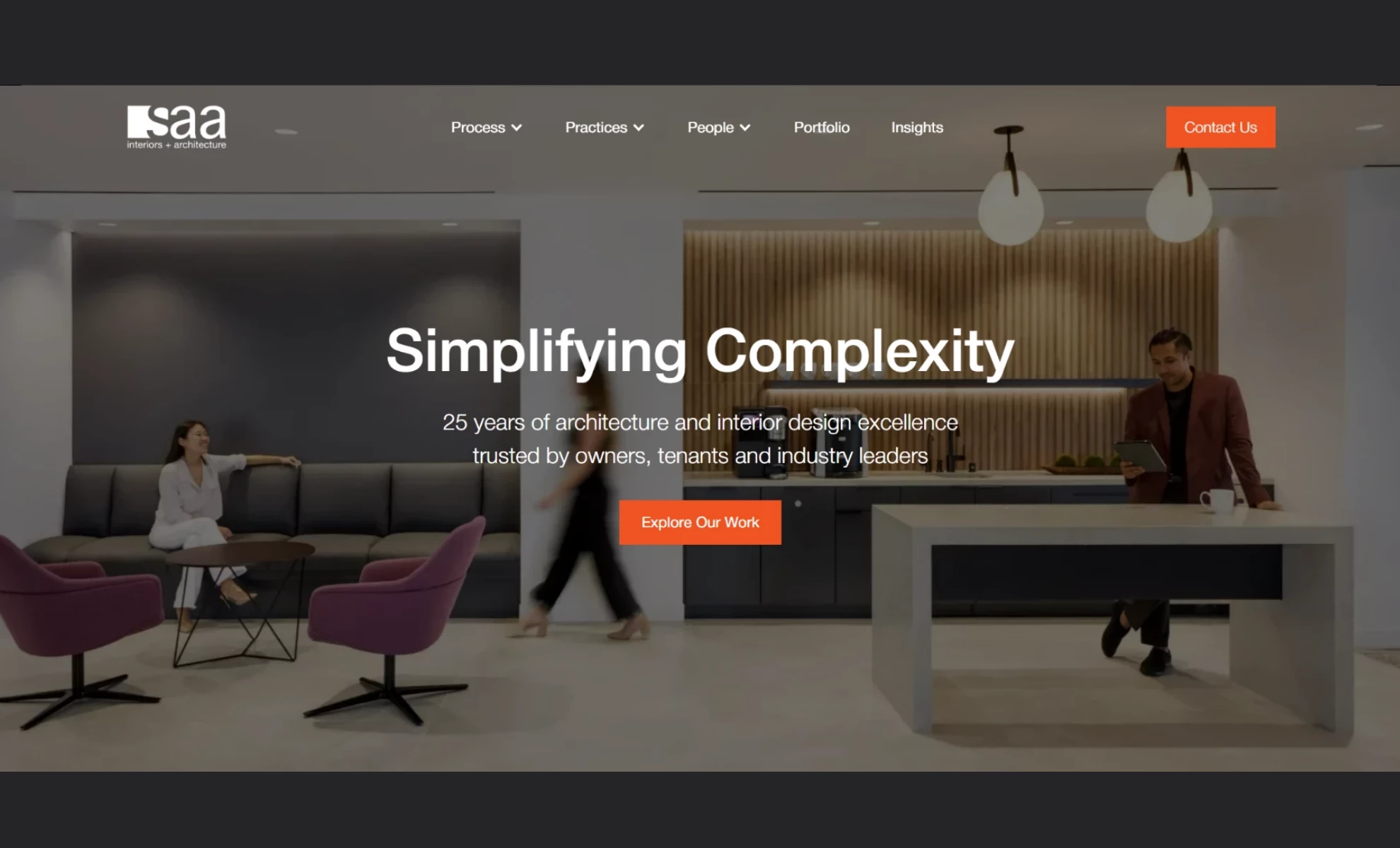
SAA Interiors + Architecture is a U.S.-based design firm specializing in commercial architecture, workplace interiors, and real estate advisory services.
Designed and developed by Quixta, the SAA website reflects the firm’s central philosophy of simplifying complexity through thoughtful design, innovation, and technical precision.
Large architectural imagery and curated portfolio highlights showcase SAA’s experience across office interiors, healthcare environments, and real estate analytics.
The layout uses generous spacing and restrained color palettes to keep the focus on the firm’s projects and design thinking, reinforcing a sense of clarity and professionalism throughout the browsing experience.
The interface emphasizes process and performance. Sections such as “Our Process Innovation” and “Core Practices” guide users through the firm’s approach to architecture and interior design, presenting complex services in an organized and digestible format. This structure helps convey SAA’s ability to manage intricate projects while delivering measurable value to clients and stakeholders.
Subtle motion effects and smooth scrolling transitions maintain visual engagement without distracting from the content. Combined with a clean sans-serif typography and consistent visual hierarchy, the website delivers a polished and contemporary user experience.
Why it works: A firm selling its ability to manage complexity is judged on whether it can explain its own process on one page. SAA's site puts the method above the portfolio.
2. Majeli Vassart Properties by Debrief Agency
[Source: Majeli Vassart Properties]
Standout features:
- Serif and sans pairing
- Forbes Global Properties lockup
- Confidentiality content block
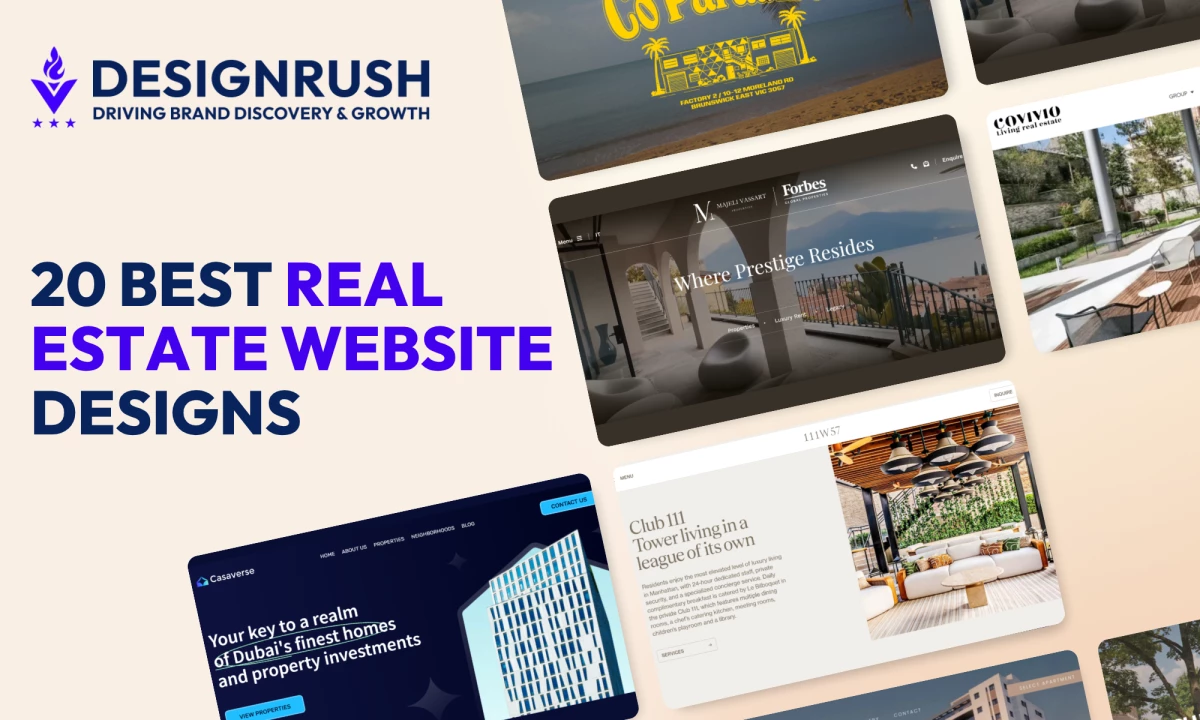
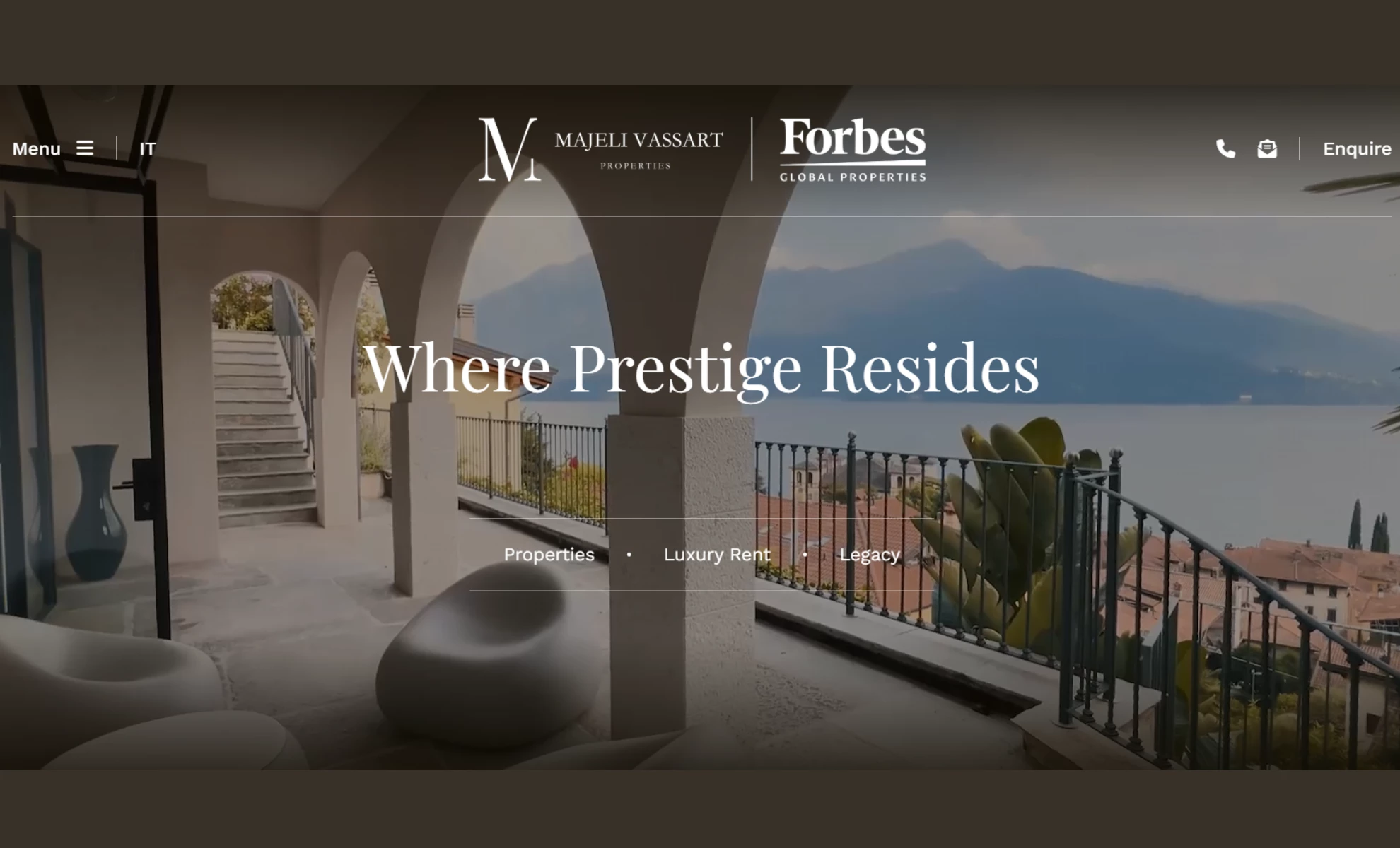
Majeli Vassart Properties sells off-market and rental estates around Lake Como under the line "Where Prestige Resides." The best inventory here cannot be advertised, so the site sells access rather than product.
The hero opens on Lake Como villas in motion with no headline over the top. Debrief Agency put the brand in the type instead, pairing a high-contrast serif for display with a crisp sans-serif on a centered grid.
The site names its sections "Passion for Excellence," "Confidentially First," and "About Exclusivity," which describe a standard of service rather than a page. There is no search, no filter, and no price anywhere on it.
Featured estates appear as named properties, among them The Lake Sanctuary and Dolce Regina Estate, each behind a single "View Property" link. The navigation runs to four items, ending in an Enquire button.
Majeli Vassart is the Forbes Global Properties member firm for Lombardy, and the dual branding does the credibility work a testimonial wall would do elsewhere. The "Confidentially First" block details NDAs, data rooms, and off-market assets.
Why it works: A seller of a nine-figure estate is buying discretion, and the absence of a public search is the proof. Forbes Global Properties membership is the one signal here a competitor cannot copy overnight.
Deloitte and Google's Milliseconds Make Millions study of 37 brands found a 0.1-second mobile gain raised luxury page views per session by 8.6%. Cinematic imagery still has to load fast.
Explore the Majeli Vassart real estate web design in full.
3. Avantgarde Properties by Digitalwerk
[Source: Avantgarde Properties]
Standout features:
- Awards row on homepage
- Menu that becomes search
- Vienna portfolio carousel
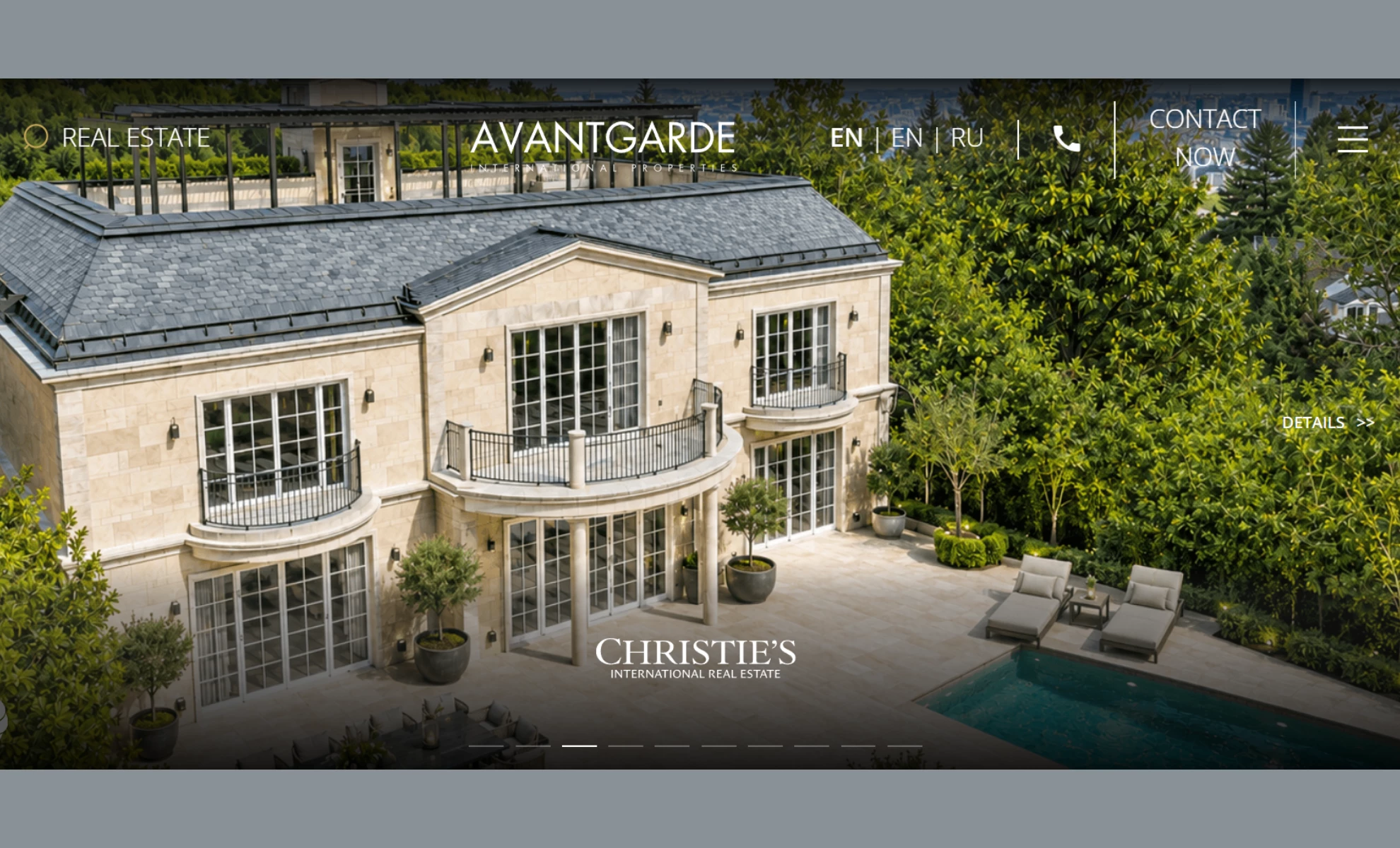
Avantgarde International Properties is a Vienna agency founded in 2011, handling high-end transactions across the city and the surrounding area. The site leads with proof rather than with property.
A carousel of Vienna properties runs at the top, and a row of awards sits on the homepage rather than on an About page three clicks in. The palette follows the white, black, and gold convention most luxury property sites use.
The smartest detail is in the navigation. The sticky menu morphs into a property search bar as a visitor scrolls, so the primary action changes at the point where intent changes.
Why it works: Third-party recognition is the one signal on a luxury site that cannot be written by the marketing team. Putting it above the fold answers the "why this agency" question before the portfolio has to.
Read more about this real estate web design in the full Avantgarde Properties website design analysis.
4. Casaverse by Whales Design
Standout features:
- Card-based listing modules
- High-contrast CTA buttons
- Bilingual navigation toggle
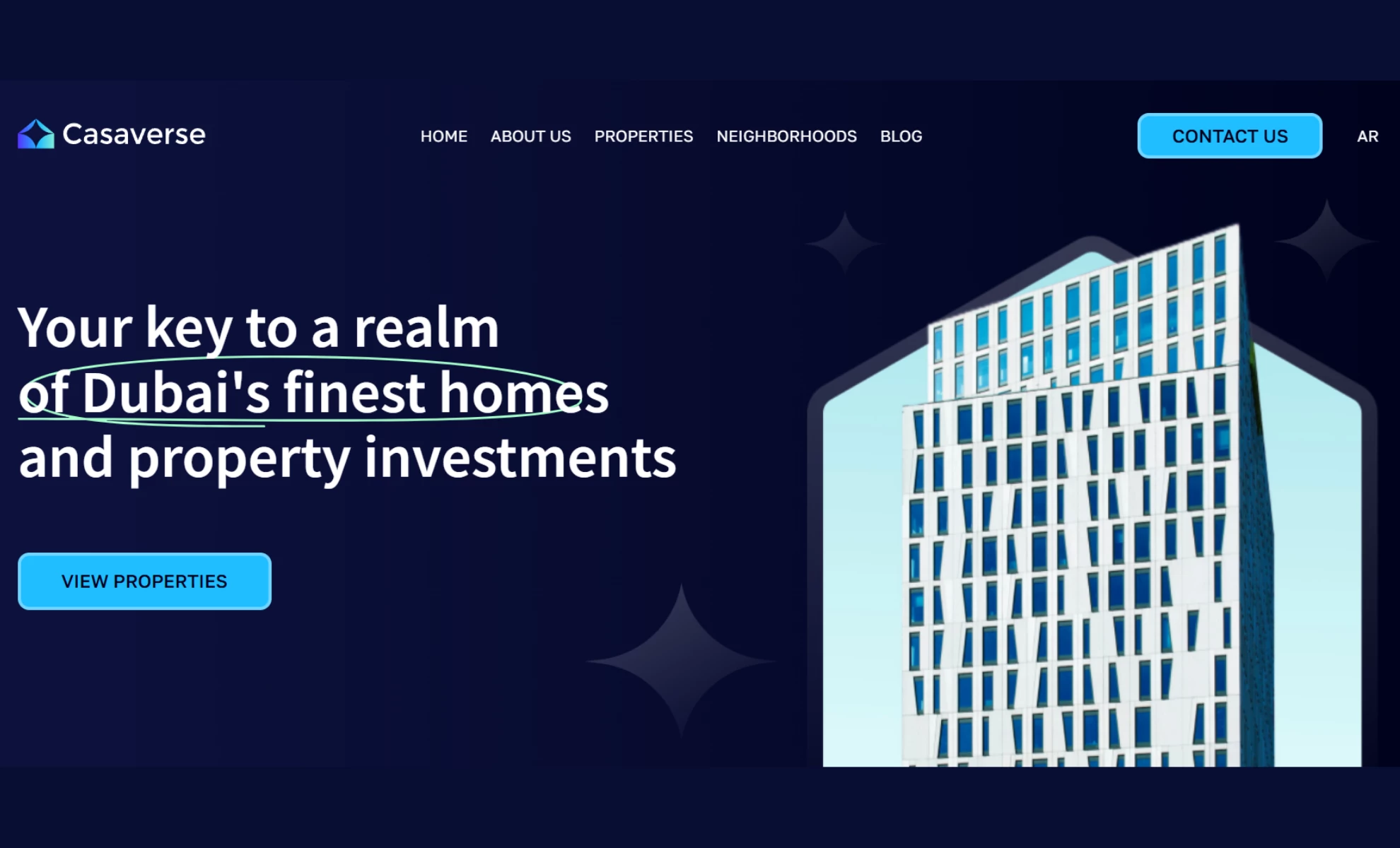
Casaverse is a Dubai agency with more than a decade in sales, rentals, and investment, based at The One Tower in Barsha Heights. The Arabic toggle in the header says the audience splits between local and overseas buyers.
Whales Design built the listing layer as consistent card modules. A Mansion at Portofino at AED 16,000,000 and a three-bedroom villa in the same development at AED 1,850,000 carry their elements in identical positions.
The palette runs white, navy, and gold, with high-contrast call-to-action buttons that stay visible against property photography. Navigation stays flat across Home, About Us, Properties, Neighborhoods, Blog, and Contact Us.
Why it works: An overseas buyer compares a dozen properties on price against bedroom count, and identical card structure is what makes that possible. Publishing the price on the card keeps them on the site to do it.
Explore the Casaverse real estate website design in full.
5. Hous Luxe Woningen by Kay Jilesen
Standout features:
- Artist impressions gallery
- White and gold theme
- Scannable property summaries
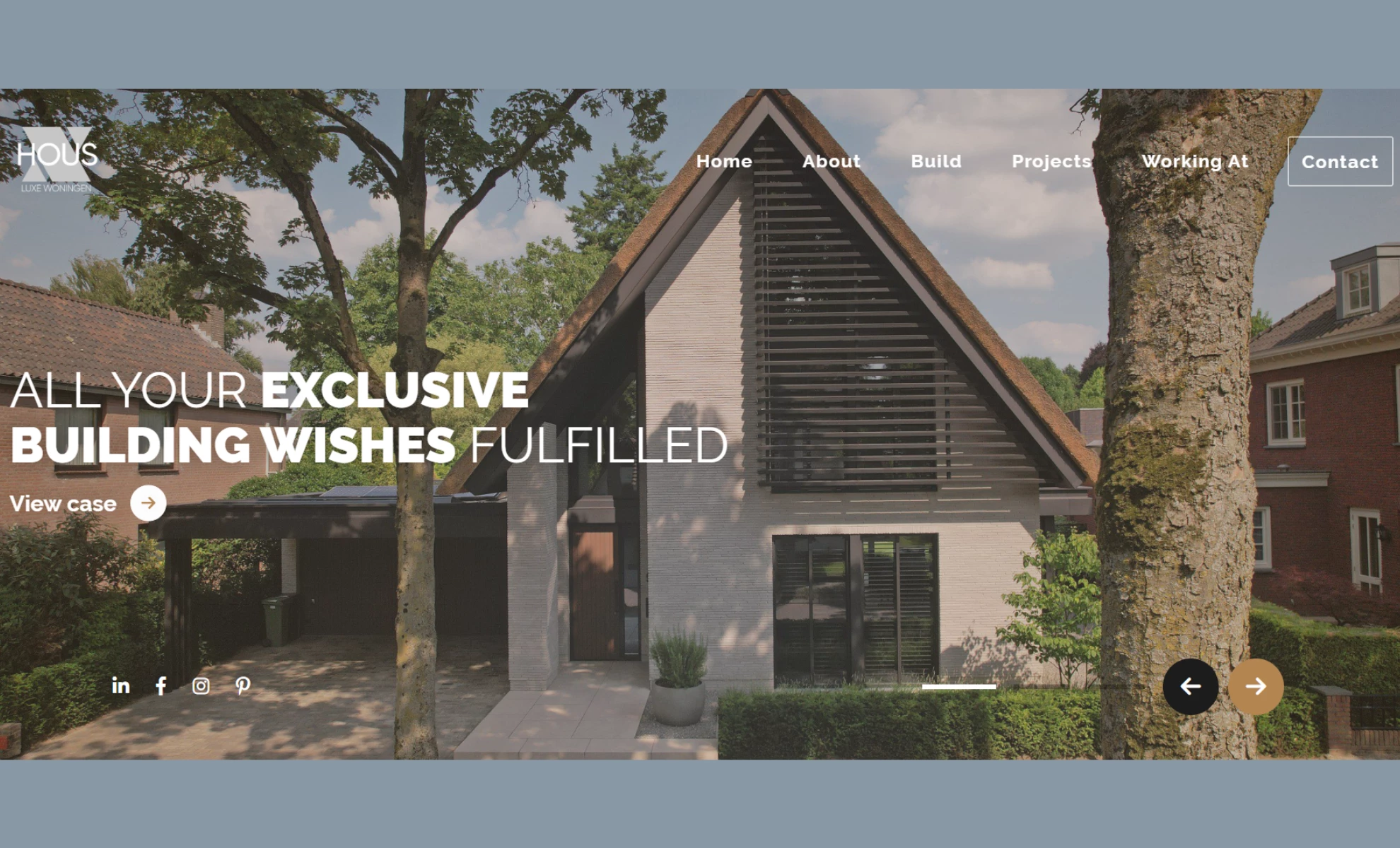
Hous Luxe Woningen sells high-end homes in the Netherlands. Kay Jilesen left more of the page empty than most property sites do, which is the convention buyers in this bracket already recognize.
Property information is written to be scanned, with a consistent typeface and short summaries that let a visitor rule a house in or out quickly. The white and gold theme holds across every page.
The gallery combines finished photography with artists' impressions, which matters for properties sold before completion. A buyer sees both the house that exists and the house being proposed.
Why it works: Artists' impressions extend one site to pre-completion stock without a second template.
NAR's reporting on listing visibility cites the 2025 Profile finding that 81% of buyers rated listing photos the most useful feature of their online search.
Read more about this real estate web design in the full Hous Luxe Woningen website design analysis.
6. Sherman Messing Group by 24 East Media
Standout features:
- Sticky section navigation
- High-resolution property images
- Location, price, and area listings
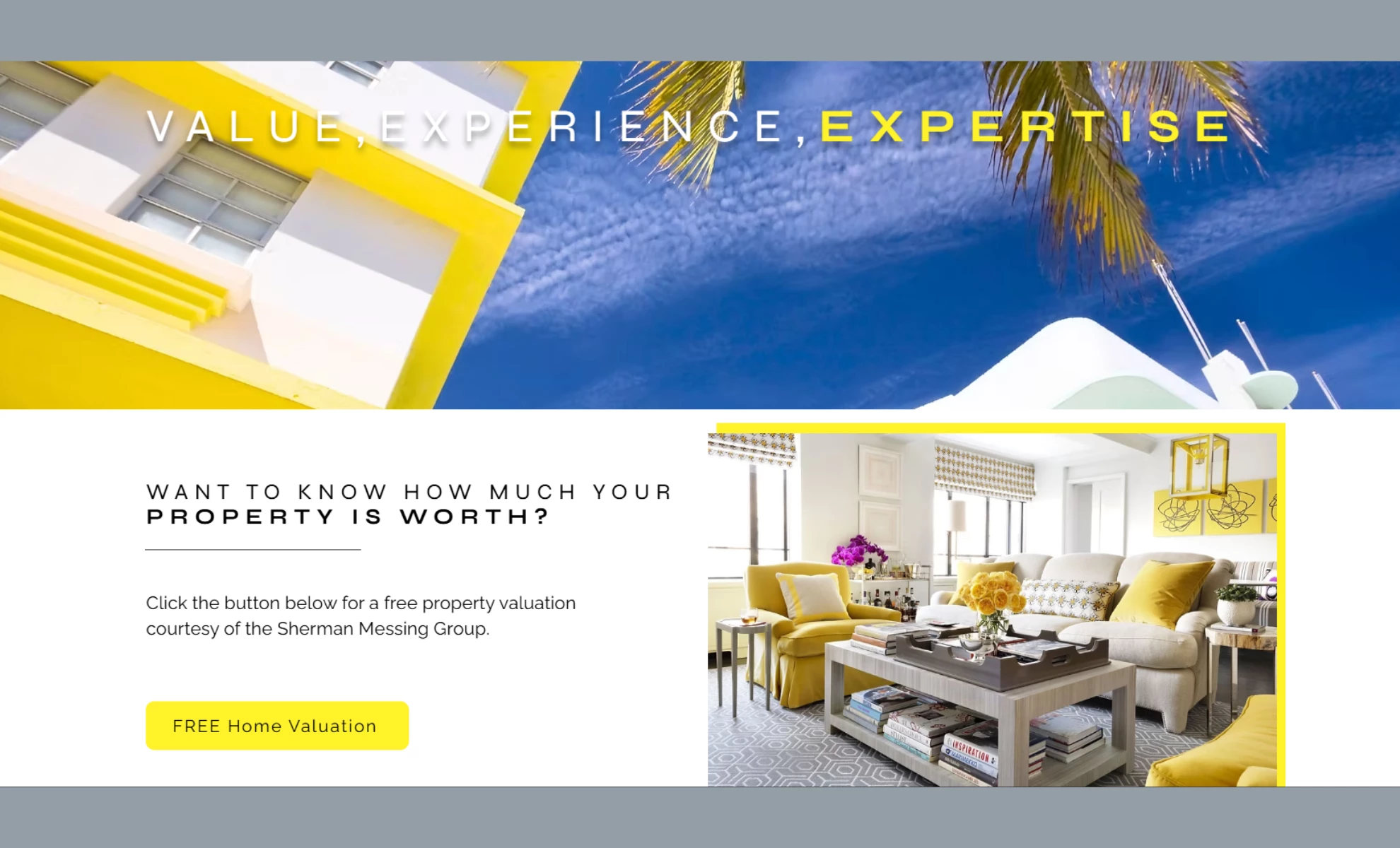
Sherman Messing Group is a Miami Beach brokerage, and 24 East Media built a site that presents a curated set of properties rather than running a search portal. The listing template is where the work went.
Every listing leads with location, price, and area in the same order, so a visitor scanning six properties reads three facts in three fixed positions. High-resolution photography sits against a low-key palette.
A sticky menu keeps the section links available through the scroll. Calls to action appear at the end of each listing block rather than only in the header.
Why it works: Fixed positions remove the re-reading that kills a browse.
HTTP Archive's 2025 Web Almanac found secondary pages beat home pages on mobile Core Web Vitals, 56% against 45%, so the listing template is also the page most likely to be fast.
7. 111 West 57th Street by Outpost
[Source: 111 West 57th Street]
Standout features:
- Offset stepped compositions
- Teodor serif masthead
- Availability behind enquiry
111 West 57th Street is a 1,428-foot Manhattan tower by SHoP Architects with interiors by Studio Sofield, rising above Steinway Hall on Central Park. Outpost built the site for a building selling full-floor residences.
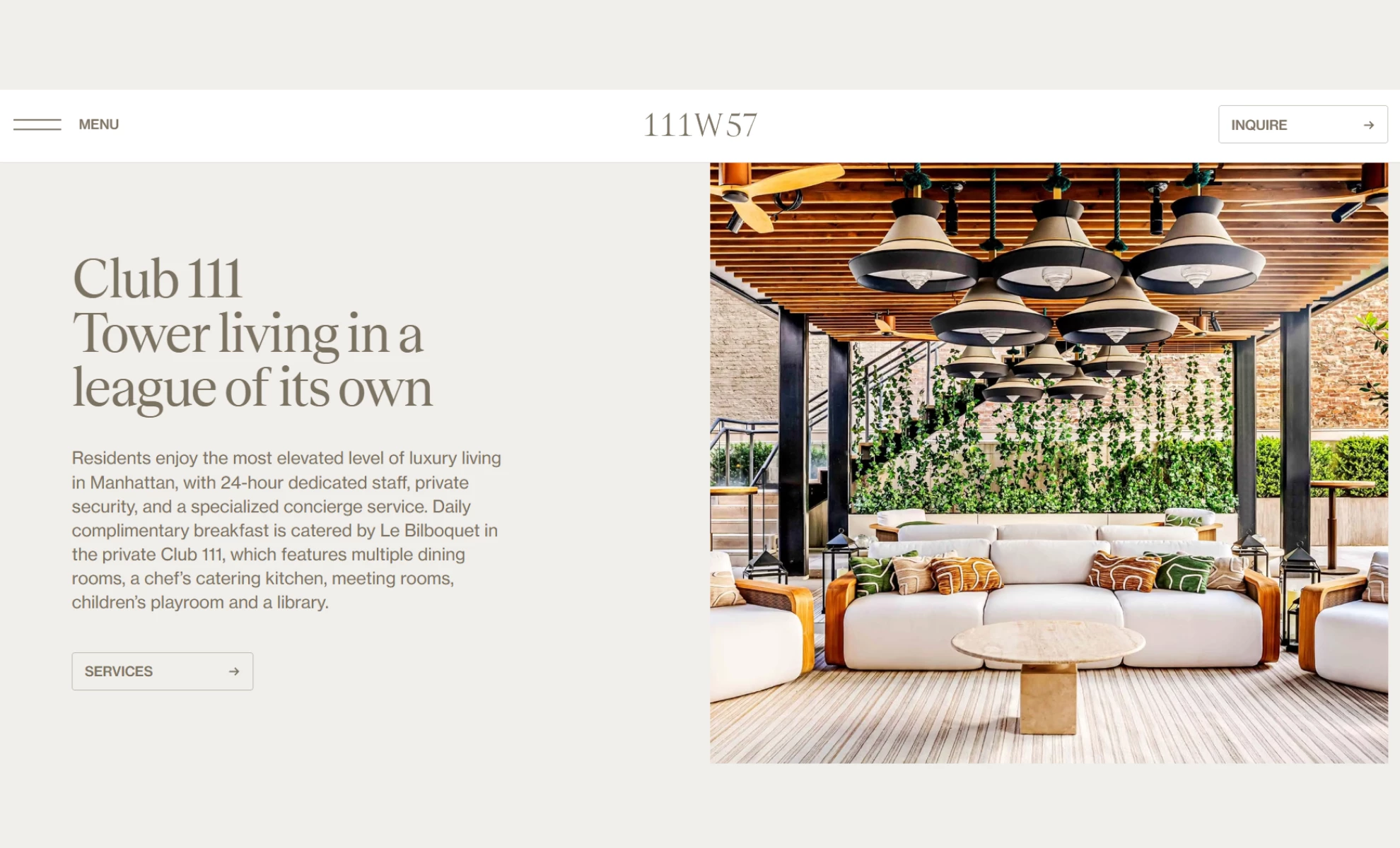
Outpost translated the building's stepped profile into offset page compositions, so the blocks shift sideways as you scroll instead of stacking flush. The agency describes the target as "the feel of a luxurious coffee table book."
The site runs two typefaces. Teodor handles the display type and Neue Haas Grotesk Text Pro handles the interface, across six navigation items ending in a persistent Inquire button.
Amenity content is specific rather than adjectival. Club 111 names Le Bilboquet catering and a dedicated concierge, and Sports Club 111 names an 82-foot pool, a golf simulator, and an indoor padel court.
Reported outcome: Outpost publishes a line from Alex Hare, VP of Marketing at Sotheby's Realty, crediting the site with helping the building get “rave reviews.”
Why it works: No prices appear anywhere on the site, which makes the Inquire button the only way to get an answer.
The stepped layout is the one element a competing tower cannot copy, because it comes from this building's silhouette.
8. ERA by Vide Infra
[Source: ERA]
Standout features:
- Five-layer 3D splash
- WebGL neighborhood map
- Parametric apartment selector
ERA is a luxury residential development, and Vide Infra built its brand out of the Art Deco architecture under the line "The Dawn of a New Era." The agency ran stakeholder interviews before it drew anything.
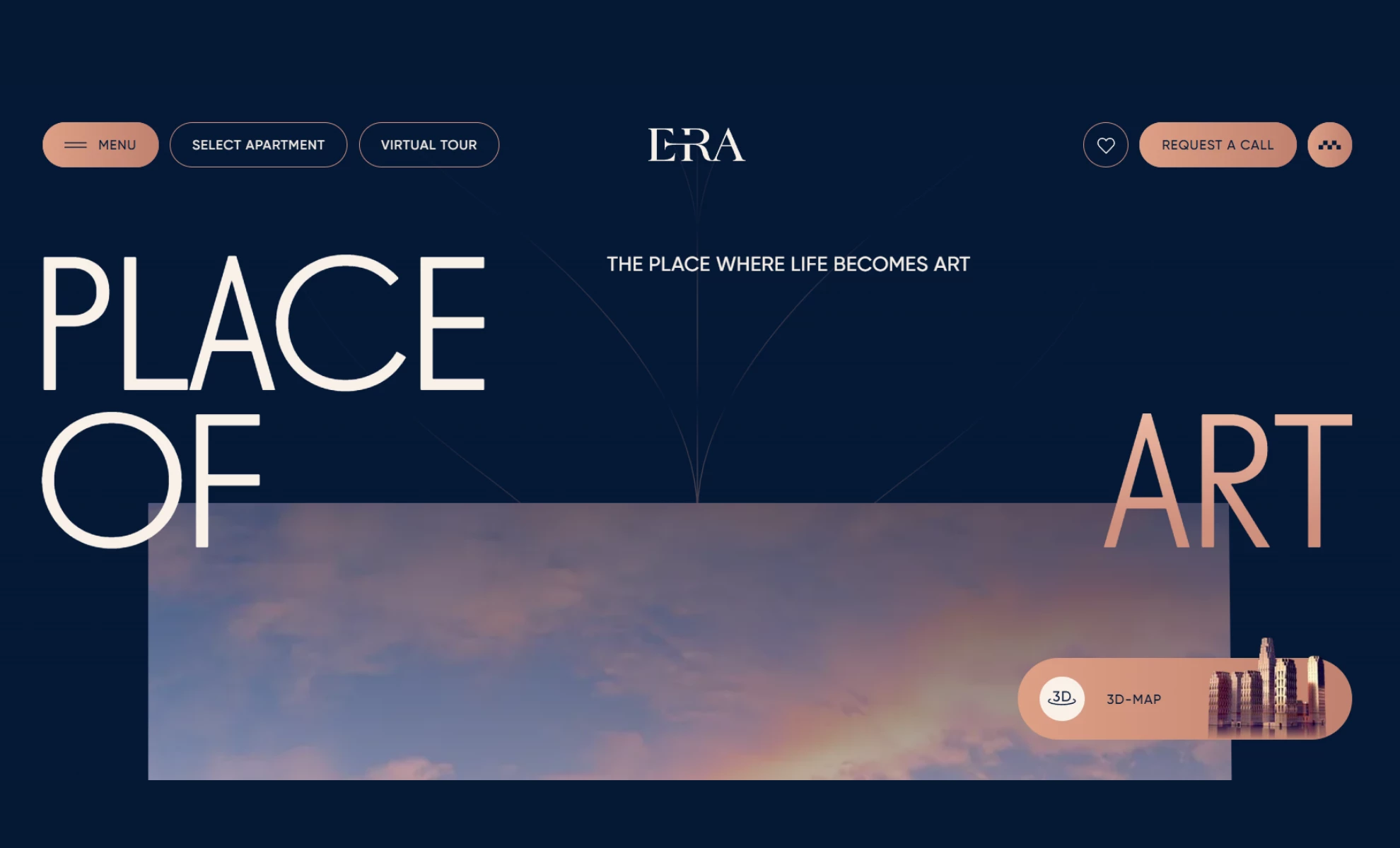
The entry is a splash screen animating five layers of 3D models. Beyond it, flowing light trails, volumetric galleries, and parallax sit on a dark palette built on #191B1D.
The site sells through two tools. A visual apartment selector moves a buyer from building to floor to unit, and an interactive 3D map in WebGL places the development among the landmarks around it.
Why it works: Pre-construction buyers pay for something that does not exist yet, and a parametric selector plus a mapped neighborhood is the closest a screen gets to a site visit.
9. Agate Luxury Residence by Yehuda Bruck
Standout features:
- Clickable floor plate
- Layout and List views
- Full-screen building opener
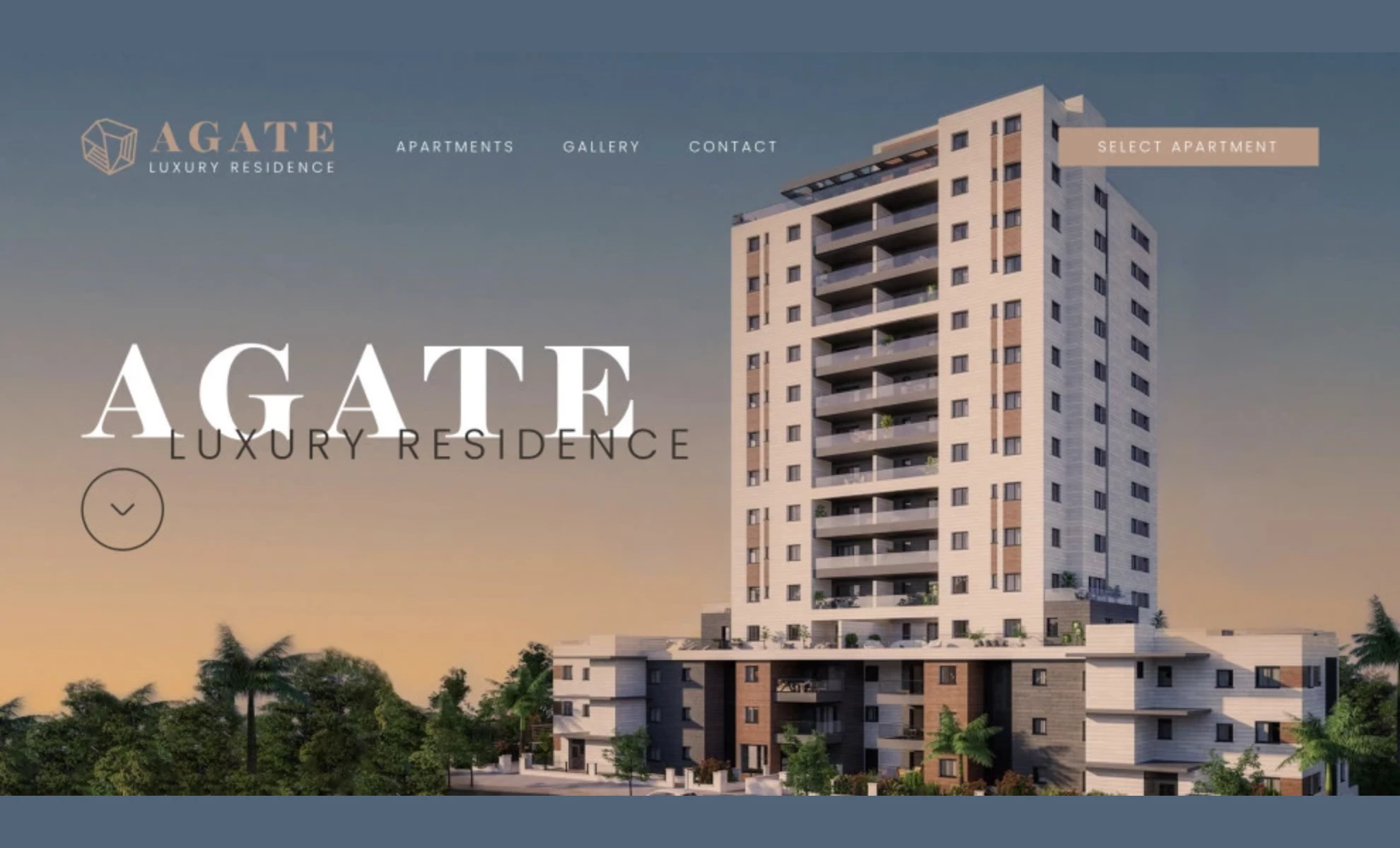
Agate is a luxury residential building in New York with 66 apartments running from four to six rooms and 87 to 423 square meters. Fixed inventory poses a different problem from a brokerage's.
The site opens on a full-screen image of the building. The Gallery page runs high-resolution interiors and exteriors, and includes the surrounding streets rather than stopping at the property line.
The Apartments page is the decision worth copying. Yehuda Bruck built a Layout view with clickable floors and a List view with filters and blueprints over the same inventory.
Why it works: Some buyers think in floors and views, others in bedroom counts and price. Two routes into one dataset cost one extra template and stop half the audience bouncing at the wrong interface.
Zillow reported in September 2025 that listings in its immersive Showcase format drew 79% more page views and 76% more saves than comparable nearby listings. Agate reaches for the same effect without a portal.
Read the complete Agate Luxury Residence website design breakdown.
10. Belyi Ostrov House by Bquadro
Standout features:
- Parallax district tour
- Gold magazine palette
- Collapsing side-panel menu
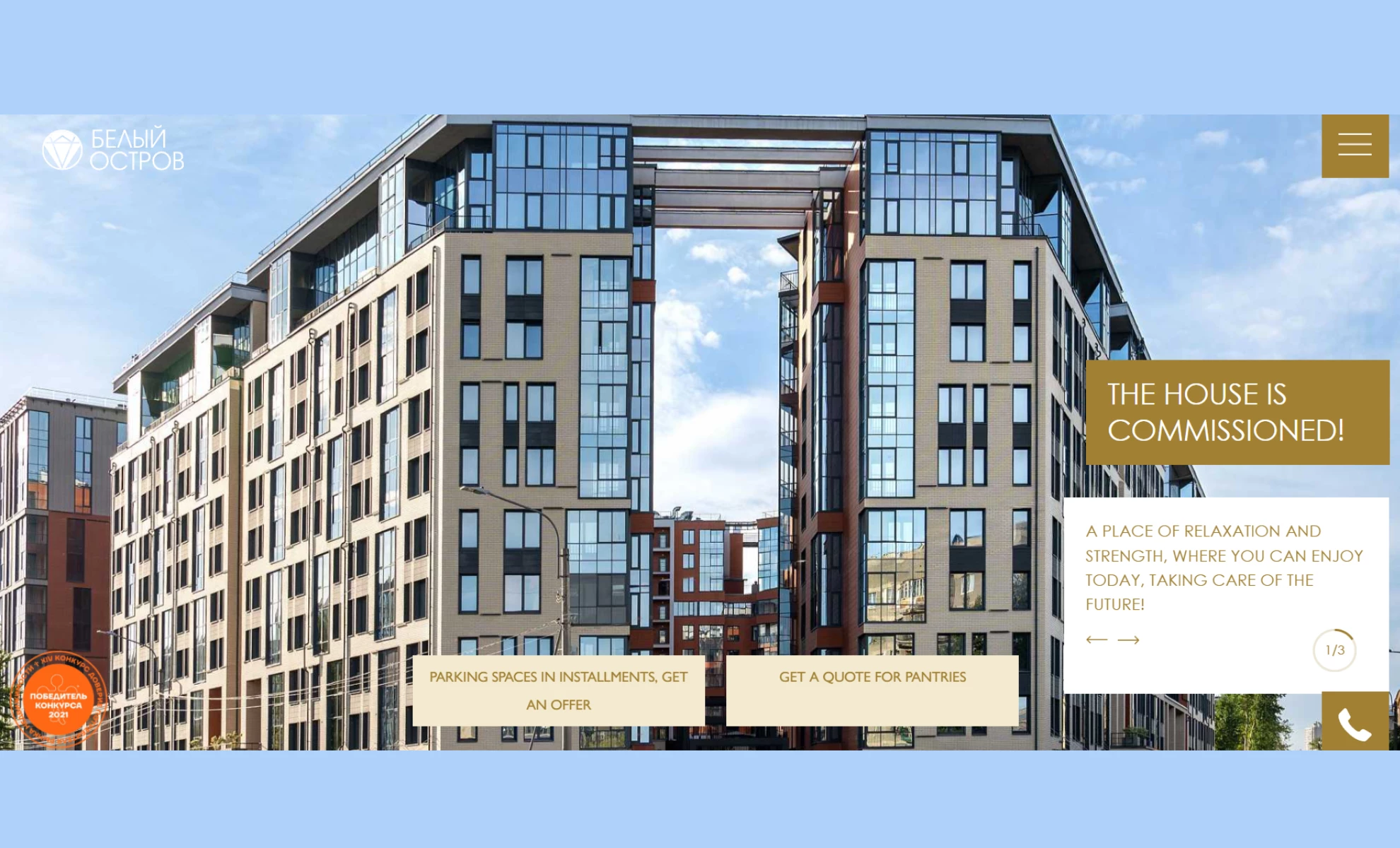
Belyi Ostrov House is a residential complex on Beloostrovskaya Ulitsa in Saint Petersburg, in a district with developed transport, retail, and leisure. Bquadro sold the location before the building.
The homepage scrolls through the district using pseudo-3D effects, motion graphics, interactive maps, and parallax. Gold accents sit across a restrained base, and the animation stays slow enough to read against.
A sticky hamburger opens into a minimal side panel collecting everything a prospective buyer needs. The unconventional scroll never traps anyone mid-page.
Why it works: A buyer relocating into a new district is buying the commute and the infrastructure before the apartment. Putting the map in the scroll answers the objection that would otherwise end the visit.
Explore the Belyi Ostrov real estate website design review in full.
11. K11 ARTUS by Unlimited (ULTD)
[Source: K11 ARTUS]
Standout features:
- Interactive day clock
- Piano audio track
- Gold-hover mega menu
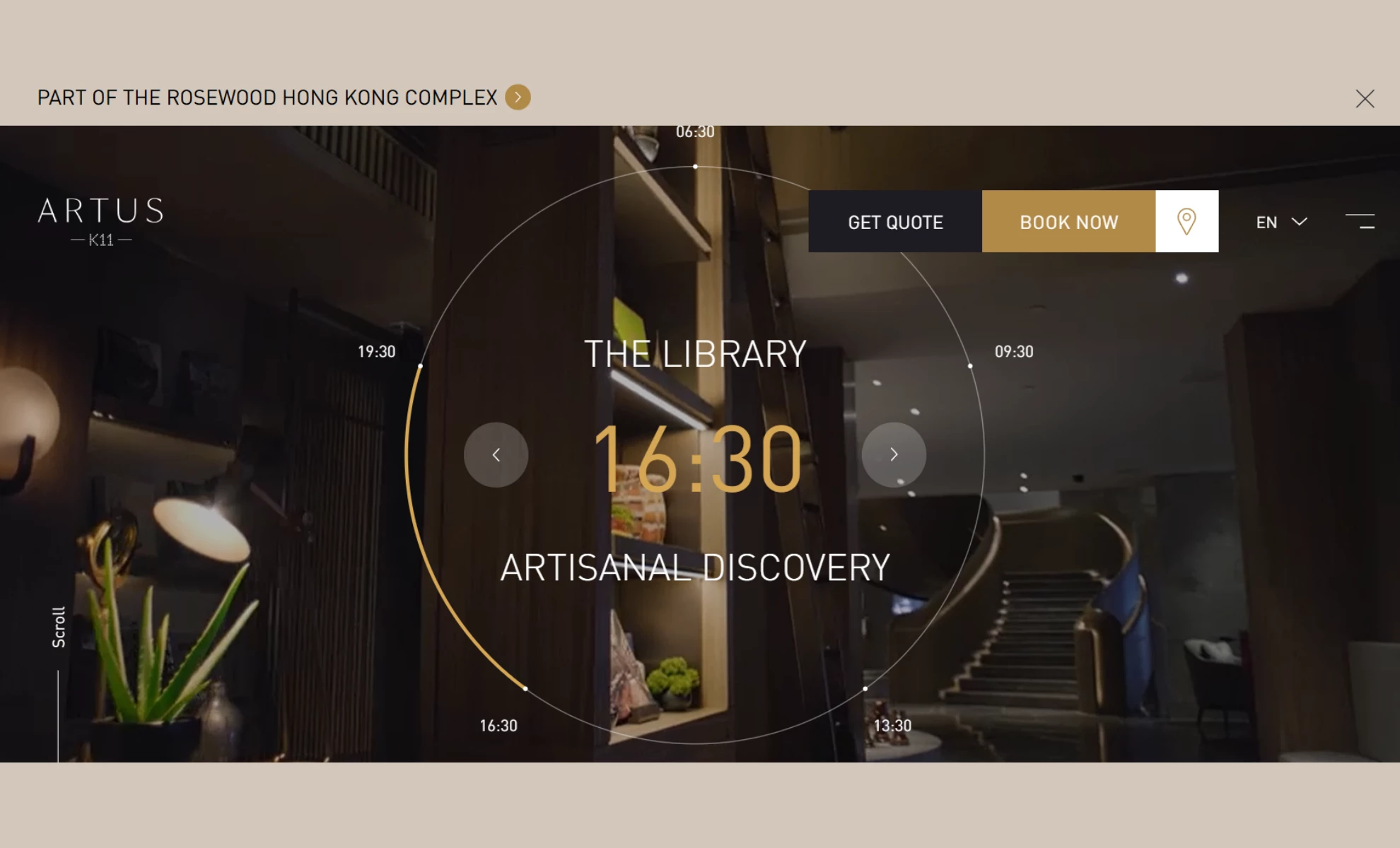
K11 ARTUS is a serviced residence in Tsim Sha Tsui, Hong Kong, part of the K11 mall-and-museum concept. A serviced residence sells a way of living rather than a floor area.
The homepage opens on full-screen video and an interactive clock that walks a visitor through an ideal day, hour by hour. A piano track plays under the scroll, quietly enough to work.
The mega menu opens from a top-right hamburger into a full-screen panel with gold hover highlights. That gives a media-heavy page one flat way to navigate.
Why it works: HTTP Archive's 2025 Web Almanac, covering 17.2 million websites, found the median mobile home page ships 2,362 KB, with 1,059 KB of that in images.
A video-led property site has to budget for that before it art-directs anything.
Read the complete K11 ARTUS website design breakdown.
12. Miami Warehouse Real Estate by Calico Marketing
[Source: Miami Warehouse Real Estate]
Standout features:
- Dotted hero overlay
- Large-numeral metrics band
- Three-option contact form
Miami Warehouse Real Estate handles industrial property across South Florida, covering buying, selling, landlord and tenant representation, development sites, and 1031 exchanges. The navigation holds four items.
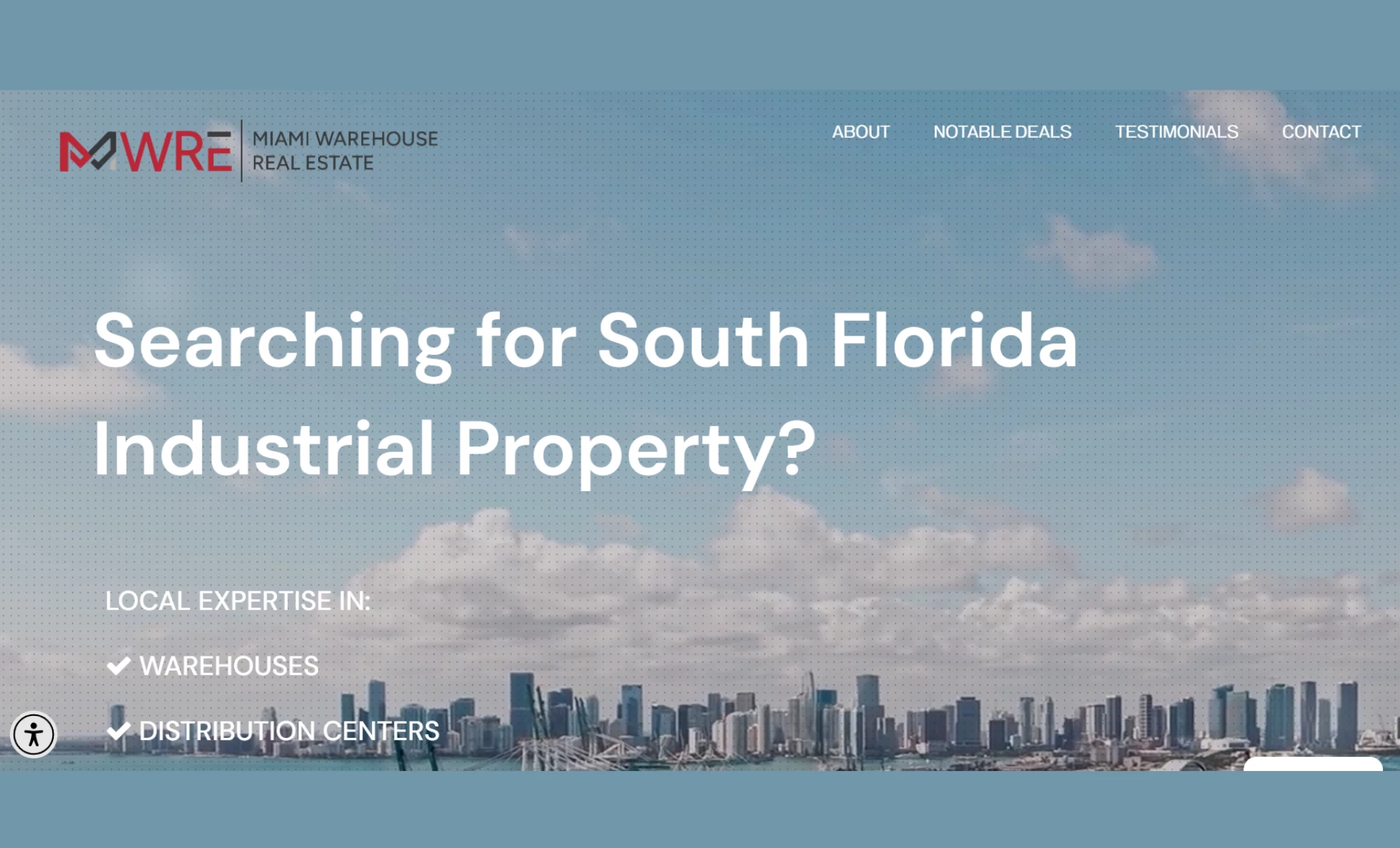
The hero puts high-contrast type over environmental photography, with a dotted overlay that lifts legibility without washing out the image. The headline runs "Industrial Real Estate in Miami, Florida. Expert Guidance. Local Knowledge. Real Results."
Below it, alternating image and text blocks carry six service lines. The credibility band uses scale rather than color, setting 150+ years of combined experience and career transaction volume in large numerals.
We credit this band with establishing trust before any sales language appears. Red and gray on white keeps the call to action visible without shouting.
The contact form is where the design earns its keep. Instead of a blank message field, it offers a question, an opinion of value for a property, or a list of available properties.
Why it works: A tenant rep, a seller, and a curious neighbor need three different follow-ups, and the form sorts them at the point of contact.
That is a one-day build that changes what the sales team receives.
Read the complete Miami Warehouse Real Estate website design breakdown.
13. Sanderson Weatherall by Show + Tell
Standout features:
- Consultants-at-work photography
- Gallery-style service pages
- Flat label navigation
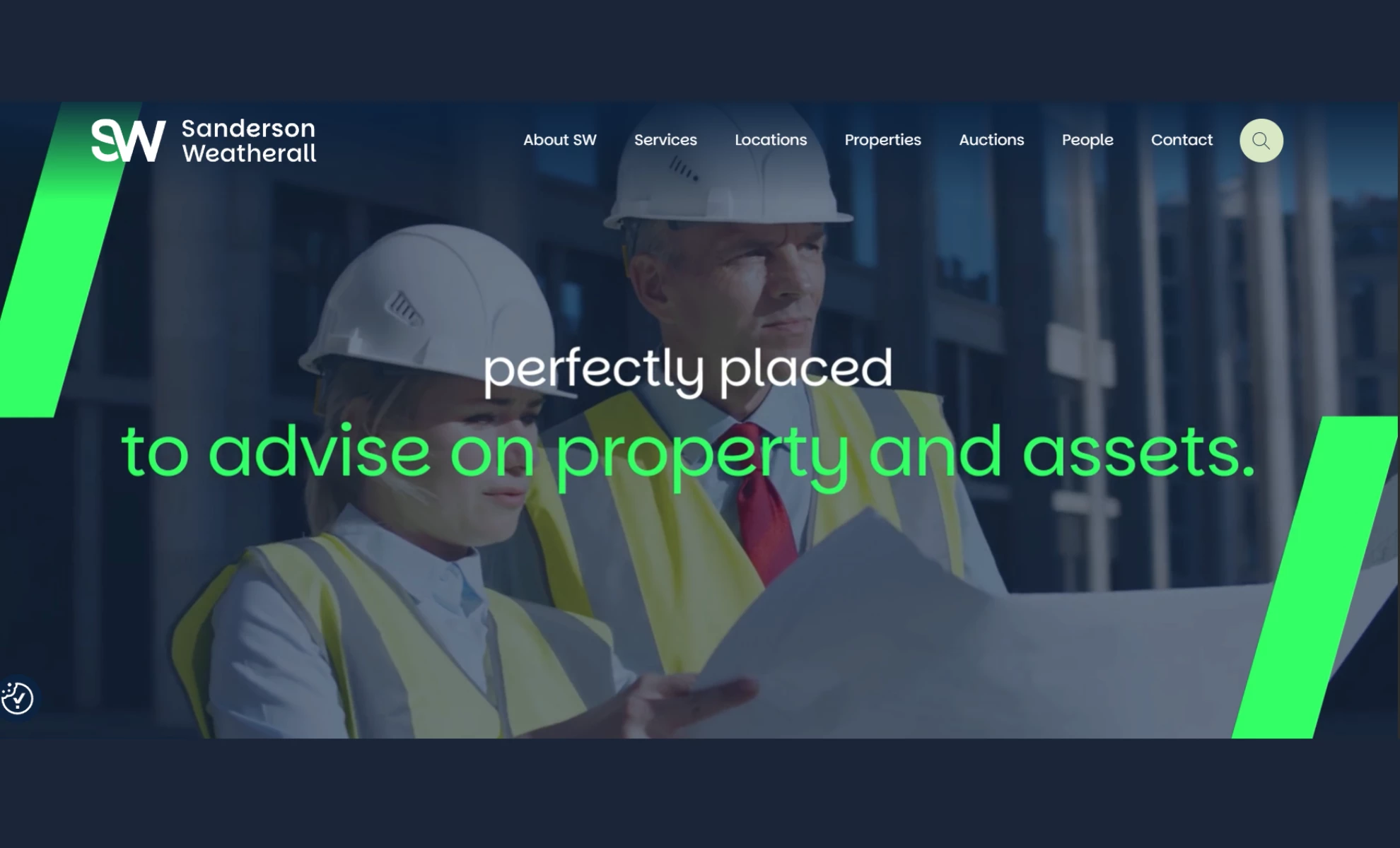
Sanderson Weatherall is a UK property consultancy selling valuation, management, and advisory services to commercial clients. Show + Tell built for retrieval rather than for exploration.
Navigation uses plain labels and a shallow hierarchy, which gets a visitor to a named service in one or two clicks. Service information runs in a gallery-style presentation rather than a page of prose.
Photography of consultants working sits behind text blocks throughout, in place of stock buildings. Clean lines and white space keep the pages calm at the length these descriptions run to.
Why it works: A commercial client arrives having already decided they need a valuation. Shallow navigation confirms the firm does it in seconds, and photographs of actual staff answer the question about who turns up.
Read more about this real estate website design in the full Sanderson Weatherall website design analysis.
14. Covivio by Be API
[Source: Covivio]
Standout features:
- White canvas layout
- Serif body typography
- Portfolio-scale imagery
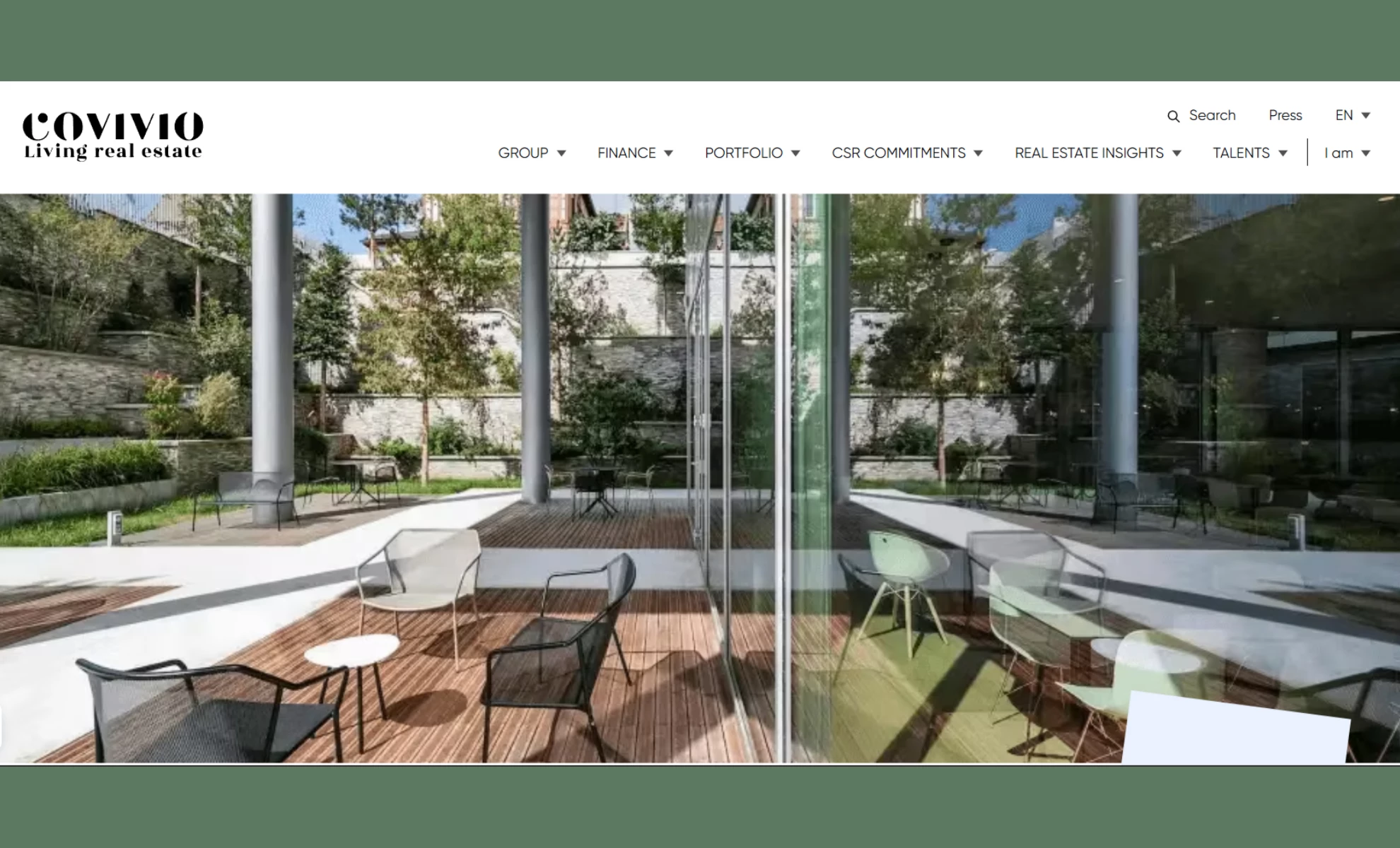
Covivio is a European commercial property group, and Be API rebuilt its site with the Covivio team. A listed property group talks to tenants, investors, and journalists at once.
A clean white background carries large photography of the portfolio, and the scale of the images does the work a client logo wall would do elsewhere. Serif typography sets the tone.
Be API also rebuilt the back office. The agency delivered a content management setup the Covivio team runs itself, which for a portfolio this size decides whether the site stays current.
Why it works: A property group's site is judged on whether the portfolio looks well managed. Handing content control to the internal team is what keeps that true in month 14.
Read more about this real estate website design in the full Covivio website design analysis.
15. Castell Management by Atelier Design
Standout features:
- Dark blue mission blocks
- Ida Thin typeface
- Copy-led page structure
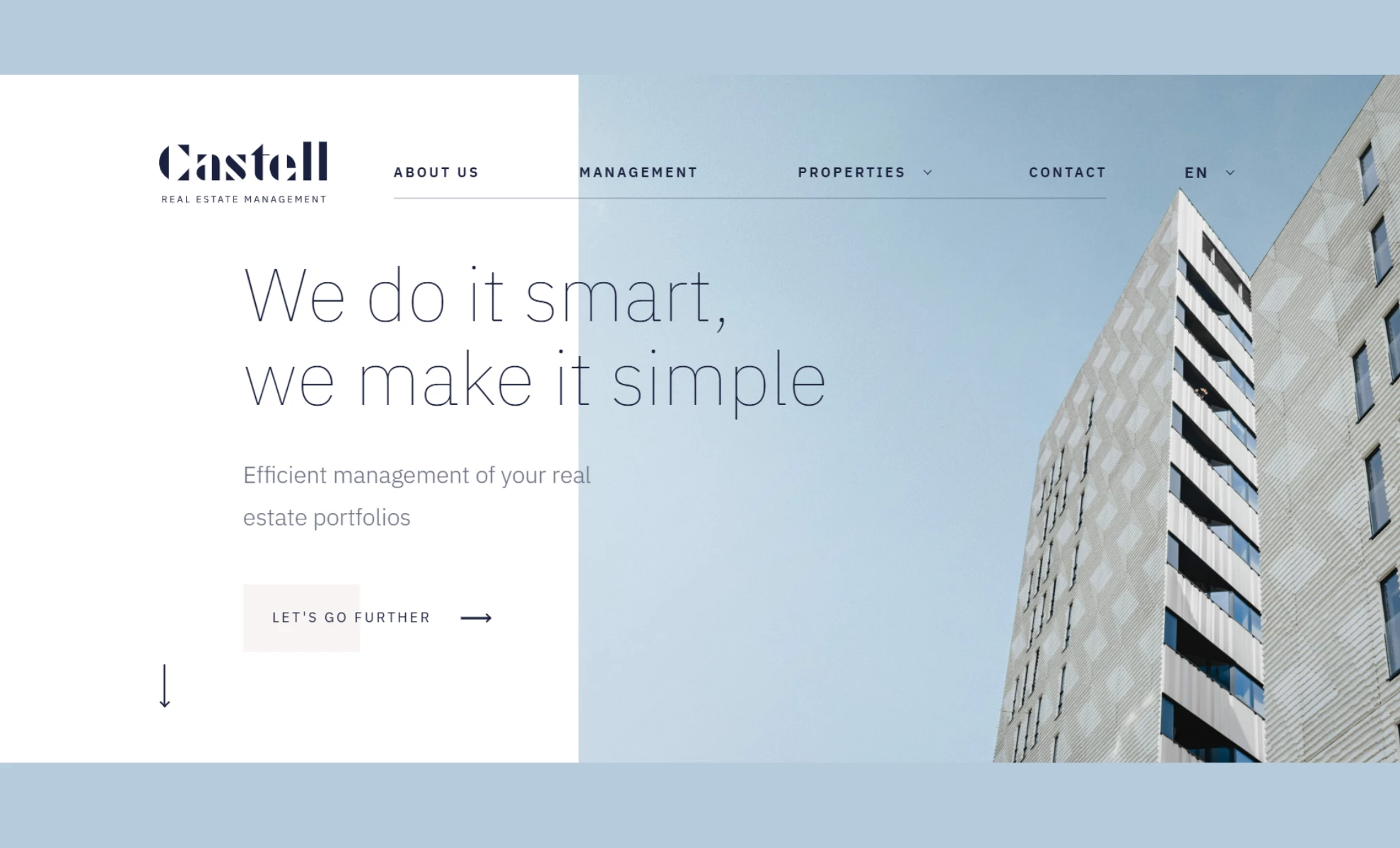
Castell Real Estate Management runs management, brokerage, and short-term rental services in Brussels. Property management sells competence rather than inventory, so Atelier Design let the writing lead.
Custom visuals and property images sit between blocks of text with enough negative space that the copy is the thing being read. The typeface is Ida Thin, a legible sans-serif set at a size that survives long paragraphs.
Scrolling down, dark blue blocks interrupt an otherwise low-key palette and carry the mission statements. Those blocks are the only saturated color on the page.
Why it works: A landlord choosing a manager reads service descriptions rather than looking at photographs. Castell puts the description first and uses color once, at the point where the promise is made.
Read more about this real estate website design in the full Castell Management website design analysis.
16. Forty Ninth Living by Khula Design Studio
Standout features:
- Four-filter unit finder
- Salmon pink CTAs
- Three-column results grid
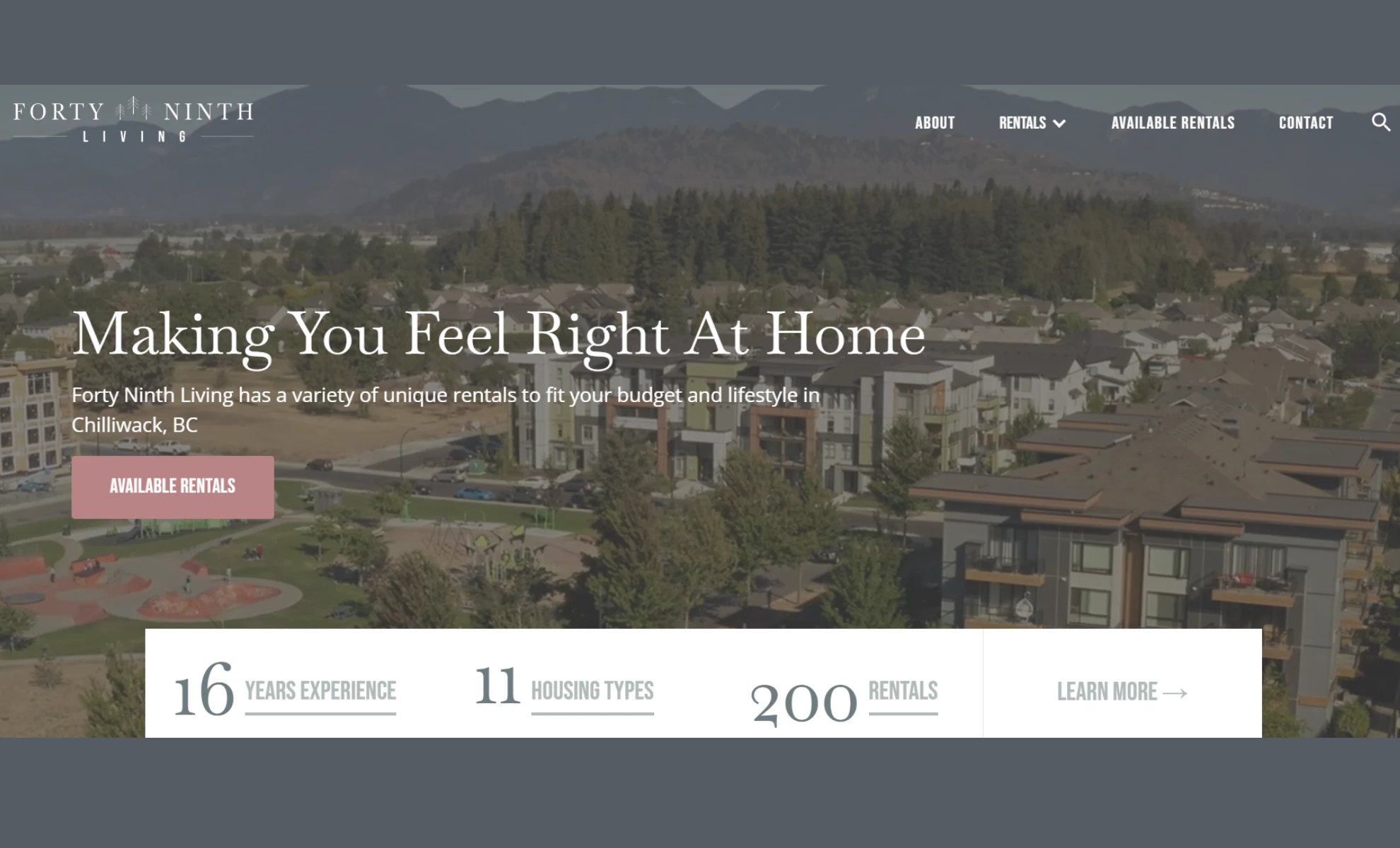
Forty Ninth Living rents apartments, suites, townhomes, and family homes in Chilliwack, British Columbia. Khula Design Studio had to hold four housing types in one interface without building a portal.
The "Find Your Unit" page does that work. Filters for housing type, bedrooms, bathrooms, and price range sit on the left, and results run three across on the right.
Clicking a photo opens a detail page with high-resolution images, floorplans, and the essentials. The palette runs light to dark grey with blue undertones and uses salmon pink for calls to action only.
Why it works: Contentsquare's 2025 Digital Experience Benchmark, drawn from 90 billion sessions across 6,000 websites, found sites lifting session depth by 10% or more saw an average 5.4% conversion lift.
A renter who compares six units is closer to a viewing than one who saw a hero image. Filters exist to raise that count, which is the whole commercial case for building the page.
Explore the Forty Ninth Living website design review in full.
17. CoParadiso by Allan Pooley
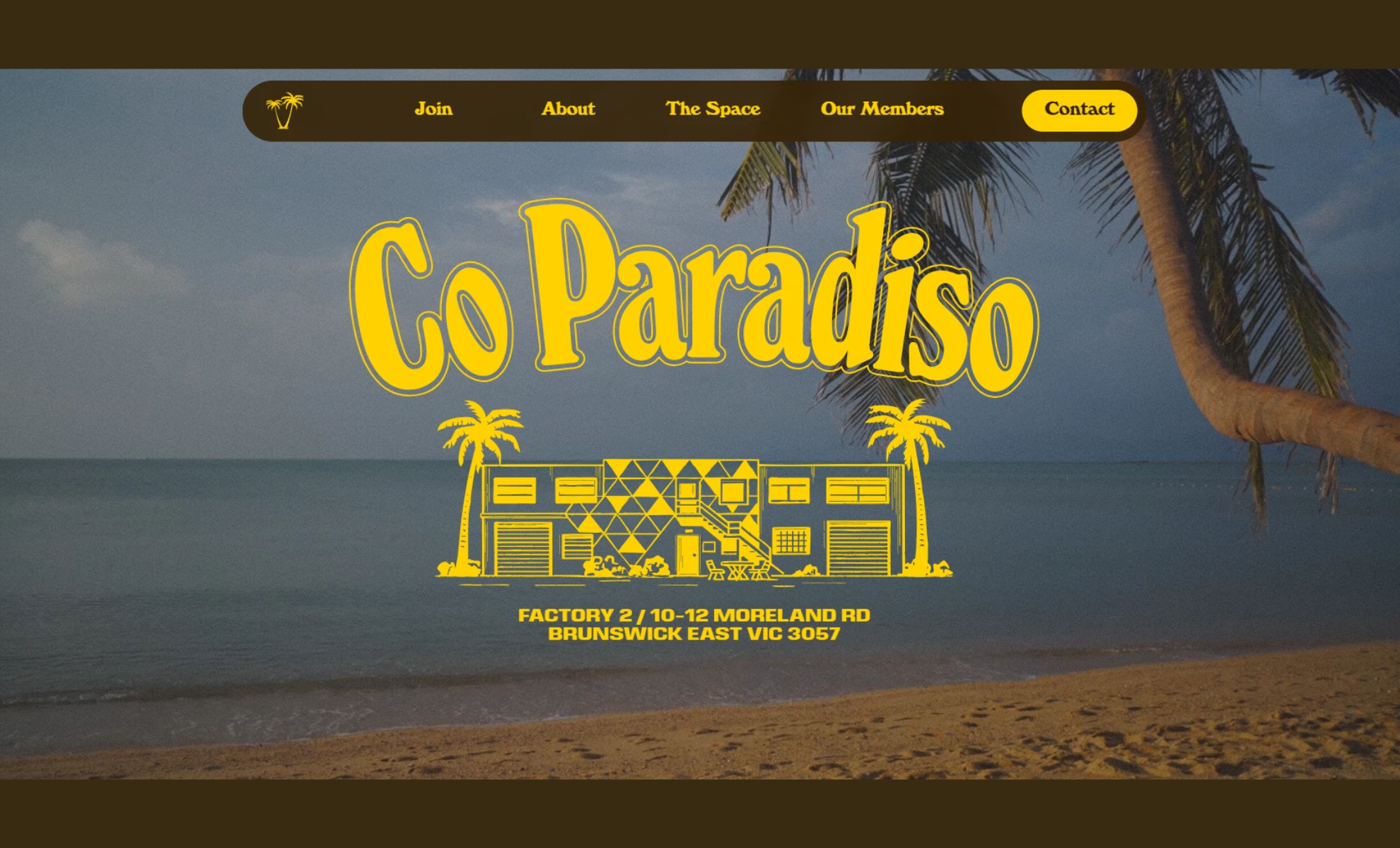
Standout features:
- Weekly pricing on page
- Members as top-level nav
- Pill-shaped brown navbar
CoParadiso is a coworking space at Factory 2, 10-12 Moreland Rd in Brunswick East, Melbourne, and DesignRush categorizes and tags it as real estate. It leases space by the week.
Allan Pooley skipped both of the usual coworking looks. Instead of corporate clean or startup minimal, the site runs 1970s tropical kitsch in brushy script and warm espresso tones with gold accents.
Navigation sits in a pill-shaped brown bar holding Join, About, The Space, Our Members, and Contact. The footer repeats the same links, so wayfinding never disappears on a long scroll.
Pricing is on the page rather than behind a form. Hot desking runs $60 per week plus GST or $40 as a daily drop-in, a permanent desk runs $110, and private studios are quoted per room.
Why it works: Contentsquare's 2025 benchmark put the rise in cost per visit at 9% year over year and 19% across two years. Every visit lost to a hidden weekly rate costs more than it did last year.
Explore the CoParadiso real estate web design in full.
18. Scott Salisbury Group by Digital Noir
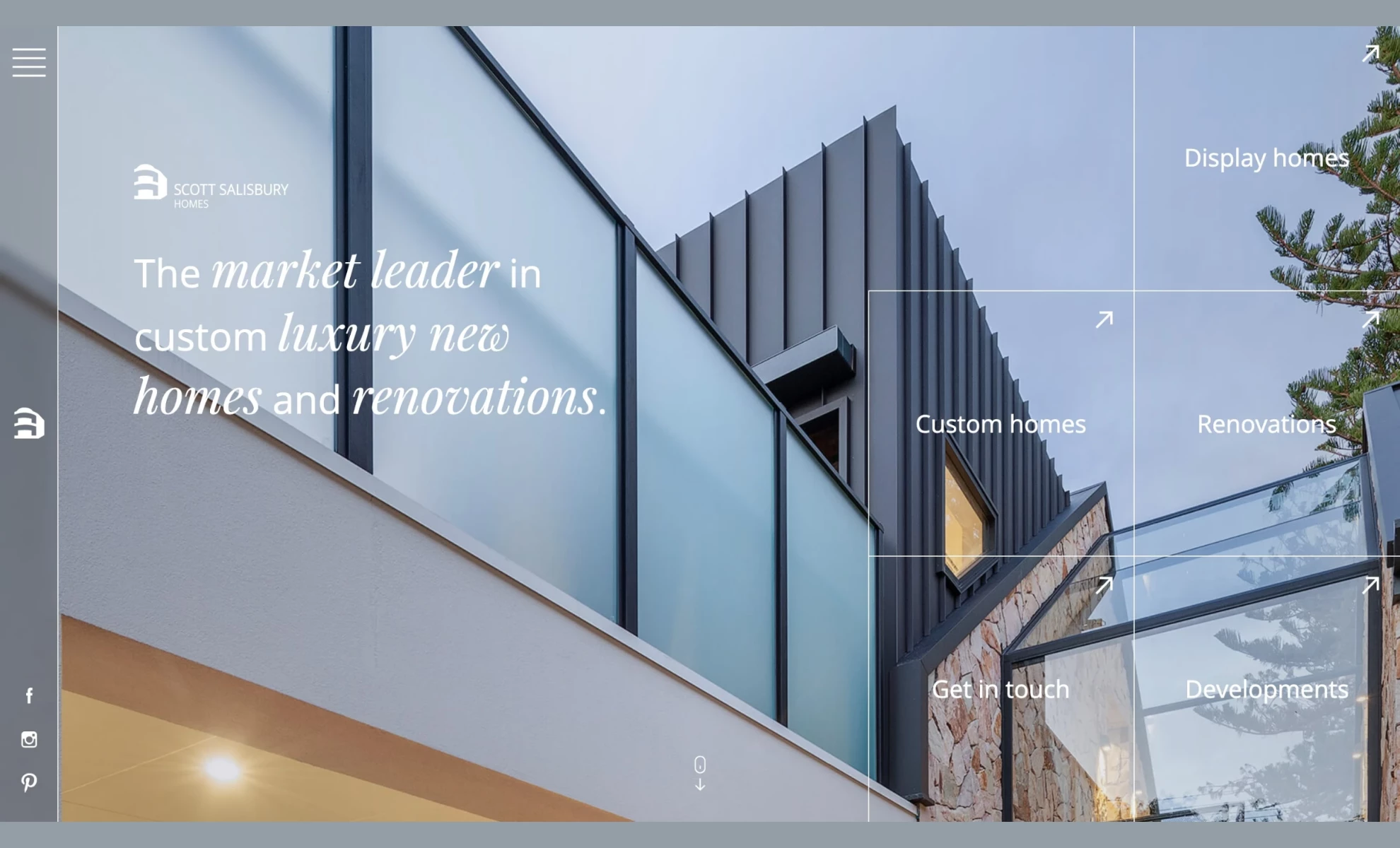
Standout features:
- Left-side hamburger
- Grid puzzle shortcuts
- Message-first page blocks
Scott Salisbury Group designs and builds luxury homes in Adelaide, and the firm sells the guided service it puts around the build. Digital Noir carried that into a site where the writing leads.
Pages are built around brand messages set in negative space, with simple typography and small hover effects. High-resolution photography of Scott Salisbury's own homes is the evidence for the claims about build quality.
The navigation breaks a convention on purpose. The hamburger sits at the upper left, and the right side of the panel holds grid puzzle pieces that jump straight into categories.
Why it works: The site sells the process before the finishes, which is what a custom home buyer is choosing between.
Two ways out of one menu serve the browser and the returning visitor from the same panel.
Read the complete Scott Salisbury Group website design breakdown.
19. Orange Design Studio by Fishtank Agency
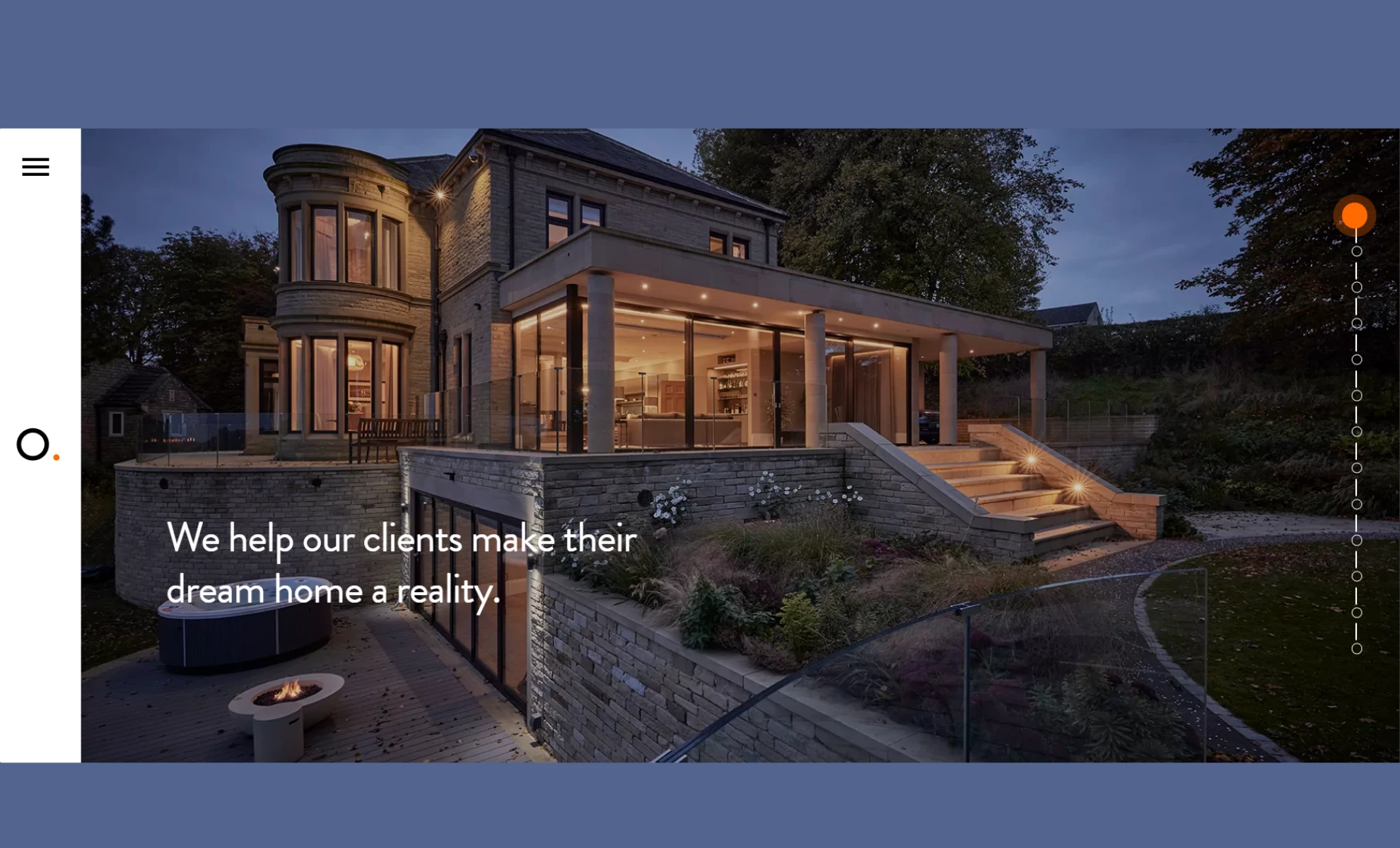
Standout features:
- Orange dot cursor
- Sequential menu order
- Text and image balance
Orange Design Studio is an architectural practice in Mirfield, Yorkshire, working with clients who arrive with an idea and no drawings. The first conversion is a conversation rather than a project.
The custom orange dot cursor is the one piece of personality on an otherwise restrained page. A sticky hamburger opens an on-brand panel whose links run in the order a client moves through a project.
Architectural photography and short informative text alternate down the page in roughly equal measure. Neither the pictures nor the copy could answer the buildability question alone.
Why it works: Ordering the menu by project stage shows a prospective client the practice understands the sequence they are about to enter, before a single project page opens.
Read the complete Orange Design Studio website design breakdown.
20. Traçat: Arquitecture 360 by Jose Sentis
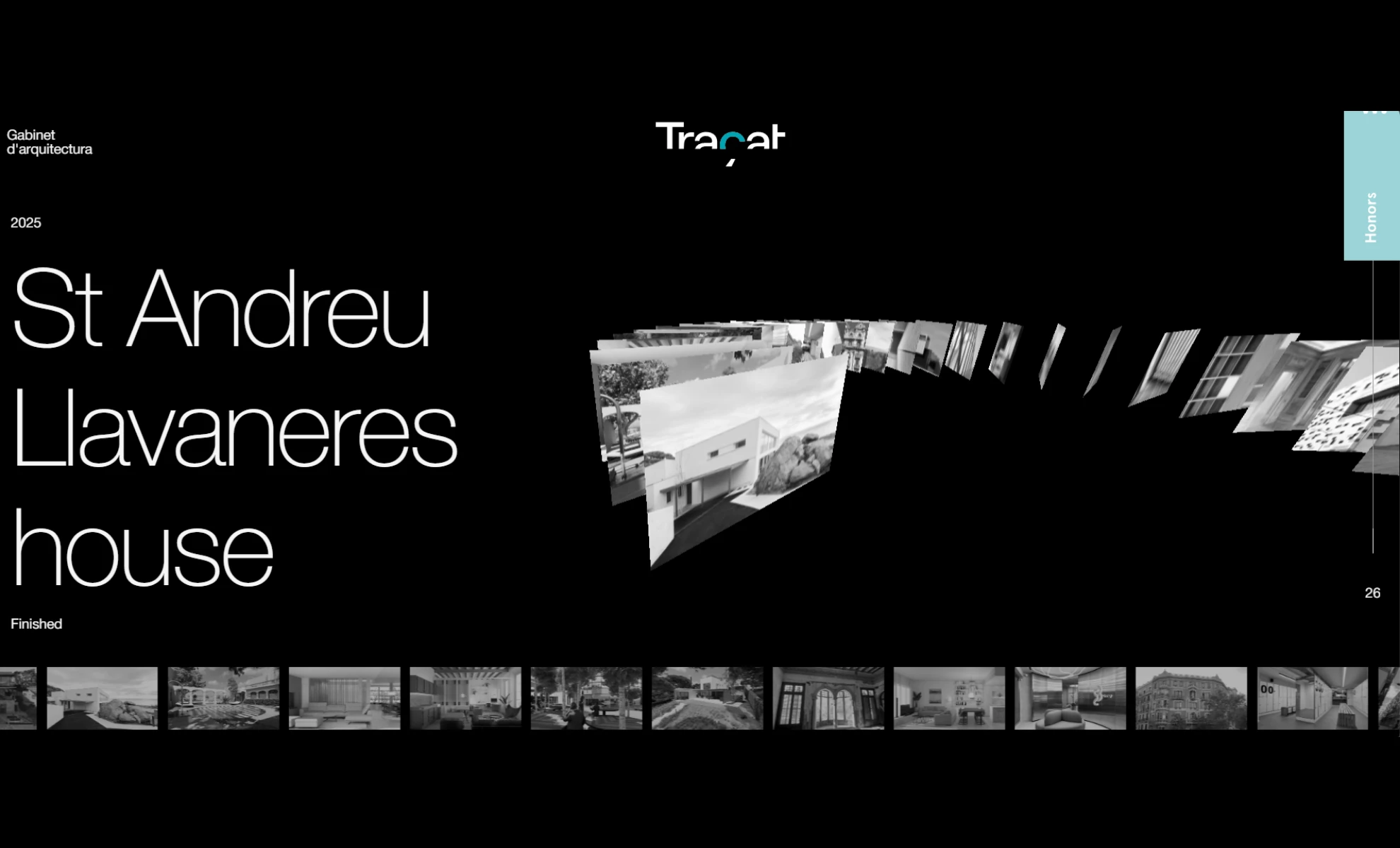
Standout features:
- Single-page architecture
- 360-degree conveyor gallery
- Dark UI with accent
Traçat: Arquitecture 360 is a Barcelona architectural practice, and Jose Sentis built the whole site as a single page. One page removes every navigation decision between arriving and looking.
The conveyor-style 3D gallery rotates a full 360 degrees, showing a building from angles a photograph set would not cover. Clicking an image opens a fuller set of visuals from that project.
The dark interface holds contrast against bright building images and keeps a long scroll comfortable. A single accent color marks the interactive parts.
Why it works: Rotation answers a question a front elevation cannot, which is what the building's form does in three dimensions. It costs less than commissioning a walkthrough render for every project.
Read the complete Traçat: Arquitecture 360 website design breakdown.
What Makes a Good Real Estate Website Design?
A good real estate website design answers one visitor's question before it sells anything. The visitor has usually already done the finding for you: 52% of buyers found the home they purchased online, and 70% used a mobile or tablet device during the search, according to NAR's 2025 Profile of Home Buyers and Sellers.
Eighty-eight percent of them still bought through an agent or broker. The site's job is not the sale: it's the handoff. This means picking one transaction to serve and keeping property data accurate.
The handoff has a shelf life, too. Harvard Business Review's audit of 2,241 US companies found:
- 42 hours: Average first response time.
- 7x more likely: Leads contacted within an hour were nearly seven times more likely to qualify than those contacted an hour later.
- 60x more likely: Leads contacted within an hour were more than 60 times as likely to qualify as those contacted a day later.
The six requirements below separate the best real estate website design work in a market from a portfolio with a contact page attached:
- Design for One Transaction at a Time
- Property Data That Updates Itself
- Local Identity as a Design Decision
- Video Doing What a Headshot Cannot
- Accessibility for a Median Buyer of 59
- Lead Capture Built for Sellers
Design for One Transaction at a Time
Buyers, sellers, tenants, and investors want four different things. A homepage offering all four equally serves none of them well, so pick the transaction that pays and let the other three reach their page from the navigation.
Miami Warehouse Real Estate serves industrial buyers and tenants in the first line of its hero. Majeli Vassart Properties serves sellers of off-market estates and never publishes a price.
The failure case is a homepage carrying a search bar, a valuation widget, an agent roster, and an investment pitch in one viewport. A visitor reads the one that matches their intent and ignores the rest.
DesignRush's guide to intuitive real estate websites works through the navigation patterns that keep a single route clear. The choice costs nothing at wireframe stage and a rebuild afterwards.
Property Data That Updates Itself
IDX stands for Internet Data Exchange, the arrangement letting a brokerage publish another brokerage's listings from the local Multiple Listing Service. Without it, someone retypes prices and statuses by hand.
DesignRush's directory of real estate web design companies names four things that separate the specialists. Property databases, listing integration, virtual tours, and mortgage calculators all sit behind the interface.
Those four items are what push a property build past a brochure-site budget. None of them is visible in a screenshot, which is why cheap quotes and expensive ones can look identical.
Casaverse runs the pattern at listing scale, with card modules holding a price and a bedroom count in the same position every time. Miami Warehouse takes the opposite route, publishing 22 closed transactions as a curated record.
Local Identity as a Design Decision
Property cannot be shipped, so the location is half of what is being sold. A brokerage that buys a national portal template ends up with the same page as every competitor in its market.
Belyi Ostrov House opens on Beloostrovskaya Ulitsa and the transport and retail around it, then works inward to the apartments. CoParadiso names inner-north Brunswick in its hero line and builds the palette around it.
The transferable move is treating the map as content rather than as a footer widget. ERA built its neighborhood tour in WebGL, and 111 West 57th Street gives the neighborhood a top-level navigation slot.
A designer who gets the location right in the layout still has to get it right in the logo. The collection of real estate branding examples shows where a logo undoes work a site had already done.
Video Doing What a Headshot Cannot
A still hero image of a lobby proves the lobby exists. Twelve seconds of the same lobby with people moving through it proves what time of day it gets light and how loud it is.
K11 ARTUS opens on full-screen video and an interactive clock walking a visitor through a day at the residence. 111 West 57th Street runs video in the hero and holds the footage-led treatment down the page.
Video is also the heaviest asset a property page loads. Both sites pair it with restrained typography and few competing elements, which is what keeps the page usable on a phone.
Accessibility for a Median Buyer of 59
The National Association of Realtors’ 2025 Profile of Home Buyers puts the median buyer at 59 and the median repeat buyer at 62. Both are records.
Those figures come from 6,103 responses collected between July 2024 and June 2025. Repeat buyers are the ones with equity, and 30% of them paid all cash.
Type size and contrast are commercial decisions on a site aimed at that group. Neither is a matter of taste once the median reader is approaching 60.
WebAIM's 2026 Million found WCAG 2 A/AA failures on 95.9% of the top million homepages and low-contrast text on 83.9%. That second figure rose from 79.1% after six years of steady improvement.
Light type over a photograph is where property sites fail this, because the hero is the one place designers put white text on an uncontrolled background. Miami Warehouse Real Estate answers it with a dotted overlay.
Lead Capture Built for Sellers
Most property sites are built entirely for the buyer side. The 2025 NAR Profile found the median seller had owned the home for 11 years, so a seller reaches a site like this roughly once a decade.
That same survey found 91% of sellers used an agent or broker, with for-sale-by-owner at a record-low 5%. The design answer is a persistent, low-commitment route for someone who wants a number rather than a viewing.
Miami Warehouse Real Estate runs the cleanest version here, offering a question, an opinion of value, or a list of available properties in one form. A seller picks the middle option without having to explain themselves.
8 Real Estate Web Design Trends Shaping 2026
Across these 20 real estate website designs, the real estate website trends of 2026 keep arriving at the same idea. The site now does the work the transaction used to need a person for.
Josh Koenig, Co-Founder and Chief Strategy Officer at Pantheon, frames why that concentration matters.
"A brand's website is the only part of the digital experience they fully own or control," he says.
Everything else is rented, he told DesignRush. "As social media continues to grow as a way to connect with audiences, the power of a cohesive website is more vital than ever.''
In this section:
- The Homepage Sells the Location First
- Video as the First Frame
- WebGL and Real-Time 3D for Pre-Construction
- Two Routes Into the Same Inventory
- Editorial Typography Instead of Portal Defaults
- Numbers on the Homepage as Credibility
- What the Site Publishes and What It Withholds
- Dark Interfaces for Portfolio-Led Firms
1. The Homepage Sells the Location First
Belyi Ostrov House opens on the district and its transport and retail before it reaches an apartment. CoParadiso names inner-north Brunswick in the hero line and builds the palette around it.
The number: NAR's 2025 Profile found the median seller moved 30 miles. Most buyers in a market are already local, so they are comparing streets rather than cities.
2. Video as the First Frame
K11 ARTUS opens on full-screen video with an interactive clock, and 111 West 57th Street runs video in the hero and keeps footage leading down the page. Neither treats it as an accent below the fold.
Jonathan Drake, Co-founder and Creative Director at RedCube Creative, treats production quality as a hiring signal.
"A great-looking website and quality video are a huge step in the right direction," he says.
He treats both as evidence a client weighs before hiring. "It is a credibility for people looking to hire you and your business," Drake told DesignRush about creative content.
A website design for realtors selling their own service is where that matters most, since the agent is the product.
3. WebGL and Real-Time 3D for Pre-Construction
ERA's splash screen animates five layers of 3D models and its neighborhood map runs in WebGL. Belyi Ostrov House reaches a similar effect with pseudo-3D and parallax at a fraction of the technical cost.
The number: HTTP Archive's 2025 Web Almanac found only 48% of mobile origins pass all three Core Web Vitals. That is the constraint every real-time 3D property site designs against.
4. Two Routes Into the Same Inventory
Agate Luxury Residence offers a layout view with clickable floors and a List view with filters over the same apartments. Forty Ninth Living runs a four-filter finder against a three-column grid.
The same thinking is showing up in the header. Avantgarde Properties turns its sticky menu into a search bar on scroll, and Belyi Ostrov House collapses a hamburger into a side panel.
The number: Contentsquare's 2025 benchmark found sites raising session depth by 10% or more saw an average 5.4% conversion lift. A second route costs one template rather than one more listing.
5. Editorial Typography Instead of Portal Defaults
Majeli Vassart Properties pairs a high-contrast serif with a crisp sans and lets white space set the pace. 111 West 57th Street runs Teodor for display and Neue Haas Grotesk Text Pro for the interface.
A buyer who has scrolled 40 listings in one font notices the 41st in a different one. That is the argument for licensing a typeface on a single-building site, since portal listings all render in the same system stack.
The number: Monotype and Neurons tested typeface choice with 400 UK participants in 2022 and measured a 13% lift in message relevance and a 9% lift in trustworthiness.
6. Numbers on the Homepage as Credibility
Miami Warehouse Real Estate sets 150+ years of combined experience and career transaction volume in large numerals with space around them. Avantgarde Properties runs its awards row in the same position.
Both are checkable by a visitor in a way an adjective is not. A combined-experience figure can be tested against the team page, and an award can be looked up.
7. What the Site Publishes and What It Withholds
CoParadiso publishes $60 per week for hot desking on the page, and Casaverse puts AED prices on every listing card. Both sell into markets where a visitor compares three or four options in one session.
The opposite call works at the top of the market. Majeli Vassart Properties lists NDAs and data rooms under "Confidentially First" with no price anywhere, and 111 West 57th Street routes every number through an Inquire button.
The number: NAR's 2025 Profile found all-cash buyers at a record-high 26%, and 30% of repeat buyers paid cash. That segment will make a phone call rather than fill in a filter.
8. Dark Interfaces for Portfolio-Led Firms
Traçat: Arquitecture 360 runs a dark single-page interface with one accent color. ERA builds on #191B1D so its render work and light effects hold contrast.
Both show architectural imagery rather than lifestyle photography, and a dark surround stops a bright render competing with a white page. The pattern gets worse on listing-heavy sites, where dark card grids are harder to scan at length.
Two of these trends carry a cost the other six do not. Video and real-time 3D both add weight to the page and a line to the budget, so they belong in the brief rather than a later revision round.
Not all real estate website trends are confined to property. The roundup of best modern website designs tracks the same moves across other categories.
What a Real Estate Website Design Costs and How Long It Takes
Industry | Cost Range |
SaaS & Tech | $10,000 to $100,000+ |
Financial Services | $10,000 to $80,000+ |
Healthcare | $7,000 to $70,000+ |
Media & Entertainment | $7,000 to $50,000+ |
eCommerce & Retail | $5,000 to $50,000+ |
Travel & Hospitality | $5,000 to $45,000+ |
Real Estate | $5,000 to $40,000+ |
Education | $5,000 to $40,000+ |
Professional Services | $3,000 to $30,000+ |
Nonprofits | $3,000 to $20,000+ |
Source: DesignRush web design pricing data.
Firms selling the highest-value assets in the economy are commissioning among the cheaper websites.
Healthcare and financial services sit higher because of regulatory compliance and secure client portals, and property has no equivalent regulatory driver.
Alex Schupp, Founder of Crowd Digital Marketing, reads that gap as a mispriced risk rather than a saving. "An outdated or unattractive website can cause customers to leave," he says.
"Businesses should invest in a professional, user-friendly design," Schupp told DesignRush in an interview on eCommerce conversions.
What Sets a Real Estate Budget
Three things decide where a property build lands inside that band, and none of them is the page count. Each one is an integration rather than a design decision.
- IDX or MLS integration. Connecting to a local board's feed is the item that most reliably moves a build into the top tier, because the feed brings a custom CMS with it.
- CRM connection. Enquiries have to reach a named agent rather than a shared inbox, which means routing rules and field mapping on top of the form itself.
- High-resolution media handling. Photography, floorplans, and video all have to load on a phone, which is a performance budget rather than a design choice.
To build a real estate website carrying all three, expect the top of that band or above it. A custom real estate website design at that level is an integration project with a design layer.
A single-development site like Agate or a practice portfolio like Traçat sits near the bottom. The inventory is fixed, nothing has to sync, and a custom real estate website design there is a design job rather than a data one.
How Property Scope Maps to Cost and Timeline
Project type | Typical property equivalent | Cost | Timeline |
Simple, 1–5 pages, no CMS | Single agent or one-building teaser | $7,000–$10,000 | 2–3 weeks |
Small business, 5–15 pages, CMS | Boutique agency, curated listings | $10,000–$15,000 | 5–7 weeks |
Mid-complexity, 15–40 pages, custom CMS | Development site with unit selector | $15,000–$30,000 | 10–14 weeks |
Complex, custom features and integrations | Brokerage with IDX and CRM | $30,000–$80,000 | 4–6 months |
Enterprise or custom platform | Multi-office or portfolio group | $60,000–$100,000+ | 4–6+ months |
Source: DesignRush web design pricing data, US agency projects. Property equivalents based on DesignRush editorial mapping.
The hours behind those bands run to 138 for a simple build, 261 for mid-complexity, and 500 or more for a complex one.
The US blended rate is $145 an hour, so the cost to build a real estate website tracks integration hours more than page count.
Additional pages run roughly $1,500 templated and $2,500 custom. That is the number to hold in mind before agreeing to a neighborhood guide for every suburb you cover.
What Pushes a Property Build Over Budget
Overrun cause | Typical increase | Why it hits property builds |
Integration complexity | 10–25% | A local MLS feed rarely matches the field structure a designer assumed |
New features mid-project | 15–30% | A valuation tool or map layer added after the wireframes are signed |
Client content delays | 10–15% | Photography for 40 listings that has not been commissioned yet |
Extra pages | 5–25% | Neighborhood and development pages multiply faster than expected |
Rush premium | 25–50% | A launch pinned to a development's sales release date |
Source: DesignRush web design pricing data.
Integration complexity and content delays hit property hardest, and both are cheap to settle at the brief stage. Ask for the MLS field mapping and the photography schedule before the contract is signed.
Comparing an agency quote against a solo designer is a separate calculation. DesignRush's breakdown of freelance versus agency cost sets out where each option stops being the cheaper one.
8 Real Estate Website Design Mistakes These 20 Sites Avoid
Each mistake carries a check you can run today and a fix with an effort estimate and the metric that proves it worked. They run cheapest first, and the 20 real estate website designs above are the counter-examples.
In this section:
- Leaving the Site to Age
- Light Type Over an Uncontrolled Photo
- Hiding the Price Behind a Form
- One Homepage for Four Audiences
- A Contact Form That Asks for an Essay
- Hand-Maintained Listings
- Unbudgeted Media Weight
- Breaking a Convention Without a Reason
1. Leaving the Site to Age
A listing carrying a wrong price or a sold status is visible to every visitor who opens it. Property sites show their age faster than most categories for that reason.
Ray Cheselka, COO at webFEAT Complete, puts maintenance ahead of redesign. "Your website is a representation of your brand," he says.
The consequence he names is reputational rather than technical. "If it's not maintained and leveraging SEO for user experience and helpful content, your brand may seem dated and lack appeal to prospective customers."
Cheselka made the point in a DesignRush interview on AI-driven SEO. His record sits on LinkedIn, where the same maintenance-first argument runs through his posts.
The check: Open your three most-visited listing pages and find the last date anything on them changed. Then do the same on your neighborhood pages, which age quietly while ranking for the searches you want.
The fix: Put a standing monthly pass in one person's calendar, roughly two hours, covering listing status, agent bios, and any page naming a year. DesignRush's guide to content marketing for real estate covers what belongs on that calendar. Watch the share of listing pages with a status changed in the last 30 days.
2. Light Type Over an Uncontrolled Photo
Every property hero is a photograph nobody graded for contrast, which makes this failure structural rather than careless. With a median buyer of 59, it costs revenue before it costs compliance.
The check: Load your homepage on a phone outdoors in daylight and read the hero headline at arm's length. Repeat it on the three property templates, since a hero that works over a dark interior fails over a bright exterior.
The fix: Add a darkening scrim behind hero type, in the pattern Miami Warehouse Real Estate uses, at roughly half a day. Set it as a token in the design system so every new listing photo inherits it. Watch the hero call-to-action click rate.
3. Hiding the Price Behind a Form
A visitor comparing four properties in one session drops the one that will not tell them the number. CoParadiso and Casaverse both publish, and both compete where the alternative is one click away.
The check: Count the clicks from landing page to a visible price, then ask someone outside the business to do it while you time them. Anything over two clicks is a decision rather than an accident.
The fix: Move the number onto the listing card or the tier block, roughly an hour per template. Where a price genuinely cannot be published, put a range or a "from" figure there instead, since a missing number tells a buyer to assume the highest one. Watch bounce rate on listing index pages.
4. One Homepage for Four Audiences
A homepage giving buyers, sellers, tenants, and investors equal weight gives each of them a quarter of a page. Miami Warehouse Real Estate picks two in its first hero line and puts everything else one click away.
The check: Read your hero headline aloud and name the single person it was written for. If you name two, check which of them your last ten enquiries came from.
The fix: Rewrite the hero for that one audience and give the others a named navigation item, one to two days of copy work. Keep the discarded audiences as landing pages rather than deleting them, since they still rank. Watch scroll depth past the hero.
5. A Contact Form That Asks for an Essay
An open message field asks a seller to describe their situation before anyone has given them a reason to. The three-option form on Miami Warehouse Real Estate lets a visitor identify themselves in one click.
The check: Count the fields on your enquiry form and how many are required. Then read the last 20 submissions and see how many free-text boxes said anything useful.
The fix: Replace the free-text field with three intent options and route each to a different follow-up, roughly one day including the CRM rules. Keep the message box, but make it optional and put it last. Watch form completion rate and the mix of enquiry types arriving.
6. Hand-Maintained Listings
Retyping prices and statuses from the MLS means the site drifts, and nobody notices until a buyer enquires about a sold property. Listing integration is one of the four things DesignRush names as separating property specialists.
The check: Pick five listings and compare price and status against the MLS record. Then ask whoever maintains them how long a full update takes, and multiply by your listing count.
The fix: Scope IDX or MLS integration as its own project rather than a task, budgeting the 10% to 25% integration band. Ask your board for the field mapping first, since that document decides how much of the work is design and how much is data. Watch the count of stale listings per month.
7. Unbudgeted Media Weight
Photography is the product on a property site, so these pages start heavier than the median and gain weight with every listing added. Speed pays back directly on lead-generation pages.
The check: Run your busiest listing page through a Core Web Vitals report on mobile, then run a competitor's. Note the image payload specifically, since that is where property sites lose rather than in scripts.
The fix: Serve modern formats, compress at upload rather than after, and lazy-load everything below the fold, two to three days. Put a file-size ceiling in the photography brief so the problem stops arriving. Watch Largest Contentful Paint on mobile.
8. Breaking a Convention Without a Reason
Scott Salisbury Group puts its hamburger at the upper left, and it works because the panel's right side carries grid shortcuts, giving a returning visitor a faster route. A convention broken for nothing costs the seconds someone spends hunting for the menu.
The check: Ask three people who have never seen the site to find the contact page, and time them. Then ask what they expected to click first.
The fix: Either restore the convention or add the compensating shortcut that justifies breaking it, half a day either way. Write down what the break buys before you keep it. Watch time to first navigation click.
Best Real Estate Website Designs: The Takeaways
Order the work by what it costs rather than by how much it matters. A top real estate website design is rarely the most expensive one in its market, and the best real estate website design in a given city usually finishes the first four items below before anyone opens a rebuild budget.
- Fix the hero contrast. Half a day, no budget. Watch the hero call-to-action click rate.
- Publish the price where the comparison happens. An hour per template, and it changes which enquiries arrive as much as how many.
- Simplify the enquiry form to three intent options. One day, including CRM routing. Watch the mix of enquiry types.
- Rewrite the hero for one audience. One to two days, and every later design decision inherits the answer.
- Compress the media. Two to three days, and it usually buys back more speed than changing framework would.
- Add a second route into the same inventory. About a week, and the first item here needing real design capacity.
- Integrate the listing feed. The 10% to 25% overrun band, and the point where a generalist web shop stops being the right supplier.
- Rebuild last. $5,000 to $40,000+ over four to six months, and only once the seven above have run out of room.
A rebuild that skips those steps reproduces the same problems in a new palette. That is how a brokerage ends up commissioning two sites in three years.
Design is one input among several, and how many people reach the page is settled upstream of it. DesignRush's guide to real estate digital marketing covers that side.
Where the underlying problem is the brand rather than the build, a redesign will not fix it. The directory of real estate branding agencies is the better starting point.

Our design experts recognize the most innovative and creative designs from across the globe. Visit Design Awards to see the:
- Best Logo Designs
- Best Website Designs
- Best Video Designs
- Best Print Designs
- Best Packaging Designs
- Best App Designs
Our team also ranks agencies worldwide to help you find a qualified agency partner. Visit our Agency Directory for the top Logo Design Companies, as well as:
- Top Web Design Agencies
- Top Video Production Companies
- Top Print Design Companies
- Top Packaging Design Companies