Connect with vetted headless CMS developers to drive better UX, conversions, and ROI through consistent omnichannel experiences. Filter agencies by expertise, budget, and location to find the right partner.
Organic rankings are determined by five factors: top services, reviews, portfolio, awards/press, and team expertise. Sponsored listings pay for a placement that appears above organic positions. Sponsorship does not affect star ratings or review content - read more on our methodology page.
Your Go-To Custom Software Solutions Partner
6sense HQ offers custom software solutions for businesses of all sizes, providing expert services in web development, managed delivery, custom software development, dedicated team options and UX design. With a proven track record of delivering top-quality solutions, our experienced team is committed to...
Top Services:
- Software Development
- Mobile App Development
- IoT
- Location
- Wilmington, Delaware
- Number of Employees
- Under 49
- Average Hourly Rate
- $49/hr
Big Agency Thinking. Small Team Focus.
The Hooten Agency helps brands communicate with clarity and purpose. We believe design is a powerful tool for human connection and we use it to help people and organizations express who they are, what they stand for, and why they matter...
Top Services:
- Graphic Design
- Branding
- Design Services
- Logo Design
- Product Design
- Show more
- Location
- Lafayette, Colorado
- Number of Employees
- Under 49
- Average Hourly Rate
- $150/hr
- Minimal Budget
- $1,000 - $10,000
Responsible AI to empower your business.
reza is an AI-native B2B growth agency for European service firms. We build the systems that compound: AI SEO that ranks in Google and AI assistants, conversion-ready websites, AI voice agents that answer inbound, and agentic workflows that run after the consultant logs off. Based in Vilnius. Serving Europe...
Top Services:
- Web Development
- AI Development
- Mobile App Development
- Software Development
- IT Services
- Show more
- Location
- Vilnius, Lithuania
- Number of Employees
- Under 49
- Average Hourly Rate
- $50/hr
- Minimal Budget
- $1,000 - $10,000
We build the systems companies actually run on.
Talegen combines enterprise engineering discipline with a practical Small to Medium-sized Business lens: reduce manual work, connect the right tools, and build custom systems only where they create durable value...
Top Services:
- Software Development
- AI Development
- Mobile App Development
- SEO
- AEO
- Show more
- Location
- York, Pennsylvania
- Number of Employees
- Under 49
- Average Hourly Rate
- $150/hr
- Minimal Budget
- $1,000 - $10,000
Custom Websites & Business Systems
Enrom is a South African web development company specialising in custom websites, business systems and digital solutions built around the way a business works. We design and develop professional business websites, custom web applications, workflow automation, systems integrations and ongoing website...
Top Services:
- Software Development
- Web Development
- Web Design
- Mobile App Development
- AI Development
- Show more
- Location
- Boksburg, South Africa
- Number of Employees
- Under 49
- Average Hourly Rate
- $30/hr
- Minimal Budget
- Under $1,000
Handcrafted Technology Solutions
At 9series, we help organizations move beyond traditional software by building intelligent systems powered by AI...
Top Services:
- Mobile App Development
- AI Development
- IoT
- Software Development
- Cloud Consulting
- Show more
- Location
- Tappan, New York
- Number of Employees
- 250 - 499
- Average Hourly Rate
- $40/hr
- Portfolios Count
- 3 Projects Listed
We Make Brands Shine
Odysense is a results-driven digital agency based in Doha, Qatar, helping businesses across the GCC grow through end-to-end digital solutions. With 12+ years of experience, we specialize in web design and development, mobile app development, custom software, UI/UX design, eCommerce solutions, and digital...
Top Services:
- Web Design
- WordPress Website Design
- eCommerce Development
- Web Development
- Digital Marketing
- Show more
- Location
- Doha, Qatar
- Number of Employees
- 50 - 99
- Average Hourly Rate
- $100/hr
- Portfolios Count
- 1 Project Listed
Transform Your Vision Into Digital Reality
Alisons Technology is an AI-powered software and IT services company helping businesses turn ideas into digital solutions. With 20+ years of experience and clients in 50+ countries, we build scalable web, mobile, and AI applications that drive innovation, automation, and efficiency...
Top Services:
- Mobile App Development
- Software Development
- Digital Marketing
- AI Development
- UI/UX Design
- Show more
- Location
- Nahwa, United Arab Emirates
- Number of Employees
- 50 - 99
- Average Hourly Rate
- $50/hr
- Minimal Budget
- $1,000 - $10,000
- Portfolios Count
- 3 Projects Listed
An agile and experienced marketing agency and consultancy. To be first, you must be fast.
Be More Cheetah is an agile marketing agency and consultancy known for its agility and effectiveness. We specialise in strategy and tactical deployment of projects and campaigns across various sectors.Unlock growth. Drive greater engagement. Enjoy improved ROI. Enjoy step-changing pace...
Top Services:
- Graphic Design
- Video Production
- Creative Services
- Web Development
- Social Media Marketing
- Show more
- Location
- Poulton-le-Fylde, United Kingdom
- Number of Employees
- Under 49
- Average Hourly Rate
- $200/hr
- Minimal Budget
- $10,000 - $25,000
Smarter IT Staff Augmentation. Powered by AI.
Based in Dallas, TX, Programmers.ai is a global technology partner leading the next generation of staff augmentation. With 1000+ developers and consultants, our team excels in hundreds of technologies across 15+ industries all trained in AI tools to deliver up to 2X productivity gains vs. traditional staffing...
Top Services:
- IT Services
- DevOps Consulting
- Staff Augmentation
- Software Development
- Software Testing
- Show more
- Location
- Texas City, Texas
- Number of Employees
- 250 - 499
- Average Hourly Rate
- $45/hr
- Minimal Budget
- $10,000 - $25,000
Your website should bring in customers. We make sure it does.
MooseBase is a US-based digital agency helping small businesses win online with websites, SEO, custom software and AI chatbots. We are small on purpose, so every client works directly with the person building their project. We also offer web applications and large scale websites for bigger companies with...
Top Services:
- Web Design
- Web Development
- SEO
- eCommerce Development
- Software Development
- Show more
- Location
- Sheridan, Wyoming
- Number of Employees
- Under 49
We build the systems that run your business
DeepRock Solutions is a Tbilisi software and AI studio for companies held back by spreadsheets, paperwork and manual routines. We build custom web, mobile and desktop systems, and add AI where it pays off: reading documents, checking them against your rules and taking routine decisions off your team. Every...
Top Services:
- Software Development
- AI Development
- Web Development
- Mobile App Development
- IT Services
- Show more
- Location
- Tbilisi, Georgia
- Number of Employees
- Under 49
- Average Hourly Rate
- $50/hr
- Minimal Budget
- $1,000 - $10,000
Simplify Complexity with Elegance with Ruby Shore Software.
Experience the elegance of simplified technology with Ruby Shore Software. We offer custom software development, captivating website design and expert digital media management. Simplify complexity with sophisticated software solutions...
Top Services:
- Web Design
- Digital Marketing
- Mobile App Development
- Software Development
- Creative Services
- Show more
- Location
- Shreveport, Louisiana
- Number of Employees
- Under 49
- Average Hourly Rate
- $150/hr
- Minimal Budget
- $10,000 - $25,000
- Portfolios Count
- 1 Project Listed
Engineering Excellence Meets Business Intelligence
Bit Byte Technology Ltd. is a strategic technical partner established in 2018 that builds scalable digital ecosystems for visionary businesses globally. Specializing in custom web applications, e-commerce development, and custom mobile apps, they bridge the gap between complex business challenges and elegant...
Top Services:
- Software Development
- Mobile App Development
- eCommerce Development
- Staff Augmentation
- Web Design
- Show more
- Location
- Dhaka, Bangladesh
- Number of Employees
- Under 49
- Average Hourly Rate
- $30/hr
- Minimal Budget
- Under $1,000
- Portfolios Count
- 1 Project Listed
True Strategy. Real Growth.
Strativera is a growth consulting and digital marketing agency that connects marketing, revenue operations, and execution into one system built to drive pipeline and revenue. We serve mid-market and PE-backed companies from startups to $500M+ enterprises...
Top Services:
- Digital Marketing
- SEO
- PPC
- Content Marketing
- AEO
- Show more
- Location
- Cherry Hill, New Jersey
- Number of Employees
- Under 49
- Average Hourly Rate
- $200/hr
- Minimal Budget
- $1,000 - $10,000
Enterprise AI and data, shipped in weeks
Bot2do builds production AI systems for enterprises: AI agents, computer vision, voice AI, and the data pipelines behind them. Our senior engineering team has shipped 900+ projects for global brands, and we work in weekly milestones so clients see working software from the first week, not a slide deck at the...
Top Services:
- AI Development
- Mobile App Development
- Software Development
- Big Data Analytics
- ERP Consulting
- Show more
- Location
- Chennai, India
- Number of Employees
- 50 - 99
- Average Hourly Rate
- $100/hr
- Portfolios Count
- 1 Project Listed
Your Engineering Partner For Production Software
We catalogued a jewellery manufacturer's stock last year and found around three lakh rupees of inventory nobody remembered they owned. Their monthly reports used to take five hours by hand. Now they take three seconds...
Top Services:
- ERP Consulting
- CRM Consulting
- Software Development
- Mobile App Development
- Web Development
- Show more
- Location
- Ajmer, India
- Number of Employees
- Under 49
- Average Hourly Rate
- $25/hr
- Minimal Budget
- $1,000 - $10,000
- Portfolios Count
- 1 Project Listed
B2B Web Design and Digital Marketing Agency
A leading digital marketing and web design agency with 25 years of success growing B2B, manufacturing, and healthcare companies through SEO, inbound marketing, ecommerce, and website development...
Top Services:
- Web Design
- Web Development
- eCommerce Development
- WordPress Website Design
- SEO
- Show more
- Location
- Louisville, Kentucky
- Number of Employees
- Under 49
Artware
Award WinnerRecipient of a Best Design Award for outstanding work.do it better
Artware is an independent award winning creative agency located in beautiful Greece. Our focus is on Branding, Web design and Content Creation...
Top Services:
- Web Design
- eCommerce Development
- WordPress Website Design
- UI/UX Design
- Branding
- Show more
- Location
- Kavala, Greece
- Number of Employees
- Under 49
- Average Hourly Rate
- $50/hr
- Minimal Budget
- $1,000 - $10,000
Web Design & Seo
Strategy-led web design studio based in Pretoria.We design and develop SEO-driven WordPress websites, helping growing businesses attract the right audience and turn traffic into measurable growth...
Top Services:
- WordPress Website Design
- Web Design
- SEO
- Digital Strategy
- Social Media Marketing
- Show more
- Location
- Pretoria, South Africa
- Number of Employees
- Under 49
- Average Hourly Rate
- $50/hr
- Minimal Budget
- $1,000 - $10,000
Strategize. Create. Succeed.
Notionhive is a globally-acclaimed agency that helps brands take their digital marketing game to the next level...
Top Services:
- Digital Marketing
- Web Design
- Social Media Marketing
- Web Development
- SEO
- Show more
- Location
- Dhaka, Bangladesh
- Number of Employees
- 50 - 99
- Average Hourly Rate
- $25/hr
- Minimal Budget
- $1,000 - $10,000
Agency Devoted to Strategic Business Development
Unbranded Manchester is a web design agency for market leading SME's. We rely on data insights, cutting-edge research & development strategies, and user experience design to drive growth and success...
Top Services:
- Web Design
- Web Development
- SEO
- Digital Marketing
- Show more
- Location
- Manchester, United Kingdom
- Number of Employees
- Under 49
- Average Hourly Rate
- $199/hr
- Minimal Budget
- $25,000 - $50,000
Innovative Technology. Passionate People.
Applifting is an international software company of over 200 self-managed professionals that specializes in FinTech and MedTech innovation. Our teal principles prioritize freedom, transparency, and ethics, driving our commitment to your success. We offer end-to-end software solutions, technical innovation...
Top Services:
- Software Development
- AI Development
- Mobile App Development
- UI/UX Design
- Branding
- Show more
- Location
- London, United Kingdom
- Number of Employees
- 100 - 249
- Average Hourly Rate
- $199/hr
- Minimal Budget
- $25,000 - $50,000
Brand strategy and rebranding for businesses in motion
Brand strategy and rebranding studio supporting established and growing businesses through positioning, identity and brand rollout...
Top Services:
- Branding
- Web Design
- Web Development
- UI/UX Design
- Logo Design
- Show more
- Location
- Sydney, Australia
- Number of Employees
- Under 49
- Average Hourly Rate
- $180/hr
- Minimal Budget
- $10,000 - $25,000
Strategize. Build. Secure. Scale.
GYSP.tech is a trusted global IT Consulting and Service Provider helping businesses strategize, build, secure, and scale Cloud, Data, AI/ML, SaaS and Ecommerce ecosystems to maximize operational ROI and competitive advantage...
Top Services:
- Cloud Consulting
- DevOps Consulting
- AI Development
- Software Development
- Staff Augmentation
- Show more
- Location
- New York City, New York
- Number of Employees
- 100 - 249
- Average Hourly Rate
- $25/hr
- Minimal Budget
- $1,000 - $10,000
Websites Designed For Performance,
The Creative Depot builds fast, modern websites engineered to perform. We focus on clarity, clean design, and real-world results. Sites that feel great to use, show up in search and AI systems, and convert visitors into customers. No templates, no outsourcing, just thoughtful strategy and expert craftsmanship...
Top Services:
- Web Design
- UI/UX Design
- SEO
- CRO
- Show more
- Location
- Lakeville, Minnesota
- Number of Employees
- Under 49
- Average Hourly Rate
- $85/hr
- Minimal Budget
- $1,000 - $10,000
Transform Digital Strategy Into Scalable Business
Zynergetix Hub is an integrated digital agency that bridges creative vision with technical execution. We specialize in building high-performance websites, developing AI-powered automation solutions, and executing data-driven marketing strategies that generate measurable ROI. From SaaS platforms and e-commerce...
Top Services:
- Web Development
- Web Design
- eCommerce Development
- Software Development
- AI Development
- Show more
- Location
- Doha, Qatar
- Number of Employees
- Under 49
- Average Hourly Rate
- $20/hr
- Minimal Budget
- Under $1,000
Building Digital From The Ground-up.
We're an multi award-winning digital marketing agency based in Hale, Manchester. We offer SEO, Social, Web Development and Hosting & Maintenance services to businesses across both Manchester and nationwide. Our tight-knit team of 20 bring a wealth and variety of experience to every project, working together...
Top Services:
- Digital Services
- Digital Strategy
- SEO
- PPC
- Social Media Marketing
- Show more
- Location
- Hale, United Kingdom
- Number of Employees
- Under 49
- Average Hourly Rate
- $100/hr
- Minimal Budget
- $1,000 - $10,000
We Do It With Passion
NCCPLUS Vietnam Joint Stock Company is a Vietnam-based software firm specializing in IT outsourcing. It provides services including mobile and web development, cloud and microservices, game and blockchain development, software testing, AI, IoT, and VoIP. With over 10 years of experience, NCC has built strong...
Top Services:
- AI Development
- Software Testing
- Blockchain
- Mobile App Development
- Software Development
- Show more
- Location
- Hanoi, Vietnam
- Number of Employees
- 250 - 499
- Average Hourly Rate
- $20/hr
- Minimal Budget
- $1,000 - $10,000
Transform - Secure - Accelerate
Sunbytes is a Dutch technology company (HQ: the Netherlands) with a delivery hub in Vietnam. For 14 years, weve helped clients worldwide Transform · Secure · Acceleratebuilding and modernizing digital products with senior engineering teams, embedding security by design through practical cybersecurity and...
Top Services:
- Web Development
- Web Design
- Software Testing
- Mobile App Development
- Software Development
- Show more
- Location
- Utrecht, Netherlands
- Number of Employees
- 100 - 249
- Average Hourly Rate
- $50/hr
With the right partner, your business becomes stronger.
At WEBEO, we bring together experienced developers, UX/UI designers, SEO specialists and digital marketers to build digital solutions that support business growth. We believe successful projects require more than technical executionthey require understanding business objectives, taking ownership and...
Top Services:
- Web Design
- eCommerce Development
- UI/UX Design
- Web Development
- WordPress Website Design
- Show more
- Location
- Poznan, Poland
- Number of Employees
- Under 49
- Average Hourly Rate
- $90/hr
- Minimal Budget
- $1,000 - $10,000
Websites | Ecommerce | SEO | PPC | Development
Whether you're launching a startup, modernizing an existing business, or replacing outdated processes, our team delivers custom software, mobile applications, eCommerce platforms, and cloud solutions built around your goals...
Top Services:
- Web Design
- WordPress Website Design
- eCommerce Development
- Software Development
- Mobile App Development
- Show more
- Location
- Mississauga, Canada
- Number of Employees
- Under 49
- Average Hourly Rate
- $30/hr
- Minimal Budget
- $1,000 - $10,000
Brand. Build. Boost.
Brainstorm Design is a senior-led Limerick web design, branding and SEO studio creating high-performance websites and brand systems for Irish organisations...
Top Services:
- Web Design
- Web Development
- SEO
- Digital Marketing
- Digital Strategy
- Show more
- Location
- Limerick, Ireland
- Number of Employees
- Under 49
Turning your ideas into complete software solutions
IT PLUS is an Egyptian software company based in Giza, delivering web and mobile development, custom systems (ERP, CRM, POS), hosting, cybersecurity and digital marketing since 2013. With 13+ years of experience and 135+ delivered projects across Egypt and the Gulf, we build fast, secure, SEO-ready solutions...
Top Services:
- Logo Design
- Branding
- Graphic Design
- Web Development
- Web Design
- Show more
- Location
- Giza, Egypt
- Number of Employees
- Under 49
- Average Hourly Rate
- $25/hr
- Minimal Budget
- $1,000 - $10,000
Websites for wellness practitioners and service businesses, built in one day and cared for after.
I founded Bewebsy to provide a quality service and maintain ongoing relationships with my fellow business owners. At Bewebsy, you will work with me directly before, during and after your project launch...
Top Services:
- Web Design
- Web Development
- Email Marketing
- SEO
- Show more
- Location
- Jacksonville, North Carolina
- Number of Employees
- Under 49
Clarkston Website Design That Wins Local Customers
Marhardt Consulting designs, builds, and manages websites, business automations, and custom software for Michigan small businesses. Managed website plans start at $100 per month with no big upfront fee, and most sites launch in about a week...
Top Services:
- Web Design
- eCommerce Development
- Web Development
- Reputation Management
- Logo Design
- Show more
- Location
- City of the Village of Clarkston, Michigan
- Number of Employees
- Under 49
- Average Hourly Rate
- $40/hr
- Minimal Budget
- Under $1,000
Strategy that turns into action.
Outglocal Consulting is a strategy and digital marketing consultancy based in Aveiro, Portugal. Since 2009, we have helped SMEs connect strategy with execution through digital marketing, social media management, branding, web design, SEO and B2B prospecting. We are also among the first companies in Portugal...
Top Services:
- Digital Strategy
- Digital Marketing
- Social Media Marketing
- SEO
- Branding
- Show more
- Location
- Aveiro, Portugal
- Number of Employees
- Under 49
- Average Hourly Rate
- $20/hr
- Minimal Budget
- Under $1,000
Stop Being Your Own WordPress Support Team
DevsTeam is a WordPress-focused technology company specializing in support, maintenance, development, security, performance optimization, WooCommerce, SEO, malware removal, and white-label WordPress services. The company helps businesses and agencies maintain secure, fast, reliable, and functional WordPress...
Top Services:
- WordPress Website Design
- Digital Services
- eCommerce Development
- Web Development
- SEO
- Show more
- Location
- Sheridan, Wyoming
- Number of Employees
- Under 49
Awwwards-level websites and mobile apps, in custom code
Ecrin Digital is an independent design and engineering studio founded in 2023 in France. We build Awwwards-level websites in Astro, Next.js, Sanity and Three.js, and iOS and Android apps in React Native and Expo, for startups and businesses of all sizes. Code is delivered to your own repository. Recognition...
Top Services:
- Creative Services
- Product Design
- Web Design
- UI/UX Design
- eCommerce Development
- Show more
- Location
- Mâcon, France
- Number of Employees
- Under 49
- Average Hourly Rate
- $80/hr
- Minimal Budget
- Under $1,000
Fewer Seizures. Operations That Are Progressing.
Ntech helps French SMEs in distribution, field installation and after-sales service automate their processes and build custom business software. We connect your existing tools (ERP, CRM, invoicing), remove double data entry and digitize field operations from quote to invoice...
Top Services:
- Software Development
- AI Development
- Mobile App Development
- ERP Consulting
- CRM Consulting
- Show more
- Location
- Grenoble, France
- Number of Employees
- Under 49
- Average Hourly Rate
- $50/hr
- Minimal Budget
- $1,000 - $10,000
Senior-led digital marketing, judged on revenue.
121 Group is a senior-led Australian digital marketing agency, founded in 2005, with offices in Melbourne, Sydney and Perth. We run SEO and GEO (visibility in ChatGPT and Google AI Overviews), Google Ads, Meta ads, Klaviyo email and Shopify and WooCommerce builds for healthcare, industrial B2B and consumer...
Top Services:
- Web Design
- eCommerce Development
- AEO
- CRO
- Digital Marketing
- Show more
- Location
- Melbourne, Australia
- Number of Employees
- Under 49
- Average Hourly Rate
- $150/hr
- Minimal Budget
- $1,000 - $10,000
Brand Personality Studio
Warsaw & Vilnius-based design studio with a global reach, specialising in brand personalitythe synergy of voice and appearance. We work for those who care about their brand's character...
Top Services:
- Branding
- Graphic Design
- Digital Services
- Design Services
- Creative Services
- Show more
- Location
- Warsaw, Poland
- Number of Employees
- Under 49
- Average Hourly Rate
- $80/hr
- Minimal Budget
- $10,000 - $25,000
Empowering Growth Through Custom Software
Custom Software Development Company with a US based team located in the Washington DC Metro Area. We're celebrating our 40 year anniversary! Our team of 30 developers and project managers provide decades of development experience in Python, .Net, PHP, Coldfusion, Java, Grails, IOS and Android apps...
Top Services:
- Software Development
- Mobile App Development
- Web Design
- eCommerce Development
- Web Development
- Show more
- Location
- Kensington, Maryland
- Number of Employees
- Under 49
- Minimal Budget
- $1,000 - $10,000
Full-Service Online Marketing Solutions
Improve your websites visibility on Google with Search Engine Optimization (SEO) strategies from a results driven digital marketing agency designed to increase organic traffic, improve keyword rankings, and support long-term online growth...
Top Services:
- Digital Marketing
- SEO
- Social Media Marketing
- Email Marketing
- PPC
- Show more
- Location
- New York City, New York
- Number of Employees
- Under 49
- Average Hourly Rate
- $150/hr
- Minimal Budget
- Under $1,000
- Portfolios Count
- 1 Project Listed
Crafted in Sydney. Built for the web.
Checkpoint Creative is a Sydney-based digital design and development studio specialising in high-quality websites and digital platforms for growing businesses and established organisations...
Top Services:
- WordPress Website Design
- Digital Services
- Web Design
- Web Development
- Cloud Consulting
- Show more
- Location
- Sydney, Australia
- Number of Employees
- Under 49
- Portfolios Count
- 1 Project Listed
Infinite Possibilities, Expert Solutions
InfiniWeb Technologies is a trusted IT company delivering custom websites, software, mobile apps, and digital marketing solutions to help businesses grow digitally...
Top Services:
- Web Design
- eCommerce Development
- Web Development
- Software Testing
- Software Development
- Show more
- Location
- Mumbai, India
- Number of Employees
- Under 49
- Average Hourly Rate
- $25/hr
- Minimal Budget
- $1,000 - $10,000
- Portfolios Count
- 3 Projects Listed
Digital Marketing That Turns Heads, Clicks, And Converts
We are the digital partners for small businesses in the US, Canada, Europe, and Australia. Specializing in expert SEO, AI-powered marketing, and performance optimization, we help you achieve real, measurable growth...
Top Services:
- SEO
- Web Design
- Web Development
- Social Media Marketing
- PPC
- Show more
- Location
- Buffalo Grove, Illinois
- Number of Employees
- Under 49
- Average Hourly Rate
- $25/hr
- Minimal Budget
- Under $1,000
- Portfolios Count
- 1 Project Listed
Transforming Businesses To Reach Their Full Potential
Transformed Design Inc. helps businesses grow through strategic web design, branding, and digital marketing. We create professional websites and brand identities that strengthen credibility, improve online visibility, and help companies attract more customers. Our work focuses on combining creative design...
Top Services:
- Graphic Design
- Branding
- Web Design
- Digital Marketing
- SEO
- Show more
- Location
- Oceanside, California
- Number of Employees
- Under 49
- Average Hourly Rate
- $75/hr
- Minimal Budget
- Under $1,000
- Portfolios Count
- 1 Project Listed
Elevating brands through connected digital ecosystems & strategic engineering.
Enterprise-Grade Digital Solutions. Startup-Friendly Pricing...
Top Services:
- Branding
- Web Development
- eCommerce Development
- Web Design
- Software Development
- Show more
- Location
- Coimbatore, India
- Number of Employees
- Under 49
- Average Hourly Rate
- $20/hr
- Minimal Budget
- Under $1,000
Premium Branding For High-Growth Professional Services
Dallas Design Co. is a boutique branding and design studio that helps ambitious professional service firms build brands that command trust, justify premium pricing, and accelerate growth. We combine strategic positioning, visual identity design, high-conversion websites, and premium marketing collateral to...
Top Services:
- Graphic Design
- Logo Design
- Branding
- Design Services
- Digital Strategy
- Show more
- Location
- Dallas, Texas
- Number of Employees
- Under 49
- Average Hourly Rate
- $100/hr
- Minimal Budget
- $1,000 - $10,000





















Explore Web Development Specializations
- Angular Development
- Backend Development
- Bubble
- CakePHP
- Casino
- Companies for Fintech
- Contentful
- Drupal
- Front End
- Jamstack Development
- Joomla Development
- Next.js
- No Code Development
- Pegasystems
- Podia
- Property Management
- React.JS
- Ruby on Rails
- Sitecore
- Small Businesses Website Development
- TYPO3
- Umbraco
- Webflow
- WordPress
- Zoho Creator
Popular Services
Everything You Need to Know Before Hiring a Headless CMS Agency
How do headless CMS companies help your business?
Headless CMS agencies help you design and implement a content platform and delivery stack that lets teams ship digital experiences faster, scale across channels, and integrate cleanly with your existing systems.
Faster iteration cycles and reduced downtime
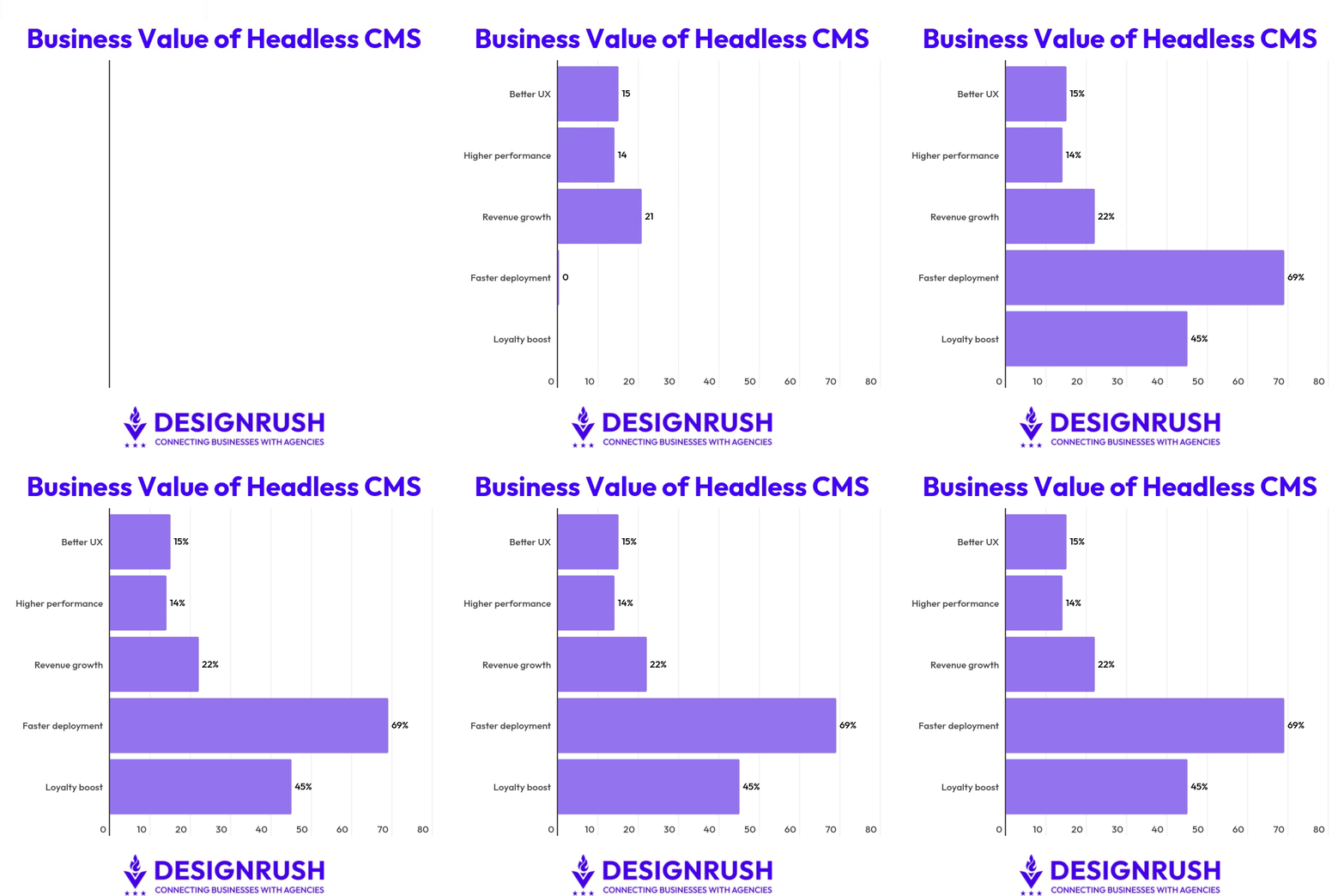
By decoupling the content platform from the front end, content teams can publish while developers ship front-end improvements on independent release cycles. In return, 69% of users report faster time-to-market and higher productivity.
Better user experiences
With 98% of mobile app users expecting consistent UX and a 123% bounce rate for slow-loading mobile sites, headless CMS companies can help you deliver unified yet personalized user experiences. They achieve this by reusing structured content across touchpoints while maintaining centralized governance.
In fact, businesses switching to headless CMS report having 15% better UX and 14% improved performance.
Stronger conversions and ROI
With more localized and personalized user experiences, businesses are reporting higher conversion rates and ROI with their headless CMS systems. According to Gitnux, headless commerce adopters experience:
- 22% year-one-year revenue growth vs. 12% for non-headless CMS stores
- 45% increase in customer retention after adopting a headless CMS
- 320% ROI in 18 months
Moreover, IDC research found that omnichannel buyers spend 15%-20% more than those purchasing on a single channel.
How much do their services cost?
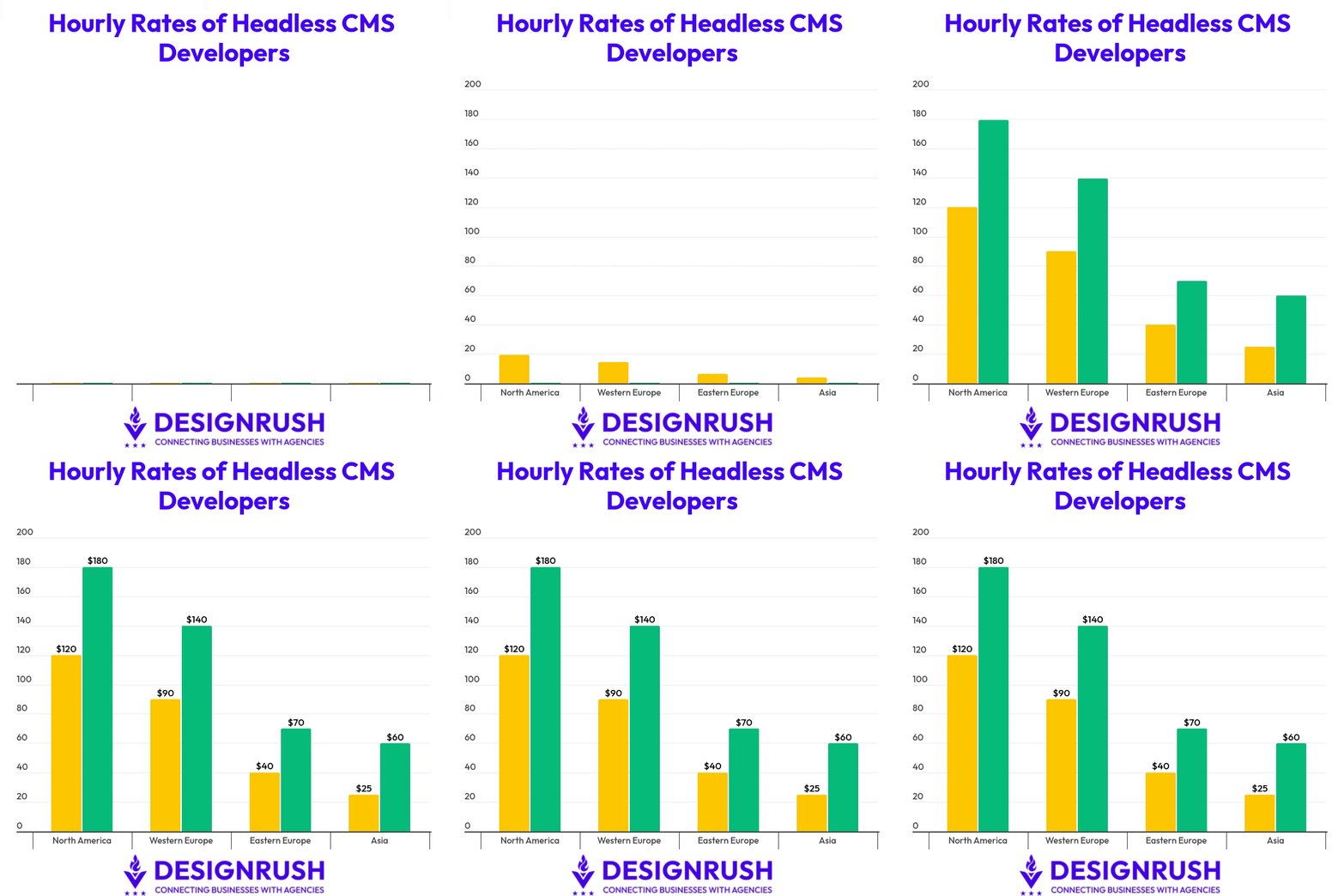
The cost to build a digital solution with headless CMS architecture can range between $8,000 to over $500,000. The final billing will depend on scope, integrations, migration effort, number of channels, and build complexity.
Here are the hourly rates of headless CMS developers per region:
- North America (United States and Canada): $120-$180 per hour
- Western Europe: $90-$140 per hour
- Eastern Europe: $40-$70 per hour
- Latin America: $35-$70 per hour
- Asia: $25-$60 per hour
Based on these hourly rates, here are the approximate costs of each headless CMS project:
- Content migration starts at $2,000-$10,000, depending on data volume and complexity.
- Small builds using a static site generator can start at $8,000-$25,000.
- Standard marketing and business sites that are dynamic, have basic analytics, and simple integration requirements can cost $20,000-$80,000.
- Mid-size platforms can cost $50,000-$150,000 for a scalable headless CMS, advanced integrations, and custom APIs.
- Web apps start at $40,000 for basic functions but go beyond $80,000-$150,000 for more complex requirements.
- Headless commerce stores start at $30,000-$60,000 for small businesses and startups, but can reach over $500,000 a global content delivery system.
- Enterprise builds often start at $100,000, depending on integration requirements, security and compliance controls, and data structures.
How long does it take to build a headless CMS project?
A headless CMS project can take 10-12 weeks for a small-scale project, like a multi-channel marketing website. However, more complex builds can take 12-20+ weeks, and enterprise replatforms can run 4-9 months.
The actual project timeline will depend on your project's complexity, core features and functions, integration and compliance requirements, and feedback loops. Here is an estimated timeline breakdown:
| Discovery and planning (2-4 weeks) | Stakeholder workshops to define business objectives, audiences, performance indicators, governance, and technical requirements. |
| Designing and prototyping (3-5 weeks) | Crafting the wireframes, architecture, design systems, and key components. |
| Content migration (2-10+ weeks, often in parallel with development) | Audit and migration plan, content cleanup, mapping, redirecting SEO, and validation. |
| Development and integration (4-8 weeks) | Content modeling, roles/permissions, environments, front-end build, and integrations (e.g., CRM and data analytics tools). |
| Testing and quality assurance (2-3 weeks) | Testing the website's performance, usability, accessibility, security, and reliability. |
| Launch (1-2 weeks) | Deploying the website to a live site and monitoring it for potential issues, so it can be resolved quickly. |
How do you choose the best headless CMS agency for your business?
Consider these steps when choosing a headless CMS company for your business:
- Define your project scope and goals, performance targets, key features, channels, and compliance and security requirements.
- Shortlist headless CMS companies with proven experience in your project type, technical stack, and industry by examining their case studies and looking for measurable business results.
- Analyze customer reviews and testimonies to assess communication, project management, on-time delivery, and how they handle changes and issues.
- Issue a request for proposal and compare them based on scope, assumptions, deliverables, team composition, and total cost of ownership.
- Interview the team working on your project to ask about process, quality assurance, compliance and security controls, ownership, and post-launch services.
- Choose a headless CMS agency that is strategic, transparent, responsive, and clearly understands your constraints, success metrics, and tech environment.
What questions should you ask before hiring?
Ask these questions before hiring a headless CMS agency to verify that it has the right skills and experience to execute your project:
Relevant Background
- What headless CMS platforms and architectures do you specialize in?
- Can you share past headless CMS projects similar to our scope, integration, and migration requirements? What were the results?
- What is your experience in our industry, and can you provide 3 client references we can contact?
Services and Processes
- Can you walk us through your end-to-end process, from discovery to launch and iteration?
- How do you ensure security, scalability, and accessibility in your design and development process?
- How do you handle quality across devices and channels?
- What are your post-launch services? Will you provide ongoing maintenance and iteration support?
Related to Your Project
- How will you design the content model, workflows, and permissions for our teams (marketing, legal, regional teams)?
- How will the headless CMS solution integrate with my existing technologies?
- Will you provide training to my employees so we can update and manage the platform independently?
- What do we own after launch (code repos, cloud accounts, documentation, CI/CD), and how do handoffs work?
Sources
DesignRush sustains a directory of over 40,000 agencies categorized by service category, location, expertise, and reviews. We build our database in two ways:
- Our dedicated team of agency experts actively searches the web for top-performing companies. We then pull information from their websites, online presence, and client testimonials to verify their status and qualifications prior to listing.
- The agencies listed get notified of their profiles on the website and they can choose to claim it or not, which suggests their availability for more collaborations.
Agencies can also reach out to DesignRush and must go through the verification process prior to being listed.

Why companies trust DesignRush
Every agency is independently vetted before it can be listed or ranked
 4.8
4.8 4.8
4.8Some agencies pay for sponsored placement, clearly labeled and held to the same vetting standards.
Frequently Asked Questions About Headless CMS Companies
What are the typical services provided by headless CMS developers?
Headless CMS companies plan, implement, and operate a headless content management system (CMS), so teams can efficiently publish content across websites, apps, and other digital channels. Typical headless CMS development services include:
- Headless CMS consulting and strategy: Advising businesses on the best headless CMS vendor and architecture or optimizing current platforms to meet their goals.
- Platform migration: Moving content and assets from legacy systems while preserving data integrity, security, and SEO with minimal downtime.
- Custom headless CMS development: Building the content models, automations, and user roles as well as the front and back end to ensure easy maintainability and reliable performance.
- API and plugin development: Integrating the headless CMS platform with third-party systems, such as payment gateways, CRMs, ERPs, and marketing automation tools.
- Ongoing maintenance and support: Continuously monitoring the platform's performance, resolving issues, installing security patches and updates, and managing infrastructure.
What is the difference between headless CMS and traditional CMS?
A headless CMS separates the content management backend from the frontend experiences. As such, content is delivered via APIs to any channel (websites, mobile apps, and IoT devices), so teams can reuse the same content across multiple experiences.
On the other hand, a traditional CMS has a unified back- and front-end (monolithic), meaning that there is a single interface that often comes in the form of a website. It can still power multiple channels, but doing so requires extensive tooling and customization.
Here are more details on their differences:
| Headless CMS platforms | Traditional CMS platforms | |
| Advantages |
|
|
| Disadvantages |
|
|
What are the most common headless CMS platforms?
Based on our research, here are some of the most common headless CMS platforms that developers use:
- WordPress: While it is a traditional CMS, it can be converted into a headless platform when paired with a modern JavaScript framework. Use this platform if you already have an existing WordPress-based site and want to migrate to a headless one.
- Strapi: An open-source, self-hosted headless CMS, enabling teams to have higher control over their data and infrastructure while being able to customize plugins, APIs, and workflows. Choose Strapi if you want to keep your data within your servers, and data sovereignty is non-negotiable.
- Contentful: A digital experience platform (DXP) with an API-first architecture and an extensive library of pre-built integrations. This platform is common for enterprises with complex needs and legacy tools.
- Sanity: Known for its collaboration features and flexible content management, Sanity is ideal for businesses that prioritize agility through controlled yet automated workflows.
While these are the most common platforms, reputable headless CMS companies will recommend a tech stack that best matches your goals, technical requirements, existing systems, operating models, team capabilities, and target audiences.
What companies benefit the most from headless CMS?
Many organizations benefit the most from a headless CMS when they need to publish content to multiple digital channels, scale across regions, or build custom experiences without being constrained by a single website template system. Common scenarios include:
- eCommerce and retail with multiple customer touchpoints (web, app, in-store screens) and heavy integrations (PIM, inventory, CRM, marketing automation), where teams want faster experimentation and performance.
- Brands running omnichannel campaigns (web + mobile + social + email + in-product) that need to reuse content consistently across channels.
- Product-led or platform businesses building multiple front ends (customer portals, apps, partner dashboards) that require developer flexibility and frequent releases.
- Global enterprises managing multiple markets, languages, and brands—where content governance, localization workflows, and reusable components are essential.
When should a company NOT use headless CMS frameworks?
A headless CMS may not be the best fit if:
- You need to launch quickly on a tight budget, and a template-based website will meet your goals.
- Your site is simple (e.g., a landing page or small brochure site), and you do not need multiple channels, complex integrations, or frequent changes.
- You do not have ongoing development capacity (in-house or via a retainer) to maintain the front end, integrations, and updates.
- Your team depends on visual page-building and WYSIWYG (what you see is what you get) editing and you are not prepared to invest in a headless setup that delivers an equivalent editorial experience.
Latest Trends Related to Headless CMS
-preview-webp.webp)