Partner with the best B2B web design agencies to enhance brand credibility, qualified leads, and conversion rates through streamlined experiences. Compare by expertise and budget.
Unlocking the brilliance of immersion
Floats is a full-stack XR lab, combining brilliant storytelling and emerging technology to create compelling experiences across Augmented reality (AR), Virtual reality and custom experiences, powered by immersive tech... View Floats XR portfolio
Top Services:
- Product Design
- Digital Strategy
- Wearables
- IoT
- AI Development
- Show more
- Location
- Lagos, Nigeria
- Number of Employees
- Under 49
- Average Hourly Rate
- $70/hr
- Minimal Budget
- $1,000 - $10,000
- Portfolios Count
- 1 Project Listed
We Have Tools, Processes, & Technology to Help Your Business.
Boutique website design and development agency focused on providing value and results to our clients through beautifully designed, coded, and SEO optimized websites... View all reviews
Top Services:
- Web Development
- Web Design
- Content Marketing
- SEO
- eCommerce Development
- Show more
- Location
- Bloomington, Minnesota
- Number of Employees
- Under 49
- Average Hourly Rate
- $100/hr
- Minimal Budget
- $1,000 - $10,000
Your Go-to Digital Agency
Higglo is a high end marketing agency that has built websites and performed marketing campaigns for the best companies around the world including Hulu, Blizzard, Bethesda, Richard Branson and more. We create memorable web experiences and get your business the attention it deserves... View Higglo Digital profile
Top Services:
- SEO
- CRO
- Web Development
- Web Design
- Graphic Design
- Show more
- Location
- Cheswick, Pennsylvania
- Number of Employees
- Under 49
- Average Hourly Rate
- $125/hr
- Minimal Budget
- $10,000 - $25,000
Top-rated software development agency in Toronto. Web & mobile apps, SaaS, & MVPs built in-house.
Modall is a leading full-service software & mobile app development company located in Toronto, Canada. We handle all development entirely in-house at our Toronto location. We don't outsource, so there are no language barriers, no time zone differences, and no headaches... View all reviews
Top Services:
- Software Development
- Mobile App Development
- Web Development
- AI Development
- eCommerce Development
- Show more
- Location
- Uxbridge, Canada
- Number of Employees
- Under 49
- Average Hourly Rate
- $60/hr
- Minimal Budget
- $10,000 - $25,000
A WooCommerce Development Agency
CoSpark, a leading WooCommerce development agency with 15+ years of experience, specializes in crafting exceptional eCommerce solutions, generating over $300 million in annual revenue for clients. Renowned for full-stack development, customizations, and ongoing maintenance... View CoSpark portfolio | View all reviews
Top Services:
- eCommerce Development
- Web Development
- WordPress Website Design
- Software Development
- Web Design
- Show more
- Location
- Irvine, California
- Number of Employees
- Under 49
- Average Hourly Rate
- $200/hr
- Minimal Budget
- $1,000 - $10,000
- Portfolios Count
- 5 Projects Listed
Better Websites to Boost Your Business
Do you need a new modern website that actually promotes your business, and helps you save admin time and bring in new customers? Marmoset specialises in 'Smart' websites that bring you more business while you sleep. Ask us how... View Marmoset Digital Media portfolio | View all reviews
Top Services:
- Web Design
- Digital Services
- Web Development
- SEO
- WordPress Website Design
- Show more
- Location
- Yarraville, Australia
- Number of Employees
- Under 49
- Average Hourly Rate
- $140/hr
- Minimal Budget
- $1,000 - $10,000
- Portfolios Count
- 3 Projects Listed
Accelerate Your Business Growth with BRK!
BRK is a Charlotte-based full-service agency specializing in branding, video production, web design, lead generation, social media, digital marketing for B2B + B2C. With over 35 years of experience, BRK delivers strategic, data-driven campaigns that captivate audiences and drive measurable results... View BRK Global Marketing portfolio | View all reviews
Top Services:
- Digital Marketing
- Branding
- Video Production
- Creative Services
- Social Media Marketing
- Show more
- Location
- Charlotte, North Carolina
- Number of Employees
- Under 49
- Average Hourly Rate
- $225/hr
- Minimal Budget
- $10,000 - $25,000
- Portfolios Count
- 4 Projects Listed
Turning your imagination to reality.
iB Arts Pvt. Ltd., an ISO 9001:2015 certified IT services provider, has been powering global businesses to success for more than seven years! Our specialized spectrum of offerings from web design & development and mobile app development to digital marketing and branding solutions caters to all types of... View all reviews
Top Services:
- UI/UX Design
- Web Design
- Web Development
- eCommerce Development
- Software Development
- Show more
- Location
- Pune, India
- Number of Employees
- 50 - 99
- Average Hourly Rate
- $15/hr
- Minimal Budget
- Under $1,000
Where Strategy Meets Creativity And Brand Growth
MP Atelier Digitale is a boutique digital agency specializing in strategy and growth for fashion, beauty, and lifestyle brands. We help companies clarify their positioning, refine their communication, and build digital systems that turn creativity into sustainable growth... View MP Atelier Digitale portfolio
Top Services:
- Branding
- Digital Services
- eCommerce Development
- Digital Marketing
- AI Development
- Show more
- Location
- Castel Maggiore, Italy
- Number of Employees
- Under 49
- Average Hourly Rate
- $85/hr
- Minimal Budget
- $1,000 - $10,000
- Portfolios Count
- 3 Projects Listed
Turning Ideas Into Powerful Solutions
Our talented team of developers, UI/UX designers, and project managers is dedicated to transforming your business needs into efficient, scalable software solutions. Based in Lithuania, we specialize in web and mobile applications, SaaS platforms, and AI automation, delivering robust, user-friendly p... View Mygom.tech portfolio
Top Services:
- Mobile App Development
- Software Development
- eCommerce Development
- Web Development
- Web Design
- Show more
- Location
- Kaunas, Lithuania
- Number of Employees
- Under 49
- Average Hourly Rate
- $70/hr
- Minimal Budget
- $10,000 - $25,000
- Portfolios Count
- 4 Projects Listed
Marketing Built to Move Faster & Make an Impact.
Brandmint is a content-first advertising agency focused on saving clients time, maximizing their return on marketing investments, and maximizing output and impact... View Brandmint portfolio | View all reviews
Top Services:
- Digital Marketing
- Social Media Marketing
- Digital Strategy
- Advertising
- Creative Services
- Show more
- Location
- Rochester, New York
- Number of Employees
- Under 49
- Average Hourly Rate
- $165/hr
- Minimal Budget
- $50,000 & Up
- Portfolios Count
- 4 Projects Listed
Don't Just Play it Back, Make it Iconic.
Playback Studio was founder with a simple mission: to provide top-tier creative services that push the boundaries of storytelling. Our team is a blend of seasoned editors, animators and visionary creatives, who are dedicated to transforming your raw ideas into a masterpiece. With years of industry experience... View Playback Studio portfolio | View all reviews
Top Services:
- Graphic Design
- Video Production
- Social Media Marketing
- Video Marketing
- UI/UX Design
- Show more
- Location
- Oakland, California
- Number of Employees
- Under 49
- Average Hourly Rate
- $25/hr
- Minimal Budget
- $1,000 - $10,000
- Portfolios Count
- 8 Projects Listed
Usability & ROI Focused UI/UX Design Agency
Usarion is a design agency that merges creativity with strategy, offering UI/UX solutions that are as innovative as they are impactful. Our approach combines design thinking, user-centric principles, and cutting-edge technology to deliver results tailored to our clients' goals... View Usarion portfolio
Top Services:
- Product Design
- UI/UX Design
- Web Design
- Design Services
- Mobile App Development
- Show more
- Location
- Dhaka, Bangladesh
- Number of Employees
- Under 49
- Average Hourly Rate
- $50/hr
- Minimal Budget
- $1,000 - $10,000
- Portfolios Count
- 8 Projects Listed
Turn your potential into profit with RunLocal marketing
Go local for your website design and digital marketing! RunLocal has been proudly serving the Longmont, Boulder, & Niwot Colorado area for 15 years. Our goal is to save you time, reduce stress, and bring you more business through rock solid SEO, marketing-based web design, review and Google Business Listing... View all reviews
Top Services:
- Digital Marketing
- SEO
- WordPress Website Design
- Web Design
- Web Development
- Show more
- Location
- Longmont, Colorado
- Number of Employees
- Under 49
- Minimal Budget
- $1,000 - $10,000
Unlock Your Digital Potential
Build, Grow, or Reinvent your brand at Adapt Digital marketing. We specialize in helping small businesses take advantage of the digital landscape... View all reviews
Top Services:
- WordPress Website Design
- Web Development
- Social Media Marketing
- eCommerce Development
- Video Marketing
- Show more
- Location
- Baton Rouge, Louisiana
- Number of Employees
- Under 49
- Minimal Budget
- $1,000 - $10,000
We turn your idea into a fully functional, clean and well optimized website in no time.
Websites and custom software solutions at world-class level. We turn your idea into a fully functional, clean and well optimized website in no time. More than 20 satisfied customers choose ExN as their primary software development agency... View ExN portfolio
Top Services:
- Software Development
- Web Development
- DevOps Consulting
- eCommerce Development
- WordPress Website Design
- Show more
- Location
- Novi Sad, Serbia
- Number of Employees
- Under 49
- Average Hourly Rate
- $40/hr
- Minimal Budget
- $10,000 - $25,000
- Portfolios Count
- 4 Projects Listed
Premium Web Design and Digital Marketing Agency since 2012
Saúl Sánchez Agency is a digital agency specializing in web design and marketing. They offer services such as web design, SEO, social media management, graphic design, and digital strategy, focusing on strategic and results-driven solutions for businesses in Spain, Europe, the United States, and Latin... View Saúl Sánchez Digital Experiences Agency profile
Top Services:
- SEO
- Web Design
- Graphic Design
- Social Media Marketing
- PPC
- Show more
- Location
- Salamanca, Spain
- Number of Employees
- Under 49
- Average Hourly Rate
- $97/hr
- Minimal Budget
- $1,000 - $10,000
Product and Webflow design agency for startups & enterprises.
Alien is your trusted partner for elevating your digital presence. From UI/UX design to branding and digital marketing, we empower incubators, startups, and SMEs to thrive in the digital landscape... View The Alien portfolio | View all reviews
Top Services:
- Web Design
- Product Design
- UI/UX Design
- Branding
- Design Services
- Show more
- Location
- Chennai, India
- Number of Employees
- Under 49
- Minimal Budget
- $1,000 - $10,000
- Portfolios Count
- 4 Projects Listed
Let's Build The Future, Together.
Fyresite is a team of highly trained individuals who specialize in web design, web development, UI/UX design and app development... View Fyresite portfolio | View all reviews
Top Services:
- eCommerce Development
- Web Development
- UI/UX Design
- Design Services
- Web Design
- Show more
- Location
- Tempe, Arizona
- Number of Employees
- Under 49
- Portfolios Count
- 2 Projects Listed
Noteworthy. Quality. Heartfelt.
Method Q provides marketing solutions for high growth companies. We prioritize giving back... View Method Q portfolio
Top Services:
- Content Marketing
- Public Relations
- Digital Services
- Logo Design
- Web Design
- Show more
- Location
- Atlanta, Georgia
- Number of Employees
- Under 49
- Average Hourly Rate
- $150/hr
- Minimal Budget
- $1,000 - $10,000
- Portfolios Count
- 2 Projects Listed
Up-and-coming UX Studio making internal tools modern, intuitive, and actually adopted
Meticular is a boutique UX studio that helps internal teams design custom software employees want to use more than a spreadsheet. From strategy and research to modern UI design, we embed with your team as a plug-and-play UX department... View Meticular portfolio
Top Services:
- UI/UX Design
- Product Design
- Web Design
- Location
- Eagle Mountain, Utah
- Number of Employees
- Under 49
- Average Hourly Rate
- $125/hr
- Portfolios Count
- 1 Project Listed
Driven by Digital Intelligence | Website and Software Development | SEO Service | Digital Marketing
Nucleosys Tech is the Best Digital Marketing Agency in Pune, employing a talented team of website and digital marketing with eCommerce experts. Their main focal point in web development is eCommerce. As one of the top website development and digital marketing agencies in the country, weve been working on web... View NucleosysTech portfolio | View all reviews
Top Services:
- SEO
- Digital Marketing
- Software Development
- Web Design
- eCommerce Development
- Show more
- Location
- Pune, India
- Number of Employees
- 100 - 249
- Average Hourly Rate
- $50/hr
- Minimal Budget
- $1,000 - $10,000
- Portfolios Count
- 8 Projects Listed
Turn Your Website Into Your #1 Salesperson
Azienbiz is a modern web design and development agency helping businesses build powerful digital experiences. We specialize in creating fast, SEO-optimized, and conversion-focused websites for startups, local businesses, and growing brands. Our services include website design, web development, software... View Azienbiz portfolio
Top Services:
- Web Design
- Web Development
- SEO
- Location
- Miami, Florida
- Number of Employees
- Under 49
- Average Hourly Rate
- $25/hr
- Minimal Budget
- Under $1,000
- Portfolios Count
- 1 Project Listed
Turning Ideas into Reality, One Line of Code at a Time.
Ventor Labs Inc. is a leading provider of custom software solutions, specializing in web and mobile applications, blockchain and AI software, product design, branding, and IT consultancy. We are committed to delivering innovative, tailored solutions to meet the diverse needs of our clients... View Ventor Labs Inc. portfolio
Top Services:
- Branding
- Product Design
- eCommerce Development
- Web Development
- Web Design
- Show more
- Location
- Winnipeg, Canada
- Number of Employees
- Under 49
- Average Hourly Rate
- $65/hr
- Minimal Budget
- $1,000 - $10,000
- Portfolios Count
- 7 Projects Listed
Accelone Advancing What's Possible
Embark on your digital transformation journey with AccelOne's Software Development delivery model, strategically designed for optimal outcomes. Initiate your digital transformation seamlessly through our comprehensive nearshore and US-based services... View AccelOne portfolio | View all reviews
Top Services:
- Software Development
- Mobile App Development
- Blockchain
- UI/UX Design
- eCommerce Development
- Show more
- Location
- Seattle, Washington
- Number of Employees
- 100 - 249
- Minimal Budget
- $25,000 - $50,000
- Portfolios Count
- 5 Projects Listed
Total Medical Design specialises in web and graphic design, plus digital marketing for healthcare professionals. We offer tailored online solutions, including medical website creation and SEO services... View all reviews
Top Services:
- Graphic Design
- Digital Services
- Branding
- Package Design
- Digital Strategy
- Show more
- Location
- Pottsville, Australia
- Number of Employees
- Under 49
Innovate Empower Transform
At Random Forest, we see software not just as code, but as craft. Our team brings together curious minds, deep tech expertise, and a shared passion for building elegant, reliable systems that scale. We believe great work happens when people feel safe, heard, and trusted. That's why we've shaped a culture of... View Random Forest Technology portfolio | View all reviews
Top Services:
- Cloud Consulting
- DevOps Consulting
- Software Development
- AI Development
- Digital Marketing
- Show more
- Location
- Bhopal, India
- Number of Employees
- Under 49
- Average Hourly Rate
- $25/hr
- Minimal Budget
- $1,000 - $10,000
- Portfolios Count
- 4 Projects Listed
Web Design & Development Company Anchored in Los Angeles, CA
We're a leading web design & development company in Los Angeles, CA – Specializing in UI/UX Design, Web Design, Product Design, & Web Development... View Black Flag Creative portfolio | View all reviews
Top Services:
- Web Development
- Web Design
- Mobile App Development
- Design Services
- Product Design
- Show more
- Location
- Los Angeles, California
- Number of Employees
- Under 49
- Average Hourly Rate
- $149/hr
- Minimal Budget
- $10,000 - $25,000
- Portfolios Count
- 4 Projects Listed
Web Design & Development for Authors, Editors, Illustrators and anyone related to publishing
Our specialization is Web Design & Development of thoughtful and minimalistic websites for Authors, Editors, Illustrators and Professionals of the Publishing World. FREE CONSULTATION. Also Website Maintenance, Technical Support, Website Redesign... View RH Digital portfolio
Top Services:
- Web Design
- Web Development
- WordPress Website Design
- UI/UX Design
- Show more
- Location
- Wroclaw, Poland
- Number of Employees
- Under 49
- Portfolios Count
- 4 Projects Listed
Innovate Inspire Illuminate
We deliver best problem solving solution for our client and provide finest finishing product in present and upcoming future. We love turning ideas into websites that work smoothly. we enjoy finding simple solutions to tricky problems. For us, every project is a chance to learn, improve, and have a little fun... View Byte Brilliance Tech portfolio | View all reviews
Top Services:
- Web Development
- UI/UX Design
- SEO
- Mobile App Development
- Logo Design
- Show more
- Location
- Surat, India
- Number of Employees
- Under 49
- Average Hourly Rate
- $25/hr
- Minimal Budget
- $10,000 - $25,000
- Portfolios Count
- 7 Projects Listed
We Connect With People.
Strategic UX and design.Bespoke, multi-platform programs.Connection and engagement.Authentic storytelling and public relations.Leveraging our experience, humility, and values, Anomali by Design connects with peoplewherever they're at, agnostic of circumstance... View Anomali By Design portfolio
Top Services:
- Design Services
- Product Design
- UI/UX Design
- Digital Marketing
- Social Media Marketing
- Show more
- Location
- Chicago, Illinois
- Number of Employees
- Under 49
- Average Hourly Rate
- $180/hr
- Minimal Budget
- $25,000 - $50,000
- Portfolios Count
- 3 Projects Listed
Take Your Business To The Next Level.
We are a Web Design and Development Agency. As well as a provider of IT solutions. We help businesses and companies implement IT solutions tailored to their needs. We help our clients grow by providing innovative technological tools to achieve their goals. We think big, and if you do too, we can work together... View Alva Technology portfolio | View all reviews
Top Services:
- Web Design
- Web Development
- Social Media Marketing
- Email Marketing
- Branding
- Show more
- Location
- Ciudad Guzmán, Mexico
- Number of Employees
- Under 49
- Minimal Budget
- Under $1,000
- Portfolios Count
- 8 Projects Listed
Custom software, mobile apps & eCommerce stores that scale
Ignite Technologies is a Dubai-based agency building AI powered software, mobile apps, websites, and eCommerce stores. We turn complex workflows into secure, fast, and scalable digital products for government, real estate, F&B, education, and retail brands... View Ignite Technologies portfolio
Top Services:
- Web Development
- Mobile App Development
- Software Development
- eCommerce Development
- AI Development
- Show more
- Location
- Dubai, United Arab Emirates
- Number of Employees
- Under 49
- Average Hourly Rate
- $25/hr
- Minimal Budget
- $1,000 - $10,000
- Portfolios Count
- 8 Projects Listed
The Way to Digital Presence
Driving Digital Transformation For Progressive Brands with ove 500+ happy clients from 23 countries and 94% client retention rate we are one of the leading shopify , shopify plus and Agentic AI solutions provider for Global Brands... View Techtic Solutions portfolio | View all reviews
Top Services:
- eCommerce Development
- Web Development
- AI Development
- Web Design
- Software Development
- Show more
- Location
- New York City, New York
- Number of Employees
- 50 - 99
- Average Hourly Rate
- $25/hr
- Minimal Budget
- $1,000 - $10,000
- Portfolios Count
- 3 Projects Listed
Web Design, Brand & Marketing Experts
Snowday Design specializes in crafting contemporary websites, impactful brands, and captivating visuals catered to entrepreneurs, small, medium, and large enterprises, as well as nonprofit organizations. Collaborating closely with clients, we aim to deliver premium services while ensuring a hassle-free... View Snowday Design portfolio | View all reviews
Top Services:
- Graphic Design
- Branding
- Logo Design
- Web Design
- SEO
- Show more
- Location
- Parker, Colorado
- Number of Employees
- Under 49
- Average Hourly Rate
- $90/hr
- Portfolios Count
- 3 Projects Listed
Responsive Websites
WebTechs.Net has always been focused on helping small to mid-sized companies in The Scottsdale Area increase their web presence since 1997. We achieve great results by using cutting edge search engine optimization (SEO) strategies and keep up with the most current techniques at all times... View all reviews
Top Services:
- PPC
- Social Media Marketing
- Digital Marketing
- Content Marketing
- SEO
- Show more
- Location
- Scottsdale, Arizona
- Number of Employees
- Under 49
- Average Hourly Rate
- $100/hr
- Minimal Budget
- Under $1,000
Helping To Modernize Small Businesses
YouWho Digital is an innovative digital marketing agency focused on providing small businesses with foundational tools and strategies needed for long-term growth... View all reviews
Top Services:
- SEO
- Social Media Marketing
- Digital Marketing
- Web Design
- WordPress Website Design
- Show more
- Location
- Littleton, Colorado
- Number of Employees
- Under 49
- Minimal Budget
- Under $1,000
A Single Partner for Marketing, SEO, Design, and Reputation Management
Many companies boast that their team is the best, but ours really is incredible. Don't just take our word for it. Most reviews focus on our gifted and extremely knowledgeable team. Located conveniently in the Phoenix metro area (Gilbert, Arizona), we happily serve the United States from the United... View all reviews
Top Services:
- Social Media Marketing
- SEO
- Web Design
- Location
- Gilbert, Arizona
- Number of Employees
- Under 49
- Average Hourly Rate
- $100/hr
- Minimal Budget
- Under $1,000
Big ideas for your small business!
We’re a Red Wing, MN marketing agency providing local website design, SEO and digital marketing. We take a personal approach to help our clients find the smartest options for their budget. Whether it's big or small, we have you covered... View all reviews
Top Services:
- Graphic Design
- Logo Design
- SEO
- Print Design
- Branding
- Show more
- Location
- Red Wing, Minnesota
- Number of Employees
- Under 49
- Average Hourly Rate
- $80/hr
- Minimal Budget
- Under $1,000
Full Service Web Design & Marketing Agency. Redefined Web Design Since 2010.
We live by our word, our actions and our dedication. We dare to think different on our clients behalf.We have - unmoveable Integrity, dedicated to Performance and Hunger for Change.We are commitedto our clients success in todays digital landscape.We lead the charge to confront and solve the challenges... View Blue Monkfish LLC profile
Top Services:
- Digital Marketing
- Web Design
- Web Development
- Graphic Design
- Show more
- Location
- Hoboken, New Jersey
- Number of Employees
- 100 - 249
- Average Hourly Rate
- $50/hr
- Minimal Budget
- $1,000 - $10,000
Creative Partners for Businesses at Any Stage
We are Artelle Creative, a design and development firm with our headquarters in Florida's beautiful sunshine state. We are a small company consisting of only the two of us, and we focus on marketing design, branding, and website design. Please get in touch if you are considering doing a project! We are a... View Artelle Creative profile
Top Services:
- Web Development
- Web Design
- Branding
- Email Marketing
- Show more
- Location
- Port St. Lucie, Florida
- Number of Employees
- Under 49
- Average Hourly Rate
- $100/hr
- Minimal Budget
- $1,000 - $10,000
We help the people behind brands make decisions on how websites should work, look, and feel.
Fischer Brand Company is a web development business that operates entirely remotely and is based in Phoenix, Arizona. We are passionate with assisting the individuals behind companies in making choices about the functionality, appearance, and overall experience of websites... View all reviews
Top Services:
- Web Design
- UI/UX Design
- Web Development
- eCommerce Development
- Show more
- Location
- Phoenix, Arizona
- Number of Employees
- Under 49
- Average Hourly Rate
- $125/hr
- Minimal Budget
- $10,000 - $25,000
From cutting-edge IT solutions to comprehensive service delivery
Softnotions is an IT solutions provider that specializes in combining business modeling, technical insights and custom-tailored strategies to maximize organizational success. With over 1000 projects executed around the world from USA, UK and Australia to Middle East countries, Softnotions' development hub... View Softnotions Technologies portfolio | View all reviews
Top Services:
- IT Services
- Business Consulting
- DevOps Consulting
- AI Development
- Mobile App Development
- Show more
- Location
- Kazhakkoottam, India
- Number of Employees
- 100 - 249
- Average Hourly Rate
- $49/hr
- Minimal Budget
- $10,000 - $25,000
- Portfolios Count
- 10 Projects Listed
Professional WordPress Web Designs and Trendy Social Media Videos
We are a family owned and operated business that specializes in professional, responsive WordPress web designs and trendy social media video advertisements. We have been working in website design, computer repair and video production industry since 1999, and have officially been in business since 2004... View David Aaron Services profile
Top Services:
- Web Design
- Location
- Tallahassee, Florida
- Number of Employees
- Under 49
- Minimal Budget
- Under $1,000
To elevate businesses with proven solutions that drive lasting success and growth
Holicky Corporation is a full-service marketing agency located in New Lenox, IL. We serve businesses of all sizes, from small local shops to large corporations around the Chicagoland Area and throughout the United States... View Holicky Corporation profile
Top Services:
- WordPress Website Design
- Digital Services
- Graphic Design
- Branding
- Content Marketing
- Show more
- Location
- New Lenox, Illinois
- Number of Employees
- Under 49
- Average Hourly Rate
- $125/hr
- Minimal Budget
- Under $1,000
Private Jet SEO Services That Boost Rankings, Visibility and Booking
At EpicEdits, we dont treat clients like numbers. Were selective about who we work with because were all-in on delivering real results not vague reports or buzzword promises.We specialise in SEO for the Aviation industry and Private Charter... View all reviews
Top Services:
- SEO
- Web Design
- PPC
- Web Development
- WordPress Website Design
- Show more
- Location
- London, United Kingdom
- Number of Employees
- Under 49
- Average Hourly Rate
- $50/hr
- Minimal Budget
- $1,000 - $10,000
Your Vision, Our Creation
We Are a Creative Agency with a Passion for DesignIts simple, Were here to help your business grow!Division Web Design is dedicated to helping businesses grow their web presence. We specializing in web design, search engine optimization, digital design & digital marketing. We provide all the tools you... View Division Web Design portfolio
Top Services:
- Web Design
- Creative Services
- Digital Marketing
- SEO
- PPC
- Show more
- Location
- Rahway, New Jersey
- Number of Employees
- Under 49
- Average Hourly Rate
- $75/hr
- Minimal Budget
- $1,000 - $10,000
- Portfolios Count
- 5 Projects Listed
The Work Should Work
Our digital marketing agency is a diverse blend of talent and passion, united by one common goal: your businesss success. From strategy to execution, were here to lend our expertise and support every step of the way. Here, we build brands while delivering results... View all reviews
Top Services:
- Web Design
- SEO
- PPC
- Social Media Marketing
- Creative Services
- Show more
- Location
- Overland Park, Kansas
- Number of Employees
- 50 - 99
We Build Websites That Sell
Allswell Agency is a WordPress web development company specializing in WordPress websites, WordPress website maintenance, and SEO services... View Allswell Agency portfolio
Top Services:
- WordPress Website Design
- Web Development
- Web Design
- SEO
- Email Marketing
- Show more
- Location
- Akron, Ohio
- Number of Employees
- Under 49
- Average Hourly Rate
- $75/hr
- Minimal Budget
- $1,000 - $10,000
- Portfolios Count
- 5 Projects Listed
We'll Build You An Amazing Website
At Website Turbix, Our expert website developers are professionals in making innovative website designs according to customer requirements... View Website Turbix portfolio | View all reviews
Top Services:
- Web Design
- WordPress Website Design
- eCommerce Development
- Mobile App Development
- Branding
- Show more
- Location
- Los Angeles, California
- Number of Employees
- 100 - 249
- Average Hourly Rate
- $1000/hr
- Minimal Budget
- $1,000 - $10,000
- Portfolios Count
- 1 Project Listed





































Explore Web Design Specializations
Popular Services
Everything You Need to Know Before Hiring the Best B2B Web Design Agencies
What can a B2B web design firm do for your business?
A B2B web design firm helps your website perform as a revenue asset: improving brand visibility, credibility, and conversion across longer, research-heavy buying journeys. Here is how:
Increase qualified lead flow
According to The State of B2B Site Search Report, 90% of B2B customers research 2-7 websites before making a purchase, highlighting the importance of being discoverable and communicating value quickly.
A reputable B2B design agency builds the foundation for inbound demand by aligning technical SEO, site architecture, and content structure to how potential B2B clients search and compare. This includes responsive design, fast performance, clear navigation, and structured data.
Establish credibility and reduce perceived risk
On average, the B2B buying cycle time lasts about 10-11 months, with about 70% of this time spent on research and evaluation.
Knowing this, leading B2B web design agencies reassure buyers early and often throughout the design, including adding case studies, measurable outcomes, product clarity, and leadership content.
Improve user experience, sales, and conversion
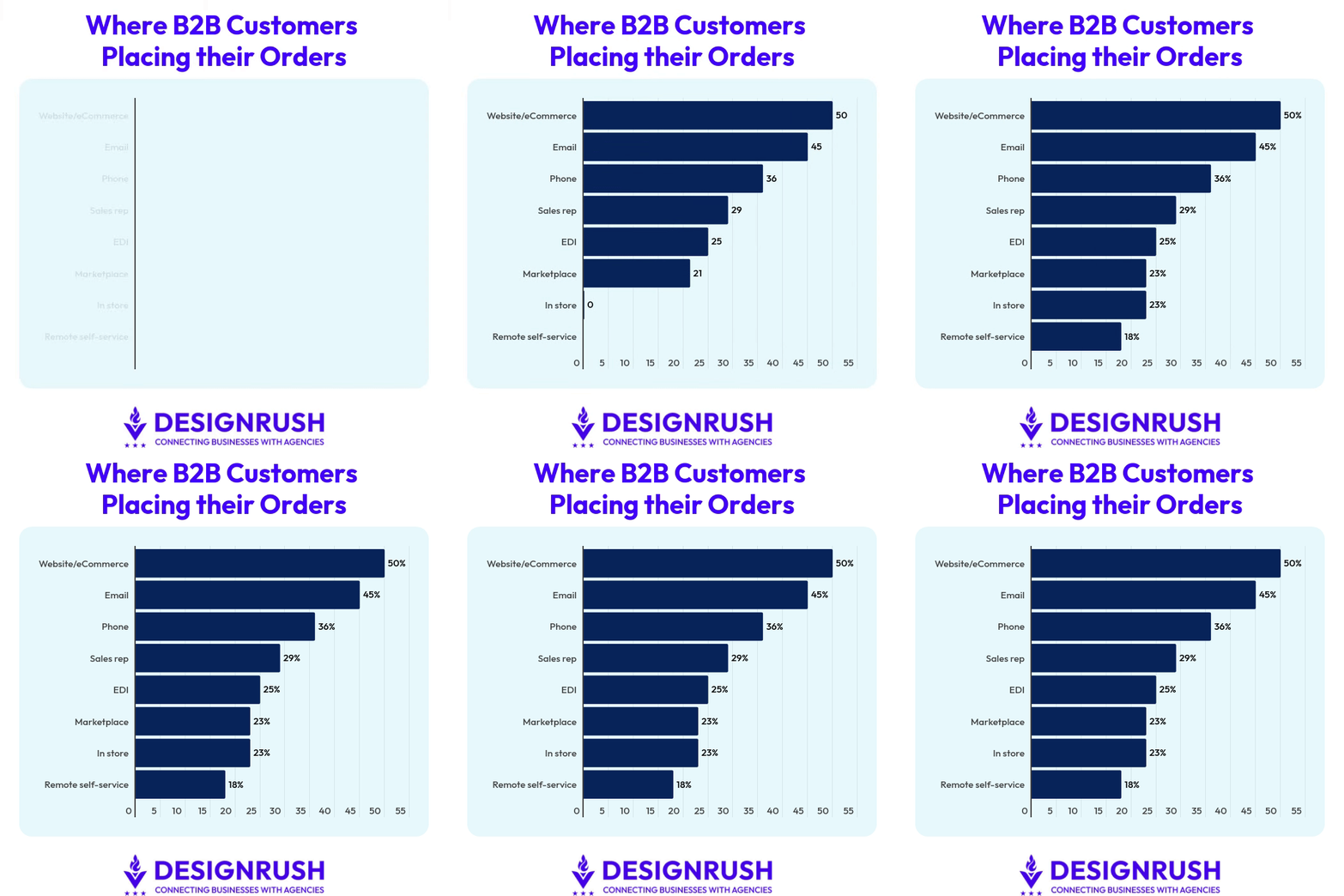
A B2B study by Sana found that 50% of B2B buyers purchase on eCommerce platforms, the highest among all digital and offline sales channels. Moreover, 81% of repeat purchases and 63% of high-value purchases are done online.
However, 94% of customers say they suffer from poor UX due to low product/feature visibility and complex ordering processes.
Top B2B web design agencies create conversion-focused, frictionless user journeys by personalizing user journeys for each persona, aligning CTAs to intent, and simplifying forms and flows.
How much do their services cost?
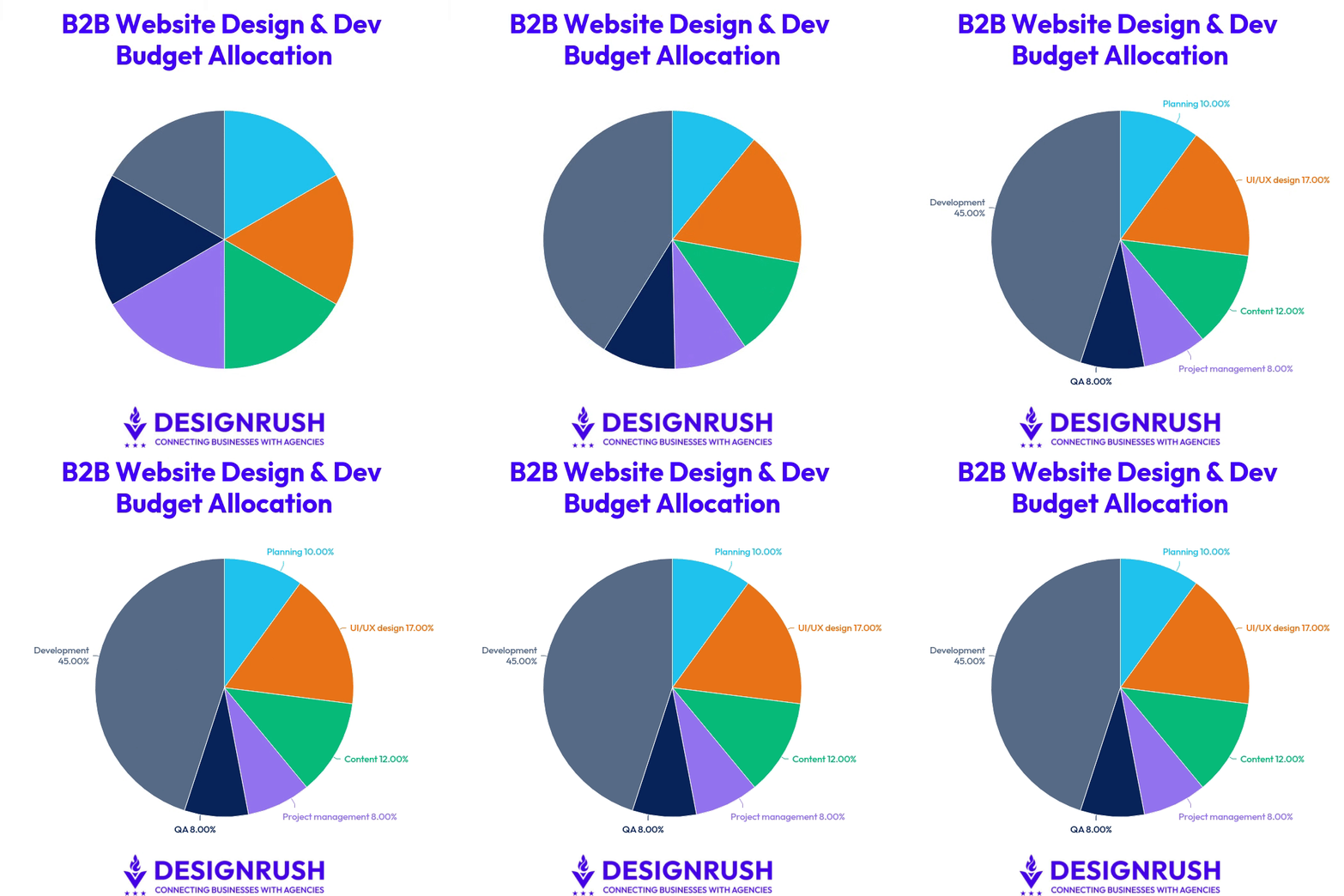
B2B web design services can cost $10,000-$100,000, depending on the design, functionality, system, and compliance requirements. Project turnaround time, agency location, and third-party integrations can also impact overall costs.
Here are how the average hourly rates of B2B web designers:
- North America (Canada and the United States): $65-$150 per hour
- Western Europe: $60-$20 per hour
- Eastern Europe: $35-$70 per hour
- South America: $35-$70 per hour
- Africa: $28-$45 per hour
- Asia and the Pacific: $20-$50 per hour
Based on these rates, here s how much each B2B web design project costs:
- Corporate B2B websites with basic company info, CMS, and a product catalog cost $25,000-$50,000
- B2B customer portals with multiple access control, account management, and order history features range between $50,000-$120,000
- Mid-complex B2B platforms with CRM integrations, custom UX design, and built-in analytics are about $75,000-$50,000
- B2B eCommerce solutions with custom pricing functions, bulk ordering features, ERP and PIN integrations, and secure payment gateways can cost $120,000-$220,000
- Enterprise B2B builds and B2B web apps with multi-vendor features, global deployment capabilities, and multiple integrations start at $200,000
How to choose the best B2B web design agency for your business?
To choose the best B2B web design agency for your business, evaluate its past projects, client reviews, and skills and services against your needs and goals. Here are some steps to guide you in your decision:
- Outline your website goals and requirements, features, functions, target users, desired style, system integrations, success metrics, compliance and security requirements, and internal decision makers for the project.
- Target agencies with proven B2B experience in your industry, target market, and tech stack. Review their case studies to understand their process and the measurable results they delivered to clients.
- Read client reviews and testimonies to assess communication, responsiveness, scope control, timeline discipline, and how the agency handles issues and change requests.
- Request for a proposal together with your business background, creative brief, and project requirements. Compare agency proposals based on scope, assumptions, deliverables, and risk management.
- Interview your top 5 design candidates to learn more about their approach to user research, design and development, QA, and security and compliance.
- Start with a pilot project, such as a website audit, discovery workshop, or prototype, before committing to a full design and development contract to further ensure project and business fit.
What questions should you ask before hiring?
Ask these questions before hiring a B2B web design agency to ensure it has the right expertise and experience for your project:
Relevant Background
- What type of B2B website and platforms do you specialize in?
- Can you share examples of B2B projects similar to ours in scope and complexity?
- What is your experience in my industry and target market? Can you provide 2-3 client references?
Services and Processes
- Who will be on our team and what are their qualifications?
- Can you walk us through your entire design process, from discovery to launch?
- How do you ensure performance, security, accessibility, and SEO are built into the website?
- How do you design for scalability, global privacy compliance, and sector-specific regulations?
Related to Your Project
- How will you validate alignment with our target audiences, brand, and business goals?
- How do you define and measure success? What will reporting look like for my project?
- Who owns the website code, design files, and content assets after deployment?
- What are your post-launch services? Do you provide warranty, iteration plans, and ongoing optimization support?
What red flags should you avoid when looking for a B2B web design agency?
Avoid these red flags when searching for a B2B web design agency to avoid rework, wasted spend, brand risk, and long-term performance issues:
- Unimpressive portfolio: Outdated designs, same templated look for different clients, AI-generated content, broken live sites, or unclear examples of real outcomes can indicate limited capability. While prototypes are not a problem, it is a red flag if they cannot provide complete live solutions.
- Weak process: Without a detailed roadmap, QA and launching plan, and service level agreement, you run the risk of scope creep, project delays, and a website that does not meet requirements.
- Skipping discovery: An agency that does not ask meaningful questions about your brand, audience, positioning, constraints, and competitive landscape may rely on cookie-cutter approaches.
- Inability to tie to business strategy: If the agency cannot connect their design decisions to business goals, you may receive an aesthetically pleasing website that does not perform.
- Unverifiable client references and testimonies: While positive reviews are a good sign, if you cannot trace back the review to a real contact or company, then the agency may have falsified the reviews and testimonies to inflate its reputation.
Why Companies Trust DesignRush
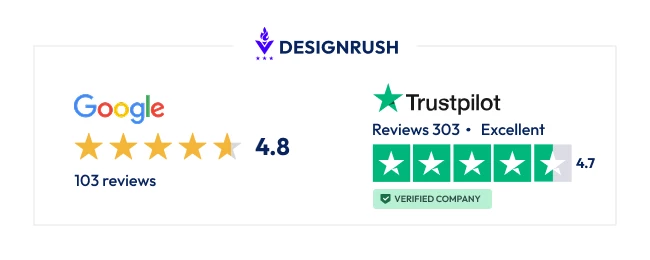
Rated 4.8 on Google and 4.7 on Trustpilot, DesignRush Agency Directory is a reliable resource for finding B2B web design agencies We owe this to our executive selection team, which follows a strict screening process when featuring agencies on the platform, assessing key performance indicators, like portfolio, client reviews, and industry reputation.
Learn more about DesignRush Agency Ranking Methodology.
Sources
DesignRush sustains a directory of over 40,000 agencies categorized by service category, location, expertise, and reviews. We build our database in two ways:
- Our dedicated team of agency experts actively searches the web for top-performing companies. We then pull information from their websites, online presence, and client testimonials to verify their status and qualifications prior to listing.
- The agencies listed get notified of their profiles on the website and they can choose to claim it or not, which suggests their availability for more collaborations.
Agencies can also reach out to DesignRush and must go through the verification process prior to being listed.
Frequently Asked Questions About B2B Web Design Agencies
What are the typical B2B web design services?
Agencies provide comprehensive B2B web design services, covering the entire website design and development process from ideation to launch. It typically includes:
- Website audit: Analyzing a website's UX design, content, SEO performance, accessibility, and technical health to identify critical issues and opportunities.
- Discovery and strategy: Conducting stakeholder interviews, audience and competitor research, and a website strategy aligned to business goals.
- Information architecture and UX design: Building the sitemap, navigation, user journeys, wireframes, and conversion paths based on user intent.
- UI design: Crafting the website's visual design, component library, and design guidelines to ensure consistent branding.
- Custom B2B website development: Building the website's front-end and back-end, including server-side logic, database management, and content management system (CMS) setup.
- System integration: Connecting the website with the business's existing IT environment, including customer relationship management (CRM), enterprise resource planning (ERP), and product information management (PIM) solutions.
- B2B eCommerce: Developing commerce portals and platforms that streamline procurement flows, manage bulk orders, and enable customized pricing.
- Website maintenance: Providing post-launch maintenance and support to ensure that the website performs optimally, including debugging, security patching, and design refinement.
Many B2B website design agencies also offer digital marketing services, including search engine optimization (SEO), AI-powered search (AEO/GEO), content marketing, conversion rate optimization (CRO), branding, and paid advertising.
What is the difference between B2B web design and B2C web design?
The primary difference between B2B web design and B2C web design is the target audience.
B2B websites target organizations and business executives, supporting the longer, higher-stakes buying journey. In contrast, B2C websites target individual customers, enabling faster and more personal purchases. Here are more details about each:
| B2B Web Design | B2C Web Design | |
| Target audience | B2B client's buying committee (executives, sponsor, and users) | Individual customers |
| Primary focus | Enable evaluation and reduce risk with clarity, proof, and decision support | Drive purchase intent with brand, emotion, and convenience |
| Content and messaging | Business value and ROI, brand differentiation, use cases, and evidence (e.g., case study) | Benefits, lifestyle, social proof, promotional |
| Sales cycle | Long and complex, involving multiple steps and stakeholders | Short and impulsive, involving only the individual buyer |
| Conversion goals | Request demo or quote, contact sales, book a call, download whitepapers | Purchase, add to cart, subscribe, signup |
How long does a B2B web design project take from kickoff to launch?
A B2B web design project can take 1 week to over 6 months, depending on the content availability, tech stack, feedback process, and the complexity of the design, features, and functions.
Below is an estimated timeline of various B2B web design projects:
- Landing pages can take about 1-2 weeks, as they typically require one page and use existing brand assets.
- Startup websites have a timeline of 2-6 weeks for basic visuals and content, but it can take 6-12 weeks if it requires brand strategy and visual identity development.
- Website redesign projects take 3-12 weeks when existing assets are reused but can last 10-16 weeks for a visual identity rehaul, including new logos and branding elements.
- Corporate B2B websites with simple layout, navigation, and features may need 4-10 weeks.
- SaaS marketing websites with multiple use cases, custom UX design, CRM integrations, and SEO may require 8-12 weeks
- B2B eCommerce solutions will need 12-16 weeks and include payment integration, filtering logic for large product catalogs, and role-based access.
- Enterprise platforms and web applications range from 4-6+ months, often having complex features and functions, advanced security controls, cloud infrastructure planning, and multiple system APIs.
Should you build a custom B2B website or use a template?
The answer depends on your goals, requirements, budget, timeline, and how differentiated the user experience needs to be.
Build a custom B2B website if:
- Brand distinction and tailored user experiences are competitive advantages.
- You need unique user flows or functionality beyond what a theme or template can handle (e.g., multi-step forms and complex integrations).
- You require deep technical control over performance, architecture, and future extensibility.
- You have strict compliance, security, or accessibility requirements.
- You expect high traffic, multiple audiences, or frequent iteration, and you want a foundation built for long-term scalability.
Use a website template if:
- You are a startup or small business with a limited budget and want to release a site immediately.
- You are validating product market fit or launching a new offer and want to move quickly.
- The site is simple by design, such as a landing page or brochure site.
How do you know if you need to redesign your B2B website?
When performance, strategy, or technical constraints start limiting your growth, then it is a sign that you need to redesign your B2B websites. This includes:
- KPIs are declining: Organic traffic, rankings, engagement, conversions, and lead quality are down compared to historical baselines, indicating UX friction, slow performance, poor navigation, or mismatched messaging.
- No longer follows modern expectations: Not truly mobile responsive, weak page performance (Core Web Vitals), or lacking accessibility practices aligned to the latest WCAG standards.
- Maintenance is difficult: Simple edits require developer support, CMS is outdated, and inability to integrate with latest systems are making your website difficult to scale.
- Strategy misalignment: A B2B website that has confusing messaging, incomplete services and products, or no longer supports your current go-to-market motions.
A good rule of thumb is that if your team finds the website frustrating (e.g., slow-loading pages, confusing navigation, and poor navigation), then your B2B buyers most likely do, too.
About The Author And Expert Reviewer

Robert de Wit has a diverse background in advertising, marketing, IT, and healthcare. With a history as both a copywriter and a video game journalist, he specializes in SEO, long-form content creation, and crafting compelling copy that drives results. Currently, he writes about website and interface design at DesignRush, delivering the latest industry insights and analysis.

Sergio is a technology leader with over six years of experience managing global teams and delivering projects across fintech, sportstech, and B2B platforms. At DesignRush, he drove product growth and development execution, building tools that speed up processes by 95% and cut costs by 35% while maintaining full uptime.
Latest Trends Related to B2B Website Design