Our directory of top accounting firms in the US is built on five main ranking criteria and reviewed by a team of 12 experts, supported by a 4.1-star average rating from verified client reviews. This gives you a clear and reliable way to choose the best accounting firms for your business.
Organic rankings are determined by five factors: top services, reviews, portfolio, awards/press, and team expertise. Sponsored listings pay for a placement that appears above organic positions. Sponsorship does not affect star ratings or review content - read more on our methodology page.
United States ×
Because Business Is Personal
Brock and Company CPAs are Colorado accountants who specialize in small business tax, closely-held business profit improvement and business tax. We offer excellent business advisory and business consulting...
Top Services:
- Accounting
- Location
- Boulder, Colorado
- Number of Employees
- 100 - 249
Tax Planning & Financial Consulting
Full service CPA firm for businesses & individuals located in Denver. Partnering with our clients to build stronger economic futures together...
Top Services:
- Accounting
- Location
- Denver, Colorado
- Number of Employees
- Under 49
Accounting Excellence. Delivered.
Lanphier LLP is a premier Denver CPA firm specializing in sophisticated tax and accounting solutions for small businesses and individual taxpayers...
Top Services:
- Accounting
- Location
- Denver, Colorado
- Number of Employees
- Under 49
Tax Settlement Solutions, For You.
At Dickmann Tax Group, we assist individuals, families, and small businesses with settling tax debts, bookkeeping, tax return preparation services, and we guarantee our work!...
Top Services:
- Accounting
- Location
- Denver, Colorado
- Number of Employees
- Under 49
Nationwide Tax Resolution Services
Nationwide – Arena & Associates are expert tax advisors who specialize in tax resolution, negotiation, and settlement. We assist clients with their complex tax liabilities. Our firm serves clients nationwide in all 50 states, including the District of Columbia in both government and state tax liabilities...
Top Services:
- Accounting
- Location
- Boulder, Colorado
- Number of Employees
- Under 49
Get More Out of Your Business.
Accountability Services is a boutique accounting and advisory firm based in Seattle, Washington, and Lafayette, Colorado. Specializing in proactive tax planning, financial analysis, and business consulting, the firm partners with entrepreneurs and small business owners to enhance financial clarity and drive...
Top Services:
- Accounting
- Location
- Seattle, Washington
- Number of Employees
- Under 49
Financial Certainty & Empowerment
Whether managing a business or planning your family's future, achieving your financial vision provides peace of mind. At Shaw & Associates CPA's & Financial Advisors, we want to be your comprehensive business and financial management partner. Tax preparation & strategy, financial services, and accounting &...
Top Services:
- Accounting
- Location
- Fort Collins, Colorado
- Number of Employees
- Under 49
From Simple to Complex, We Have You Covered.
We strive to offer accurate and affordable Bookkeeping & Tax Preparation services for individuals and businesses. We specialize in Small Businesses and keep an Enrolled Agent on staff year round, so you don't have to wait until tax season. You have access to our answers anytime regarding questions and...
Top Services:
- Accounting
- Location
- Greeley, Colorado
- Number of Employees
- Under 49
Hassle Free Accounting & Bookkeeping
We are a full-service Accounting Firm licensed in CO, CA & NM. We can handle any combination of services you require from bookkeeping, tax planning, payroll, human resources management, tax preparation and more...
Top Services:
- Accounting
- Location
- Denver, Colorado
- Number of Employees
- Under 49
Denver CPA Accounting
Gheen & Co., CPA, LLC is the fastest growing CPA firm in Colorado. We've built our reputation on designing innovative accounting solutions and money-saving tax strategies for medical professionals, dentists, veterinarians, and high net worth business owners...
Top Services:
- Accounting
- Location
- Denver, Colorado
- Number of Employees
- Under 49
- Average Hourly Rate
- $30/hr
- Minimal Budget
- $1,000 - $10,000
Accounting & Tax Services in Buffalo
Choose Blatner & Mineo CPA PC to work with you one-on-one for your personal and business accounting needs. We are New York natives who want to help our community grow and thrive in the area. We have been serving local businesses and individuals in Buffalo for over 30 years and have handled all financial...
Top Services:
- Accounting
- Location
- Buffalo, New York
- Number of Employees
- Under 49
Accounting. Bookkeeping. Tax Planning.
Young & Company CPAs LLP provides accounting, bookkeeping and tax planning services for the Rochester New York and surrounding areas. We are veteran and family owned and proud to be the areas dedicated experts to the success of our clients, always serving with integrity...
Top Services:
- Accounting
- Location
- Rochester, New York
- Number of Employees
- Under 49
Trusted Income Tax & Accounting Services
At Bianchi & Associates, LLC our goal as Rochester NY Accountants is to work with all of our clients on a personal level. One of the main sources of our continued success is through the referrals of our clients. We pride ourselves in trying to do whatever it takes to meet the unique financial needs of our...
Top Services:
- Accounting
- Location
- Rochester, New York
- Number of Employees
- Under 49
Over 35 Years of Tax & Accounting Excellence
Just as we were thirty two years ago, the accountants and tax professionals at Flower City Tax, remain motivated by one simple and fundamental goal; providing a reliable, affordable, and highly-personable alternative to high-priced accounting, payroll and tax preparation services in Rochester NY...
Top Services:
- Accounting
- Location
- Rochester, New York
- Number of Employees
- Under 49
Your Financial Management Advisors
Greendyke Jencik & Associates CPAS, PLLC is one of the leading firms in and throughout Rochester, NY. By combining our expertise, experience and the team mentality of our staff, we assure that every client receives the close analysis and attention they deserve...
Top Services:
- Accounting
- Location
- Rochester, New York
- Number of Employees
- Under 49
Accounting for Impact
We Cheerfully Provide Outsourced Accounting and Tax Services for Nonprofits, Social Enterprises and You! Our mission is to disrupt the traditional accounting model through technology, innovation, and a radically client-focused approach...
Top Services:
- Accounting
- Location
- Melbourne FL, Florida
- Number of Employees
- Under 49
Franchising Since 2015
Taxleaf has been helping businesses, families, and individuals with their taxes since 1976. Let us show you why experience matters most when planning for your future.A state-of-the-art Tax and Accounting firm that provides a high level of service and support to the Personal and Business communities of...
Top Services:
- Accounting
- Location
- Miami, Florida
- Number of Employees
- 50 - 99
Your Personal Trusted Advisor
Peggy's Bookkeeping & Tax Service is an affordable, experienced, and friendly bookkeeping and tax firm that offers a broad range of services for business owners and individuals. We have years of real-world experience providing bookkeeping and tax services for all kinds of small businesses including...
Top Services:
- Accounting
- Location
- Mesquite, Texas
- Number of Employees
- Under 49
- Average Hourly Rate
- $50/hr
- Minimal Budget
- $1,000 - $10,000
Fat Bottom Line & Skinny Taxes
Chahal & Associates provide proactive accounting, tax, payroll and consulting services for individuals and small business owners...
Top Services:
- Accounting
- Location
- Hercules, California
- Number of Employees
- Under 49
- Average Hourly Rate
- $250/hr
- Minimal Budget
- $1,000 - $10,000
Accountants You Can Trust
We are accountants you can trust to get the best results. Our mission is to help your business flourish by taking the stress out of tax time.Fraim, Cawley & Company, CPAs can assist with all phases of tax preparation while helping you harness the power of modern accounting practices. Whatever your unique...
Top Services:
- Accounting
- Location
- Roanoke, Virginia
- Number of Employees
- Under 49
Brown Edwards is a full-service regional accounting firm providing personalized services to businesses and individuals with 11 different office locations in VA, TN, & WV. Visit www.BEcpas.com...
Top Services:
- Accounting
- Location
- Roanoke, Virginia
- Number of Employees
- 500 - 999
Professional Tax, Bookkeeping & Business Services
At Be's Professional Services, LLC we will thoroughly and effectively provide audit resolution, tax preparation, and planning that can help you minimize your future tax liability. We assist with negotiating past tax situations and IRS letters received...
Top Services:
- Accounting
- Location
- Cedar Hill, Texas
- Number of Employees
- Under 49
Keiter is a CPA firm in Richmond, Virginia. The firm is dedicated to providing superior client service, developing the careers of its staff, and serving the community...
Top Services:
- Accounting
- Location
- Glen Allen, Virginia
- Number of Employees
- 100 - 249
CPA firm specializing in accounting, tax and consulting for over 40 years in Richmond, Virginia. Come for the service, stay for the services. Our mission is to Achieve extraordinary results by Inspiring and Empowering our people, our clients and our community...
Top Services:
- Accounting
- Location
- Richmond, Virginia
- Number of Employees
- Under 49
Trusted Accounting For Your Small Business
We will work with you to develop the perfect business consulting plan - expanding services as you grow. Get the assistance you need to start your new business, including setting up your accounting processes, writing a business plan, and more...
Top Services:
- Accounting
- Location
- San Diego, California
- Number of Employees
- Under 49
Minimize Taxes. Maximize Profitability.
Geltrude & Company, LLC is a leading accounting and financial consulting firm delivering advanced expertise and capabilities with a personal touch...
Top Services:
- Accounting
- Location
- Nutley, New Jersey
- Number of Employees
- Under 49
Expert Tax Support
TaxFirm.com has been helping individual taxpayers, small business owners and self-employed workers resolve complex tax issues for over 30 years...
Top Services:
- Accounting
- Location
- Toms River, New Jersey
- Number of Employees
- Under 49
Joshua Lance CPA, LLC is a boutique public accounting firm located in Chicago, Illinois specializing in outsourced accounting and CFO services to small businesses and entrepreneurs using cloud-based solutions...
Top Services:
- Accounting
- Location
- Chicago, Illinois
- Number of Employees
- Under 49
- Average Hourly Rate
- $35/hr
A Better Way to Approach Your Financial Future
Founded in 1983, WilkinGuttenplan is a leading accounting and advisory firm in NJ & NYC. The Firm serves a multitude of industries, including closely-held businesses, high-net-worth individuals, real estate, healthcare, international, sports and many more...
Top Services:
- Accounting
- Location
- New Brunswick, New Jersey
- Number of Employees
- 100 - 249
Where Expertise Meets Excellence
We provide accounting, tax, and advisory services that are tailored to every client. It’s the personal attention we give that makes us a successful firm...
Top Services:
- Accounting
- Location
- Fairfield, New Jersey
- Number of Employees
- 100 - 249
Financial Guidance That Empowers Your Business
Blackman & Sloop strives to work with our clients to help them meet their goals. As a partner, we offer an insight into the issues our clients face each day. We offer proactive solutions and services for the ever-changing needs of businesses and families alike...
Top Services:
- Accounting
- Location
- Chapel Hill, North Carolina
- Number of Employees
- Under 49
Guiding Your Finances With Precision and Insight
Red Bike Advisors is a modern accounting firm that delivers strategic financial guidance, tax planning, and advisory services to help businesses grow with confidence...
Top Services:
- Accounting
- Location
- Wilmington, North Carolina
- Number of Employees
- Under 49
Accurate Accounting & Bookkeeping Solutions
Here at Steward, Ingram, & Cooper, PLLC, our top priority is to provide accurate and knowledgeable accounting and bookkeeping assistance to individuals and small businesses in and around Raleigh. While much of our focus is on working with our clients to look toward the future with financial success, we also...
Top Services:
- Accounting
- Location
- Morrisville, North Carolina
- Number of Employees
- Under 49
The leading Food & Ag consulting and accounting firm
For over 64 years, Anderson ZurMuehlen has provided CPA and business advisory services. Billings, Bozeman, Butte, Great Falls, Helena, and Missoula Montana...
Top Services:
- Accounting
- Location
- Billings, Montana
- Number of Employees
- 250 - 499
Comprehensive Financial Solutions for Individuals, Businesses & Organizations
Boyle, Deveny & Meyer, PC is located in Missoula, MT, United States and is part of the Accounting, Tax Preparation, Bookkeeping, and Payroll Services Industry...
Top Services:
- Accounting
- Location
- Missoula, Montana
- Number of Employees
- Under 49
Bozeman Accounting Firm offering tax preparation, payroll and business accounting services. Located in the heart of Gallatin Valley, Montana...
Top Services:
- Accounting
- Location
- Idaho Falls, Idaho
- Number of Employees
- 100 - 249
Experts in Accounting Bozeman's local, trusted CPA group.
Our mission is to provide the most credible, honest and accurate advice in a professional setting with the highest level of customer service...
Top Services:
- Accounting
- Location
- Bozeman, Montana
- Number of Employees
- Under 49
At Jordahl & Sliter, We Are Committed to Your Success.
Jordahl & Sliter PLLC is located in Kalispell, Montana – the heart of the beautiful Flathead Valley. Founded in 1952 as a full-service firm, we serve thousands of clients across a variety of industries...
Top Services:
- Accounting
- Location
- Kalispell, Montana
- Number of Employees
- Under 49
Beyond Accounting, A Partner in Success
We are a group of finance and accounting professionals with various specialties; providing clients with a wide range of expertise while educating them in an understandable manner...
Top Services:
- Accounting
- Location
- Bozeman, Montana
- Number of Employees
- Under 49
Trusted Accounting & Financial Guidance Since 1976
In keeping with our overall goal of helping make clients successful, the partners and staff of Neil & Company CPAs, P.C. provide a broad range of services.Our team includes experienced accountants with a broad range of expertise, offering clients both a broad perspective and a narrow, targeted focus on the...
Top Services:
- Accounting
- Location
- Bozeman, Montana
- Number of Employees
- Under 49
Harris CPAs has been a trusted advisor and leading provider of specialized accounting, audit and assurance, tax and consulting solutions...
Top Services:
- Accounting
- Location
- Meridian, Idaho
- Number of Employees
- Under 49
At JTC CPAs, we guide our clients through the labyrinth of tax planning and preparation to help you make decisions to improve your business...
Top Services:
- Accounting
- Location
- Boise, Idaho
- Number of Employees
- Under 49
Through dedication and responsiveness to the needs and objectives of our clients, we provide an experience that cannot be found elsewhere. Our 100+ years of combined experience will support your organization's strive for excellence with quality services as you navigate an increasingly complex and...
Top Services:
- Accounting
- Location
- Boise, Idaho
- Number of Employees
- Under 49
Partnering for Your Success, Planning for Your Future
RFH is a highly skilled local firm in Lexington, Kentucky. Our size is large enough to handle complex technical issues but small enough that each client receives personal attention by management...
Top Services:
- Accounting
- Location
- Lexington, Kentucky
- Number of Employees
- Under 49
Personalized Financial Guidance and Solutions.
If you feel overwhelmed and spend a lot of time worrying about your finances, then you need Welenken CPAs on your team. We will guide you through the complexities of the financial world to give you the peace of mind and freedom you deserve...
Top Services:
- Accounting
- Location
- Louisville, Kentucky
- Number of Employees
- Under 49
Accounting for Your Success
We’re a Maine CPA firm focused on “you,” the client.You are who counts here. You are who matters.It’s what we’ve been doing for 30 years and more...
Top Services:
- Accounting
- Location
- Portland, Maine
- Number of Employees
- 50 - 99
Trusted Advisors for Your Financial Success.
We are a full service accounting firm offering various levels of service depending on your individual needs. At HEC we welcome the chance to assist you with everything from starting a business to planning your retirement and everything in between...
Top Services:
- Accounting
- Location
- Hampden, Maine
- Number of Employees
- Under 49
Helping You Achieve Financial Success.
Davidson Associates is a Maine tax and accounting firm that brings 40 years of successful client and practice experience to both business and individual needs. We firmly believe that one-size DOES NOT fit all, and deliver individualized tax solutions to every client...
Top Services:
- Accounting
- Location
- Portland, Maine
- Number of Employees
- Under 49
Since 2010, the firm and its predecessor have been helping entrepreneurs, both established and new business owners, in the creation and preservation of business value and personal wealth. Whether you are a startup entity, an emerging company, a growing company, an individual, a sole proprietor, or even a...
Top Services:
- Accounting
- Location
- Madison, Wisconsin
- Number of Employees
- Under 49
With over 35 years of experience, Hegg Accounting has built a reputation on quality accounting and reliable customer services. We are a licensed business. You can depend on us to help you in completing all the necessary paperwork...
Top Services:
- Accounting
- Location
- Madison, Wisconsin
- Number of Employees
- Under 49
















































Accounting Firms by City
Accounting Firms by State
Accounting Specializations in the US
Popular Services
Hiring Guide: How to Choose the Top Accounting Firms in the US
What should I prepare for my first meeting?
A well-prepared first meeting helps them recommend the right services, set realistic timelines, and establish a productive working relationship from the start.
It also allows the firm to quickly determine whether your needs are primarily operational, compliance-driven, or advisory-focused.
Before the meeting, gather key business and financial information to support an efficient onboarding process.
You should include business registration documents, your Employer Identification Number (EIN), and financial statements from the last 12 months, such as profit and loss statements, balance sheets, and cash flow reports.
Recent bank and credit card statements, along with payroll summaries, are also essential for providing a complete picture of your finances.
You should also be ready to explain how your business currently handles invoicing, expense tracking, payroll frequency, and tax payments.
When you provide context like that, the firm will be able to evaluate your workflows and identify potential areas for improvement much better.
Many first-time clients underestimate onboarding timelines as initial setup, data cleanup, and reconciliations can take 2–6 weeks, depending on the quality and consistency of existing records.
If cleanup is required, the firm may recommend a phased approach before moving into ongoing monthly services.
Finally, outline your main financial priorities and challenges, such as improving cash-flow visibility, preparing for growth, managing compliance, and reducing tax exposure.
Clearly defined priorities help prevent over-scoping and ensure the firm focuses on services that deliver measurable value early on.
What documents should I prepare if I’m switching providers?
If you’re switching companies, having well-organized documentation will help ensure a smooth and efficient transition.
Most firms will ask for two to three years of financial statements, prior tax returns, and detailed transaction histories to understand your financial position and historical reporting.
This historical context helps the incoming firm identify inconsistencies, past adjustments, or compliance risks early in the process.
You should also prepare bank statements, credit card records, and payroll documentation, including W-2s, 1099s, and quarterly filings, to maintain continuity in payroll processing and financial reporting.
Providing secure access to your accounting software reduces manual data entry, speeds up reconciliations, and minimizes the risk of errors.
In some cases, structured communication between your outgoing and incoming firms helps clarify prior accounting treatments, resolve open items, and address outstanding compliance issues.
Such coordination is typically limited to transition-related questions and helps avoid duplicated work or conflicting adjustments.
How do businesses benefit from hiring US accountants?
They ensure financial accuracy, tax compliance, and strategic growth through expert budgeting, forecasting, and identifying cost savings, ultimately freeing up owners' time and protecting them from costly errors or legal issues by navigating complex U.S. tax laws and regulations.
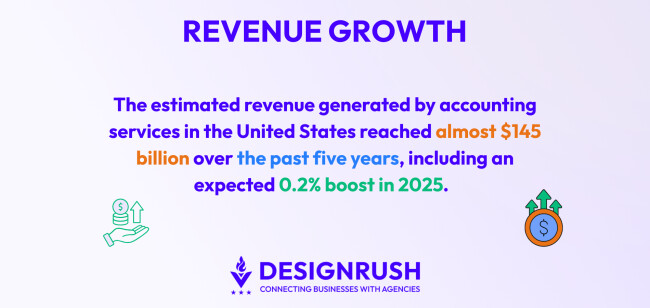
The estimated revenue generated by accounting services in the United States reached almost $145 billion over the past five years, including an expected 0.2% boost in 2025.
According to statistics, 72% of accounting and bookkeeping practices reported increased revenue in the past 12 months to highlight the growth seen across the industry.
Offering new and additional services to clients is a leading reason for revenue and profit increase. On average, accounting and bookkeeping practices offer around six services to their clients.
Key benefits include:
- Ensured adherence to federal and state financial law
- Help with strategic financial planning
- Low operational costs
- Allow owners to focus on core business activities
- Accurate financial reporting
What red flags should I watch out for when hiring a firm?
Several red flags can indicate a poor accounting partner, including:
- Unclear pricing: Vague fee structures or a lack of detailed pricing breakdowns often lead to unexpected charges, budget overruns, and disputes once work is underway.
- Slow or inconsistent communication: Delayed responses (longer than 24 hours and leading to several days) during the sales or onboarding phase may indicate ongoing responsiveness issues, especially during critical reporting or tax deadlines.
- Lack of industry experience: Firms without experience in your specific industry may overlook relevant tax strategies, misinterpret regulations, or apply inefficient reporting practices.
- No structured onboarding process: Top accounting firms typically offer defined timelines, clear document checklists, and assigned points of contact to ensure a smooth transition and accurate setup.
- Purely reactive approach: Firms that only respond when contacted tend to focus on basic compliance rather than proactively identifying risks, explaining financial trends, or recommending improvements before issues escalate.
What is the difference between an accounting firm and a CPA firm?
Top accounting firms typically offer a range of services, including bookkeeping, payroll, financial reporting, and advisory services, that support day-to-day operations.
They may employ accountants without CPA licensure and typically focus on management and operational accounting.
A CPA firm employs Certified Public Accountants who have passed licensing exams and meet state regulatory requirements.
In the United States, there are over 650,000 actively licensed CPAs, reflecting the professional standards required to hold this credential.
In addition to standard services, CPA firms can perform audits, reviews, and formal attestations of financial statements and represent clients before the IRS.
While all CPA firms are accounting firms, not all accounting firms are CPA firms. The distinction matters when audited financials or formal tax representation is required.
How do I measure whether they are actually adding value?
To truly measure value, you need to consider other factors aside from receiving reports on time.
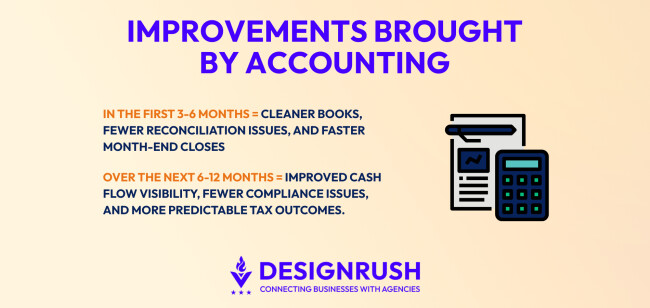
In the first 3-6 months, improvements typically show up as cleaner books, fewer reconciliation issues, and faster month-end closes, often shortening reporting cycles by 20-40%.
You may also notice a decline in last-minute requests for missing data or corrections, indicating stronger processes and better organization.
Over the next 6-12 months, value should extend further into improved cash flow visibility, fewer compliance issues, and more predictable tax outcomes.
Reduced penalties, smoother audits, and proactive tax planning are strong indicators of effective performance.
At this stage, your accounting firm should help you anticipate potential issues and plan, rather than react to problems after they arise.
Time savings are another measurable benefit. Many business owners reclaim 5-15 hours per month previously spent on financial administration.
When your partner consistently improves accuracy, provides forward-looking insights, and supports better decision-making, it is delivering strategic value rather than just transactional support.
Regular review meetings and performance check-ins are also strong signs of a high-value accounting partnership.
Sources
DesignRush sustains a directory of over 40,000 agencies categorized by service category, location, expertise, and reviews. We build our database in two ways:
- Our dedicated team of agency experts actively searches the web for top-performing companies. We then pull information from their websites, online presence, and client testimonials to verify their status and qualifications prior to listing.
- The agencies listed get notified of their profiles on the website and they can choose to claim it or not, which suggests their availability for more collaborations.
Agencies can also reach out to DesignRush and must go through the verification process prior to being listed.

Why companies trust DesignRush
Every agency is independently vetted before it can be listed or ranked
 4.8
4.8 4.8
4.8Some agencies pay for sponsored placement, clearly labeled and held to the same vetting standards.
Frequently Asked Questions About Accounting Companies
At what point should I hire an accounting firm?
Most businesses begin working with one of these companies once financial complexity interferes with daily operations.
While there is no universal threshold, many companies seek professional support when:
- Annual revenue consistently exceeds $100,000-$250,000
- Monthly transaction volume reaches 40-50 or more entries
- Payroll, tax filings, or reporting begin consuming operational time
At those stages, manual bookkeeping becomes inefficient and increases the risk of errors or missed compliance deadlines.
Accounting outsourcing is also driven by efficiency. Around 65% of businesses outsource finance and accounting tasks to free up internal resources and focus on growth.
As requirements expand, they provide structure, accuracy, and regulatory oversight that small internal teams often struggle to maintain.
What accounting services do most top accounting companies offer in the US?
The best accounting firms in the US typically provide a mix of core financial, compliance, and advisory services.
Common offerings include:
- Bookkeeping and bank reconciliations
- Financial statement preparation
- Payroll processing
- Accounts payable and receivable management
- Tax planning and federal, state, and local tax filings
Many firms also offer:
- Budgeting and forecasting
- Cash flow and financial performance analysis
- Audit preparation and internal controls assessments
- Compliance support under U.S. Generally Accepted Accounting Principles (GAAP)
Many businesses outsource several accounting functions at the same time, which is why US companies typically offer these services as bundled, ongoing engagements rather than isolated tasks.
This approach aligns with the scale of the finance and accounting outsourcing market, which stood at $54.79 billion in 2025.
How much does it cost to hire top accounting firms in the United States?
The cost of hiring one of these firms in the United States depends on business size, transaction volume, and service complexity. Typical pricing includes:
- $300-$800 per month for basic bookkeeping and reconciliations
- $150-$400 per hour for specialized CPA services
- $800-$2,500 per month for comprehensive monthly packages (payroll, reporting, tax support)
- $2,500-$5,000+ per month for mid-sized or higher-complexity businesses
At a macro level, the global accounting outsourcing market is expected to exceed $80 billion by 2030, as companies pursue cost efficiencies of 20-60% compared to maintaining full in-house accounting teams.
What additional costs can I expect from these types of companies?
In addition to base retainers, they often charge for specialized or non-recurring services, such as:
- Year-end financial statements
- Multi-state or corporate tax filings
- Audit preparation
- System migrations
- International compliance
- Advisory or consulting projects
Other common add-ons include payroll setup, budgeting assistance, and financial forecasting.
For many growing businesses, these services increase total annual accounting spend by 20-40% beyond base fees.
While this raises short-term costs, outsourcing often reduces overall operating expenses by eliminating the need for full-time internal finance staff and minimizing compliance risks.
What do I need to know before I switch to a top accounting firm?
Switching companies usually involves a transition period of 4-8 weeks. During this time, businesses should be prepared to provide:
- 2-3 years of financial statements
- Prior tax filings
- Payroll records
- Access to accounting software
A brief overlap between outgoing and incoming firms is common and helps:
- Resolve open items
- Prevent reporting gaps
- Ensure continuity of compliance
Planning the transition outside of peak tax or reporting seasons further reduces disruption and operational risk.
Latest Trends Related to Accounting