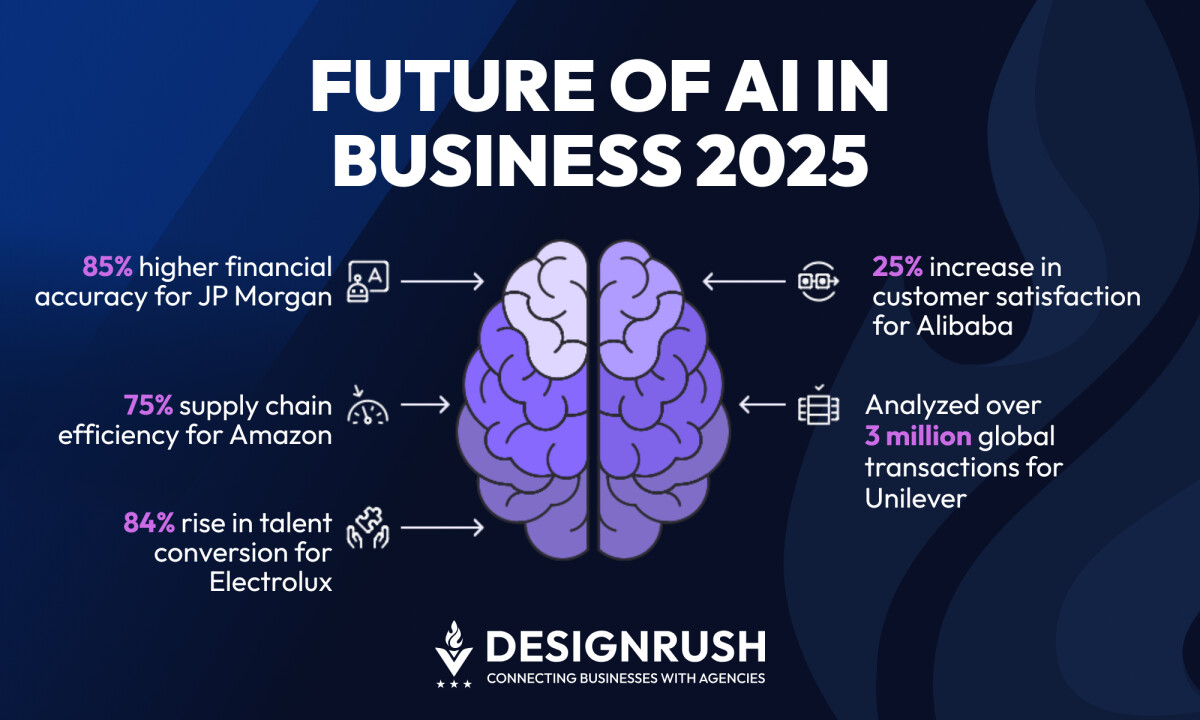

As organizations embed AI into their operational fabric, they’re reimagining how value is created and delivered at scale.
Future of AI in Business: Key Points
- Companies like Amazon and UiPath are achieving up to 75% efficiency gains in logistics and 85% automation in financial workflows through agentic AI and robotic systems.
- Businesses using AI-powered personalization and marketing tools report 50% faster campaign production, 40% ROI increases, and 25% higher customer satisfaction, as seen with Alibaba’s AI chatbot.
- Enterprises like Unilever use AI to simulate product outcomes and market impact, improving innovation cycles and managing over 240 TB of data.
- Successful companies are restructuring into agile, cross-functional teams, integrating AI into workflows, and shifting to an innovation-focused culture.
How AI Is Driving Strategic Transformation Across Business Functions
Over 78% of organizations worldwide are using or exploring AI, making AI adoption nearly ubiquitous across industries, signaling a seismic shift in how businesses compete, grow, and lead in the digital age.
Today, we examine how AI is transforming business outcomes, from driving innovation and automation to workforce and organizational shifts.
Related Articles:
1. AI in B2B
2. 65 AI Business Statistics
3. 15 Real-World AI Examples
4. 20 Most Popular AI Tools
4 Major Ways AI is Impacting Businesses in the Future
AI adoption has moved beyond isolated use cases — it’s now a structural pillar in how enterprises operate and grow.
The key to differentiating yourself from other AI adopters is authenticity, according to John Maeda, VP of Engineering and Head of Computational Design and AI Platform at Microsoft. He expounds further:
“AI agents will act with more autonomy. AI will deeply integrate into decision-making and customer service.
“Cost structures will shift. Authenticity will become a brand differentiator. New products, roles, and services will emerge from AI fluency,”
Here’s how AI is reshaping key functional areas:
- Operations and Supply Chain
- Marketing & Customer Experience
- Finance, HR, & Enterprise Automation
- Executive Decision-Making & Predictive Intelligence
1. Optimizing Operations and Supply Chain
AI is streamlining retail and supply chains by enabling better demand forecasting, inventory management, and logistics optimization.
For instance, autonomous inventory systems use real-time analytics to minimize overstock and spoilage. On the other hand, predictive logistics algorithms dynamically optimize delivery routes to cut shipping costs and times.
As Christ Timmer, CEO of Linnworks, explains in our recent article:
“Decision-making is faster and surer with AI, creating new and revolutionary adaptations in processes. AI will become commonplace and table stakes when managing inventory and fulfillment.”
You can see these technologies in real-world applications via Amazon’s Sequoia.
Sequoia integrates mobile robots, gantry systems, and robotic arms to efficiently containerize and route inventory to human workers. At the same time, it coordinates these systems to optimize flow and reduce idle time.
The result is a 75% more efficient sorting and inventory management workflow and 25% faster order processing.
In short, AI lets supply chains operate with greater accuracy, speed, and resilience, which is vital amid volatile global trade environments.
2. Amplifying Marketing and Customer Experience
AI-driven personalization engines analyze customer data to dynamically customize product recommendations, offers, and messaging to different buyer personas and behaviors.
Subsequently, generative AI can also rapidly produce and test variant ad copy or creative, compressing campaign timelines.
As a result, marketing teams deliver hyper-personalized experiences without straining teams and budgets.
Already, businesses implementing AI in their marketing report 50% accelerated campaign production, up to 50% higher efficiency, and 40% ROI. They’re also experiencing a 10%-25% spike in ROAS.
Another way AI is reimagining customer experience is through voice AI and chatbots.
These AI chatbots enable 24/7 intelligent customer support, handling routine inquiries with instant answers, and detecting sentiment to route issues appropriately. This always-on service improves response times and provides insights back to marketing.
In our interview with Nick Francis, co-founder and CEO of Help Scout, he advises:
“What’s more important than the technology is your goal. When implementing something new, is your primary goal to reduce costs or provide great customer service? Maybe you can do both, but which one is the priority?”
A standout example of this is Alibaba’s AI chatbot system, which it has been using since 2015. As of 2024, it has handled over 2 million daily sessions and 10 million lines of daily conversations.
Through this system, Alibaba reports 25% higher customer satisfaction and $150 million in annual savings.
3. Supporting Finance, HR, and Enterprise Automation
In addition to supply chain and marketing, AI is also redefining general and administrative (G&A) functions. Here's how:
Finance
AI is streamlining everything from forecasting to fraud detection. AI copilots, such as Microsoft Dynamics 365 Copilot, can automatically analyze cash flow patterns, flag budget anomalies, and even draft management reports.
According to Gartner’s latest survey, 58% of businesses are using AI for financial functions, including:
- Intelligent process automation: used in 44% of financial functions
- Anomaly and error detection: used in 39% of financial functions
- Operational assistance and augmentation: used in 27% of financial functions
You can see these functions play out in JP Morgan, as it applies AI across fraud detection, risk management, algorithmic trading, and customer service.
Through its holistic adoption of AI, the multinational firm:
- Saves over $250 million annually
- Records an ROI of 8.7%, exceeding competitors like Goldman Sachs and Barclays
- Achieves 85% higher accuracy and response times under 1 minute in customer service
HR
Recruiting platforms now use AI for resume screening, candidate matching, and even video interview analysis.
This has drastically sped up hiring cycles and optimized resource allocation: 31% of HR teams reported a cost reduction of over 10% and 12% an increase in revenue by over 6%.
AI-powered HR tools also improve internal mobility and retention by analyzing employee data to predict flight risks and suggest career paths. HR teams can use these insights to proactively engage and reskill staff.
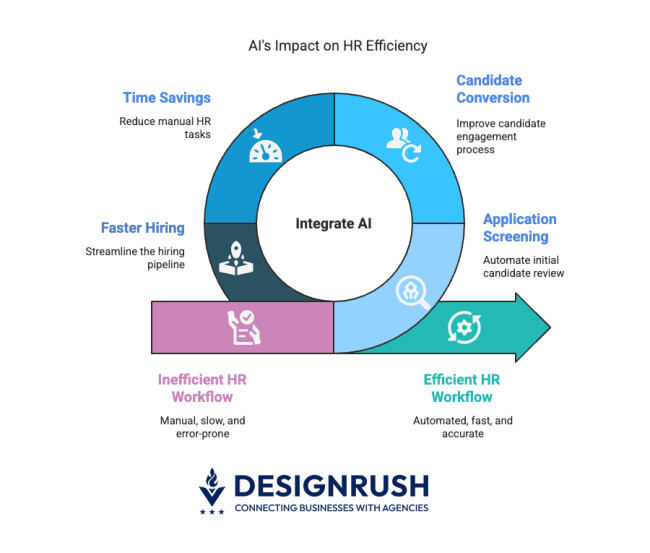
Electrolux, for example, partnered with Phenom to integrate AI into its HR workflow. Some of which included implementing DCO campaigns to nurture leads, precisely matching candidates based on portfolio, and automating interview scheduling.
Their collaboration led to a 51% reduction in incomplete applications, an 84% higher conversion rate, 78% time saved, and 9% faster time-to-hire process.
Enterprise Automation
RPA and AI assistants are streamlining myriad back-office tasks. From automated compliance monitoring to policy management chatbots, these tools reduce manual workload and errors.
For instance, an RPA bot can handle an entire payroll run or expense report audit overnight, which frees staff for higher-value analysis.
View this post on Instagram
You can see AI’s role across enterprise IT services through UiPath’s partnership with Deloitte.
Wanting to launch a customer zero initiative, UiPath embedded automation at every stage of its SAP S/4HANA. This included quote to cash (Q2C), treasury, and record to report (R2R) processes.
Using an agentic AI, UiPath automated 85% of financial workflows, streamlined product testing, accelerated product delivery by 10%, minimized technical debt, and significantly reduced manual labor and human error.
It also established a reusable Automation Playbook and set a new industry standard for ERP transformation, demonstrating how AI can drive scalable, intelligent enterprise operations.
4. Facilitating Executive Decision-Making through Predictive Intelligence
AI-powered analytics offers a distinct competitive edge over traditional platforms.
Unlike manual or rules-based tools, AI systems deliver real-time insights, highly accurate forecasts, and deep contextual understanding by automatically analyzing vast volumes of structured and unstructured data.
They not only identify hidden patterns and emerging risks. They also recommend the next best actions, enabling faster, smarter decision-making across the enterprise.
With the ability to scale effortlessly, adapt to change, and automate routine processes, AI analytics shifts data from a retrospective asset to a forward-looking strategic advantage.
Alex Banks, founder of The Signal, explains in our latest interview:
"We’re seeing this massive shift from reactive to proactive decision-making. The best companies aren’t waiting to adapt — they’re actually using AI to predict what’s next and get ahead of it before it happens."
Additionally, AI-driven scenario simulators allow leaders to test decisions in virtual “sandboxes.”
For instance, AI can model the impact of raising prices, entering a new market, or adjusting inventory levels under various assumptions. In doing so, it reveals the optimal strategy or worst-case risks.
In practice, Unilever has been using AI to predict the shelf life of their products, flavor profiles that align with a specific customer market, and update their recipes.
In one instance, the global enterprise used AI predictive analytics and digital modeling to construct its Knorr Zero Salt Cube product.
The advanced technology helped it find the right ingredients and formulation to maintain the product’s well-known salty flavor, structure, and texture. In doing so, Unilever has saved time and resources in conducting experiments in both the marketplace and laboratory.
In a separate interview, Unilever’s CETO, Steve McCrystal, explains that AI helped manage over 1,500 applications, 25,000 data pipelines, over 240 terabytes of data, and 3 million transactions across its global operations.
How AI is Redefining the Future of the Workforce
From transforming job roles to reshaping organizational structures, AI is accelerating a profound workforce evolution that demands adaptability, continuous learning, and a new kind of human-machine collaboration. For business leaders, the challenge isn’t just to adopt AI — but to redesign the workforce to thrive alongside it.
1. Shifting Job Market Demand
The World Economic Forum projects that clerical and secretarial positions, like bank tellers and payroll clerks, will shrink the fastest by 2027 due to AI.
At the same time, it predicts a 30%-40% rise in demand for roles, like AI and machine learning specialists, data analysts, and information security analysts.
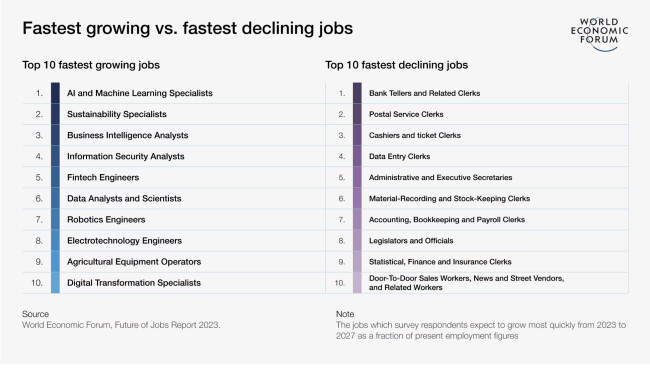 The writing is on the wall: While AI will replace many rule-based, routine jobs, it will also create new jobs and increase the demand for others.
Next Steps for Businesses:
- Identify which roles are at risk due to AI and align future strategies with emerging skill demands.
- Involve employees in early AI integration plans through transparency and clear communication to reduce resistance and boost morale.
- Redesign workflows to combine AI automation with human creativity and judgment. For instance, delegating routine customer calls to AI chatbots, while enabling human agents to handle complex issue resolution.
- Encourage a growth mindset by embedding ongoing learning incentives, cross-functional training, and digital credentialing into their career development.
2. Redefining Current Job Roles
Beyond influencing the job market, AI is also rewriting job roles.
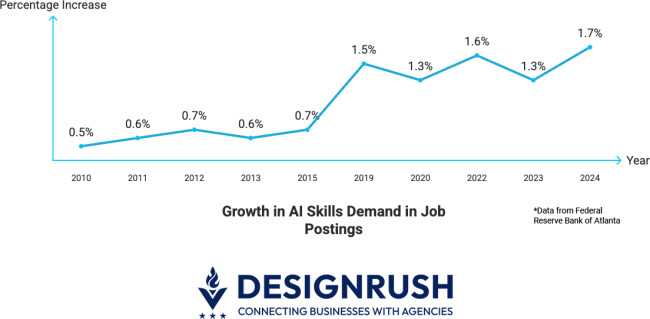
Based on the Federal Reserve Bank of Atlanta’s research, about 628,000 job listings today require at least one AI skill — a 240% increase from 2010 and a 31% change from 2023.
Additionally, it observed that the AI skill requirement is no longer confined to STEM jobs. Rather, it has expanded to multiple business functions, including marketing, finance, legal, and management.
McKinsey also reports that nearly 50% of surveyed employees seek formal AI training and access to AI tools, even in beta or pilot forms.
In short: AI is not just transforming how work is done — it’s redefining who does the work, what skills are in demand, and how organizations must evolve to remain competitive.
Next Steps for Businesses
- Launch cross-functional AI upskilling programs tailored to roles across departments, not just IT or data teams.
- Integrate AI tools into everyday workflows to promote hands-on learning and accelerate adoption.
- Partner with academic institutions or online platforms to offer accredited AI training and certifications.
- Incentivize continuous learning by tying career growth or bonuses to completion of AI readiness tracks.
- Measure the outcomes of upskilling initiatives to ensure training investments are effective and continuously optimized.
3. Evolving Work Structures
As AI redefines roles and reshapes skills, it is also transforming how organizations are structured.
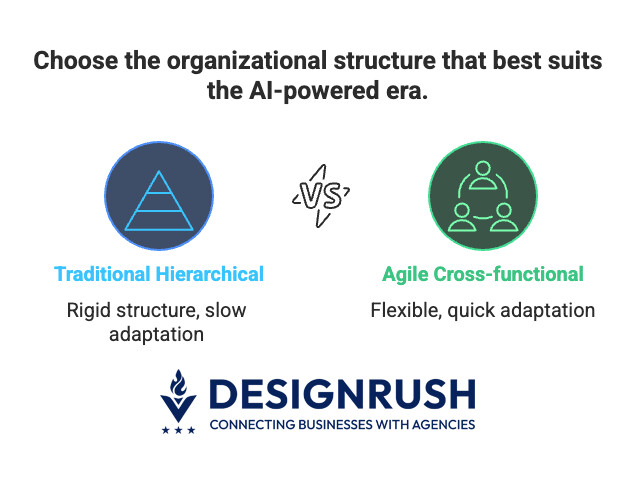
Traditional hierarchical models are giving way to agile, cross-functional teams designed to respond quickly to change, adopt new technologies, and continuously learn. In this AI-powered era, work is becoming more fluid, decentralized, and collaborative.
As a result, businesses can expect to adopt agile organizational structures with a flat reporting structure.
In fact, a Harvard Business Review study found that teams using advanced AI tools, like GitHub Copilot, increased work activity by 5% and reduced project management by 10%.
In other words, teams are working more autonomously, requiring fewer supervision and alignment meetings from middle managers. In exchange, managers can focus more on high-level tasks, like process optimization and product experimentation.
Next Steps for Businesses
- Redesign team structures around agile, cross-functional pods that empower faster decision-making and AI-driven execution.
- Flatten hierarchical layers to reduce bottlenecks and encourage autonomous, self-organizing teams.
- Equip managers to shift from supervision to strategy, focusing on enabling tools, coaching, and process innovation.
- Pilot AI-integrated workflows that streamline project coordination, task assignment, and performance tracking.
- Encourage fluid talent allocation by allowing employees to move between projects based on skills and evolving priorities.
- Invest in collaboration platforms that integrate AI assistants to reduce meeting overload and enhance productivity.
Tech Trends Shaping the Future of AI in Business
AI is evolving rapidly, and its influence will only deepen as businesses continue to invest heavily in it. To stay ahead of the curve, here are the key trends shaping the future of AI in the enterprise landscape:
1. Generative AI & LLMs
Generative AI and LLMs have evolved from single use cases to an entire ecosystem that spans multiple functions.
For instance, Cohere offers domain-specific LLMs and NLP APIs that many companies use for functions like semantic search of enterprise data. Through it, employees can query internal knowledge bases with natural language.
Meanwhile, ChatGPT and Gemini are widely used for content generation, coding help, and as a conversational front-end to many business apps. Enterprises are fine-tuning these models on their own data to get bespoke capabilities.
2. Autonomous & Edge AI
Edge AI refers to AI algorithms running on local devices in real time and without needing a round-trip to a data center. This trend is growing fast because it enables split-second decisions due to low latency and enhances privacy.
For example, modern factory lines have AI vision systems on the edge that inspect products for defects in milliseconds and automatically reject faulty items — far quicker than sending images to a cloud AI.
Edge AI also enables devices to function even with limited connectivity and safeguards local data from exposure to external servers and third parties.
3. AI + Data Ecosystem Integration
AI effectiveness is only as good as the big data strategy behind it.
As such, we’re now seeing a focus on integrating AI development with robust data infrastructure or machine learning operations (MLOps)
Technologies like unified data lakes, feature stores, and automated ML pipelines are enabling AI at scale. These tools also collect vast amounts of raw data, clean and label it, and then train and deploy models in a repeatable, efficient manner.
For instance, AWS SageMaker provides end-to-end managed ML pipelines, lowering the barrier for companies to deploy dozens of AI models across different departments. Another is Databricks which unifies data engineering and model training.
The goal is to break silos between data engineering and AI teams, making model development an automated factory line (with continuous data refresh, retraining, and monitoring).
Future of AI in Business: Wrap Up
Successful enterprises treat AI as transformative to their business model, not just a shiny tool. They are reorganizing processes, upskilling people to work in tandem with AI, and embedding it throughout the value chain. This holistic approach turns AI from a buzzword into real competitive differentiation, resulting in higher growth and profitability versus laggards.
It’s time to re-strategize your business intelligently.

Our team ranks agencies worldwide to help you find a qualified partner. Visit our Agency Directory for the business consulting firms, as well as:
- Top AI Companies
- Top DevOps Consulting Companies
- Top Business Operations Consulting Firms
- Top HR Outsourcing Companies
Future of AI in Business: FAQs
1. How can small and mid-sized businesses compete with AI giants?
Small and mid-sized businesses (SMBs) can compete with AI giants by leveraging accessible, cloud-based, and startup-focused AI platforms. Examples include Zapier, Canva AI, and PitchBob, which are plug-and-play tools for task automation, content design, and business kit creation without needing in-house data science teams.
They can also focus on specific, high-impact use cases, like improving customer support with AI chatbots, to realize meaningful returns at a manageable scale.
Another strategy SMBs can take is to partner with AI startups, industry vendors, or innovation hubs to stay agile, adopt best practices early, and co-create AI solutions tailored to niche markets.
2. How will AI reshape business models over the next decade?
AI will fundamentally transform business models by shifting value creation from physical assets to data and intelligence, enabling organizations to move from reactive decision-making to predictive and even autonomous operations.
Companies will increasingly adopt AI-as-a-service, offer AI-augmented products, and leverage personalized customer experiences at scale as a key differentiator.
Revenue streams will evolve through dynamic pricing, usage-based models, and hyper-targeted offerings. Moreover, AI will drive the rise of “algorithmic enterprises” where continuous learning and data feedback loops power innovation, reducing reliance on static business planning and fostering more adaptive, outcome-driven models.
3. What’s the best way to measure AI ROI?
The best way to measure AI return on investment (ROI) is to tie outcomes directly to business objectives, using both financial and operational metrics. Key indicators include cost reductions through process automation, revenue growth from increased conversion or retention), productivity gains, customer satisfaction improvements (CSAT/NPS), and speed-to-decision.
Organizations should also track AI project adoption rates, model accuracy, and time-to-value from pilot to production.
You can learn more about how to measure AI performance in our latest article.