Browse leading web design agencies that create high-performing websites built to engage users, strengthen your brand, and support business growth. Compare agencies to find the right partner for your goals, budget, and technical requirements.
List of the Best Website Design Companies
156 Companies-Rankings updated: August 19, 2026
Every company listed in our directory is evaluated based on expertise, service offerings, industry experience, and client feedback. Some listings may include paid placements.
Digishot Technologies is a leading digital marketing agency in India, specializing in SEO, social media, PPC, web design, SMO, graphic design and content marketing. We help brands boost visibility, attract quality leads, and accelerate growth with tailored strategies. Recognized among the best SEO companies...
Impressico Digital, a CMMI Level 5 and ISO-certified company, specializes in providing 360-degree digital solutions designed to help businesses grow online. Their comprehensive offerings include custom-built, responsive, and SEO-friendly website development and maintenance; robust SEO and performance...
GameIgnis is a full-service game development company creating immersive experiences across mobile, PC, console, casino, AR/VR, and metaverse. From concept to launch and live ops, we deliver scalable, engaging, and revenue-driven games. Our expertise spans multiplayer, cross-platform, esports, and monetization...
BitGoLabs is a blockchain development company based in India that delivers specialized Web3 and blockchain solutions to startups and enterprises worldwide. Its expertise spans smart contracts, DeFi protocols, RWA tokenization, crypto trading bots, Web3 applications, blockchain infrastructure, and security...
Responsive web design to ensure the site works on desktop, tablet, and mobile
UI/UX design to make the site easy to use
Website development to turn designs into functional websites
Landing page design for campaigns and conversions
Website redesign to improve outdated or underperforming sites
Beyond these core services, many web design companies also support digital marketing, including search engine optimization, content marketing, and email marketing to help improve visibility in search engines and attract potential customers.
Some also offer brand identity, graphic design, and ongoing web design services like maintenance, updates, and performance improvements to strengthen your online presence over time.
How much do website design companies charge for their services?
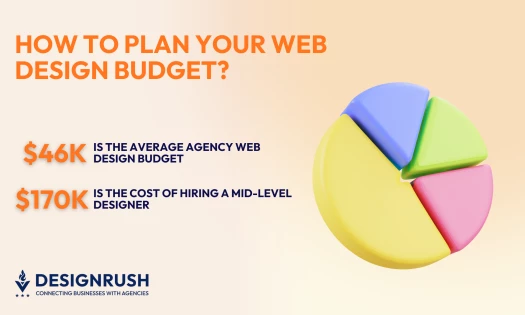
Professional web design services typically range between $5,000 and $60,000+, depending on complexity, features, and level of customization. Their projects commonly start around $10,000 to $15,000 and can exceed $50,000 for advanced websites.
Here is a general breakdown:
Basic business websites: $5,000 to $15,000
Custom business websites with advanced UX design: $15,000 to $30,000
Ecommerce and complex custom website projects: $30,000 to $60,000+
Several factors influence what website design companies charge. The biggest cost drivers include the number of pages, level of custom website design, and required web development. Features like booking systems, ecommerce functionality, or integrations increase the price because they require more design and development hours.
In addition to the initial build, many web design companies charge ongoing maintenance fees ranging from $1,200 to $12,000 per year, which cover updates, security, and performance improvements.
How long does it take to build a website?
A typical website design company timeline ranges from a few days to several months, depending on scope, content readiness, and required web development.
Simple brochure website (1 to 5 pages): 1 to 2 weeks
Small business website (5 to 15 pages, blog, forms): 4 to 8 weeks
eCommerce website (standard features, 10 to 100 products): 8 to 16 weeks
Large-scale custom website (bespoke features, integrations): 4 to 6+ months
Custom web application: 6 to 12+ months
Most delays come from two things: missing content (copy, images, product data) and an unclear scope that expands during the web design project.
If content is ready and approvals are fast, timelines compress. If content is late and feedback is slow, timelines stretch.
What are the hidden costs of web design?
Hidden web design costs usually show up in two phases: before launch and after launch.
Pre-launch hidden costs
Stock photos, fonts, and premium plugins (one-time fees plus renewals)
Scope creep and extra revisions beyond what the contract includes
Content migration from an old site (formatting, redirects, image cleanup)
Integrations (CRM, booking, payments, analytics) that require extra setup and testing
Post-launch hidden costs
Web hosting and domain renewal (often increases as traffic grows)
SSL certificate upgrades for ecommerce or higher trust requirements
Website maintenance and security (updates, backups, monitoring, fixes)
Email hosting (Google Workspace or Microsoft 365 per user)
These costs appear because a website build quote often covers only the core design and development. Anything tied to licensing, content production, ongoing ownership, or changes outside the original scope gets billed separately unless the statement of work includes it.
What is the difference between web design and web development?
Web design defines the visual interface and user experience of a website, while web development implements that design through code and technical functionality.
Aspect
Web design
Web development
Core responsibility
Defines the design, layout, and user experience
Builds and maintains the website through code
Primary objective
Ensure the site is clear, engaging, and aligned with brand identity
Ensure the site works correctly, loads fast, and supports required features
Deliverables
Wireframes, mockups, prototypes, and visual systems
Front-end interfaces, back-end systems, and integrations
Key disciplines
UX design, UI design, responsive web design
Front-end, back-end, and full-stack web development
Business impact
Influences perception, usability, and user engagement
Enables functionality, performance, and scalability







 Proposals